
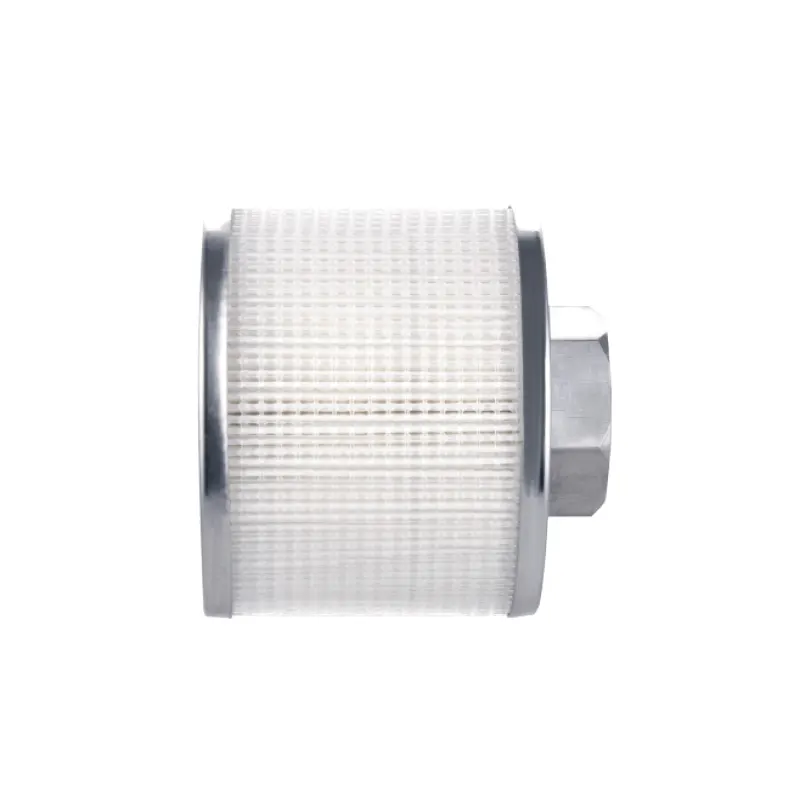
A HEPA filter cartridge is a replaceable filtration element that captures airborne particles in the gas of a glove box system. It is not a purification column, and it does not lower moisture or oxygen levels. It sits inside a housing connected to the enclosure's gas path — a recirculation line, a transfer chamber, or an exhaust route, depending on the design — and it keeps dust, powder fines, and fibres away from samples, viewing panels, blower and purification hardware, and the surrounding laboratory. This article explains what the cartridge does, how particle capture works, which specifications matter, and where its limits lie.
What Does a HEPA Filter Cartridge Do in a Glove Box?
Particles appear inside a controlled-atmosphere enclosure from more sources than most users expect. Weighing, transferring, or sampling a powder releases fines into the working gas. Gloves shed material as they flex, wipes leave fibres behind, and every transfer through an antechamber carries a little room dust into the box. Where the gas is continuously recirculated, particles that are not captured stay in motion and are gradually spread over the entire interior.
The glove box HEPA filter cartridge addresses that specific problem. The cartridge is the consumable element; the housing around it provides the mechanical connection and the seal that separates the dirty side from the clean side. Gas passes through pleated media, particles are retained on and inside the fibres, and the cleaned gas returns to the enclosure. Depending on where the manufacturer positions the housing, the cartridge may protect the working zone, the blower and purification hardware downstream of it, or the exhaust path when gas leaves the box.
Scope matters as much as mechanism. A cartridge is one component in a larger atmosphere-control system: it does not create an inert atmosphere, cannot maintain one on its own, and is no substitute for the leak-tightness of the enclosure. Judging it means judging it against particle control, not against the performance of a purification loop.
How Particle Capture Actually Works
HEPA media is a dense mat of fine fibres — commonly glass fibre or a synthetic polymer — pleated so that a large filter area fits into a compact cartridge. Gas does not travel through the material in straight lines; it moves around the fibres, and particles are removed by several mechanisms acting at once.
The mechanisms that remove particles
- Inertial impaction. Heavier particles cannot follow the curving streamlines around a fibre and strike it directly. This dominates for coarse dust and powder agglomerates.
- Interception. A particle small enough to follow the airflow can still touch a fibre if its path passes within roughly one particle radius of the surface.
- Diffusion. Very small particles move randomly through Brownian motion and are therefore more likely to contact a fibre; this dominates below roughly 0.1 µm.
- Sieving. Particles larger than the gaps between fibres are simply blocked. In most HEPA media this is a final barrier rather than the primary mechanism.
Because the mechanisms overlap, capture efficiency is lowest in a narrow band of particle sizes — historically described as the most penetrating particle size, around 0.3 µm — and higher for both larger and smaller particles. Filter classes are therefore quoted against a defined test aerosol and test method, not against an average dust sample. Some media also carry an electrostatic charge that improves capture at low pressure drop, but charge-based performance can decay in the presence of certain vapours, so it is worth knowing which media type a cartridge uses.
Where the cartridge sits in the gas path
Position decides what a cartridge protects. An element on the return line from the working zone keeps particles away from the blower and purification column, protecting the most expensive hardware. An element on a transfer chamber's gas path limits the dust carried in with each load. A filter on the exhaust side protects the room when the enclosure is purged. Each position also changes the consequence of loading: a clogged filter upstream of the blower reduces circulation, and circulation rate is what determines how quickly the atmosphere mixes and how efficiently the purification media is used.
Why Particle Filtration Is Not Atmosphere Purification
Treating a particle filter as if it were part of the purification loop leads to wrong purchasing decisions, so the functions are worth separating.
- Water and oxygen removal is the job of the purification column and its regenerable media. A HEPA cartridge does not remove water vapour or oxygen, however fine its media.
- Solvent vapour removal needs an adsorbent such as activated carbon; a particle filter has almost no capacity for vapour-phase organics.
- Measurement is a separate function again: water and oxygen analysers report the state of the atmosphere, and particle counters count particles, but neither removes anything.
- Leak-tightness belongs to the enclosure and its seals. A filter cannot compensate for a leaking glove port, and a leak admits both gas and particles.
The same reasoning explains why particle filtration should not be presented as a cleanliness certification. A cartridge can reduce airborne particle counts, but it does not make an enclosure sterile, does not establish a cleanroom class, and does not by itself provide biological or hazardous-materials containment. Those qualifications depend on the entire system, its procedures, and its validation.
Which Types and Configurations Matter?
Element, housing, and interface
Some systems use a replaceable pleated cartridge inside a permanent housing; others use a sealed cassette exchanged as a unit. Replaceable elements usually cost less per change, but the housing must be opened, which means the atmosphere has to be re-established afterwards. A sealed cassette reduces the chance of releasing captured dust during the change but generally costs more and produces more waste. Either way, the design needs a defined interface — flange, clamp, or threaded connection — and a gasket suited to the enclosure atmosphere and the chemicals used inside it.
Filter class and media
HEPA grades come from test standards, not from supplier preference. The long-standing definition of a HEPA filter is a minimum capture efficiency of 99.97% for particles around 0.3 µm; the EN 1822 family classifies filters as H13, H14 and above using efficiency at the most penetrating particle size, and ISO 29463 provides an international framework along similar lines. Two cartridges that both say "HEPA" can therefore differ in tested class, and the class is what should be compared. Media type matters as well: glass-fibre media tolerate higher temperatures but can shed fibres if damaged, while polymer media resist moisture better but often have narrower chemical compatibility.
Which Specifications Should You Check?
The useful specification list for a cartridge is short and specific, and it is not the list you would use for powder-processing machinery — a cartridge does not process material, it conditions the gas around it.
- Tested efficiency and the standard behind it. Look for a class and a test method rather than a marketing adjective.
- Rated flow and pressure drop. The element must match the circulation blower's flow and static pressure; a very high-efficiency element on a weak blower lowers circulation and can degrade overall atmosphere control.
- Dimensions, connection, and gasket material. Fit is a hard constraint, and the elastomer determines whether the seal survives the solvents and temperatures used inside the box.
- Chemical and thermal compatibility of media, binder, frame, and seal — one unsuitable component is enough to limit the whole cartridge.
- Service indication. A differential pressure gauge or a defined change interval makes maintenance predictable; without one, a loaded filter is usually noticed only after circulation has already fallen.
- Suitability for the enclosure's pressure regime. If the box is evacuated and refilled with inert gas, the element and seals must be rated for that cycling. A cartridge intended for near-ambient circulation is not automatically suitable for vacuum duty.
Where Is It Suitable, and Where Are Its Limits?
Particle filtration earns its place wherever fine solids are handled under inert gas: weighing and transferring lithium and solid-state battery materials, preparing perovskite, OLED, and semiconductor samples where surface particles create defects, handling air-sensitive reagents, and recovering metal powders in additive-manufacturing post-processing. In all of these the cartridge protects both the sample and the hardware downstream — a purification column shielded from dust holds its capacity longer, and a blower that is not eroding against abrasive fines lasts longer.
The limits follow from the mechanism. A particle filter does not reduce water or oxygen content, does not adsorb solvent vapour, does not sterilise, and does not correct a leak. It also adds resistance to the gas path, so an undersized or overloaded element works against the circulation the atmosphere-control system depends on. Finally, performance depends on the seal and the housing as much as on the media: a good element in a poor installation lets dust bypass the filter rather than pass through it.
How Should You Select or Integrate a Cartridge?
Start with the source of the particles, not with the filter. Identify where the dust originates — powder handling, glove wear, transfers, or an abrasive process — and decide what needs protection: the sample, the blower and purification column, the exhaust path, or all three. Then work through the constraints.
- Estimate the airflow the position requires and compare it with the blower curve, allowing for the pressure drop of a loaded filter rather than a clean one.
- Choose a tested efficiency class that matches the sensitivity of the work, and confirm the media is compatible with the chemicals in use.
- Verify the mechanical interface: connection type, dimensions, gasket material, and mounting orientation.
- Confirm the element is rated for the enclosure's pressure and temperature regime, including evacuation cycles.
- Decide how loading will be detected and how the cartridge will be changed, including how the atmosphere is restored afterwards.
- Confirm with the manufacturer that the specific cartridge is approved for the specific enclosure or housing — appearing in the same accessory catalogue is not evidence of compatibility.
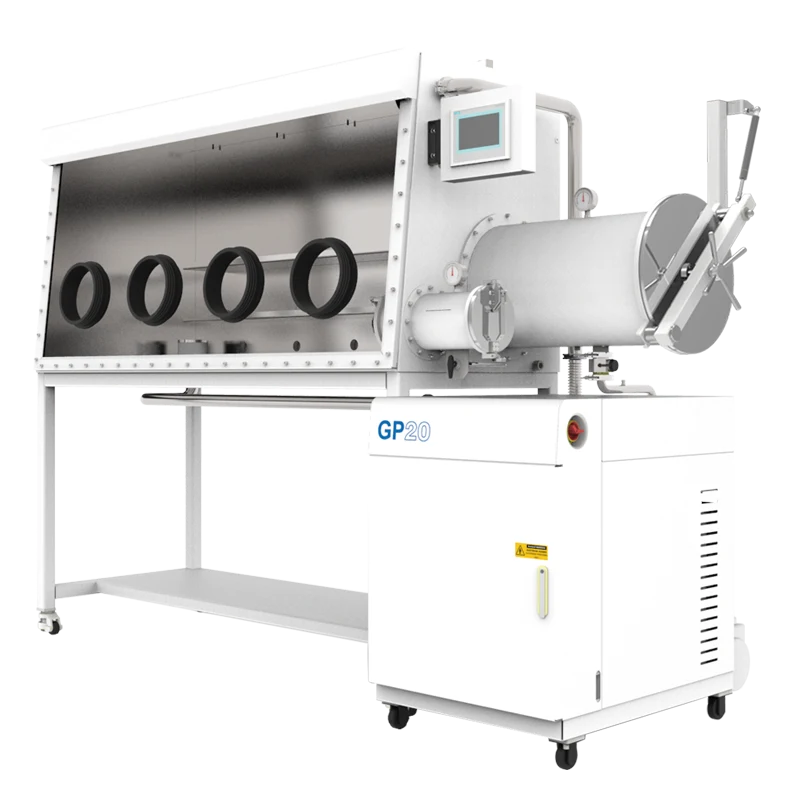
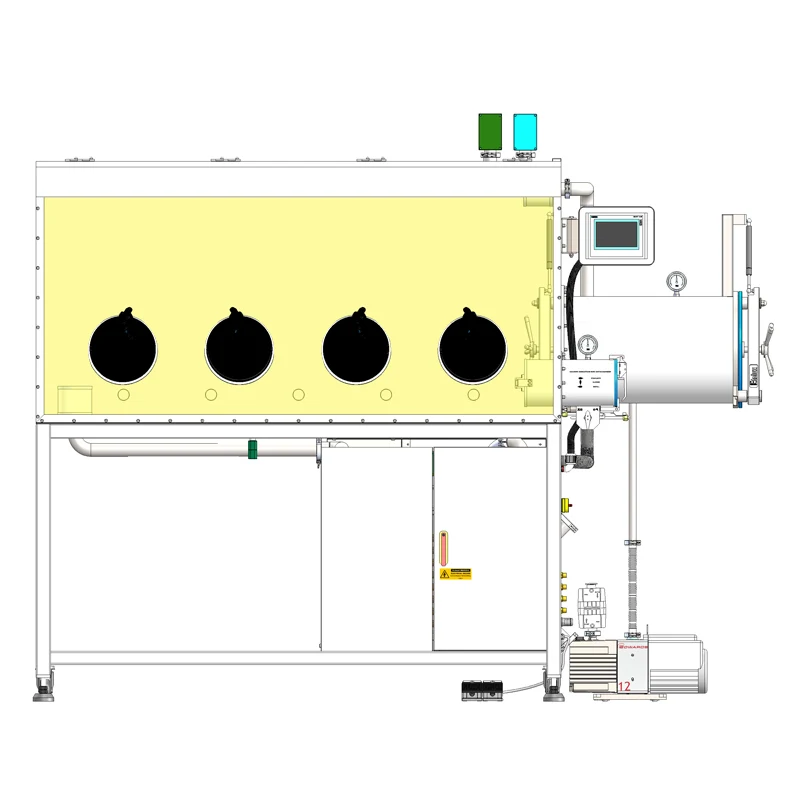
As a reference point, the HEPA filter cartridge listed in the TENCAN Glove Box Systems accessory range is documented as a glove box accessory, so the accessory page is the right place to check the offered configuration before assuming it fits a particular enclosure. A purification glove box such as the two-station single-sided glove box with gas purification system shows the kind of system in which particle management supports, but does not replace, moisture and oxygen control. Whether a given cartridge suits a given enclosure must be confirmed against that enclosure's specification.
Frequently Asked Questions
Does a HEPA filter cartridge lower oxygen or moisture levels in a glove box?
No. Water and oxygen are removed by the purification column and its regenerable media. A particle filter removes solids from the gas stream and has no meaningful capacity for water vapour or oxygen.
Can a cartridge be added to any glove box?
Not automatically. A retrofit depends on whether the enclosure has a suitable housing, a connection point, and enough blower capacity to absorb the extra pressure drop. The specific combination should be confirmed with the equipment manufacturer.
How do I know when to replace the cartridge?
Watch for a rising pressure drop across the filter, a falling circulation rate, and higher particle counts in the working zone. A dust release inside the box is another reason to inspect the element. Manufacturer intervals assume defined operating conditions, so treat them as a starting point.
Is HEPA filtration the same as a cleanroom class or a sterile barrier?
No. A filter reduces airborne particles, while cleanroom classification, sterility, and containment verification depend on the complete system, its procedures, and formal validation.
Do I also need a solvent adsorber?
If the process releases solvent vapour, yes. Particle media capture solids, vapour-phase organics require an adsorbent, and neither device substitutes for the water and oxygen purification loop.
Matching Particle Control to the Way You Work
A HEPA filter cartridge is best understood as one deliberate answer to one specific problem: particles that would otherwise circulate through an inert-atmosphere enclosure and settle on samples, optics, or hardware. It works by physical capture in pleated media, its performance is defined by a tested efficiency class and by pressure drop at a given flow, and its value depends on where it is installed and how it is maintained. It does not control moisture, oxygen, or solvent vapour, and it cannot make a leaking enclosure tight. Choosing well means starting from the particle source, matching the element to the blower and the interface, and confirming with the supplier that the cartridge and the housing are genuinely a compatible pair.
