
A three-station split-type glove box with a gas purification system is a sealed working environment in which three operator positions share one conditioned atmosphere, supported by a separate purification cabinet that continuously removes moisture and oxygen from the circulating gas. The chamber and the purification unit are built as two assemblies linked by gas lines rather than stacked in a single frame. It solves a practical problem: holding air-sensitive materials at a defined water and oxygen level through weeks of work while letting more than one person operate at the same time. The delivered configuration is described on the three-station single-sided split-type glove box with gas purification system page.
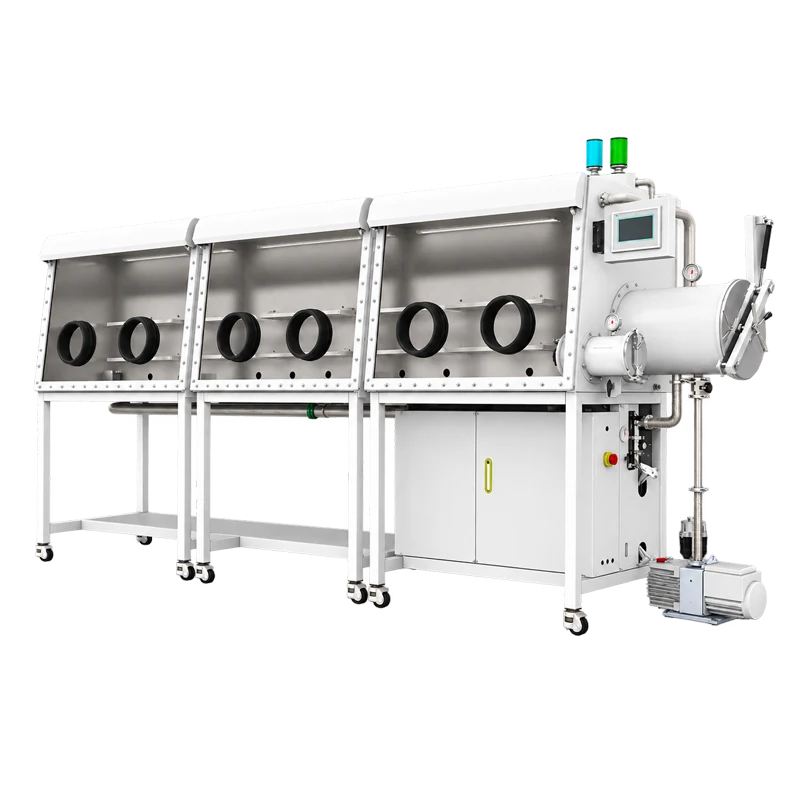
What Does a Three-Station Split-Type Glove Box Do?
The chamber replaces the air around a sample with nitrogen or argon and then keeps that atmosphere stable while people weigh powders, assemble cells, load small equipment or run reactions inside. It is a working environment, not a storage cabinet. Three stations mean three glove ports on one working face, so three operators, or one operator moving along a long bench, can handle the same protected material without opening the box to the laboratory.
Because the atmosphere is shared, the box behaves as one system: what an operator brings in, spills or leaves open affects everyone working at the other two ports. That is the main practical difference between one large multi-station chamber and three small boxes.
How the Closed Loop Removes Moisture and Oxygen
A purification glove box runs as a closed circuit. Gas is drawn out of the chamber, pushed through a purification column filled with regenerable media, and returned. The media usually work in two ways: a sieve-type desiccant captures water vapour, and a copper-based catalyst removes oxygen. Neither medium is used once and forgotten. Both saturate, and both must be regenerated periodically by heating the column while a regeneration gas passes through it, with the column valved off from the working chamber so that the released moisture and oxygen do not return to the box.
This is why regeneration is a scheduled event rather than a fault. If regeneration has to happen during working hours, the box either loses purification capacity for that period or relies on a second column. Some systems are built with two columns so one can work while the other regenerates; whether that applies to a particular unit has to be confirmed from its own documentation rather than assumed from the category.
Why the Split-Type Layout Is Chosen
In an integrated glove box, the column, blower and control cabinet sit under or behind the chamber inside one frame. In split-type construction they form a separate unit connected by circulation lines, which changes several things at once. Service access improves: the purification cabinet can be opened, and columns regenerated or replaced, without disturbing the chamber or the samples inside. Heat and vibration from the blower stay away from the working area. The heavier assembly can be placed near its utilities, and the chamber can go where the workflow needs it.
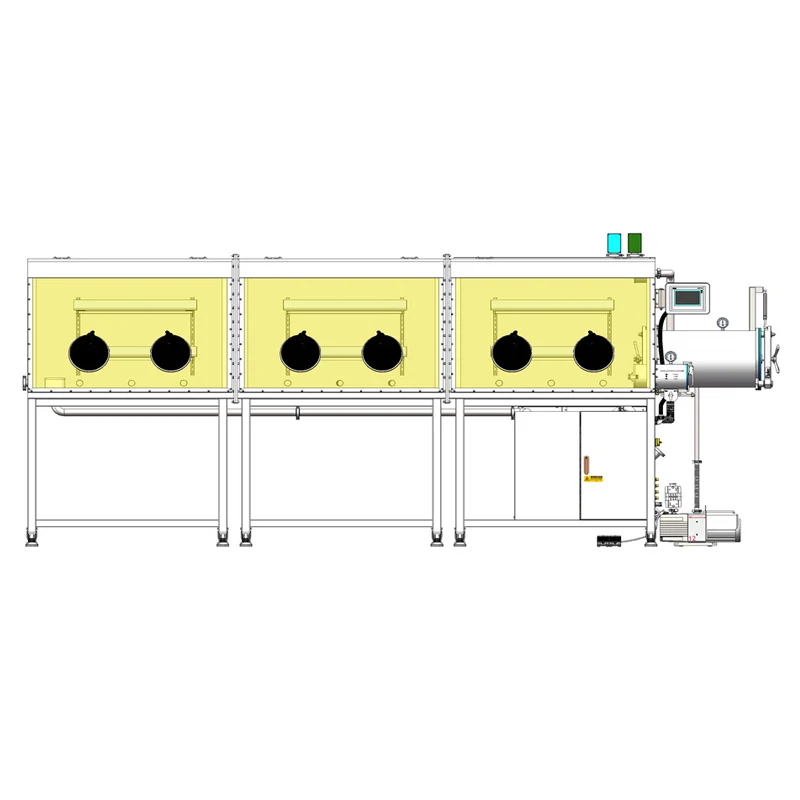
The trade-offs are real. Longer circulation lines mean more joints to leak-check, more pressure drop for the blower to overcome, and careful routing so that lines are not kinked or run through traffic areas. Two footprints must be planned instead of one, and the room's height, floor loading and gas supply points all become part of the layout decision.
Which Configurations Matter?
The product name already carries most of the configuration information: how many stations, whether access is from one side or two, whether the purification unit is separate, and whether purification is included at all.
Three Stations on One Side
Three ports on a single face give a long working wall. The rear wall is then free for feedthroughs, gas and vacuum connections, and instruments, and work can be sequenced along the length: sample preparation at one end, assembly in the middle, measurement at the other. The cost is scale. A three-station chamber holds more gas volume and exposes more seal length than a single-station box, so the same purification capacity has more to do. Single-sided access also makes long equipment awkward if it must be loaded or unloaded from both ends.
Single-Sided and Double-Sided Working Access
Single-sided designs suit equipment operated from one face, with instruments mounted on the back wall. Double-sided designs place ports on two opposite faces and are chosen when a long object, such as a furnace tube, a coating fixture or a transfer line, has to be reached from both ends, or when two groups must work face to face. The choice follows the equipment, not the headcount.
Transfer Ports and Antechamber Capacity
Every transfer is the largest routine source of air entering the box. An antechamber limits that intrusion by evacuating and refilling, or by purge cycling, before the inner door is opened. What matters at the specification stage is chamber volume against the size of what you actually transfer, door clear opening, how many antechambers the box carries, and whether the vacuum pump provided is matched to the chamber volume and the gas being handled. A box with one small port and one large port is often more useful than two identical ports.
Purification, Monitoring and Pressure Control
Moisture and oxygen analyzers report the atmosphere; they do not clean it. Their value depends on range, resolution, accuracy, sampling point and calibration interval. Resolution is not the same as accuracy, and a displayed decimal place is not a guarantee. Pressure control keeps the chamber slightly above ambient so that any leak moves outward; it is normally set through make-up gas and exhaust regulation, sometimes with foot-pedal control so an operator can adjust pressure while both hands stay in the gloves. Working pressure, antechamber vacuum, pump ultimate vacuum, leak rate and atmosphere level are five different quantities, each measured under its own conditions.
Which Specifications Should You Check?
- Atmosphere target: the water and oxygen levels your process needs, and whether the figure is continuously maintained or reachable only under favourable conditions.
- Chamber dimensions and volume: internal working space, glove port count and diameter, and how the volume relates to the purification capacity supplied.
- Working pressure range: the range the control system holds, and how it is adjusted.
- Leak-tightness basis: the leak rate or pressure-hold test used, and the conditions under which it is measured.
- Purification arrangement: single or twin columns, expected regeneration interval, regeneration gas consumption, and whether the cycle is automatic or manual.
- Analyzer specification: measurement range, stated accuracy, sampling point and calibration interval for both water and oxygen.
- Antechamber and pump: chamber volume, door clear opening, achievable vacuum, and whether the pump is included and matched to the gas and the load.
- Interfaces and utilities: KF flange sizes, electrical and signal feedthroughs, HEPA filter position, solvent trap provision, plus electrical supply, purge or exhaust route for regeneration, and cooling.
Two habits prevent most specification mistakes. First, do not carry a value quoted for one chamber into a different size or configuration. Second, when a datasheet is ambiguous or a figure looks inconsistent, treat the number as unconfirmed and ask for the test conditions. A glove box is defined as much by how it is measured as by what it achieves.
Where Is It Suitable, and What Are Its Limits?
Applications That Fit the Capability
A purification box of this type is normally chosen for lithium and solid-state battery work, where lithium metal, electrolytes and cell stacks must be handled without air exposure; for perovskite, OLED and semiconductor-related processing; for air-sensitive chemistry and organometallic synthesis; for additive manufacturing powder handling and post-processing, where powder stays inside the controlled atmosphere instead of the room air; and for general materials research in which oxidation or hydrolysis must be excluded during preparation and measurement.
Limits That Are Often Misread
An inert atmosphere is not a sterile environment, a cleanroom classification, a biosafety cabinet or a hazardous-material containment system, and it should not be presented as one. Nor is it automatically inert to every sample: nitrogen is not the right working gas for materials that form nitrides, which is why argon is specified instead.
The remaining limits are procedural. Solvent vapour accumulates and must be managed by a solvent trap; HEPA filtration removes particles and does nothing about vapour, moisture or oxygen. Frequent transfers raise the load on the purification columns, and regeneration periods reduce available capacity. Samples that arrive wet, or large volumes of solvent, need pre-drying or dedicated handling before they enter the chamber, whatever the analyzer reads at that moment.
How Should You Select or Integrate It?
Start from the workflow rather than the catalogue. How many people work simultaneously, and for how long? How large is the equipment that has to sit inside, and from which direction is it loaded? What water and oxygen level does the process really need, with margin for transfers and regeneration? How often will items go in and out, and how much floor area is available for a split assembly with its separate purification cabinet?
Then check the interfaces. Accessories are matched by flange standard, port size, thread, voltage and signal type, not by product name, and an item that fits mechanically can still be wrong for the gas or the vacuum level involved.
Where the Antechamber Earns Its Place
The small glove box antechamber is the accessory most often added after the box is running, because it addresses the most frequent disturbance. A small chamber evacuates and refills quickly, so a sample vial, a tool or a small fixture can be introduced without opening the main chamber and without cycling its whole volume. That shortens transfer time and reduces gas consumption compared with using a large port for small items.
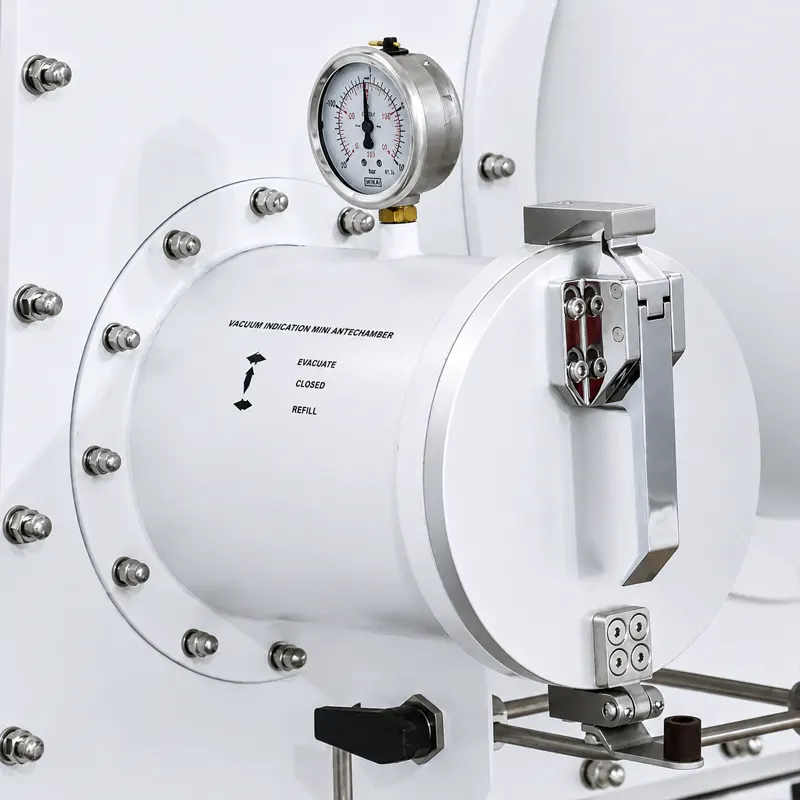
What an antechamber does not do is purify. It limits how much air gets in; the purification column removes what gets in. Compatibility should be checked before ordering: chamber volume against the largest item you expect to pass, door clear opening, achievable vacuum and the pump matched to it, seal and glove compatibility, and the flange or port on the box that the chamber will actually mount to.
Short Answers to Common Questions
Does the box come with its own purification system?
In this configuration, gas purification is part of the product as named. What still needs confirming for a specific order is the scope of supply: whether the split purification cabinet, the moisture and oxygen analyzers, the vacuum pump and any antechamber are included or quoted separately.
Can an antechamber lower the water and oxygen inside the box?
No. It reduces how much air enters during a transfer, and therefore how hard the columns have to work, but the removal of moisture and oxygen is done by the purification media, not by the antechamber.
How do I judge whether an accessory is compatible?
By interface and duty, not by name: flange standard and size, port thread, chamber volume against the item, glove port diameter together with glove material and permeation behaviour, voltage and signal type for feedthroughs, and whether a pump suits the gas and the load it will see.
Is a single purification column enough?
It depends on duty cycle: transfers per day, how tight the box is, ambient humidity, the target level, and whether regeneration can be scheduled while the box is idle. Twin columns allow work to continue through regeneration, at the cost of more space and more gas management.
Can the box handle any air-sensitive reaction?
Only where the sample tolerates the working gas and the achievable atmosphere. Materials that react with nitrogen need argon; solvent-heavy processes need vapour management; and a clean analyzer reading does not compensate for a wet sample or an unsealed transfer.
Confirming the Configuration Before You Order
Before finalising a three-station split-type box, confirm the atmosphere target and how it is measured, the chamber dimensions and station layout, the placement and utility routing of the separate purification cabinet, the purification arrangement and regeneration logistics, the analyzer specification and calibration path, the antechamber size and pump match, the inventory of flanges, feedthroughs and filters, and the compatibility of every accessory with the specific port it will use. These checks take far less time than correcting an atmosphere problem after the box is installed.
