
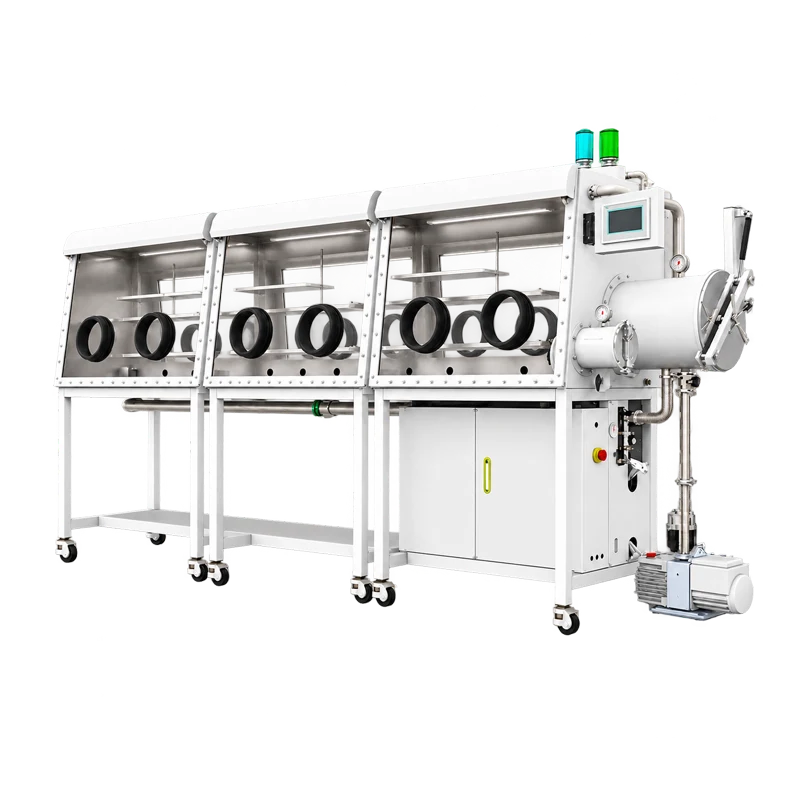
This TENCAN glove box is a six-station, double-sided, split-type enclosure supplied with a gas purification system. It sits between the operator and the ambient laboratory atmosphere: the enclosure provides a sealed working volume with glove access, while the purification system circulates the internal gas through media that remove water and oxygen. Its purpose is to maintain a controlled inert atmosphere for materials and processes that would otherwise change during handling.
The product name carries useful information, but it does not replace a layout drawing or a performance specification. “Six-station” describes a multi-position working arrangement. “Double-sided” describes access from two faces of the enclosure. “Split-type” describes a construction divided into sections rather than a single uninterrupted shell. “With gas purification” describes an atmosphere-management system, not a promise that every oxygen- or moisture-sensitive sample will remain unchanged.
What does a purification glove box do?
A conventional glove box controls physical access. A purification glove box also controls the chemistry of the gas inside it. The two functions are related, but they are not the same. A well-sealed box with no purification can hold a charged inert atmosphere for a period, but it cannot continuously remove the water and oxygen that enter with materials, gloves, and small leaks. A purification system adds a circulation loop, removal media, and monitoring so that the atmosphere can be managed rather than merely filled.
The six-station double-sided split-type glove box with gas purification system is a product configuration in TENCAN’s purification glove box range. The enclosure and the purification system should be evaluated together: the box determines the working space and the routes by which contamination can enter, while the purifier determines how the circulating gas is treated and how quickly the atmosphere can recover after a transfer or an opening.
A purification glove box is not a general ventilation device, a fume hood, a sterile workbench, or a biological safety cabinet. The glove box is intended to isolate the work from the surrounding air and to keep the internal atmosphere within a defined range. If the process generates toxic gases, fine powders, biological agents, or flammable vapors, the system must be reviewed for that duty rather than assumed to cover it.
Separating the enclosure from the atmosphere system
It helps to think of the installation as four connected functions. The first is the sealed enclosure, including the walls, viewing panels, glove ports, and transfer interfaces. The second is the gas purification loop that circulates the internal atmosphere. The third is the monitoring and alarm system that measures the condition of that atmosphere. The fourth is the material-transfer path, such as an antechamber or another controlled interface.
The transfer path is often the most visible limitation in daily use. Every time a sample, tool, or container enters, some air or moisture can be carried in. A transfer chamber reduces that load, but it does not eliminate it. The size of the chamber, the number of transfer steps, and the way the chamber is evacuated and refilled all affect recovery. Ask for the transfer arrangement to be described specifically rather than inferred from the overall product name.
How the purification loop works
In a typical purification glove box, a blower circulates gas from the working volume through a purifier and back to the box. Water is captured by adsorbent media, while oxygen is removed by a catalytic or reactive medium, depending on the design. The exact media, number of columns, regeneration method, and operating sequence are configuration details that should be confirmed in the current product documentation. The important principle is that purification is a continuous or repeated process, not a single fill of inert gas.
Regeneration is a separate procedure. It restores the removal medium after it has taken up water or reacted with oxygen, and it follows the manufacturer’s instructions rather than a generic recipe. Regeneration is not the same as normal circulation, and it should not be treated as an ordinary operating step that any user can improvise. The system also needs a defined work gas, a defined control gas for instruments or valves where applicable, and a planned procedure for startup and shutdown.
Monitoring is another separate function. An oxygen analyzer or moisture analyzer measures the atmosphere; it does not purify it. A displayed value can tell the operator whether the atmosphere is within a target range, but the reading depends on the sensor’s range, resolution, accuracy, calibration, and sample point. Resolution is not accuracy. A display that changes in small increments does not prove that the absolute value is correct.
What the six-station, double-sided, split-type layout changes
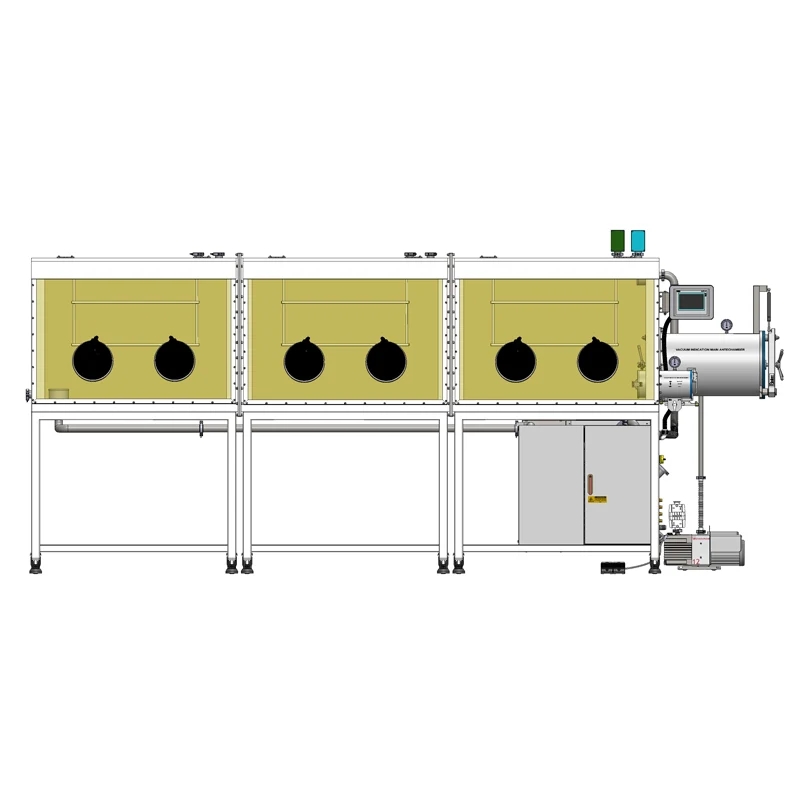
Multi-station glove boxes are often chosen for shared laboratories, parallel experiments, or processes that need more than one operator position. The layout affects the work more than the model name suggests. It changes reach, sightlines, glove-port spacing, transfer routes, service access, and the number of sealing interfaces that must be maintained.
Six stations
“Six-station” indicates a multi-position working arrangement, but the term should be read with the layout drawing. It can refer to operator positions, glove-port positions, or defined work zones, and those are not always the same. Ask whether all six positions are intended for simultaneous use, how they share the internal atmosphere, and whether each has equal reach and access to the transfer chamber. A six-station box can improve throughput and collaboration only if the internal layout supports the actual workflow rather than merely multiplying glove ports.
Double-sided access
A double-sided enclosure allows work or observation from two faces. That can support collaboration between operators, a pass-through workflow, or a division between sample preparation and inspection. It also adds practical requirements. Both sides need clear floor space, safe access, and enough room for glove changes and service. The second side adds sealing interfaces and viewing surfaces that must be maintained. If the second side will rarely be used, a single-sided enclosure may be simpler to place and operate. Double-sided access is a workflow choice, not an automatic upgrade.
Split-type construction
A split-type box is arranged in sections rather than as one uninterrupted shell. This can make transport, installation, or service easier, and it can allow different sections to serve different functions. The trade-off is that every joint, connection, and divided section is a potential leak path. The relevant questions are how the sections are sealed, how the complete assembly is leak-tested, whether the split affects the purifier loop, and whether one section can be isolated for service.
Which specifications should you check?
Do not select a purification glove box by the phrase “gas purification” alone. Ask for a data sheet or specification table that separates the enclosure, the gas loop, the transfer path, the monitoring, and the accessory interfaces. The following areas are the most useful starting points.
Working volume and station ergonomics
Check the internal dimensions, usable height, glove-port spacing, and the distance an operator must reach. A large box can hold more equipment, but it also contains more gas and more surface area, and it may be harder to purge and recover. Confirm the layout of shelves, ports, and transfer openings, and check that the split sections do not obstruct the work. If several users will work at once, ask how their arms and sightlines interact. The best size is the smallest enclosure that comfortably supports the process, not the largest one that fits the room.
Atmosphere performance and verification
Oxygen and moisture are the usual atmosphere indicators, but the specification should state the measurement range, resolution, accuracy, calibration method, sample location, and alarm logic. Ask how performance is verified at installation, what test load is used, and how the atmosphere recovers after a transfer. A guaranteed value at commissioning is not the same as a continuous guarantee under every workload. The attainable condition depends on leak integrity, purifier condition, glove condition, transfer frequency, materials brought in, and maintenance discipline.
Pressure and vacuum boundaries
Several pressure-related numbers are often mixed together. The working pressure of the box, the vacuum level of a transfer chamber, the ultimate vacuum of a pump, the leak rate of the enclosure, and the oxygen or moisture concentration are different parameters with different test methods. A pump’s ultimate vacuum does not describe the leak rate of the box. An antechamber vacuum rating does not describe the main chamber. Keep the original units and the object being measured, and omit any number whose basis is unclear until the supplier confirms it.
Transfer, pumping, and connections
Look at how materials enter and how the transfer chamber is evacuated and refilled. Check the chamber volume, door size, and the space needed to move containers in and out. If a pump is part of the configuration, confirm that it is matched to the gas and the duty. For electrical or signal connections, check feedthrough type, sealing, and serviceability. For particle control, a HEPA filter may be relevant, but it removes particles rather than water or solvent vapor. Solvent adsorption is a separate function and does not replace water and oxygen purification.
Gloves, materials, and solvent compatibility
Gloves are the user’s interface with the controlled volume, and they are also a permeable barrier. Selection depends on the sample, the solvent, the required dexterity, the glove-port size, and the acceptable replacement interval. A thicker glove is not automatically better: it may reduce tactility and increase fatigue, which can lead to poor technique. Confirm the glove material with the supplier and review compatibility with the chemicals in use. The box materials, viewing panels, seals, and purifier media should also be checked against the process, especially when corrosive or high-solvent workloads are expected.
Where is it suitable, and what are its limits?
The strongest fit is work that requires repeated handling of air- or moisture-sensitive materials in a shared laboratory. Examples can include battery and solid-state electrolyte research, perovskite and organic electronic materials, semiconductor precursors, catalysts, and air-sensitive chemical synthesis. The common thread is not a particular industry; it is the need for a controlled atmosphere, a defined transfer path, and a working space that can accommodate the tools and containers used in the process.
The limits deserve equal attention. A purification glove box does not make every material inert, and it does not remove every possible contaminant. HEPA filtration addresses particles, not oxygen or water. Solvent adsorption addresses organic vapors but is not a substitute for the water and oxygen removal loop. A purifier can be overloaded by a large spill, an excessive transfer load, or a damaged glove. The enclosure is not a fume hood or a biological safety cabinet unless it has been specifically designed, tested, and documented for that duty. Processes that generate hazardous dust, toxic gas, or a serious fire risk need a separate hazard review.
A glove box also depends on operating discipline. Gloves must be inspected and replaced. Door seals and glove-port seals must be checked. The purifier must be regenerated or serviced according to its condition, not only according to a calendar. Analyzers must be calibrated. A box that is never monitored can appear to be working while its atmosphere has drifted. The monitoring system is therefore part of the process, not an optional display.
How should you select or integrate the system?
Start with the workflow rather than the model name. List the materials to be handled, the worst-case moisture or oxygen sensitivity, the size and number of items transferred per day, the number of simultaneous users, and the tools that must remain inside. Then compare those requirements with the enclosure layout, the purification capacity, the transfer path, and the monitoring arrangement. Ask for a layout drawing and a utility list before committing to a room plan, because a six-station double-sided box affects access, ventilation, power, and service clearance around the equipment.
- Confirm the meaning of the station count and whether all positions can be used at the same time.
- Request the installed performance verification method, not only a catalog value.
- Check the transfer chamber volume and the evacuation sequence appropriate to the workload.
- Review glove material, thickness, and port size against the actual chemicals and dexterity needs.
- Confirm purifier media, regeneration requirements, spare parts, and service access.
- Separate particle filtration, solvent adsorption, and water and oxygen purification in the selection discussion.
- Plan calibration, leak checks, glove replacement, and operator training before installation.
Accessory integration: the KF vacuum clamp
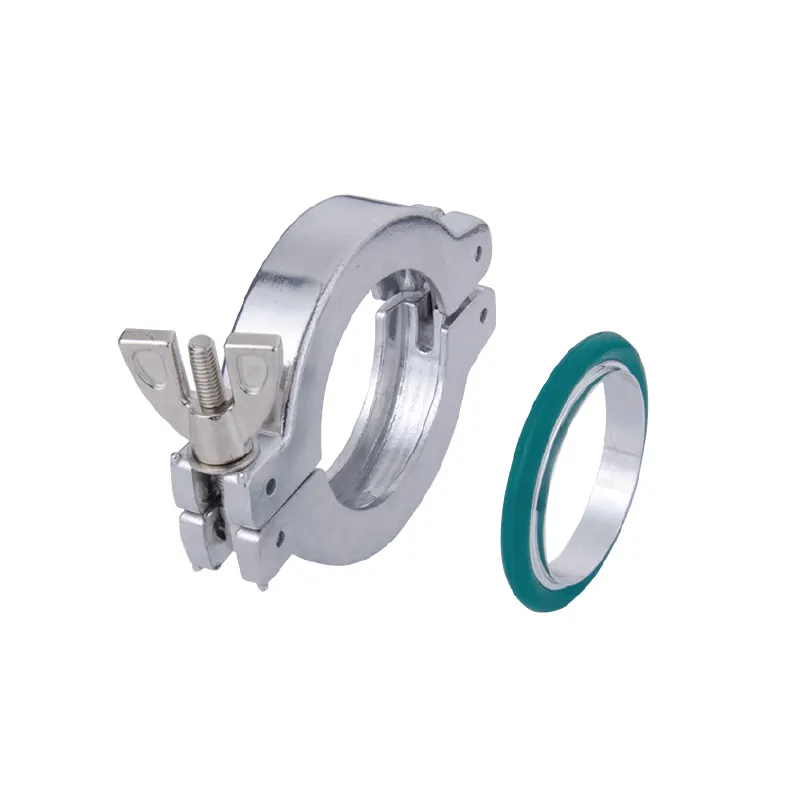
Accessories should be selected for the function they actually perform. A KF vacuum clamp is a connection component used to secure compatible KF flanges. It does not purify the atmosphere, and it does not make an incompatible flange suitable. If the box, transfer chamber, or pump line uses KF connections, confirm the flange size, the centering ring and seal material, the vacuum duty, and the clearance for installation. The clamp is a small part, but a poor seal at a vacuum connection can undermine the atmosphere work that the rest of the system is designed to protect. See the KF vacuum clamp for its connection role.
FAQ
Does this glove box include gas purification?
Yes. The product is described as a six-station double-sided split-type glove box with a gas purification system. The specific purifier configuration, media, monitoring, and regeneration requirements should be confirmed in the current product documentation.
Can it guarantee a particular oxygen or moisture level?
No universal guarantee should be assumed from the product name. The attainable atmosphere depends on the enclosure’s leak integrity, the purifier’s condition and capacity, the transfer load, the gloves, and the operating procedure. Ask for the documented verification method and the conditions under which performance is stated.
Do six stations mean six independent atmospheres?
Not necessarily. A multi-station box may share one purification loop and one internal atmosphere across the working volume. Confirm whether the sections can be isolated, whether each station has independent monitoring, and how the split-type construction affects circulation.
Is a double-sided box always better than a single-sided box?
No. Double-sided access is useful when the workflow genuinely uses both faces for work, transfer, or observation. Otherwise, the second side adds footprint, sealing interfaces, and maintenance without improving the process.
Can a HEPA filter or solvent trap replace the purification system?
No. HEPA filtration removes particles, and solvent adsorption targets organic vapors. Neither replaces the water- and oxygen-removal function of a gas purification loop. They are complementary functions with different selection criteria.
For a six-station purification glove box, the useful decision is not whether the enclosure looks large enough, but whether the complete installation can support the material, the transfer routine, the monitoring, and the maintenance that the work requires. Confirm the layout, the atmosphere verification, the pressure boundaries, and the accessory interfaces before the system is installed.
