
A three-station single-sided split-type glove box with gas purification system is a controlled-atmosphere enclosure for moisture- and oxygen-sensitive work. It provides three working positions along one operator side and uses a closed purification loop to maintain the internal atmosphere. The split-type arrangement organizes the glove chamber separately from the purification and utility section. The system is more than a sealed box with a gas inlet: enclosure, transfer path, purification, monitoring, and pressure control must work together.
TENCAN Glove Box Systems lists this configuration as the three-station single-sided split-type glove box with gas purification system. The product page is the reference for current dimensions, utilities, options, and performance statements. The notes below explain the engineering logic and the points to verify; they do not replace the product datasheet.
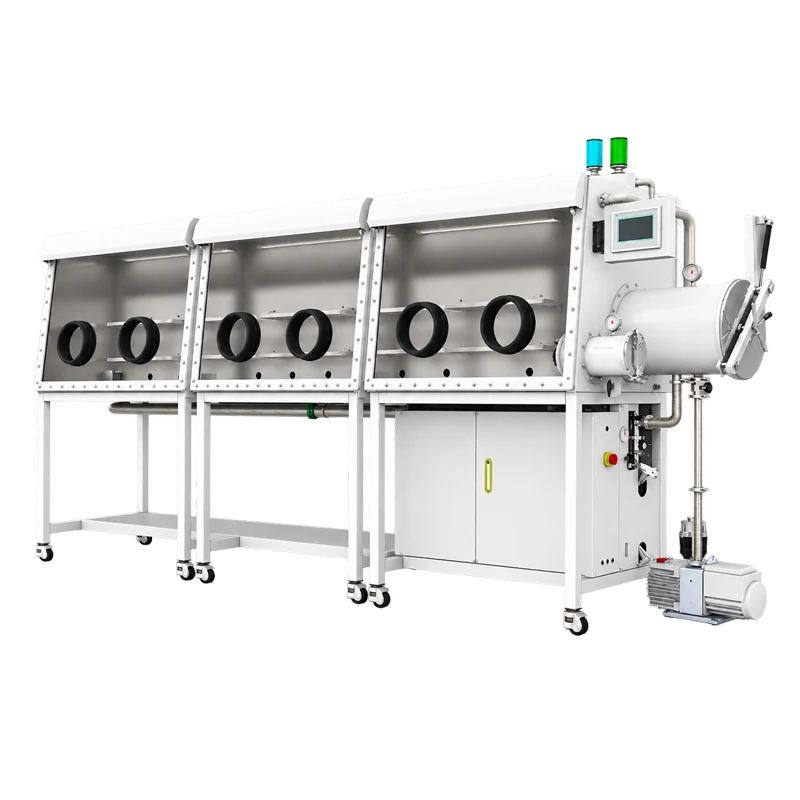
How a Split-Type Purification Glove Box Works
The enclosure provides the physical boundary; the purification system maintains the condition inside it. In a closed loop, gas from the glove chamber passes through purification material that removes moisture and oxygen, then returns to the box. A circulator, valves, columns, sensors, and a controller manage the sequence. The exact components depend on the supplied configuration. The practical question is whether the loop is sized for the chamber volume, access points, and material load, not merely whether purification is listed.
The enclosure and three workstations
“Three-station” describes three working positions. “Single-sided” means they are served from one operator face. That can support parallel tasks, shared instruments, or a multi-step process without moving every sample to another box. It also creates more internal volume and more sealed access points than a smaller enclosure. Because the atmosphere is shared, a contamination event or heavy outgassing load at one position can affect the others. A three-station box is not three independent boxes.
The gas purification loop
Purification is a circulating process, not a single purge. A purge displaces existing atmosphere with inert gas; purification removes contaminants that continue to enter through gloves, materials, small leaks, or transfers. Regenerable purification columns must be regenerated periodically, and regeneration is a separate operating state with its own sequence before normal circulation resumes. The procedure belongs in the manufacturer’s instructions. For selection, ask how the loop behaves during regeneration, whether another column supports the box at that time, and how the system reports completion.
The split-type arrangement
“Split-type” indicates separate sections rather than one monolithic cabinet. This can ease movement through doors, lifting, and service access, and it can place the purification and utility section outside the immediate working area. Interfaces remain: gas lines, electrical cables, signal wiring, and any cooling or exhaust connections must be routed, labeled, supported, and leak-tested after assembly. Confirm which sections separate, how they join, the supplied connection length, and whether the enclosure can be isolated for maintenance.
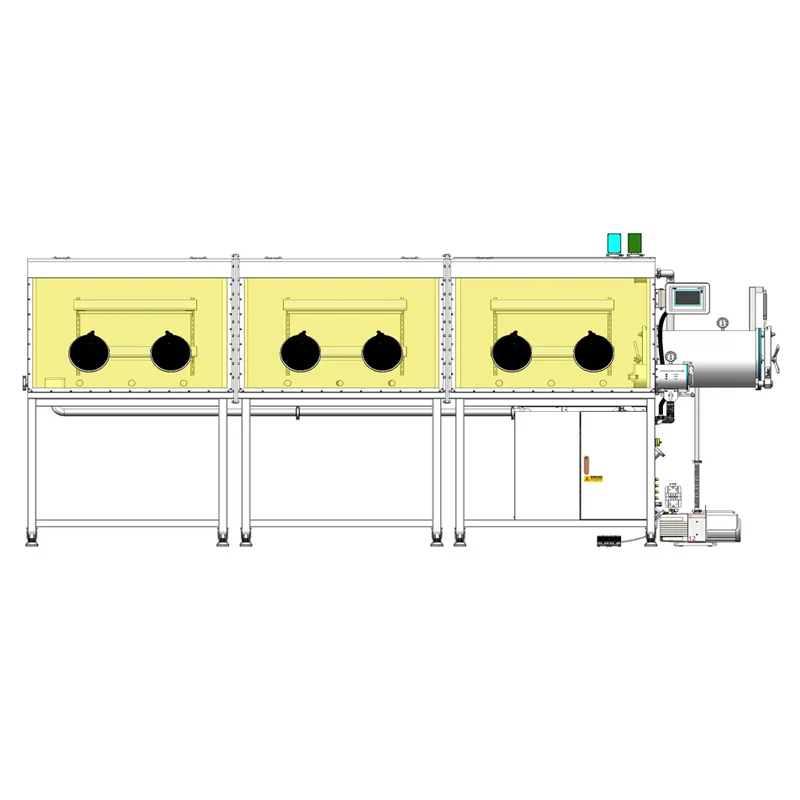
Which Configuration Details Matter?
This is one named configuration, so the useful comparison is not a list of invented variants. It is the set of details that change how the three-station, single-sided, split-type concept performs in a real laboratory.
Workstation count and access
Three stations can improve workflow when several users or process steps need the controlled zone at once. They also add surface area and potential leak paths. Single-sided access leaves the opposite wall available for services or instruments, but concentrates operator movement on one face. Check usable working depth, height above the work surface, and space for fixtures rather than relying on station count alone.
Split construction and site layout
A split system can fit a room where a single large cabinet cannot pass through the door or be lifted into place. The trade-off is field integration. Ask for the arrangement drawing, connection schedule, utility requirements for each section, and commissioning checks. If the purification module sits away from the chamber, confirm the circulation path and interconnecting line length. Do not assume the sections can be reassembled in any orientation.
Purification and regeneration
Ask for the number of purification columns, circulation capacity, regeneration method, and monitoring arrangement. With a single column, the box may have a defined state during regeneration. With dual columns, confirm whether one can support the box while the other is regenerated. Neither arrangement should be assumed; both should be documented. The word “purification” alone does not define capacity or operating continuity.
Monitoring and control
Oxygen and moisture analyzers report conditions; they do not remove contaminants. Readings are only as useful as their calibration and sample point. Ask which variables are measured, where the sample is taken, how often sensors are calibrated, and what alarm follows an out-of-limit reading. Resolution is not accuracy. A stable display is not proof of leak integrity. Keep measurement, purification, and pressure control separate when reviewing specifications.
Transfer and access
Every item entering the box passes through a transfer path. If an antechamber is part of the offered configuration, check its size, door arrangement, vacuum or purge capability, and operating sequence. If no antechamber is included, the transfer procedure differs. Do not infer a vacuum antechamber from “purification glove box.” The transfer path is often the practical bottleneck when several users share one box.
Specifications to Check Before Selection
Box working pressure, antechamber vacuum, pump ultimate vacuum, leak rate, oxygen concentration, and moisture concentration are different quantities with different test conditions. Record the unit and the object of each value. If a figure is supplied without a condition, ask for the missing condition rather than assuming it applies to your process.
- Internal working space: width, depth, usable height, and fixture space. Station count does not define volume.
- Leak integrity: test method, test pressure, allowed leak rate, and the boundary tested. A leak rate is not an oxygen level.
- Atmosphere performance: oxygen and moisture targets, sample point, sensor type, calibration, response time, stabilization period, and workload.
- Purification capacity: circulation flow, column capacity, regeneration interval, redundancy, and behavior during regeneration.
- Pressure control: working range, relief protection, control dead band, and alarms.
- Transfer path: antechamber dimensions, door operation, vacuum or purge capability if offered, and cycle time.
- Utilities and site: power, inert gas, vent or exhaust, cooling, footprint, service clearance, and routing for split sections.
- Material compatibility: samples, solvents, gloves, and seals. Solvent adsorption and HEPA particle filtration are separate functions, not substitutes for water and oxygen removal.
- Control and records: alarms, data logging, user access, and remote support where included.
Where It Suits and Where It Does Not
A three-station single-sided split-type purification glove box fits laboratories that need multiple working positions in one controlled atmosphere, want a defined purification loop rather than simple gas flushing, and have a site where a split installation is easier to place. Typical matching work includes lithium and solid-state battery materials, perovskite and OLED materials, air-sensitive chemistry, semiconductor and electronic materials, and additive manufacturing powders or post-processing that must avoid ambient moisture and oxygen. The layout suits shared instruments and multi-step preparation inside one atmosphere.
Limits matter too. The box is not, by itself, a sterile isolator, cleanroom classification, biological safety cabinet, or fume hood, and it does not replace a facility’s hazardous-gas or fire-safety review. Gas purification does not remove every solvent vapor; significant solvent loading may need separate adsorption. HEPA filtration, if present, removes particles rather than water or oxygen. An analyzer measures the atmosphere rather than improving it. Not every sample is inert in every gas, and not every glove material suits every solvent. Three stations do not guarantee three times the throughput because transfer and purification can limit the workflow.
Accessories and Integration
Accessories should be selected for the process, not added as a generic package. When a gas or liquid line must reach a sample or instrument inside the enclosure, a feedthrough is the relevant component. TENCAN lists a gas and liquid feedthrough in its glove box accessories. It passes a line through the enclosure boundary while preserving the controlled atmosphere; it does not create the atmosphere, remove water or oxygen, or replace purification.
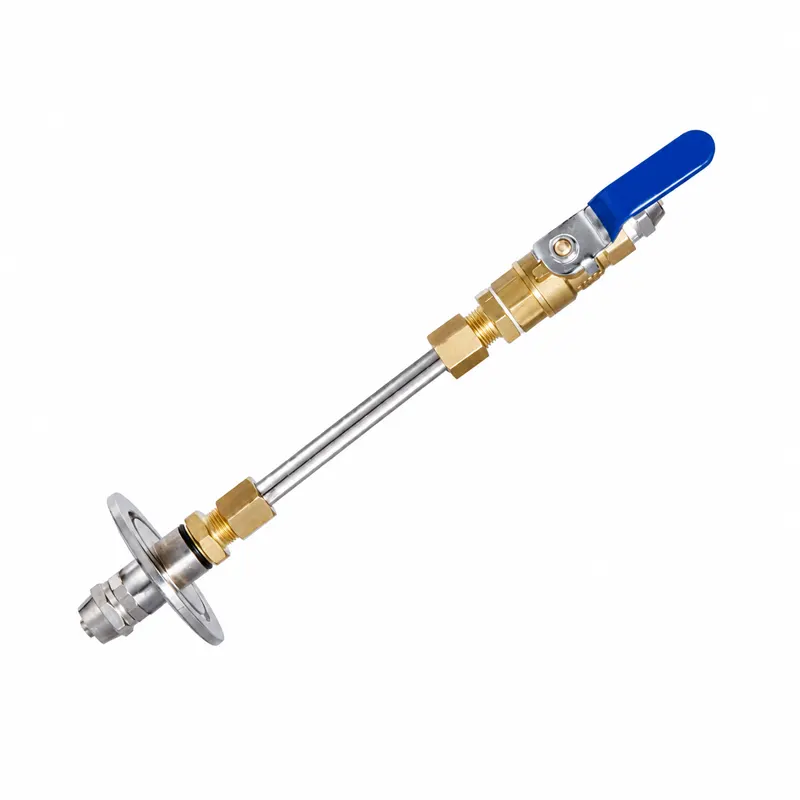
Compatibility with a specific three-station box must be confirmed rather than assumed from the accessory name. Check the port schedule, wall construction, seal arrangement, line type, pressure, temperature, wetted materials, and connections on both sides of the wall. A feedthrough that suits one enclosure may not suit another. The same logic applies to gloves, antechambers, pumps, analyzers, valves, and electrical feedthroughs: each has its own interface and performance question. The system-level test is whether the accessory preserves the boundary without creating a new leak path or unmonitored condition.
How to Select and Integrate the System
- Define the work before the box. List samples, solvents, instruments, campaign length, users, and worst-case outgassing load.
- Match the layout to the room. Confirm three-station width, single-sided access, split footprint, doorway clearance, lifting route, and service clearance.
- Separate atmosphere from measurement. State the required oxygen and moisture conditions, then ask how they are measured, calibrated, and reported, including the test conditions for any performance value.
- Review purification and regeneration. Ask about columns, circulation, alarms, and the state of the box during regeneration.
- Map the transfer path. Decide how samples, tools, and waste enter and leave. Verify antechamber capability only if that equipment is offered, and include the time cost of each transfer.
- Plan utilities and interfaces. Confirm power, inert gas, venting, cooling, network, and feedthrough locations. For a split system, review interconnection drawings and commissioning checks.
- Check compatibility and documentation. Review gloves, seals, solvents, and sample chemistry; ask for the manual, maintenance schedule, spare-parts list, calibration procedure, and alarm list.
Common Questions About Split-Type Purification Glove Boxes
Does the purification system run continuously?
It may run continuously or under a defined operating schedule, depending on the design and use. Purification is a closed-loop function, not a one-time gas fill. Ask how circulation is controlled, how regeneration is scheduled, and what happens to the atmosphere during that schedule.
Can the box guarantee a specific oxygen or moisture level?
Only a documented performance specification, with test conditions and a measurement method, can support such a claim. The achievable condition depends on the enclosure, leak integrity, purification capacity, sensor calibration, transfer frequency, and materials inside. Do not infer a guaranteed value from the phrase “gas purification system.”
Can I add a gas or liquid feedthrough?
It depends on the enclosure’s port schedule, wall construction, sealing interface, and the feedthrough’s own ratings. The accessory must be compatible with the line, the process, and the box. Confirm the interface and leak-test method before installation; a feedthrough is a boundary penetration, not a plug-in extra.
Is a split-type system easier to install?
It can be easier to move and place where a single large cabinet cannot pass through the site. It is not automatically simpler to commission. Split sections add field connections, alignment, and leak testing. Review the arrangement drawing and commissioning plan before comparing it with a single-piece enclosure.
Can HEPA filtration replace gas purification?
No. HEPA filtration addresses particles. Water and oxygen removal require a purification function, and solvent vapor may require separate adsorption. These functions can coexist, but one does not substitute for another.
