
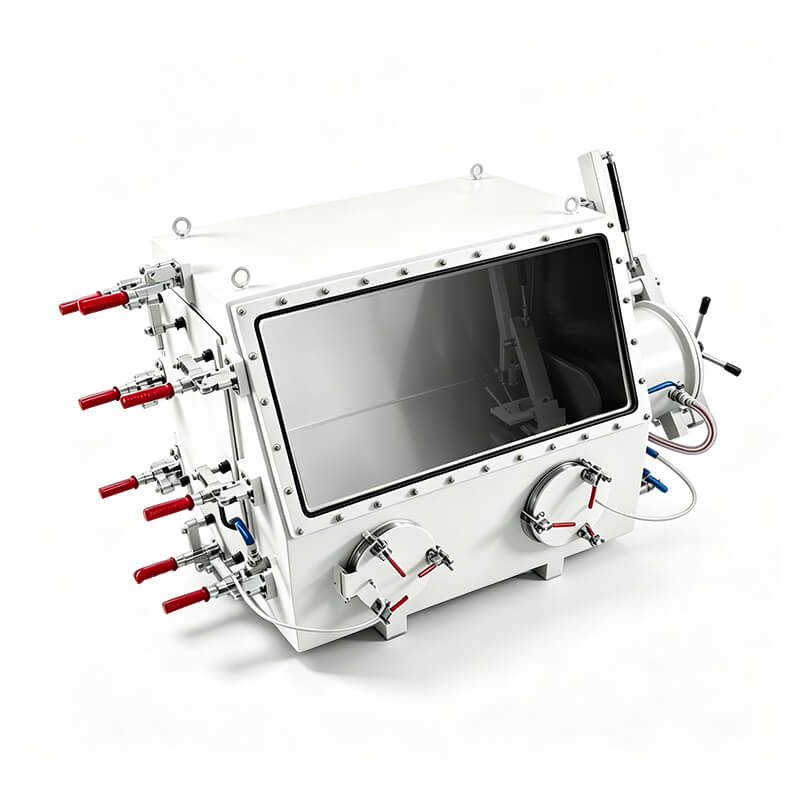
The GBV-3 Stainless Steel Vacuum Glove Box is a sealed stainless steel work enclosure designed for handling materials while limiting their exposure to ambient air. It belongs at the point where an air-sensitive sample must be manipulated, weighed, packed, or assembled, rather than at the exhaust end of a process. Its working principle combines a glove-access chamber with vacuum-assisted atmosphere exchange: air is removed from the sealed chamber, an inert gas is introduced, and the cycle may be repeated before work begins. The result is a controlled inert environment, but the name alone does not establish continuous gas purification, a specific oxygen limit, or suitability for every sensitive material.
What the GBV-3 Does in an Inert-Atmosphere Workflow
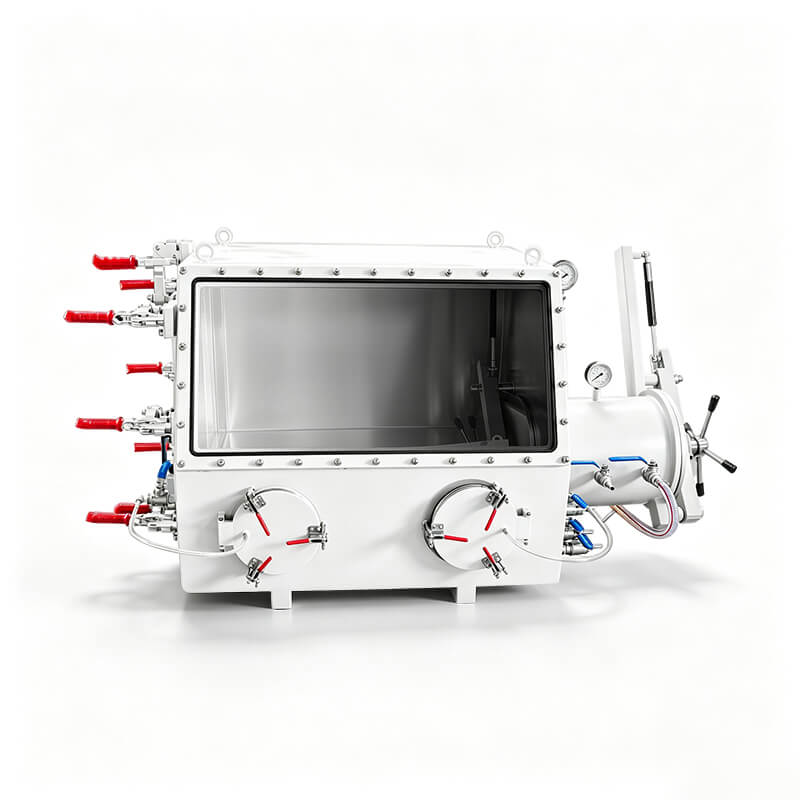
A vacuum glove box is a boundary between the laboratory and a sample. The operator keeps hands outside the chamber and uses gloves to reach the workspace inside; a viewing panel, where fitted, allows observation without opening the enclosure. Gas connections support evacuation and refill, while the chamber and seals hold the chosen atmosphere between operations. The enclosure therefore creates a repeatable place to work, not merely a storage container. Its value depends on how well the seal, the exchange procedure, and the material-handling plan work together.
The GBV-3 stainless steel construction is a useful starting point for a durable laboratory enclosure, but the metal alone does not define performance. Internal dimensions, glove-port layout, window material, seal design, surface finish, and the number and type of ports determine whether the box fits a particular task. Two boxes with the same model name can serve very different workflows if one offers more access space, a different transfer arrangement, or a different vacuum and gas connection set. Those details need to be confirmed from the current specification, not inferred from a photograph.
It is equally important not to make the enclosure do a purifier's job. A vacuum glove box can remove a large fraction of the original air by evacuation and refill, but a continuously circulating purification system is a separate architecture. If a process requires a sustained oxygen or moisture level, the user must define that requirement and ask whether the chosen configuration includes the necessary purification, monitoring, and regeneration capability. Vacuum exchange and continuous purification are complementary in some workflows, not interchangeable terms.
How Vacuum-Assisted Atmosphere Exchange Works
The basic sequence is mechanical. After the chamber is closed and sealed, a vacuum pump reduces the pressure inside. The removed gas carries some of the ambient oxygen, nitrogen, moisture, and solvent vapor with it. An inert gas is then admitted to bring the chamber back to a workable pressure. Repeating the evacuation and refill reduces the residual air fraction further; the number of cycles, the attainable pressure, and the purity of the supply gas all influence the result.
- Seal the chamber. Confirm that gloves, ports, doors, and connections are closed and that the intended vacuum path is isolated from the gas supply.
- Evacuate. Use a pump and plumbing compatible with the chamber volume and the required duty. The pump's ultimate pressure is not the chamber's working pressure.
- Refill with inert gas. Admit the chosen gas through the intended inlet. The supply gas quality and the refill endpoint both affect the resulting atmosphere.
- Repeat if the procedure requires it. Additional cycles dilute residual air, but they also consume time and gas. The appropriate protocol depends on the sample and the operation.
This is a batch exchange. Every cycle consumes time and gas, and every opening of the box interrupts the established atmosphere. For frequent transfers, a properly sized transfer chamber or a planned transfer procedure matters more than a long evacuation of the main workspace. The appropriate exchange protocol is the one that matches the sample, the allowable exposure, and the number of operations, not the one with the longest sequence on paper.
What Vacuum Does and Does Not Remove
Vacuum lowers total pressure and removes gas-phase molecules, but it does not automatically produce an inert atmosphere. The refill gas does that. Vacuum is also not a universal water-removal method: water can adhere to surfaces, sit in pores, or diffuse slowly out of polymers, gaskets, and sample containers. A short evacuation may remove the bulk atmosphere while leaving adsorbed moisture to return later. This is why designers pay attention to seals, surface area, dead spaces, and the way samples and tools are introduced.
The distinction between pressure and atmosphere is central. A low chamber pressure tells you about the gas load and the pump, not directly about oxygen or water content. A gauge reading or a pump's ultimate pressure should not be presented as proof of a particular oxygen level. Where atmosphere quality matters, it needs an appropriate measurement method, a defined sampling point, and a realistic acceptance criterion. Without those, a claim of complete removal is a marketing statement rather than a specification.
It is also worth separating three tasks: gas exchange, continuous circulation through a purifier, and regeneration of purification media. Gas exchange uses vacuum and refill; continuous circulation moves chamber gas through a purification loop; regeneration restores the capacity of the purifying material. The GBV-3 designation does not by itself establish that all three are present. Treat each as a configuration question.
Configuration Choices That Matter on a Vacuum Glove Box
Rather than assume a family of variants, focus on the configuration choices that change how the box behaves in service and have them confirmed for the exact unit being quoted.
Chamber and Access
The internal workspace must accommodate the sample, tools, and any fixture used during assembly or testing. A box that is large enough on paper can still be awkward if the glove positions force the operator into an uncomfortable reach or if the viewing panel limits visibility at the working plane. Confirm the usable internal dimensions, glove-port count and spacing, window size and material, and the maximum size of an object that can be introduced without dismantling the setup. If a transfer chamber is proposed, check its internal dimensions and how it is evacuated and refilled; do not assume that every vacuum glove box has one.
Sealing, Vacuum, and Gas Path
A vacuum cycle depends on the whole gas path: chamber seals, glove cuffs, port covers, tubing, valves, and the pump connection. Ask which connections are supplied, what the chamber is rated for, and how the vacuum and inert-gas lines are isolated when the box is not in use. Keep the pressure ratings of the chamber, the transfer chamber, and the pump separate. A pump's ultimate pressure is not the same as a chamber's working pressure, and a leak rate is not the same as either. If a supplier gives a number without stating the object and conditions, the correct response is to ask rather than to convert it into a performance promise.
For work with powders, the handling method is as important as the atmosphere. Fine particles can migrate, cling to gloves, and contaminate seals. The box should be cleaned according to its materials and the process should use trays, liners, or closed containers where appropriate. Stainless steel is easier to wipe down than many plastics, but it is not resistant to every acid, solvent, or salt. Compatibility with the specific chemicals in use remains a separate check.
Specifications to Check Before Purchase
The specification review should start with the material and the task, then move to the equipment. The following items are more useful than a single headline performance number.
- Usable workspace: internal dimensions, glove-port positions, and clearance above the working surface.
- Enclosure construction and seals: stainless steel grade or finish where stated, gasket material, and compatibility with cleaning agents.
- Viewing and access: window material, visibility, door or transfer arrangement, and the way objects enter and leave.
- Vacuum path: chamber and transfer-chamber pressure limits, valve arrangement, hose and fitting types, and pump compatibility.
- Inert-gas path: inlet and vent locations, flow control, and whether the supply gas is suitable for the sample.
- Atmosphere monitoring: what is measured, where the sample is taken, the range, resolution, accuracy, and calibration requirements. Resolution is not accuracy.
- Controls and safety: gauge type, interlocks where provided, relief protection, and the procedure for a power or gas failure.
- Consumables and service: glove size and material, seal replacement, filter maintenance, and access to spare parts.
The last two items are often where a low-cost proposal becomes expensive. A box that is difficult to service or whose gloves and seals are hard to source will spend more time out of service. Ask for a clear scope of supply: which pump, gauges, valves, gloves, and fittings are included, and which are the user's responsibility. If a value is missing from a data sheet, record it as an open question for the quotation rather than filling it with an assumption.
Do not compare a vacuum glove box using powder-processing metrics such as milling throughput or particle size. The relevant performance questions are workspace, sealing, exchange, contamination control, and operator access. A box can be excellent for one sample size and unsuitable for another without any change in its basic technology.
Where the GBV-3 Is Suitable, and Where It Is Not
A stainless steel vacuum glove box is a reasonable candidate for air-sensitive work that benefits from a sealed, cleanable workspace and a repeatable evacuation and refill procedure. Typical settings include lithium-battery and solid-state battery materials, air-sensitive chemical handling, perovskite and OLED sample preparation, semiconductor or electronic materials, advanced materials research, and post-processing of additively manufactured parts where oxygen or moisture exposure must be limited. The common thread is a sample that is better handled inside a controlled enclosure than on an open bench.
Suitability is not automatic in any of those fields. A sample may be sensitive to one gas but not another; an inert supply gas may not be inert for every material; a solvent may attack a seal or window; a powder may create a cleaning problem. The box should be evaluated against the actual chemistry and physical form of the sample. If the process requires continuous removal of evolved solvent vapor, high-efficiency particulate filtration, or a specific cleanliness class, those are separate requirements. A glove box is not a fume hood, a sterile isolator, or a certified hazardous-duty enclosure unless it has been specifically designed and verified for that role.
The main limitation is the one implied by the product type: vacuum exchange is a batch process. It is good at removing the bulk atmosphere and reducing the ingress of air during a planned operation, but it does not provide an unlimited sink for moisture, oxygen, or solvent vapor. Work that needs a continuously maintained low-level atmosphere should be matched to a system with the appropriate purification and monitoring. Work with large or frequent transfers needs a transfer strategy, not just a larger chamber.
Adding a Vacuum Pump Oil Mist Filter
If the GBV-3 vacuum cycle is served by an oil-sealed rotary-vane pump, the pump exhaust deserves attention. Oil mist can escape with the exhaust and deposit on nearby surfaces, and it can be unpleasant in a small laboratory. A vacuum pump oil mist filter is placed on the exhaust side to capture that mist before it reaches the room. It is a pump accessory, not a chamber component, and it does not improve the atmosphere inside the glove box. Its job is to control what leaves the pump.
The Vacuum Pump Oil Mist Filter should be selected against the actual pump and exhaust arrangement. Confirm the fitting type and size, the intended flow direction, the oil type, and the maintenance interval. A filter that is undersized will restrict exhaust flow; one that is saturated will stop capturing mist. Neither condition is a substitute for checking the pump's own condition. The filter also does not remove oxygen or water from the box and should never be described as doing so.
Compatibility is the key word. The available information does not establish that every GBV-3 package includes a particular pump, nor that a given filter fits every pump. If an oil-sealed pump is part of the plan, ask the supplier to confirm the exhaust connection and the filter mounting arrangement together. If the pump is dry-running or already has an appropriate exhaust treatment, the filter may be unnecessary. The correct configuration follows the pump, not the other way around.
Selection and Integration Checklist
A sound selection process begins with a short written process description: what the sample is, how sensitive it is, how often it is handled, how it enters and leaves, what solvents or powders are involved, and what atmosphere condition must be demonstrated. From there, the equipment questions become specific.
- Define the exposure limit. State whether the requirement is bulk-air exclusion, a measured oxygen level, a moisture level, or protection from a particular gas. Do not accept a single word such as inert as a specification.
- Size the workspace around the operation. Include tools, fixtures, containers, and the operator's reach.
- Map the transfer path. Decide whether objects will enter through a door, a transfer chamber, or another arrangement, and how that path is evacuated and refilled.
- Check the gas and vacuum services. Confirm supply-gas quality, connection sizes, pump type, exhaust route, and the need for isolation valves.
- Plan monitoring and maintenance. Select gauges or analyzers for the quantity that matters, and define calibration, glove inspection, seal replacement, and filter changes.
- Ask for the scope of supply in writing. A low base price can hide missing valves, gauges, gloves, or pump items.
The GBV-3 Stainless Steel Vacuum Glove Box should be quoted against those requirements rather than chosen from a photograph. Ask for the current data sheet, a dimension drawing, the utility requirements, and a list of included accessories. If an accessory is needed, connect it to a defined function: a transfer chamber to the transfer path, a monitor to the atmosphere decision, a pump filter to the pump exhaust. That functional mapping prevents both over-specification and hidden gaps.
Frequently Asked Questions
Does the GBV-3 include continuous gas purification?
The product designation identifies a stainless steel vacuum glove box; it does not establish that a continuously circulating purification system is included. Vacuum and inert-gas exchange can reduce residual air, but continuous purification is a separate capability. Confirm the exact configuration, including any purification column, circulation blower, analyzers, and regeneration provisions, before relying on a low oxygen or moisture level.
Can the GBV-3 reach sub-ppm oxygen and moisture?
No universal answer is possible without a defined configuration, test method, and acceptance point. Vacuum-refill exchange and continuous purification are different processes, and a pressure reading is not an oxygen or moisture measurement. Ask for the guaranteed condition, the measurement location, and the procedure used to demonstrate it. If a supplier cannot state those details, treat the claim as unverified.
Is a vacuum pump included?
The pump scope is not defined by the product name alone. A vacuum glove box needs a suitable vacuum source for evacuation, but whether the pump, hose, fittings, and exhaust treatment are supplied depends on the package. Confirm the pump type, compatibility with the gas path, and exhaust arrangement. If an oil-sealed pump is used, review the need for an oil mist filter at the same time.
Can powders or solvents be used inside the box?
They can be considered, but not without a compatibility and cleaning review. Fine powders can migrate into seals and gloves; solvents can attack gaskets, windows, or coatings; both can change the atmosphere. Use secondary containment where appropriate and confirm chemical compatibility with the manufacturer. A stainless steel chamber is not automatically compatible with every chemical.
Why use an oil mist filter on the vacuum pump?
It protects the laboratory air and nearby surfaces from oil mist in the pump exhaust. It does not purify the glove box atmosphere and does not replace a trap for solvent vapor. Fit it to the actual pump exhaust, size it for the flow, and maintain it before saturation.
