
A Glove Box Trace Oxygen Analyzer is an accessory that measures oxygen concentration in a glove box atmosphere or in a gas sample taken from its circulation path. It is normally mounted at the box, on an instrument panel, or in the gas-handling cabinet, where it gives a direct reading at the sampling point. Its job is measurement and verification: it helps answer whether the atmosphere is at the intended oxygen level, whether a purge or maintenance event has changed that level, and whether the purification system is behaving as expected. It does not by itself remove oxygen, dry the atmosphere, or establish a safe working environment.
Trace oxygen means oxygen at a low concentration rather than at percent levels. It is not a fixed range. The lower detection limit, resolution, accuracy, response time, and drift of a particular instrument are documented performance characteristics; the phrase trace says only that the intended application is below the percent range. A product name therefore starts the selection process but does not replace a datasheet or a review of the actual sample conditions.
What the analyzer measures—and what it does not
Inside a glove box, the analyzer is a sensor and indicator, not a treatment device. In a purification glove box, the purifier and circulation loop remove oxygen and moisture; the analyzer observes the result. Adding an analyzer to a box with ineffective purification produces a record of the problem, not a solution. In the same way, a stable oxygen reading does not replace a leak test, a pressure check, a moisture measurement, or a material-compatibility assessment.
An oxygen reading is also local. A large enclosure with several workstations has volume, flow paths, door openings, and local sources of oxygen. A sample drawn from one port may not represent every corner at the same moment. The reading becomes more useful when the sample point, circulation pattern, and operating state are defined and kept consistent. If the box is divided into zones or has separate transfer chambers, each zone may need its own verification.
Finally, a trace oxygen analyzer measures oxygen, not water. For moisture-sensitive materials, water concentration or dew point requires a separate measurement. The same applies to solvent vapor, total pressure, and particle contamination. One instrument does not answer every atmosphere-quality question.
Where the analyzer fits in a glove box system
A glove box trace oxygen analyzer can be arranged in several places: at a dedicated port on the box, on a sample panel connected to the box, or in the gas circuit feeding or returning from the purification unit. The best location is the one that delivers a representative sample with acceptable delay and can be calibrated without disturbing the working atmosphere.
On a continuously purified box, the analyzer is often treated as part of atmosphere monitoring. The purifier does the removal; the analyzer measures the result. That distinction matters during troubleshooting. A rising oxygen reading can point to a door seal, a transfer cycle, a purge problem, or a purification issue, but the analyzer alone does not identify which one. The operator must compare the reading with the operating state and with other measurements.
Larger systems show why sampling strategy matters. The eight-station double-sided split-type glove box with gas purification system is an example of a multi-workstation enclosure with a purification loop. Its size and layout increase the number of potential sample points and make mixing and circulation important. The product entries do not establish that this analyzer and that box are a validated combination. Port type, sample flow and pressure, wetted materials, control signals, and installation access must be confirmed before integration.
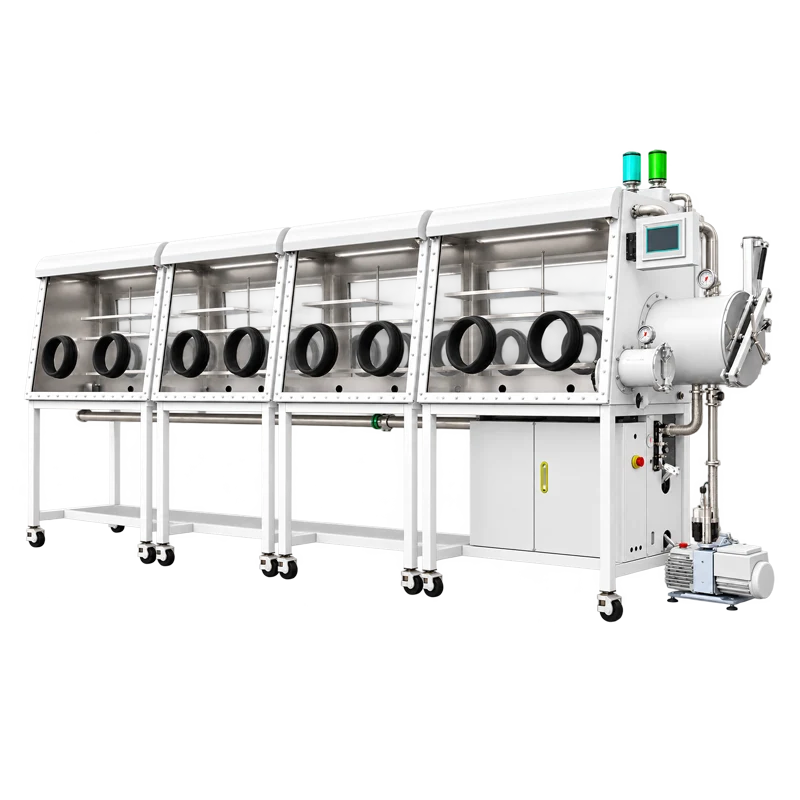
Not every glove box has a continuous purifier loop. A vacuum glove box uses evacuation and inert-gas backfill to create a controlled environment, while an acrylic glove box may be an isolation, micro-vacuum, or vacuum type depending on its configuration. In those cases, an analyzer can still be useful for spot verification if the box has a suitable sampling point and the sample conditions match the instrument. It should not be described as if it were continuously purifying the box or as if one reading were continuously representative.
How a trace oxygen measurement is produced
Although the external appearance is simple, a reading is the result of a chain: sample port, tubing, filtration or conditioning, flow and pressure control, sensor, electronics, display or transmission, and return or exhaust. Each part can add error. A long sample line increases transport lag. A filter can protect the sensor but may also slow the response. A pressure regulator or flow restrictor that is unsuitable for trace oxygen can introduce contamination or make the reading unstable. The manufacturer's specified sample conditions are part of the measurement, not an accessory detail.
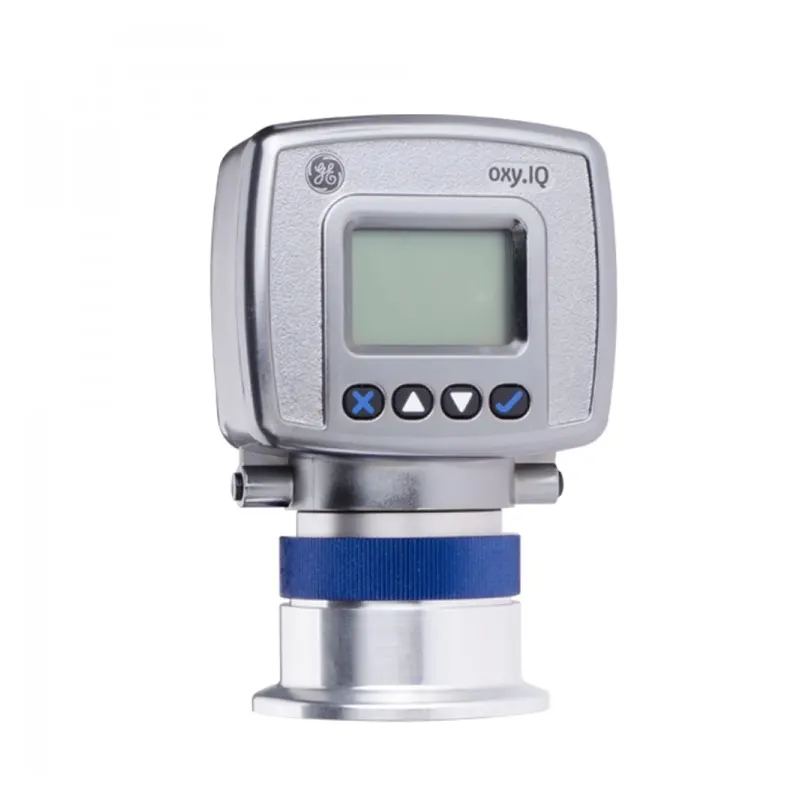
Trace oxygen analyzers use different sensing principles. Some use electrochemical cells, some use high-temperature zirconia sensors, and others use alternative low-level oxygen methods. Each principle has different cross-sensitivity, warm-up behavior, service needs, and suitability for a given gas stream. The available product information for this accessory does not list the sensing principle or performance values, so those details should be confirmed against the current datasheet rather than inferred from the product name.
Calibration is central to a credible trace measurement. Sensor output can drift, and a displayed number is not automatically an accurate oxygen concentration. A meaningful calibration uses zero and span gases appropriate to the analyzer and the intended range, following the manufacturer's procedure. Ambient air is not a zero gas. The span gas should be compatible with the sensor and relevant to the operating range. Calibration gas must be introduced in a way that does not contaminate the box or expose the sample to an unintended gas. The exact gases, warm-up time, and interval belong in the instrument instructions; there is no universal schedule.
The analyzer may provide a local display, alarm contacts, analog or digital outputs, or data logging. If the signal is used in control or records, verify how it behaves during warm-up, calibration, fault, and power loss. A reading that is not flagged during calibration can be mistaken for a process value.
Which configurations and installation choices matter?
The supplied product entry presents one accessory item, the Glove Box Trace Oxygen Analyzer, rather than a list of model variants. It is therefore not appropriate to invent a family of ranges or a set of model names. The meaningful choices are those surrounding the measurement.
Continuous monitoring or periodic checks
Continuous in-line monitoring shows trends and can support alarms. Periodic checks with a valved sample point can be sufficient for occasional verification. Continuous monitoring places more demands on sample conditioning, calibration access, and data handling. Periodic checks place more demands on operator procedure and record keeping.
Single-point or multi-point sampling
Multi-point sampling with selector valves can survey several locations, but each line adds purge time and possible carryover. The sampling sequence must be long enough for the reading to stabilize. A single point should be chosen where mixing is good and where the result is meaningful for the work being done.
Local display or remote signal
Some installations need a local readout; others need a signal in a control cabinet, data logger, or alarm system. Verify the available outputs and how the signal is handled during calibration, fault, or power loss.
Box type and sample compatibility
Purification boxes, vacuum boxes, and acrylic boxes differ in pressure regime, port options, and materials. An analyzer that suits one may not suit another. For acrylic boxes, solvent compatibility and port sealing are particularly important. For vacuum boxes, the sampling arrangement must not compromise the vacuum or create an unintended leak path.
Specifications to verify before integration
The following checklist is more useful than a single headline number. None of these items can be assumed from the product name.
| Area to check | Question to answer | Why it matters |
|---|---|---|
| Range and lower detection limit | Does the analyzer cover the oxygen levels expected in normal operation and in an upset, including the lowest level to be reported? | “Trace” is not a range; a display that cannot resolve the operating level is not useful. |
| Accuracy, resolution, repeatability, and drift | Which value is guaranteed, under which conditions, and over what period? | Resolution is the smallest displayed change; accuracy is closeness to a reference. They are not interchangeable. |
| Response time and sample lag | What is the sensor response, and how much additional delay comes from the sample line, filter, and flow? | A fast sensor can still produce a slow system reading. |
| Calibration | Which zero and span gases are required, how often, and how is traceability documented? | Calibration is part of measurement quality, not an optional service item. |
| Sample conditions | What pressure, flow, temperature, moisture, solvent, corrosive gas, and particle exposure are acceptable? | Incompatible sample conditions can bias the reading or damage the sensor. |
| Wetted materials | Are the sample path and seals compatible with the box atmosphere and any process solvents? | Material compatibility affects both service life and contamination risk. |
| Interfaces | What display, alarm, analog, digital, data, and power connections are available? | The measurement must fit the way the box is operated and recorded. |
| Installation and leak integrity | What port type, isolation, return or exhaust, and sealing method are required? | Adding a sampling path creates a potential leak path and must be checked. |
| Maintenance | What sensor life, replacement, cleaning, and service access should be planned? | A trace analyzer is a maintained instrument, not a fit-and-forget device. |
Where a trace oxygen analyzer is suitable—and where it is not
Within those limits, a trace oxygen analyzer is useful wherever oxygen level is a process variable and a direct reading helps decisions. Examples include lithium metal and solid-state battery research, perovskite and OLED development, semiconductor and thin-film work, air-sensitive chemistry, and advanced materials or additive manufacturing steps that require inert handling. In these settings, the analyzer supports atmosphere verification, purge checks, trend monitoring, and troubleshooting.
It is also useful during commissioning and maintenance. A baseline reading and the response to a door opening or a transfer can show whether the box returns to its intended condition. The analyzer cannot substitute for the procedure that restores that condition.
The limits are significant. The instrument does not remove oxygen or water, does not prove that a box is leak-free, and does not guarantee that every workstation is protected. A particle filter, including a HEPA filter, addresses particles; it does not remove oxygen or water. Solvent adsorbers and moisture traps serve different purposes as well. A reading from one sampling point is evidence about that sample, not a certificate for the whole enclosure.
The analyzer also does not make a gas inert for every sample. Material compatibility and the actual gas composition remain separate questions. Solvent vapors, corrosive gases, high humidity, particles, and oxygen-reactive compounds may require sample conditioning or a different sensor arrangement. The analyzer should not be treated as a personnel safety monitor, an area oxygen monitor, or the sole basis for flammable-atmosphere control unless it is specifically designed and rated for that role.
It is equally important not to confuse oxygen monitoring with sterility, cleanroom classification, or biological safety. Those are different requirements with different verification methods.
How to select and integrate an analyzer
Selection starts with the decision the reading must support, not with a catalog number. A practical sequence is:
- Define the measurement objective. Decide whether the analyzer is for continuous trend monitoring, alarms, post-purge verification, maintenance checks, or records. Define the sampling point and the acceptable delay before a change is visible.
- Characterize the sample gas. List the expected oxygen range, moisture level, solvents, corrosive components, pressure, flow, particles, and temperature. Check wetted materials and sample conditioning against that list.
- Choose the location and sampling arrangement. Prefer a representative point with a short, purgable path and good access for calibration. Confirm port type, isolation, return or exhaust, and leak integrity. Do not assume that an existing port fits the analyzer.
- Verify analyzer performance. Confirm range, lower detection limit, accuracy, resolution, response time, drift, calibration method, outputs, and documentation. Treat “trace” as a description of the application, not as a specification.
- Plan calibration and maintenance. Identify the required gases, regulators, vent or return path, training, intervals, and spare parts. Calibration gas handling must not contaminate the box.
- Confirm electrical and data integration. Check power, signal type, alarm behavior, control logic, and records. A reading without a valid or invalid status can mislead users during calibration or fault conditions.
- Commission and document the installation. Check the sampling path for leaks, establish a baseline with a suitable reference, record the settings, and train users on what the reading does and does not prove.
Before ordering, confirm compatibility with the host box or purifier. The current Glove Box Trace Oxygen Analyzer product page is the starting point for model-specific information; final details should be checked against the datasheet and the actual installation. TENCAN Glove Box Systems can confirm the available configuration, but a catalog listing alone is not a compatibility approval.
Frequently asked questions
Does a trace oxygen analyzer remove oxygen?
No. It measures oxygen at the sample point. Removal is performed by a purification system, purge, or gas replacement. A low reading is evidence about the sampled atmosphere, not a treatment action.
Can it control water content?
No. Oxygen and moisture are separate measurements. A water-sensitive process needs a moisture analyzer or dew-point measurement in addition to oxygen monitoring.
Is resolution the same as accuracy?
No. Resolution is the smallest change the display can show. Accuracy describes how close the reading is to a reference value. A highly resolved display can still be inaccurate if the analyzer is uncalibrated or affected by its sample conditions.
Can one unit monitor several glove boxes?
It may be possible with a suitable multi-point sampling system, but each line and valve adds purge time, carryover risk, and installation complexity. The analyzer must suit each sample condition, and isolated boxes cannot be represented by one simultaneous reading.
What should be checked before adding one to an existing box?
Check the sampling port, pressure and flow conditions, wetted materials, available space, power, signal and alarm requirements, calibration access, and leak integrity. Confirm the integration with the box and purifier supplier rather than assuming compatibility from separate product listings.
