
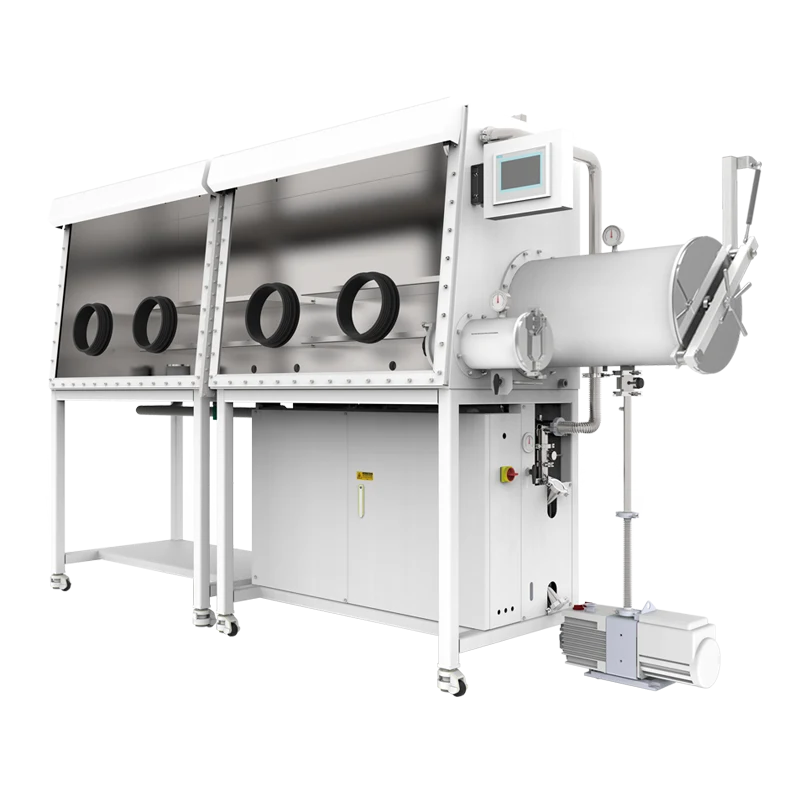
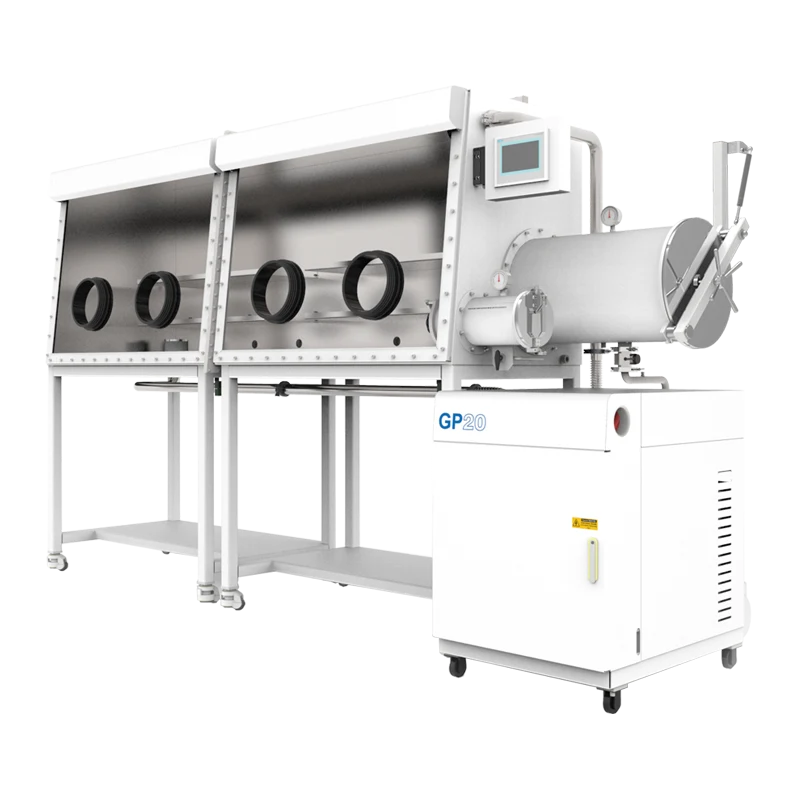
A two-station single-sided split-type purifying glove box is a work enclosure for handling air- or moisture-sensitive materials in a controlled inert atmosphere. It brings together three configuration choices: a single-sided operator interface, two working positions, and a split layout in which the work chamber and the gas-purification and control section are separate but connected. The purification loop circulates the box atmosphere through media that remove oxygen and moisture, then returns it to the chamber. The result is not simply a sealed box filled with nitrogen; it is a managed environment whose pressure, circulation, impurity levels, and transfer procedures must work together. The current TENCAN product, the Two-Station Single-Sided Split-Type Glove Box with Gas Purification System, is built around this combination.
What does a two-station purifying glove box do?
The primary job is to keep the working atmosphere separated from the surrounding room while giving operators gloved access to samples and tools. The box provides a physical barrier through its walls, window, gloves, and sealed ports, and it provides a gas-management system that opposes the slow inward leakage of moisture and oxygen. In a purifying design, the atmosphere is not just replaced once; it is continuously cleaned and recirculated. That distinction matters because a box that is only purged with inert gas will drift once the gas supply stops, whereas a closed-loop purifying box is intended to hold and restore the atmosphere during normal work.
Two stations mean two operating positions within the same enclosure or connected work area; single-sided means the operator works from one face. The precise dimensions, glove-port arrangement, and whether the stations share one antechamber must be confirmed from the current arrangement drawing. A split-type design separates the purification module, including columns, blower, valves, sensors, and controls, from the main work chamber. This can reduce intrusion into the work zone, simplify service access, and allow the chamber and utility section to be positioned separately. It also adds interconnecting pipework and joints, so installation quality becomes more important, not less.
How does the gas-purification loop work?
Circulation and impurity removal
During normal operation, a blower moves gas from the work chamber through the purification circuit and back. The circuit typically contains one or more columns for moisture and oxygen removal, particulate filters, a heat exchanger or temperature-control section, and instruments for the parameters the design monitors. Oxygen is commonly removed by a reactive medium, while moisture is adsorbed by a regenerable desiccant or similar material. The exact media, sequence, and operating conditions are specific to the purification system; they should not be inferred from a generic description or from another manufacturer's design.
The loop is a treatment path, not a storage path. Its performance depends on circulation rate, the amount of exposed material, door-opening frequency, leaks, and the condition of the media. A purifier that is working correctly can still show a slow recovery after a large or wet load enters the box. That is a capacity and procedure issue, not evidence that the analyzer is wrong. The analyzer measures the atmosphere; it does not purify it. Resolution, accuracy, calibration, and sensor location all affect what a displayed value means.
Regeneration, pressure, and transfer
Purification media have finite capacity. They must be regenerated or replaced according to the manufacturer's procedure, which may involve heat, vacuum, and a sweep gas. Regeneration is not the same as purging the box, and it should not be improvised. The box also needs pressure management. Excessive positive pressure can stress gloves and seals; negative pressure can draw room air inward. The acceptable range and control method belong to the specific system.
Material transfer is another part of atmosphere control. An antechamber allows an object to be introduced through a smaller volume that can be evacuated and refilled, rather than opening the main chamber directly to the room. The effectiveness of the transfer depends on chamber volume, pump capacity, purge procedure, and the item's surface area. Porous, wet, or outgassing items are harder to introduce than a clean metal tool. For the same reason, a glove box is not a substitute for drying a wet sample before entry.
Why do split-type and single-sided layouts matter?
Split-type construction is a layout decision with engineering consequences. Keeping the purification cabinet separate can free bench or floor space around the work chamber, reduce heat and vibration reaching the working area, and make columns and valves easier to service without opening the box. The cost is a longer gas path, more connections, and a larger overall installation footprint. The connecting lines must be routed, supported, leak-tested, and protected from accidental damage. A compact integrated box can be simpler to install, but service access may be tighter and the utility section may sit closer to the operator.
Single-sided access suits a bench-facing workflow and can give a clear view of both stations, but it limits simultaneous access to one face. Two stations can support a sequence, such as preparation at one position and inspection at another, or two operators working together. Unless the box is specifically partitioned, the stations normally share one atmosphere and one purification loop. That shared atmosphere is efficient, but it also means that a solvent spill, a hot process, or a heavily outgassing sample at one station can affect the other. Throughput should be judged by the whole workflow, including transfer time and recovery after opening, not by the number of stations alone.
Which specifications should you check?
Atmosphere performance and monitoring
Do not select a purifying glove box from a single oxygen or moisture number. Ask how the performance figure was defined: sensor type and location, calibration, stabilization time, load in the box, and whether the value was a one-time best result or a maintained condition. Check whether the system reports both oxygen and moisture, how often sensors are calibrated, and what happens during regeneration or a power interruption. A displayed resolution is not the same as measurement accuracy, and a trace-level sensor can be unsuitable for a high-humidity start-up. The right question is not only what the lowest number is, but what level this configuration can hold during the actual process, and how that level is verified.
Workspace, access, and transfer
Compare usable space per station, not external cabinet size. Check glove-port diameter and spacing, window height, shelf position, internal clearances, and the reachable volume from each port. For the transfer path, confirm antechamber volume, door size, available vacuum, and purge connections where an antechamber is fitted. If large or heavy items must enter, the antechamber and handling method may set the practical limit. For a split system, also check the length and routing of the interconnecting piping, service clearance around the purification module, and whether future columns or accessories can be reached without dismantling the work chamber.
Sealing, materials, and connections
Gloves, window gaskets, door seals, valve seats, and feedthroughs are part of the atmosphere boundary. Their material compatibility with solvents, acids, cleaning agents, and process vapors matters as much as their initial leak performance. Confirm the type and size of electrical, signal, gas, and vacuum feedthroughs, plus any KF or other flanged connections. If a chiller or other thermal utility is used, check tubing, coolant compatibility, and whether lines pass through the box wall in a sealed manner. Leak testing and commissioning should be defined before installation, because a split system has more joints to verify than a single integrated cabinet.
Where is it suitable, and what are its limits?
It is a reasonable fit for work that needs a maintained low-oxygen and low-moisture environment: air-sensitive chemical handling, lithium and solid-state battery materials, perovskite and OLED device preparation, semiconductor precursors, catalyst and advanced-material research, and some additive-manufacturing post-processing. The two-station layout can be useful when a process has distinct preparation and inspection steps, or when two operators need to share a controlled atmosphere. The split layout is helpful where the purification equipment should be kept out of the immediate work zone or serviced from a separate position.
Those applications do not make the box universal. Inert gas is not automatically inert toward every sample, and a purifying loop is not a general chemical scrubber. Solvent vapors may require dedicated adsorption or other control; HEPA filtration captures particles but does not remove water, oxygen, or solvent vapor. A glove box is not a sterile isolator, a cleanroom classification, a fume hood, or an explosion-protection measure unless the specific system has been designed and verified for that duty. High heat loads, corrosive vapors, reactive dusts, and large solvent volumes need an engineering review, not just a larger purifier. Shared stations also create a cross-contamination path that should be managed by procedure or by separation.
How should you select and integrate it?
Start with the process rather than the cabinet. List the materials, maximum sample mass, tools, solvents, heat sources, required atmosphere, working duration, and transfer frequency. Then map the workflow: where samples enter, where they are prepared, where they are measured, and how waste or tools leave. This map determines whether two stations are useful, whether a split layout saves space or creates a routing problem, and how much antechamber capacity is needed.
Ask for a current configuration drawing and a clear scope list: work chamber, purification module, gloves, antechamber, pump, valves, analyzers, feedthroughs, controls, and utilities. Confirm who supplies gas, vacuum, power, exhaust, cooling, and network connections. Ask how leak testing, atmosphere testing, regeneration, and operator training will be handled. For a split-type purifying box, review the interconnecting piping and service access before the floor layout is fixed. A lower purchase price is not useful if the installation cannot be serviced or if the transfer path becomes the bottleneck. The two-station split-type purifying glove box product page gives the current starting configuration; final scope should be confirmed against the quoted system.
When does a recirculating water chiller belong in the system?
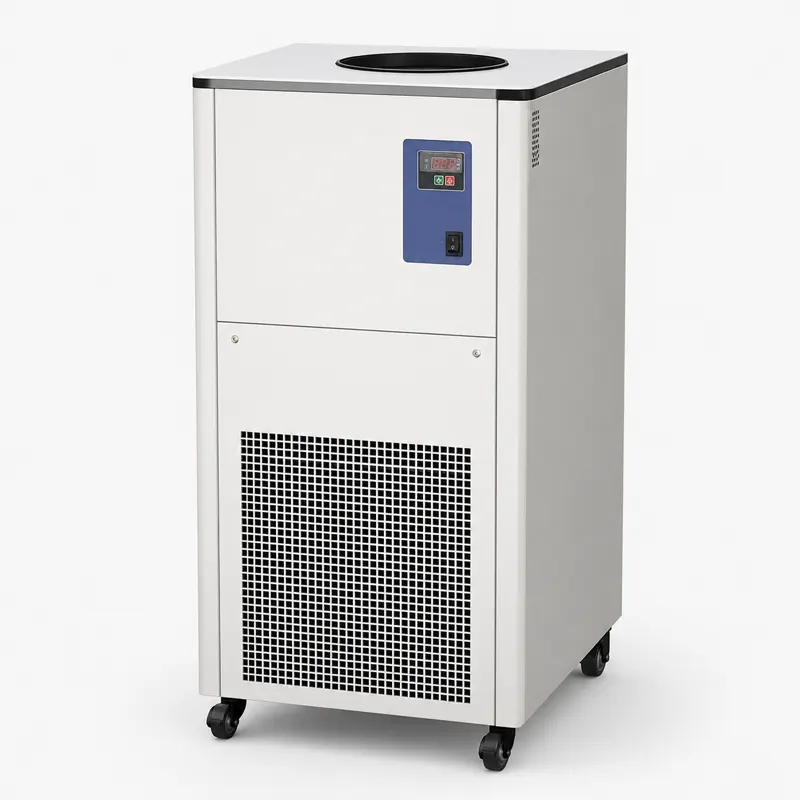
A precision recirculating water chiller is a thermal utility, not an atmosphere-control device. It can be relevant when a process, analytical instrument, or other equipment associated with the glove box needs stable cooling, but the chiller's heat-removal capacity, temperature range, coolant, flow, pressure, tubing, fittings, and control interface must match the actual load. The Precision Recirculating Water Chiller listed in the accessory range should be evaluated as part of that thermal design, not assumed to be necessary for every purifying glove box. Adding a chiller does not lower oxygen or moisture, and it does not replace purification media, leak repair, or a proper transfer procedure. If cooling lines cross the box boundary, the sealed entry and coolant compatibility need explicit review.
Common questions about split-type purifying glove boxes
Does this glove box include gas purification?
The product name specifies a gas purification system, but the quotation and configuration drawing define what is included: column type, blower, controls, analyzers, regeneration equipment, and spares. Confirm those items rather than relying on the category name alone.
Can the two stations be used independently?
Only if the design provides separate compartments or isolation. In a shared-atmosphere box, both stations draw on the same purification loop and are affected by the same pressure and contamination events. Ask for the partition and valve arrangement if independence is required.
Can I add a chiller after installation?
That depends on available space, utilities, sealed feedthroughs, and whether the load can be connected safely. A chiller should be sized from the actual heat load and coolant requirements. It is not a plug-in accessory that can be added to any box without checking interfaces.
Does the purifier remove solvent vapors?
Water and oxygen removal media are selected for those duties; they are not a general solvent scrubber. Solvent adsorption, ventilation, or process changes may be needed, and the compatibility of gloves and seals with the solvent must also be checked.
What should be confirmed before purchase?
Confirm the atmosphere target and test method, usable space, transfer path, leak-test criteria, utility requirements, regeneration procedure, analyzer calibration, service access, and the exact boundary between supplied and site-provided equipment. Those details matter more than a generic capacity claim.
