
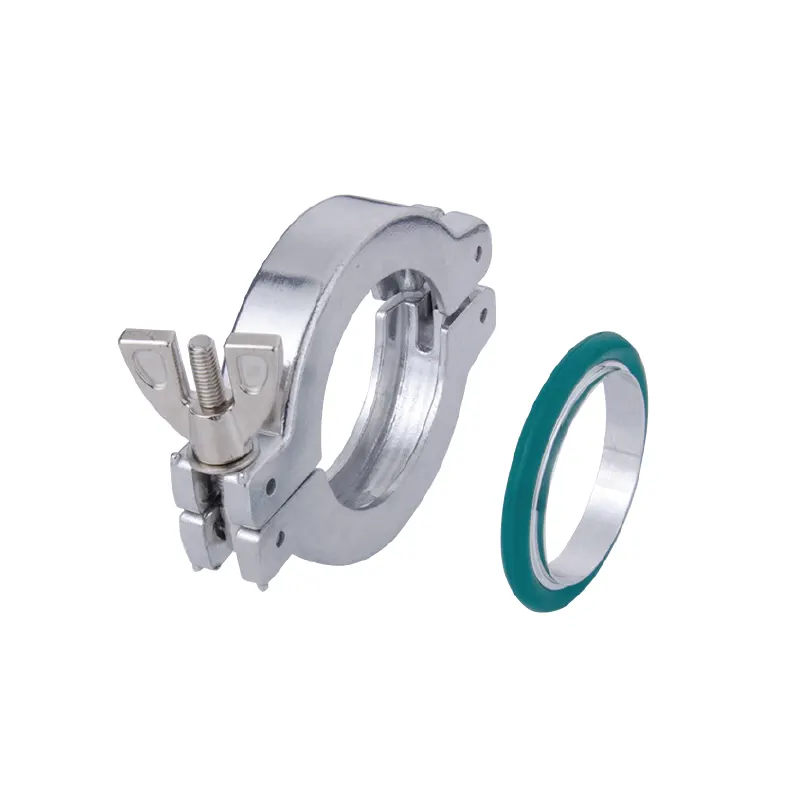
A KF vacuum clamp is a reusable fastener that pulls two KF flange faces together so a centering ring and elastomer seal can close a demountable vacuum joint. On a glove box, it sits on the vacuum side—at a pump inlet, gauge port, transfer-chamber connection, or other service point—and solves a practical problem: how to make a joint that can be assembled, opened, and resealed without cutting or welding tubing. It does not create vacuum, remove oxygen or water, or purify gas.
What does a KF vacuum clamp do in a glove box system?
The clamp is an accessory, not a subsystem. It belongs to the mechanical boundary between the controlled environment and the equipment that maintains it. TENCAN's KF Vacuum Clamp is listed in the glove-box accessories category, which is the right place to think about it: its job is to secure a connection while the glove box, pump, and purification system perform their own functions.
A KF joint is a stack: flange face, centering ring with an O-ring, second flange face, and clamp around the outside. The clamp does not sit in the gas path. It squeezes the stack. The O-ring provides the seal, the centering ring positions it and keeps it from being pulled into the bore, and the flange faces provide the flat surfaces against which the seal is compressed. If any part of that stack is missing or mismatched, a clamp alone cannot make a leak-tight joint.
In glove box service, a KF clamp may be used where a vacuum line, gauge, small transfer chamber, or service port has to be disconnected for maintenance. That demountability is the main advantage. The trade-off is that every opening and reseating operation depends on the condition of the seal and the cleanliness of the flange faces, not only on the clamp.
How the clamp works: compression, alignment, and the sealing element
A KF clamp has a circular band that engages the outside rims of two mating flanges. A screw, wing nut, or toggle mechanism shortens the band and pulls the flange rims toward one another. That axial movement compresses the elastomer seal. The clamp converts tightening force into seal compression. Too little compression leaves a leak path; too much can distort the seal, damage the centering ring, or make the joint difficult to open.
Alignment matters as much as force. The two flange faces should meet squarely, and the centering ring should sit fully in its recess. If the flanges are cocked, the clamp can pull them together unevenly and compress one side of the O-ring more than the other. A slow leak that appears only under vacuum is a common result. Bring the flanges together by hand, fit the centering ring and seal, position the clamp, and tighten evenly. The clamp should not be used to pull a misaligned pipe or a heavy component into place.
The sealing element is the part that actually blocks gas. A clamp that is mechanically strong but paired with the wrong elastomer may still fail. Vacuum grease is not a substitute for a correct seal, and a damaged O-ring should be replaced rather than over-tightened. For glove box work, the seal material also has to be compatible with the gases and solvent vapors that may contact it. That is a materials question, not a clamping-force question.
Which KF clamp configurations matter?
KF clamps are not a single item. The main variables are nominal flange size, flange profile, clamp style, clamp material, and whether the clamp is supplied alone or with a sealing kit. The TENCAN product page should be checked for the exact configuration offered; the name “KF Vacuum Clamp” does not by itself establish the size or the included parts.
Flange size and profile
KF connections are commonly identified by nominal sizes such as KF10, KF16, KF25, KF40, and KF50. A clamp for one nominal size will not correctly seat on another. The flange profile also matters: two parts may both be called KF but have different rim shapes or dimensions. Measure the flange outside diameter, confirm the nominal size, and compare the clamp's intended flange range. Do not choose by hose or tube diameter alone.
Clamp style and material
Clamps may be hand-tightened with a wing nut, secured with a bolt, or designed for quicker operation. Aluminum clamps are light and convenient for frequent opening; stainless steel clamps offer more corrosion resistance and mechanical robustness in some environments. The trade-off is weight, cost, and galvanic or chemical compatibility with the surrounding hardware. Neither material removes the need for a compatible seal. For a glove box, the clamp should also be easy to operate without damaging gloves or introducing sharp edges into the working area.
What is included
Some clamps are sold as the clamp only. Others are supplied with a centering ring and O-ring. The difference matters because the clamp is not a complete sealing assembly on its own. Confirm whether the seal is included, what elastomer it is made from, and whether spare seals are available. If the clamp arrives without a centering ring, the user must select one that matches both the flange size and the intended gas and temperature range.
Which specifications should you check before ordering?
Because a KF clamp is a mechanical accessory, the useful specifications describe fit, sealing, and service conditions—not powder throughput, milling energy, or other unrelated equipment metrics. The first check is dimensional. The second is the seal. The third is the operating envelope.
- Nominal size and flange compatibility: confirm that the clamp matches the actual flange diameter and rim profile.
- Seal material and temperature range: verify compatibility with the process gas, solvent vapors, and cleaning agents.
- Pressure and vacuum service: establish whether the joint is for vacuum only or also for positive pressure.
- Clamp material and finish: check corrosion resistance and compatibility with the surrounding hardware.
- Included components: confirm whether a centering ring, O-ring, or spare seal is supplied.
- Operating access: make sure the clamp can be reached and tightened without disturbing adjacent lines.
- Load support: do not use the clamp as the only support for a pump, trap, or long pipe run.
- Leak-test method: plan how the assembled joint will be checked before the system is returned to service.
A clamp may be described as suitable for vacuum service, but the joint's actual vacuum performance depends on the seal, surface finish, alignment, and leak rate of the assembled connection. Do not read a pump's ultimate vacuum or a glove box's oxygen specification as the pressure rating of the clamp. Those are different quantities.
Where a KF clamp is suitable—and where it is not
A KF clamp is suitable wherever a demountable KF joint is part of the vacuum-side architecture: pump inlet lines, gauge connections, small transfer chambers, and service ports that are opened for maintenance. It is a good choice when the user needs to break and remake a connection regularly, because the clamp is reusable and the seal can be replaced. It is less suitable when the joint must be welded, when the flange standard is not KF, or when the connection must carry a heavy load without independent support.
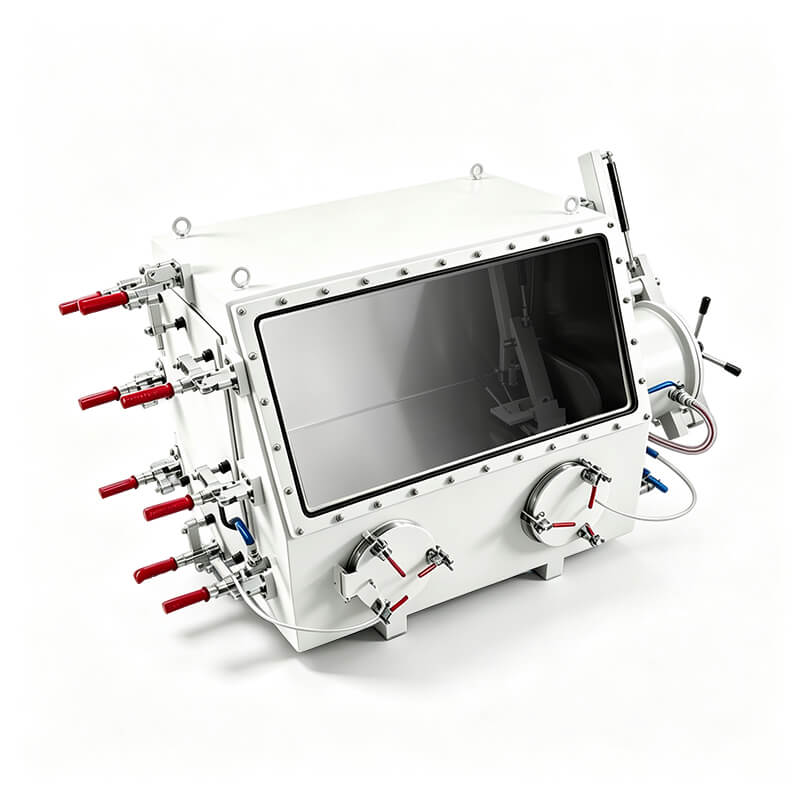
The GBV-1 stainless steel vacuum glove box is an example of a system whose vacuum and gas-exchange functions depend on sealed connections rather than on the clamp alone. The existence of a vacuum glove box does not prove that its ports are KF ports, and a KF clamp should be selected only after the actual port geometry is confirmed. Adding an adapter to force a KF clamp onto a non-KF port creates extra joints and potential leak paths; sometimes the better answer is a different connection type.
- A clamp is not a purification device and cannot lower oxygen or moisture levels.
- A clamp is not a seal by itself; it needs the correct centering ring and O-ring.
- A clamp should not be used on positive-pressure gas lines unless its rating and the complete joint design allow it.
- An elastomer seal may be unsuitable for aggressive solvents, high temperatures, or repeated bakeout.
- A clamp should not carry structural loads or compensate for poor pipe alignment.
- A clamp is not a substitute for leak testing, maintenance, or a proper vacuum procedure.
How to select and integrate a KF clamp
Start with the port, not the clamp. Identify the flange standard, nominal size, and rim profile on the glove box or vacuum line. Then confirm the seal material against the actual gases and cleaning agents. Only after those checks should the clamp style and material be selected. A clamp that is convenient to use but incompatible with the seal or the port is not a valid choice.
- Measure the mating flange and confirm that both sides are the same KF size and profile.
- Select a centering ring and O-ring suitable for the gas, temperature, and vacuum level.
- Confirm whether the clamp is supplied alone or as a complete sealing set.
- Check access for tightening and for later seal replacement.
- Support pumps and long lines independently so the clamp carries no bending load.
- Assemble, tighten evenly, and leak-test the joint before introducing sensitive material.
Integration is usually straightforward when the port is already KF. The difficulty appears when the user tries to adapt a non-KF port. A single adapter may seem harmless, but it adds two sealing interfaces, changes the internal volume, and may create a crevice that is difficult to clean. If the glove box port is threaded, welded, or of another flange standard, verify the intended adapter and sealing method rather than assuming that a KF clamp can be made to fit.
KF clamp, CF, and threaded connections: a practical comparison
KF is one option among several. A CF flange uses a metal gasket and bolts and is chosen when lower outgassing and higher vacuum performance are needed; it is less convenient to open repeatedly. A threaded connection can be compact and inexpensive, but it may not align as consistently and can be damaged by repeated assembly. A KF clamp sits between these extremes: quick to open, dependent on an elastomer seal, and well suited to rough or medium vacuum connections and routine service. The right choice follows the required vacuum level, bakeout temperature, gas compatibility, and how often the joint will be opened.
Frequently asked questions
Does a KF vacuum clamp include the O-ring?
Not necessarily. Some clamps are supplied as the metal clamp only; the centering ring and O-ring may be separate. Check the product listing or ask the supplier before ordering, because the clamp cannot seal without a compatible seal assembly.
Can a KF clamp lower the oxygen or moisture level inside a glove box?
No. The clamp only holds a joint together. Oxygen and moisture control comes from the glove box's gas purification, vacuum, and gas-exchange functions, not from the clamp. A leaking KF joint can make atmosphere control harder, but a tight joint does not purify the gas.
Can I connect any glove box to a pump with a KF clamp?
No. The glove box port and the pump-side connection must both use compatible KF flanges. Many glove boxes use other port types, and adapters add sealing interfaces. Confirm the actual port geometry before selecting the clamp.
How tight should a KF clamp be?
Follow the manufacturer's instructions for the specific clamp and seal. The goal is even compression of the O-ring, not maximum force. Over-tightening can damage the seal or centering ring, while under-tightening can leave a leak. A leak test is the practical check.
