
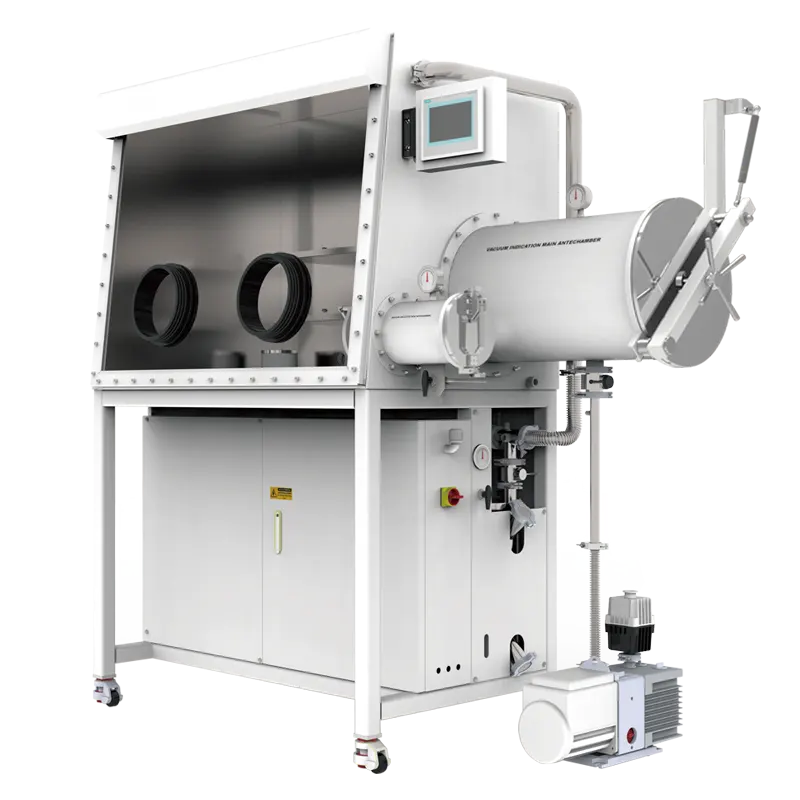
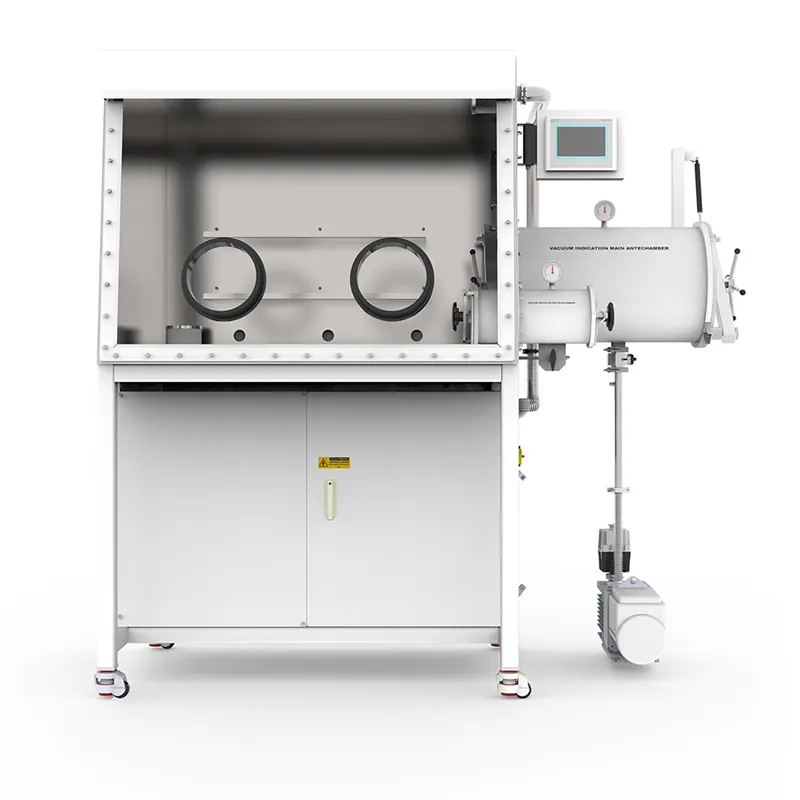
A single-station, single-sided glove box with a gas purification system is a sealed workspace with one operator station and one working face, connected to a closed-loop atmosphere purifier. It sits between the user and an oxygen- or moisture-sensitive sample: gloves provide manual access, the enclosure isolates the work volume, and the purification loop circulates internal gas through media that remove contaminants. Its purpose is not merely to fill a box with inert gas, but to maintain and monitor a controlled atmosphere during weighing, assembly, testing, or storage.
What the system does and where it sits in the workflow
The single-station single-sided glove box with gas purification is a complete workstation rather than a collection of separate components. The box provides the sealed volume; the gloves provide controlled manual access; the purifier conditions the circulating atmosphere; and the monitoring instruments report the condition of that atmosphere. In a laboratory workflow, it is the place where a sample is transferred from a protected container, handled with tools, and then passed out again without being exposed to room air for the entire procedure.
That integration matters because each part affects the others. A large or poorly sealed enclosure loads the purifier. A permeable or damaged glove creates a continuous contaminant path. A purifier that is not matched to the box volume and leak rate may run continuously without reaching the target condition. Monitoring shows whether the system is holding, but it does not fix a leak or replace purification. The practical goal is a balanced system: adequate access, a sealed enclosure, a matched purification loop, and calibrated instrumentation.
How a purification glove box works
The sealed workspace and glove interface
The enclosure is the first barrier. Its panels, doors, ports, and seals form a boundary between the controlled atmosphere and the room. The quality of that boundary is not determined by the thickness of a single panel or by the appearance of the frame; it depends on the complete assembly, including gaskets, flanges, gloves, and any feedthrough or transfer opening. A box that is difficult to seal, or that is opened frequently, places a higher load on the purification system.
Gloves are the routine manual interface. Their material, thickness, and cuff design affect dexterity, permeation, and compatibility with solvents, samples, and cleaning agents. Glove ports and cuffs must seal reliably, and damaged gloves should be replaced before they become a contamination path. In a single-sided box, the operator's reach and visibility are set by the glove-port layout, so the position of the ports should be judged against the tools and samples that will actually be handled.
The closed purification loop
In a closed-loop purification system, gas is drawn from the box, passed through purification columns, and returned. The columns may use media for water removal and oxygen removal, and some designs include a catalyst. The exact media, capacity, and regeneration procedure are configuration-specific; they belong in the manual and the quotation, not in a generic assumption. The loop is not a one-pass gas flush. It continuously treats the same atmosphere while the box remains closed.
Leak tightness is central because purification is a continuous balancing act. As air enters, the purifier spends capacity removing the incoming oxygen and water. A well-sealed box with a matched purifier is more stable than a leaky box with a larger purifier.
Some systems distinguish working gas, control gas, and regeneration gas. Do not assume a single supply can serve all three functions. Gas quality, supply pressure, connection size, and regeneration requirements should be confirmed as part of the installation plan. If regeneration is required, the procedure and the conditions under which it is performed must follow the manufacturer's instructions; it is not an ordinary operating step to improvise.
Monitoring is separate from purification
Oxygen and moisture analyzers measure the atmosphere; they do not remove contaminants. Readings depend on sensor location, sample flow, response time, and calibration. A fine display resolution is not the same as measurement accuracy. Readings can differ between a sensor in the loop and one in a quiet corner of the chamber. Ask where the sample is drawn, how the sensor is calibrated, and whether the reading represents the operator's working zone.
Working pressure, antechamber vacuum, pump ultimate vacuum, leak rate, oxygen content, and moisture content are different quantities. Quote each with units and with the object it describes. A pump's ultimate vacuum is not the box's working pressure, and an antechamber vacuum level is not a purification guarantee. If a value is unclear, ask for the test condition rather than assuming.
What the single-station, single-sided layout changes
The single-station format provides one work zone; the single-sided format provides one operator face. That arrangement can be efficient for a researcher working alone, for a bench with limited depth, or for a process that needs a dedicated controlled atmosphere rather than a shared walk-in room. A smaller working volume can be easier to purge and condition than a multi-station box, provided the enclosure is sealed and the purifier is correctly sized. It also keeps tools and samples within a short reach, which reduces awkward movements inside the gloves.
The trade-offs are equally practical. One face is not a collaboration station. It is not designed for two simultaneous operators, and parallel experiments may require a second station or a scheduled workflow. The single face also constrains how the box can be positioned relative to walls, services, and adjacent equipment. Access for maintenance, glove replacement, and purifier service should be checked before the unit is placed. If the largest item in the process does not fit through the available transfer path, the layout is unsuitable regardless of internal volume.
Internal volume is only one part of usable space. Height, depth, port position, and the route for tools and cables matter. The single station should be judged against the actual work: the largest sample, the tools used to manipulate it, the time the gloves must remain in place, and the number of transfers per session. A compact box that is opened constantly may perform less consistently than a slightly larger box with a well-planned transfer routine.
Which specifications should you check?
The product name describes architecture, not a guaranteed atmosphere. The following checks turn the name into a verifiable configuration.
- Working space and access. Confirm internal dimensions, usable height, glove-port position, and the size of the largest item that can be transferred. If an antechamber is part of the configuration, check its volume, door clearance, and vacuum function separately.
- Glove and seal compatibility. The glove material, thickness, cuff size, and port sealing method should suit the samples, solvents, and cleaning agents. Gloves are consumables and a contamination path if damaged; spare gloves and a replacement procedure belong in the operating plan.
- Purification capacity and duty. Ask how the purifier is matched to the box volume and expected leak rate, what media are used if disclosed, and what regeneration or replacement involves. The purifier is part of a system; it is not a standalone gas generator.
- Monitoring performance. Check the measurement range, accuracy, calibration method, sample location, and response time for oxygen and moisture. Resolution alone is not enough. The instruments should be appropriate for the target condition, not merely for a display specification.
- Leak integrity and pressure ratings. Review the leak-test method, acceptance criterion, working pressure, antechamber vacuum rating, and pump compatibility as separate items. Do not infer one from another.
- Utilities and integration. Confirm electrical supply, gas supply, exhaust or venting, heat load, and space for service. Any electrical feedthrough, sensor port, or KF flange must match the enclosure and the connected equipment.
- Particle and solvent management. HEPA filtration captures particles, not oxygen, water, or solvent vapor. A solvent adsorber can help with vapors, but it does not replace water and oxygen purification. Each function needs its own justification.
Where it is suitable, and what it does not do
Typical matches include lithium metal and solid-state battery component assembly, perovskite and OLED device work, semiconductor and air-sensitive chemistry, additive manufacturing powder handling and post-processing, and general materials research where oxygen or moisture changes the sample. These examples are not claims that every material is compatible with every working gas. The sample, gas, glove material, and purifier media must be considered together. A reactive gas, corrosive vapor, high heat load, or solvent that attacks seals may require a different configuration or engineering review.
An inert-atmosphere glove box is not a sterile enclosure, a cleanroom classification, a biological safety cabinet, or a substitute for a fume hood. It does not automatically provide hazardous-material containment for every substance. It also does not guarantee that a particular sample will remain unchanged; the working gas itself may react with some materials. Those are process-safety and compatibility questions to settle before the box is selected.
Adding electrical measurements with a KF40 feedthrough
Many controlled-atmosphere tasks are not only about handling; they also involve measurement. The KF40 Electrical Test Lead Feedthrough is an accessory for passing electrical test leads through a KF40 flange so that a device, sensor, or sample inside the box can connect to instruments outside. It is useful when a test must be performed without opening the workspace for every connection.
The accessory is an interface, not a purification device. It does not change the oxygen or moisture level, and it does not make an unsuitable enclosure leak-tight. Its selection depends on the electrical and mechanical details: the number of conductors, current and voltage ratings, insulation, feedthrough body material, sealing method, and compatibility with the available KF40 port. Confirm that the box has the correct port and that the feedthrough rating covers the intended test. Electrical safety practices still apply; a sealed feedthrough does not remove the need for appropriate circuit protection.
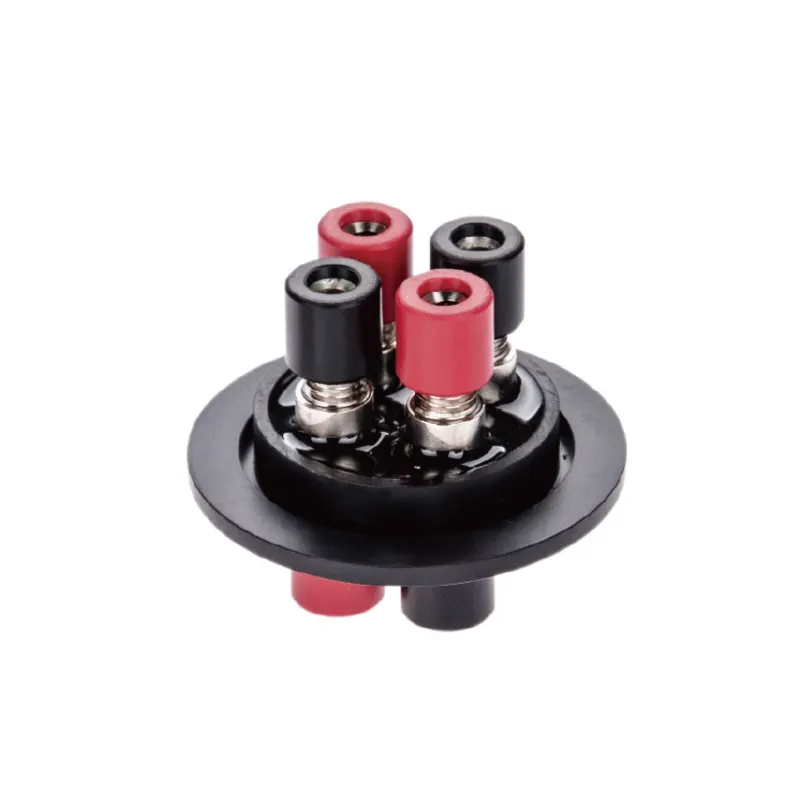
For a single-station box used in device testing, the practical benefit is a shorter connection path and fewer atmosphere-disrupting openings. The limitation is equally clear: if the test requires many high-power conductors, special shielding, or a port that the box does not have, the feedthrough may not be the right solution. Check compatibility before treating it as a standard option.
How to select and integrate the system
Start with the process, not the model. Write down the largest item to be handled, the required atmosphere, the duration of each session, the number of users, the measurements to be made, the solvents or powders involved, the heat load, and the available gas and electrical services. These inputs determine whether a single-station, single-sided box is adequate and which ports and accessories are needed.
Then ask for a configuration that matches those inputs. Request the internal dimensions, glove-port and glove specifications, transfer path details, purifier description, sensor information, leak-test method, utility requirements, and available feedthrough options. Ask how atmosphere performance is verified, what maintenance involves, and what conditions are assumed in any performance statement. A measured value at a defined test condition is more useful than a headline number without context.
Plan commissioning as part of the project. A controlled-atmosphere box needs a clean installation, a leak check, an initial purge or conditioning procedure, and training for everyone who uses it. The operating routine should cover transfer discipline, glove inspection, sensor checks, and the response to an alarm or a suspected leak. These steps protect the sample and the investment; they are not optional extras.
The right choice is the smallest system that fits the work and has documented support for the required atmosphere, access, utilities, and measurements. If the process needs two operators at once or a larger transfer path, a single-station design will become a bottleneck. If the process is a focused single-user task with a clear transfer plan and a matched purifier, the compact format can be a sensible fit. For electrical work, add a feedthrough only after the port and rating are confirmed.
Common questions
Does this glove box generate its own purified atmosphere?
An integrated purification system conditions the internal gas, but it depends on a sealed enclosure, the correct working gas, and regular maintenance. It is not a room-air purifier, and it cannot compensate indefinitely for an open door or a persistent leak.
Can I specify a particular oxygen or moisture target?
Targets should be tied to defined test conditions and a stated measurement method. Ask for documented performance for the exact configuration rather than a generic figure. Sensor accuracy, calibration, and sample location matter as much as the displayed value.
Is a vacuum glove box the same as a purification glove box?
No. Vacuum and inert-gas replacement can establish an initial atmosphere, while a purification loop continuously removes contaminants that enter or outgas inside the box. Some systems combine these functions, but they are distinct; confirm what the configuration includes.
When is a KF40 electrical feedthrough useful?
It is useful when instruments outside the box must connect to test leads, sensors, or devices inside without opening the workspace. It must match the port and the electrical rating, and it does not replace the purification system.
Can the box be used with solvents or powders?
Only within the limits of the glove and seal materials and the configured filtration. HEPA filtration captures particles, not solvent vapor; solvent adsorption does not remove oxygen or water. Confirm material compatibility and cleaning requirements with the manufacturer.
