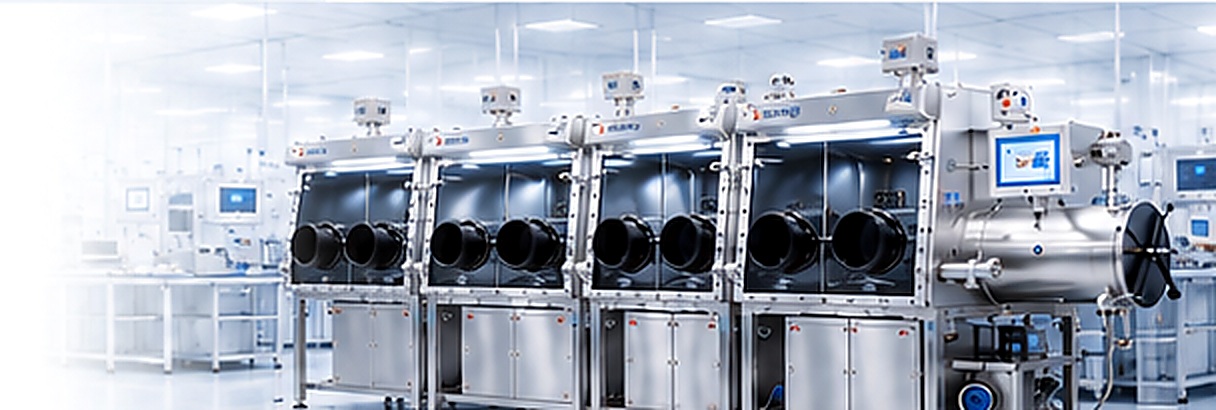
What is a three-glove single-sided glove box with gas purification? It is a sealed work enclosure with three glove ports on one operating side, linked to a closed-loop gas purification system that conditions the internal atmosphere. The enclosure provides the working volume; the purification system circulates gas, removes moisture and oxygen, and helps hold the atmosphere within a defined range. The point is to let an operator manipulate air- or moisture-sensitive materials through gloves without opening the box to the room, while keeping access and services organized on one side. The three-glove single-sided glove box with gas purification system is a specific configuration of that idea. It should not be confused with a simple sealed box or with a vacuum glove box that relies on evacuation and refilling rather than continuous purification.
The working enclosure: what three-glove and single-sided mean
Three-glove refers to the number of glove ports; single-sided describes access from one face. These labels describe access, not performance. A box can have three ports and still differ in internal volume, window size, transfer chamber, shelving, feedthroughs, and control architecture. Port spacing and glove material affect reach and dexterity. Before specifying, map the tools and sample containers that will be inside; a layout that is comfortable for small vials may be poor for a microscope, a heated stage, or a sealing tool.
The single-sided arrangement concentrates work on one face. That can simplify siting because the operator side is clearly defined, while the remaining surfaces can carry connections and services. It also means that working depth and window height matter: if the operator cannot see and reach the back of the box comfortably, three ports do not guarantee productive access. Internal equipment should be positioned so that it does not block circulation or create stagnant zones. Sharp tools and repeated lateral loads should be considered when choosing glove material and port design.
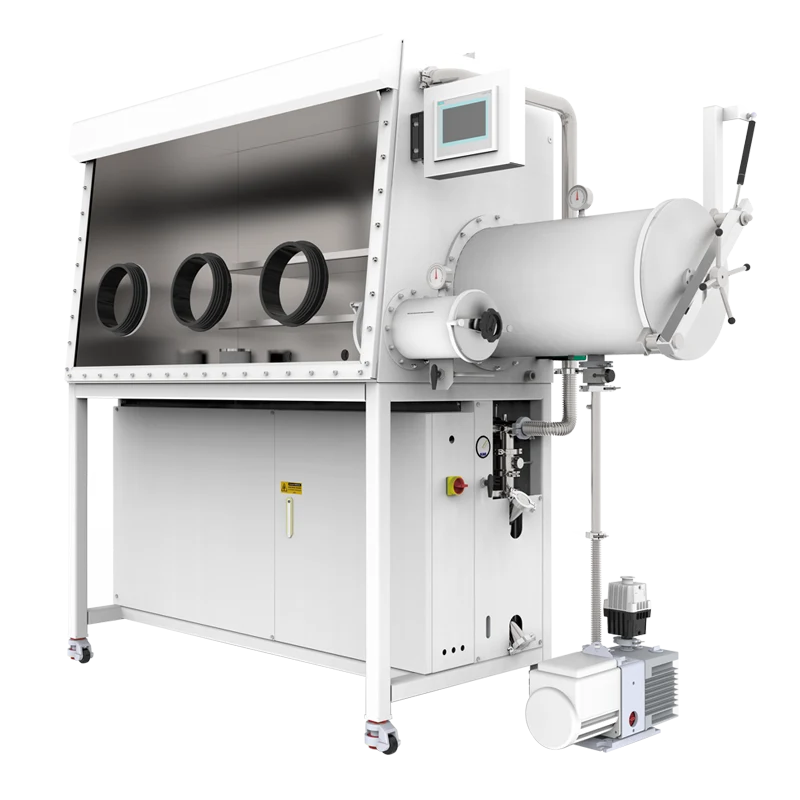
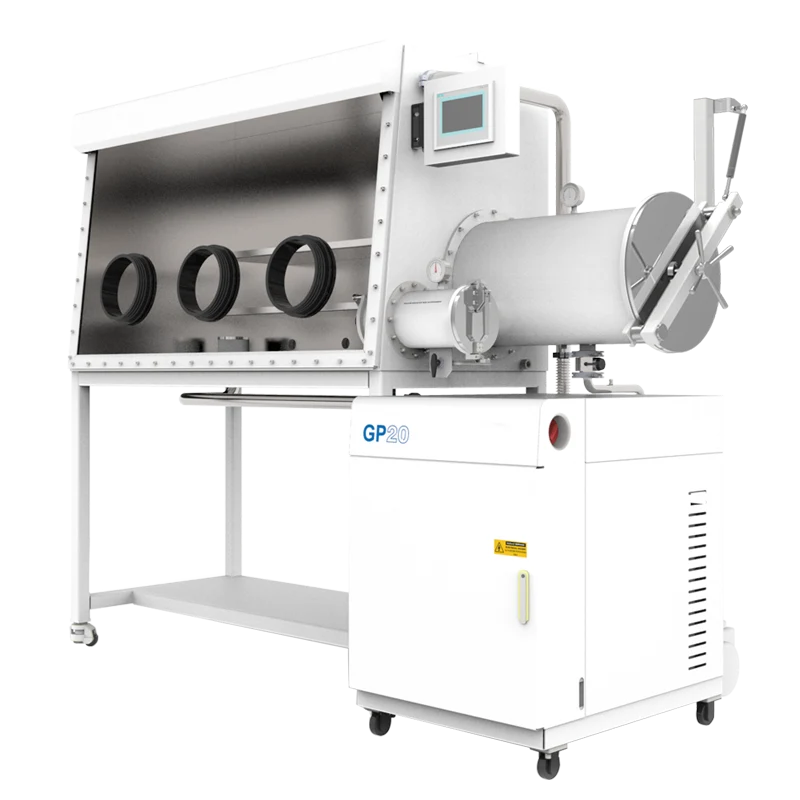
The enclosure and the purifier are separate functions that must be matched. A box cannot be judged by the number of gloves alone, just as a purifier cannot be judged by the number of columns alone. Working volume, leak-tightness, the transfer path, and the process load all influence atmosphere stability.
How the gas purification loop works
The gas purification system is a loop, not a filter at the end of a pipe. In normal operation, atmosphere is drawn from the box, passed through purification material, and returned. The loop also includes a blower or circulation device, valves and piping, oxygen and moisture analyzers, and a controller. The exact arrangement, the number of purification columns, and the media used depend on the model and must be read from the current datasheet and manual.
Water and oxygen are removed by different interactions on the purification media, and the media has a finite capacity. When capacity is approached, the material must be regenerated or replaced according to the manufacturer's procedure. Regeneration is a separate mode with its own gas, temperature, and sequence; it is not the same as normal atmosphere circulation, and it should not be improvised. A system that has just been regenerated may need time to stabilize before sensitive work resumes.
Leakage and transfers are the main loads on the loop. Every time a sample or tool enters, some moisture and oxygen enter with it, even if the transfer chamber is used correctly. The purifier offsets that load, but it cannot compensate for a persistent seal fault, a wet sample, an open solvent bottle, or an unsuitable process. This is why leak checks, purge discipline, glove inspection, and a clean transfer routine matter as much as purification capacity.
Measurement is separate from removal. An oxygen analyzer reports oxygen at its sampling point; a moisture analyzer reports water vapor, not liquid water or the water content of a sample. Resolution is not accuracy, and a stable display does not prove that the whole working volume is at the same condition. Sensor location, calibration gas, sample flow, and response time all affect what the number means. HEPA filtration captures particles and does not remove water or oxygen. Solvent adsorption protects the purifier or reduces vapor exposure, but it is not a substitute for water and oxygen removal. Pressure control, transfer-chamber evacuation, and purification are also distinct functions.
Which specifications should you check?
For a three-glove single-sided purification glove box, the useful comparison is a set of system specifications, not a single atmosphere number. The following items should be confirmed against the current product documentation for the exact configuration being purchased.
| Area | What to verify | Why it matters |
|---|---|---|
| Working envelope | Internal dimensions, usable depth, window size, shelf or rail positions, port spacing, and transfer opening location. | Determines whether the tools and samples fit and whether the operator can reach them without strain. |
| Access and gloves | Port count and size, glove material and thickness, cuff seal, and replacement method. | Affects dexterity, chemical compatibility, inspection frequency, and the risk of a glove leak. |
| Atmosphere control | Stated oxygen and moisture ranges, test conditions, sensor type and location, calibration method, and stabilization time. | A reachable value without stated conditions is not a working guarantee for the process. |
| Purification and regeneration | Column configuration, circulation method, media condition indicators, regeneration gas and utilities, and the required procedure. | Sets the maintenance burden and shows whether the loop capacity matches the process load. |
| Sealing and pressure | Design pressure, leak-test method, pressure protection, control set points, and interlocks. | Prevents inward leakage and protects the enclosure; it is separate from the oxygen reading. |
| Transfer path | Antechamber volume, door size, vacuum or purge capability, cycle control, and interlocks. | Most contamination enters during transfers, so the transfer routine shapes atmosphere recovery. |
| Materials and utilities | Solvent and acid compatibility, wetted materials, HEPA or solvent-trap options, electrical and signal feedthroughs, heat load, and exhaust. | Process chemistry can damage seals or purification media and can invalidate a clean atmosphere claim. |
Do not transfer an oxygen or moisture number from one configuration to another. A value may be described as achievable, baseline, or typical; ask what sample load, transfer frequency, sensor, and duration it assumes. If a page lists conflicting units or an incomplete configuration, leave the number out of the decision and ask for clarification. This is especially important when comparing a purified glove box with a vacuum glove box: evacuation and refilling can create a controlled atmosphere, but they are not the same as continuous closed-loop purification.
Where it is suitable, and what it cannot do
This configuration is appropriate for bench-scale or pilot work that needs frequent hand access and a controlled atmosphere, but not necessarily a large multi-operator enclosure. Examples include lithium metal and solid-state battery precursors, perovskite and OLED materials, air-sensitive chemical handling, semiconductor and electronic materials, advanced materials research, and some additive manufacturing post-processing where oxygen or moisture changes the result.
The limits are just as important. A purified glove box is not a sterile isolator, a cleanroom classification, a biological safety cabinet, or a substitute for a fume hood. It does not make every gas inert for every material, and it does not remove every solvent vapor, particle, or reaction by-product. High heat loads, corrosive vapors, sticky powders, and heavy tools can all change the required configuration. Users should confirm material compatibility and ask for the relevant safety documentation rather than assuming that a sealed box is suitable for a hazardous reaction.
Production scale is another boundary. Three glove ports and a single-sided layout favor manual work and small batches; they do not by themselves provide the throughput, automation, or redundancy of a production system. If the process requires frequent large transfers or continuous high-load operation, the transfer strategy and purification capacity need to be designed together.
Adding a turbomolecular vacuum pump: when it makes sense
The Glove Box Turbomolecular Vacuum Pump is an accessory, not a standard part of every purification system. A turbomolecular pump is a high-vacuum pump and normally works with a backing pump and appropriate controls. It is relevant when a compatible transfer chamber, load lock, or process chamber must be evacuated to a lower pressure than a roughing pump can reach, or when a process step needs high vacuum before inert-gas backfill. It is not a replacement for the gas purification loop and does not continuously clean the working atmosphere.
Compatibility must be checked at the chamber and system level: inlet flange and connection, chamber volume and gas load, required operating pressure, backing pump, exhaust path, condensable vapors from the process, purge and venting sequence, control interlocks, vibration, and available space. A pump should not be connected to a chamber that is not rated for the pressure or the load. Nor should the pump be selected from its name alone; the current page for the glove box turbomolecular vacuum pump should be read together with the chamber specification and the glove box manual.
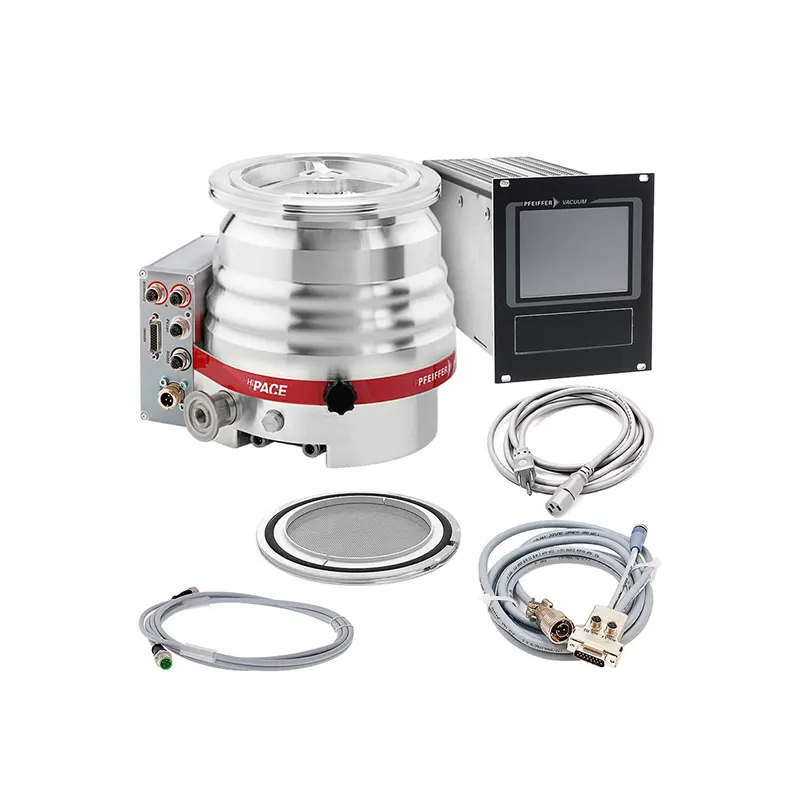
For the three-glove box, the pump question is therefore not whether the box has three gloves, but whether the specific transfer or process chamber is vacuum-compatible and what gas load it will see. If the work only needs routine sample transfer under inert gas, a simpler purge cycle may be sufficient. If high vacuum is required, the pump, chamber, valves, and control sequence should be treated as one subsystem.
How should you select and integrate the system?
A sound selection process starts with the work, not with a model name. The sequence below keeps the atmosphere claim tied to the actual configuration.
- Define the process: materials, sample mass, tools, temperature, solvents, particle generation, acceptable exposure time, and the atmosphere condition the work truly needs.
- Map access: port count and spacing, glove material, window position, internal fixtures, and any microscope, press, or sealing equipment that must fit. Confirm whether one operator or occasional assistance is expected.
- Verify atmosphere data: ask for the stated oxygen and moisture values, the sensor type and location, the test conditions, and whether the figure is an achievable target or a normal operating range.
- Plan the transfer path: sample size and frequency, antechamber volume, purge or vacuum cycles, waste removal, and how tools will be cleaned before entry.
- Check chemistry: solvents, acids, corrosive gases, high heat, and particles can affect seals, windows, gloves, and purification media. Confirm compatibility for the exact materials in use.
- Confirm utilities and controls: inert gas supply, electrical power, exhaust, control interfaces, data logging, floor space, and heat rejection should be known before installation.
- Request the current documents: configuration drawing, datasheet, operating manual, maintenance schedule, spare-parts list, and the agreed acceptance procedure. These documents should identify what is and is not included.
For a TENCAN Glove Box Systems configuration, ask for the current drawing and datasheet for the exact model rather than relying on a generic description. The correct choice is the combination of enclosure, purification capacity, transfer arrangement, and instrumentation that matches the process. A larger purifier does not fix a poor transfer routine, and a well-sealed box does not replace a maintenance plan.
FAQ
Does the purification system remove oxygen and moisture continuously?
It removes them while the loop is running and the purification media is active. The achieved level depends on the system, load, leaks, transfer practice, and maintenance. It should be monitored and verified, not assumed.
Can the turbomolecular pump be added to any glove box?
No. It needs a compatible vacuum chamber, flange, backing pump, control, and process conditions. Confirm with the equipment supplier before connecting.
Do three glove ports mean three operators are required?
No. The count describes access points, not staffing. A single-sided box is used from one side; the number and spacing of ports affect reach and tool handling.
Do HEPA filters or solvent traps lower water and oxygen?
No. They address particles or solvent vapor. Water and oxygen removal depends on the purification loop, sealing, and transfer discipline.
What is the first document to request?
The current configuration drawing and datasheet for the exact model, followed by the operating manual and maintenance schedule. These should identify the working volume, utilities, sensors, purification components, and transfer arrangement.