
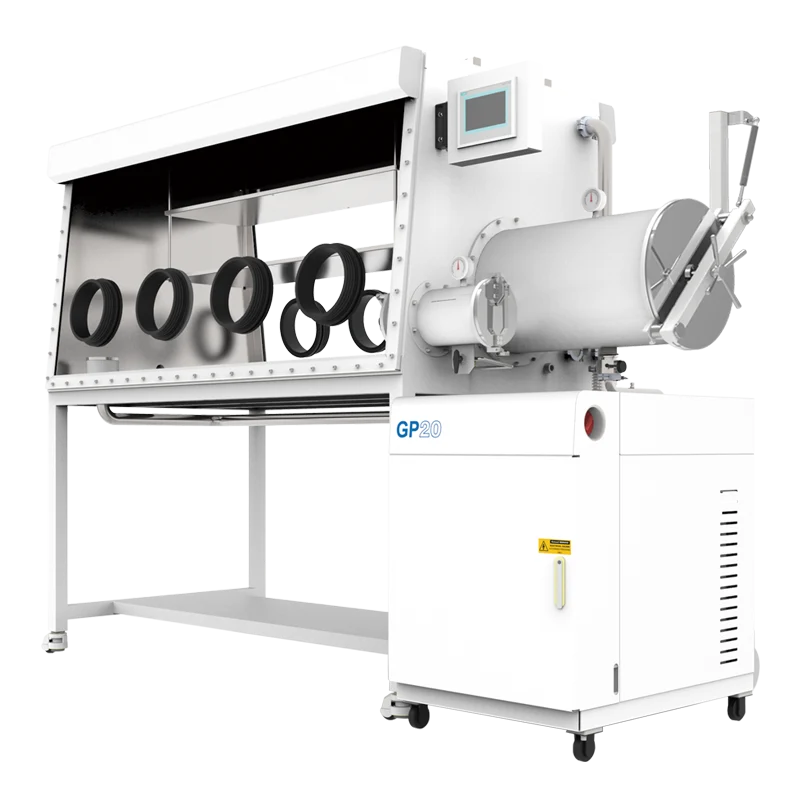
A four-station, double-sided glove box with a gas purification system is a sealed working enclosure that gives up to four operator positions — arranged on two opposing faces — access to one shared inert atmosphere, while a closed-loop purifier continuously removes oxygen and moisture from the circulated gas. Material enters through an airlock rather than through the gloves, so the seal is never broken for handling. The purification loop, not the window or the gloves, is what holds the atmosphere inside its working range, which is why this class of equipment is specified as a system rather than as a cabinet. The current TENCAN configuration is set out on the four-station double-sided purification glove box product page.
What the System Does and Where It Sits in the Workflow
A purified glove box sits between material preparation and measurement, and it has to do four jobs at once: keep the sample away from ambient air, let tools and samples in and out without spoiling the atmosphere, hold oxygen and moisture at the level the process needs, and tell the operator whether that level is still being held. Those jobs map onto four subsystems that must be sized together — the enclosure (window, gloves, ports, antechambers), the transfer path (vacuum and refill cycles in the airlock), the purification loop (blower, columns, valves and regeneration hardware), and the control layer (oxygen and moisture analyzers, pressure regulation and alarms).
The enclosure sets what you can physically do. The transfer path sets how quickly material can come in before the atmosphere suffers. The loop sets how tightly contaminants are held. The control layer is what turns a set of hardware into an instrument you can trust on a Monday morning.
The Transfer Path Carries Most of the Contamination Load
Every time an antechamber is opened to the room, the air inside it has to be removed before the inner door is opened — normally by pulling a vacuum and refilling with working gas, often more than once. Shortcuts here, such as a single quick cycle, an oversized chamber paired with a small pump, or an inner door opened too early, show up later as a slow rise in the analyzer readings that nobody can explain. On a busy four-station box the antechamber is the hardest-working component, and its volume and cycle time matter more than most buyers expect at the quotation stage.
What "Four-Station, Double-Sided" Changes in Practice
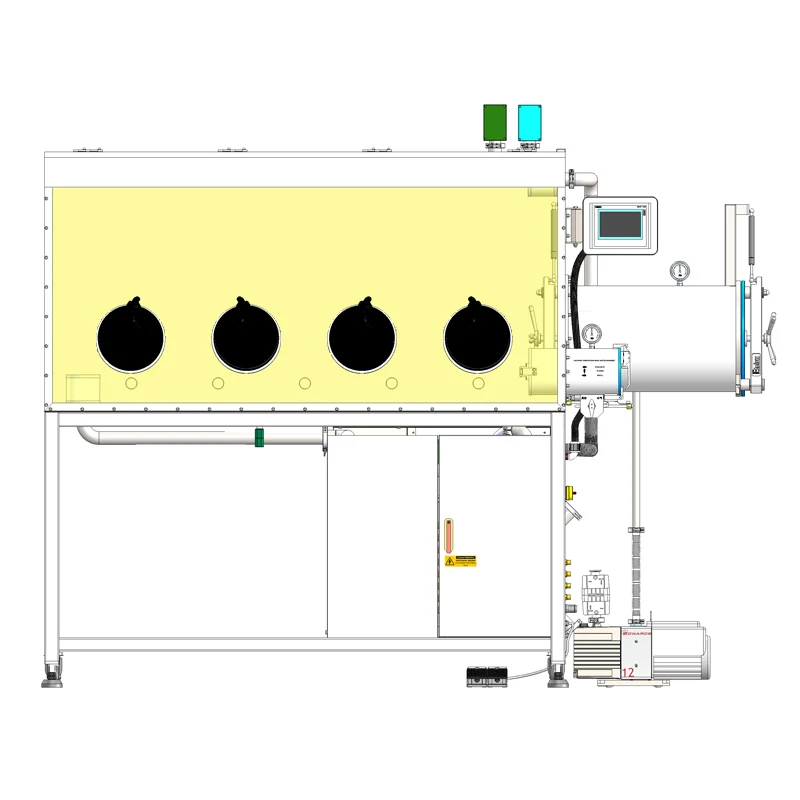
A station means an operator position: a pair of glove ports at working height with enough room in front of them to handle material. Four stations means four such positions sharing one atmosphere. Double-sided means the ports sit on two opposing faces, so two operators can work facing each other, or one operator can work from either side depending on where the equipment inside has been placed.
One Atmosphere, Two Working Fronts
The practical gain is not simply more hands. It is the ability to separate tasks that should not share a bench: cell or device assembly at one end, sample preparation, weighing or disassembly at the other, with shared equipment such as a small press or a microscope placed in the middle where both sides can reach it. Because the atmosphere is shared, however, a spill or an outgassing sample at one station affects every station — which is why zoning is worth planning before the box is ordered rather than after it is installed.
Capacity Comes With an Atmosphere Cost
A larger enclosure has more internal surface area, more seals, more glove ports and more traffic through the airlock, and all of those add water and oxygen load. The consequences are a longer initial purge after installation, a longer recovery time after each transfer, and higher working-gas consumption. More glove ports also mean more potential leak paths, so a fourth station that is rarely used is not free. Compare a four-station double-sided box against a narrower single-sided model on the number of simultaneous operators and the real transfer frequency, not on the maximum number of people who could theoretically stand around it.
How the Gas Purification System Works
The purification system is a closed circuit attached to the box, not a filter sitting in a corner. Gas is drawn from the enclosure, passed through purifying media and returned. Contaminants are captured on media that eventually saturate and must be regenerated or replaced.
Circulation
A blower moves the box atmosphere through one or more purification columns and back into the enclosure, typically against a slight positive working pressure so that any leakage goes outward. Circulation keeps the whole volume homogeneous, so analyzers see a representative sample and a local outgassing event is diluted instead of being trapped at one station. Loop flow rate, column capacity and box volume are matched together; a large box with an undersized loop will show slow recovery after each transfer even when the media are in good condition.
Adsorption, Saturation and Regeneration
The columns hold media that capture moisture and oxygen respectively, and those media load up over time. Regeneration reverses the loading by heating the column and passing a regenerating gas through it, with the released contaminants carried to exhaust. While a column is regenerating it is offline, so a single-column system loses purification capacity for the duration of the cycle while a two-column system can alternate. Working gas, control gas and regenerating gas are three different supplies and should be specified separately; the regeneration schedule belongs in the operating procedure, not in someone's memory.
Measurement and Control
Oxygen and moisture analyzers sample the circulating gas and display readings. They measure the atmosphere, they do not purify it, and a good reading is not proof that the whole enclosure is clean if the sample point is badly placed. Read the specifications carefully: resolution is the smallest change the instrument displays, accuracy is how close the displayed value is to the true value, and the two are not interchangeable. Calibration gas, calibration interval and sensor replacement all belong in the maintenance plan. Pressure control — supply and vent valves working with a controller — keeps the box inside its working band as gloves move and the airlock cycles.
Which Specifications Should You Check Before Ordering
- Atmosphere performance and its conditions. Ask which oxygen and moisture values are achievable, under what conditions — empty box, after a defined purge, with a typical load — and whether those figures are guaranteed or typical. A value reached once during commissioning is not a continuous guarantee.
- Analyzer specifications. Range, resolution, accuracy, sample point and calibration requirements for both oxygen and moisture.
- Enclosure geometry. Internal volume, number and position of glove ports, window size, glove material and size, and the working pressure band.
- Transfer capability. Antechamber count and volume, the vacuum level the chamber is rated for, and whether the pump supplied is matched to that volume and to the gas in use.
- Leak integrity. The test method and acceptance criterion, since leak rate, working pressure, antechamber vacuum and pump ultimate vacuum are four different quantities often quoted in the same breath.
- Regeneration requirements. Cycle duration, regenerating gas supply, exhaust arrangement, and whether purification is unavailable during the cycle.
- Utilities and siting. Power, working gas, regenerating gas, compressed air if used, exhaust, floor loading, footprint and service clearance.
Keep the original units and the object each value applies to. A pressure quoted for the antechamber is not the box working pressure; a pump's ultimate vacuum is not the atmosphere the box will hold; an oxygen figure for one model is not a series-wide promise.
Where It Is Suitable, and Where It Is Not
Applications that justify four stations and a purification loop are those where several people handle air-sensitive material in parallel: lithium-metal and solid-state cell assembly, perovskite and OLED device fabrication and encapsulation, air-sensitive synthesis, two-dimensional materials and semiconductor-related processing, and metal powder handling for additive manufacturing where powder must not oxidise between steps.
The limits matter just as much. A purification loop is not a solvent removal system: solvents released inside the box load the media and can damage them, so solvent work needs its own trap and a written procedure. A HEPA filter removes particles and does nothing for water or oxygen; a particle filter is not a substitute for purification, and purification is not a substitute for particle control. The box is not a cleanroom, a biological safety cabinet or a fume hood, and it should not be described as providing sterility or containment certification. Strongly outgassing items — cardboard, paper, some tapes, wet samples — will temporarily overwhelm the capacity of the loop whatever the media.
It also helps to keep product classes straight. A stainless-steel vacuum glove box such as the GBV series creates a controlled environment through a sealed chamber and vacuum–inert gas exchange, and should not be assumed to include continuous purification. Acrylic boxes in the GBT range vary by model and wall thickness: not every unit can be evacuated, and not every unit has an antechamber or a purifier. A standalone purifier such as the GP20 works with a compatible sealed enclosure but is not a complete glove box with working space, and it cannot be connected to an arbitrary box without checking loop, volume and pressure control. Inert is also not a universal property: the working gas should follow the chemistry of the sample, not the other way round.
Ports, Feedthroughs and Accessory Integration
Most accessory problems are interface questions rather than performance questions. Gloves are chosen on size, material and permeation behaviour; antechambers on transfer volume; pumps on gas compatibility and load; analyzers on range, resolution and calibration; feedthroughs on connection type and sealing. Each is judged against the job it does, not against the box's headline atmosphere figure.
Take the KF40 BNC feedthrough connector as an example. KF40 is a standard ISO-KF flange size and BNC is a coaxial connector, so the part carries a single coaxial signal through the enclosure wall on a KF40 port. That is useful when a sensor, an electrode or a small electrical measurement inside the box has to reach an instrument outside without a cable being routed through the antechamber on every cycle, which would slow the transfer and work the seal harder. Before ordering, confirm that the box or antechamber actually has a free KF40 port, check whether that port is on the enclosure or on the airlock, and consider the signal itself: a low-level measurement may need shielding and a defined grounding point, and an unused port should be blanked off rather than left open.
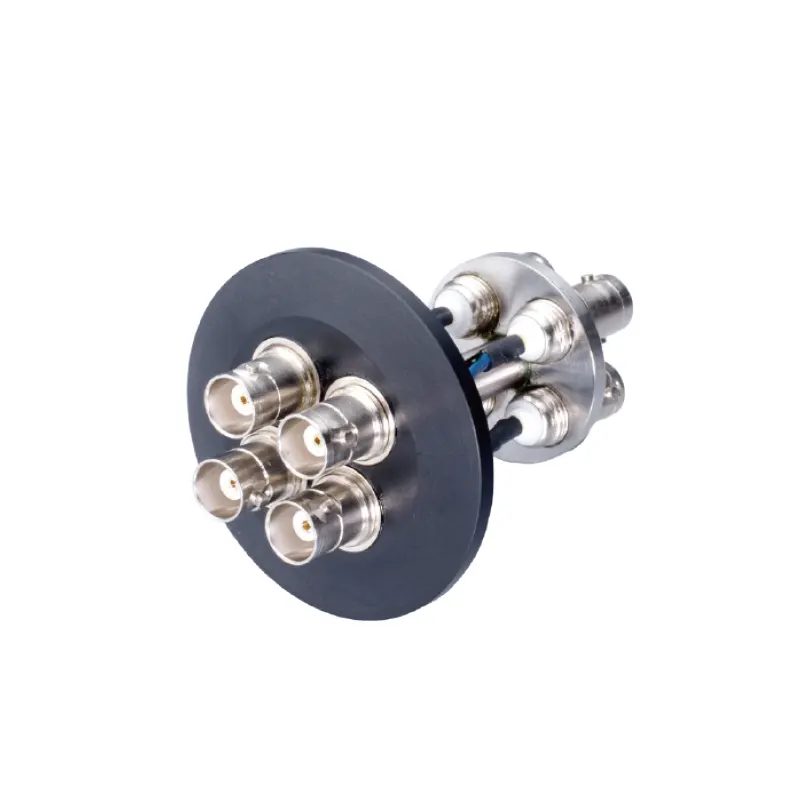
The same discipline applies to every add-on. A feedthrough is not a purification device, an analyzer does not clean the gas, and a filter does not remove moisture. Accessories extend what the box can do; they do not change what it is.
How to Select and Integrate a System
- Write down the process steps and every material that will be inside, including solvents and powders.
- Count simultaneous operators, then decide how many stations and which faces you need.
- List the equipment that will live inside — heat sources, presses, microscopes, balances — with the power and signal connections each requires.
- Estimate transfer frequency and item size, then size the antechamber and pump around that.
- Decide how solvents, particles and outgassing materials will be handled, and specify the traps and filters that go with them.
- List the feedthroughs and ports needed now, plus spare ports for later.
- Confirm utilities, footprint, floor loading and service access before the delivery date is fixed.
- Plan commissioning: leak check, purge, first regeneration, analyzer calibration and operator training.
Then verify the package against current product documentation rather than a general description; the four-station double-sided purification glove box page is the reference for what a delivered configuration includes. If a value matters to your process, ask for the test condition behind it in writing.
Short Answers to Common Questions
Does the purification system make the box suitable for every air-sensitive sample?
No. It controls oxygen and moisture. It does not remove solvent vapour, it does not provide sterile or particle-free conditions, and it does not guarantee that a given gas is inert towards a given material.
Will the box reach its lowest oxygen level immediately after installation?
Not usually. Commissioning involves a leak check, repeated purge cycles and often one or more regeneration cycles before the analyzers settle. New gloves, new seals and residual moisture in the enclosure all influence the first readings.
Can a standalone purifier be added to an existing box?
Only after checking compatibility of loop connections, enclosure volume, pressure control and materials. A purifier is not a universal add-on, and a box built without purification is not automatically upgradeable.
The analyzer reads well — does that mean the whole box is clean?
It means the gas at the sample point is clean at that moment. Sample point placement, calibration status and recent transfers all affect how representative that reading is.
Do I need a feedthrough if I only run one cable?
If the cable has to be connected during work, a feedthrough keeps the seal intact and removes the cable from the airlock cycle. For a one-off connection, routing it through the antechamber once may be enough.
A four-station, double-sided box with gas purification is a good fit when several people genuinely need to work in parallel on air-sensitive material and the workflow can be zoned. It is a poor fit when the extra stations would sit idle, when solvent loads are heavy and unmanaged, or when the process needs containment or sterility that no glove box provides.
