
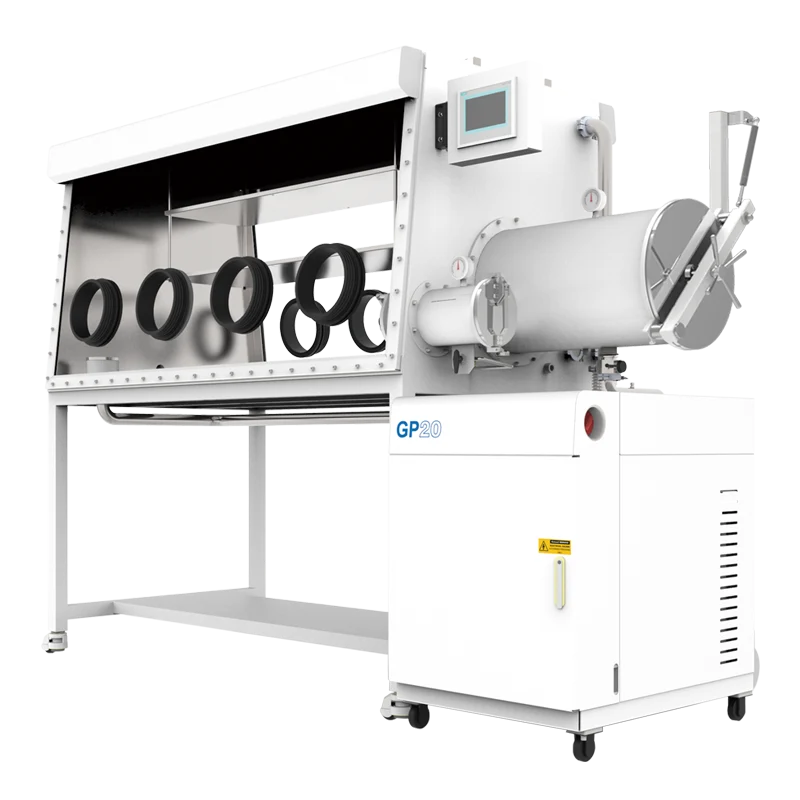
A four-station double-sided glove box with gas purification is a sealed workspace that gives several operating positions access to one controlled inert atmosphere from two sides. It sits between the user and the sensitive sample: gloves provide manual access, the cabinet isolates the workspace, the transfer chamber controls entry, and a purification loop conditions the circulating work gas. The purpose is not simply to enclose a sample, but to keep atmosphere quality stable while samples, tools, and small equipment are used and moved.
What Does the Four-Station, Double-Sided Layout Change?
In the product name, four-station describes the working capacity, while double-sided describes access. The practical consequence is a shared atmosphere: users on opposite sides look into the same cabinet environment rather than into separate boxes. That arrangement can support sample handoffs, training, tandem assembly, or inspection from a second angle. It can also make better use of laboratory space because one cabinet and one atmosphere circuit serve multiple working positions.
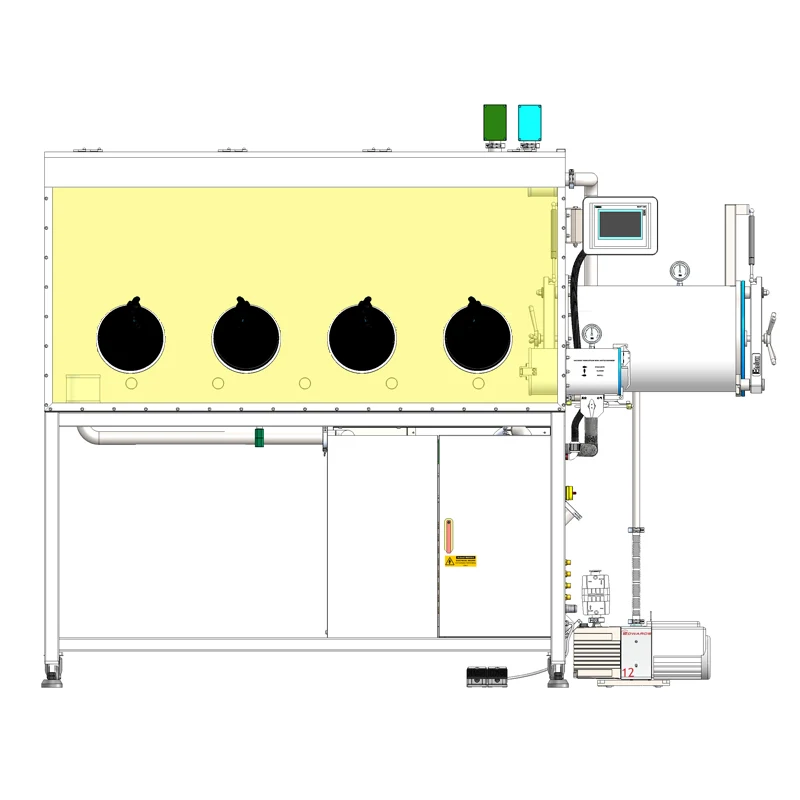
The working positions share the cabinet envelope, but the name alone does not establish whether the chamber is continuous or divided, how many glove ports are fitted, or where the transfer chamber and controls are located. Those details must come from the dimensional drawing and order specification. For a double-sided workflow, check which side carries the main transfer interface, whether the intended work needs a clear internal span, and whether the control screen can be reached and viewed from the operating positions. A layout that looks efficient on a floor plan can still create awkward reach, poor sight lines, or a transfer route that forces operators to cross the chamber unnecessarily.
Shared volume is efficient, but it is not free of constraints. More gloves, larger access openings, bulky fixtures, and frequent transfers increase the load on the purification system and make entry discipline more important. The actions of one operator also affect the atmosphere seen by everyone using the cabinet. The current TENCAN listing for the four-station double-sided glove box with gas purification system identifies the configuration; the engineering drawing and order specification should be used for port positions, chamber dimensions, and utility locations.
How Does a Gas Purification Loop Work?
In a purification glove box, the usual flow path is a closed recirculation loop. A blower or circulator draws work gas from the chamber, passes it through purification media that remove water and oxygen, and returns it to the box. During normal operation the objective is to clean the same inventory of gas repeatedly, not to keep adding fresh gas. Sensors monitor the resulting atmosphere. They may be placed in the chamber, in the return line, or in a sampling circuit, and their readings describe the gas at the measurement point rather than the purifier capacity by themselves.
Three gas roles should be kept separate in any technical discussion. The work gas is the inert atmosphere inside the cabinet. Control gas operates valves or instruments. Regeneration gas is used when the purification media are restored, and regeneration is a distinct cycle with its own gas, heat, and valving requirements. A system may use nitrogen, argon, or another compatible gas, but the choice depends on the sample and process, not on the word inert alone. The exact gas, purification media, regeneration method, and permissible cycle frequency for this model are not established by the model name and should be taken from its current documentation.
Purification also has limits. Water and oxygen ingress comes from leaks, glove permeation, transfer operations, wet samples, and solvent vapors. A purifier can remove water and oxygen, but it cannot compensate indefinitely for a poor seal or a heavily outgassing load. Solvent adsorption is a separate function and should be planned when solvents are used. HEPA filtration captures particles; it does not remove water vapor, oxygen, or solvent vapor. Likewise, an oxygen analyzer measures oxygen, and a moisture analyzer measures water; neither device improves the atmosphere by itself.
Performance figures need conditions. A low oxygen or moisture value may describe a clean, empty box after a stabilization period, or it may be a target for a particular configuration. It should not be read as a continuous guarantee for every load, every transfer, or every gas. Where a data sheet gives a value without specifying the measurement point, load, purge history, or sensor, the sensible course is to ask for the test conditions rather than to treat the number as universal.
Which Components and Configurations Matter?
Cabinet, gloves, and visibility
The cabinet material, glazing, glove-port rings, and seals form the atmosphere boundary. Material compatibility with the process matters because a cleaning agent, solvent, or sample residue can attack the wrong seal or surface. Glove material, thickness, and size affect tactility and permeability; a glove that is comfortable for fine work may not be the best barrier for a particular solvent. The right choice depends on the task and on the wetted materials, not on a universal ranking. Visibility should also be judged from the actual working height, especially when two operators face each other across a double-sided cabinet.
Transfer chamber
A transfer chamber, sometimes called an antechamber, lets items enter without opening the main chamber directly to the room. Its volume, door arrangement, and vacuum rating matter because they set what can be transferred and how much gas exchange is involved. A small chamber is convenient for tools and vials; a larger one may be needed for fixtures or small equipment, but it also presents a larger volume to evacuate and refill. The product title does not state the number or size of transfer chambers, so those points belong in the dimensional drawing and order specification.
Purification and monitoring package
Ask how the purification loop is sized, how media are regenerated, what sensors are fitted, and how the control system handles alarms and interlocks. Sensor range, resolution, accuracy, calibration method, and response time are different specifications. A display that reads to a fine increment is not necessarily accurate to that increment. The purification capacity should be quoted for a defined inlet condition and duty cycle, and the regeneration procedure should be compatible with the site gas supply and operator routines.
Utilities, feedthroughs, and internal equipment
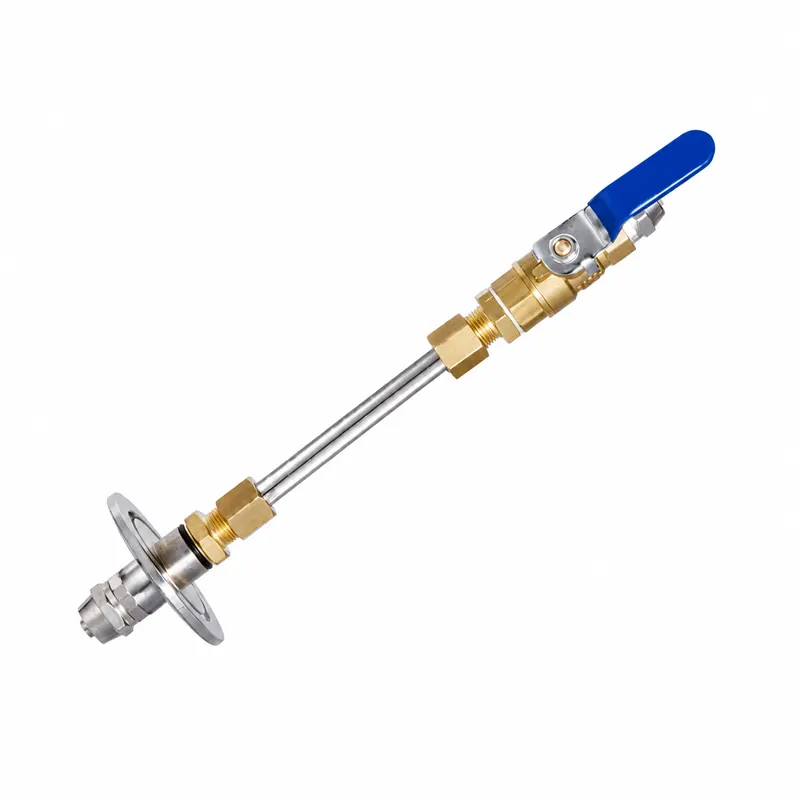
Electrical feedthroughs, gas and liquid feedthroughs, thermocouples, and small motors all cross the atmosphere boundary. Each penetration adds a sealing point. Plan the number and type of penetrations before the cabinet is built, because retrofitting a port can be more disruptive than specifying it at the outset. Internal heaters, stirrers, or test fixtures also add heat and outgassing load; they need to be included in the atmosphere and utility plan rather than treated as later additions.
Which Specifications Should You Check?
A useful specification review separates the cabinet, the transfer interface, the gas circuit, and the measurement package. The table below groups the questions that are easy to blur together.
| Specification group | Why it matters | What to confirm |
|---|---|---|
| Internal working space and station layout | Tools, sight lines, and collaboration | Dimensions, port positions, side access, clear height, and any internal dividers |
| Pressure boundary and leak integrity | Holds the inert atmosphere | Design pressure, test method, acceptable leak rate, and sealing materials |
| Transfer chamber | Controls entry and gas exchange | Volume, door size, vacuum rating, number of chambers, and loading method |
| Purification loop | Removes water and oxygen | Work gas, media, capacity, regeneration gas and method, and duty cycle |
| Sensors | Shows the state of the atmosphere | Measured species, range, resolution, accuracy, calibration, and sample point |
| Gloves | Manipulation and barrier performance | Material, thickness, size, port ring, and chemical compatibility |
| Solvent and particle control | Protects the loop and the sample | Solvent adsorption, HEPA filtration, filter location, and compatibility |
| Feedthroughs and utilities | Connects the process to the chamber | Port type, tube size, seal material, pressure or vacuum rating, and electrical rating |
Keep units attached to the item they describe. Chamber working pressure is not transfer chamber vacuum; pump ultimate vacuum is not the vacuum reached in a loaded chamber; leak rate is not oxygen concentration; and water concentration is not the same as dew point unless the relationship is defined. A specification that mixes these quantities is difficult to compare. If a supplied description omits a value or shows a unit that cannot be reconciled with the application, leave it out of the decision and request clarification.
Where Is It Suitable, and What Are Its Limits?
The strongest fit is work where the sample surface or bulk chemistry changes on contact with ambient moisture or oxygen: lithium metal and anode handling, solid-state electrolyte preparation, perovskite and OLED materials, semiconductor and electronic components, air-sensitive catalysts and ligands, and some additive-manufacturing powder or post-processing steps. A double-sided four-station cabinet is especially relevant when two people need to work at once, or when a sample must be assembled, inspected, and passed to another operation without leaving the atmosphere.
The limits are just as important. A glove box is not a sterile enclosure, a cleanroom classification, a biological safety cabinet, or a fume hood. It does not make a hazardous material safe by itself, and it does not guarantee inertness for every gas and sample pair. Some materials react with nitrogen; some processes generate vapors that challenge seals or purification media. Thermal load, sharp tools, and solvent spills need specific assessment. If the process requires continuous particulate control, solvent capture, or high-temperature work, those functions need dedicated design provisions. A purification system is not a substitute for good transfer discipline, and an inert atmosphere is not the same as zero contamination.
Common Questions About Four-Station Purification Glove Boxes
Does this cabinet always include gas purification?
This product is identified as a glove box with a gas purification system, so the purification function is part of the configuration being described. That does not establish its capacity, sensor package, or achievable atmosphere. Those details belong to the ordered specification and should be confirmed against the drawing and control philosophy.
Can it hold sub-ppm oxygen and moisture continuously?
A purification system can be designed for low oxygen and moisture targets, but continuous performance depends on leak integrity, glove condition, transfer frequency, sample outgassing, purifier status, and the measurement point. No responsible specification should reduce this to a single figure without conditions. Ask for the test basis and for the alarm and regeneration criteria.
Does a HEPA filter improve the atmosphere?
No. HEPA filtration removes particles. Water vapor, oxygen, and solvent vapors require different removal mechanisms. HEPA can be useful for powders and particulates, but it does not replace the purifier or a solvent trap.
Can one side be used while the other side is open?
The chamber is normally operated as a sealed system; opening a door or transfer chamber changes the atmosphere for the shared volume. A double-sided layout supports work from both sides, but it does not make an open side atmosphere-independent. Follow the operating procedure for transfers, door interlocks, and recovery after access.
How Should You Select and Integrate It?
Start with the process rather than the model number. The following sequence keeps the atmosphere target, the physical workflow, and the utility plan connected.
- Define the sample chemistry and the acceptable atmosphere. Ask whether nitrogen or argon is compatible, whether solvent vapor or particles will be released, and whether the sample needs heating, cooling, electrical stimulation, or analysis inside the box.
- Map the physical workflow. Count the operators, identify which side they work from, list the largest items that must enter, and estimate how often transfers will occur. Use that map to judge station spacing, reach, sight lines, and transfer chamber size.
- List every utility and penetration before ordering. Electrical, sensor, gas, liquid, vacuum, data, and heat loads all cross the boundary. Each one needs a defined port, seal, rating, and service access.
- Set a verification plan. Decide what will be measured, where, with which sensor, after what stabilization period, and what alarm or maintenance trigger is acceptable. Distinguish a target from a guaranteed operating value.
- Request the drawing, bill of materials, utility schedule, and operating and regeneration instructions. Check that these documents agree with the quoted atmosphere target and with the way the cabinet will actually be used.
A gas and liquid feedthrough is a useful example of an interface that should be settled early. TENCAN's gas and liquid feedthrough is intended for routing media through a glove box wall so that a process can be supplied or sampled without opening the main chamber. It is not a purification device and does not create an inert atmosphere by itself. Compatibility depends on the port provided on the cabinet, the tube or connection size, the seal material, the media being carried, and the pressure or vacuum conditions. A feedthrough that suits one solvent or gas may be unsuitable for another, so confirm the wetted materials and sealing arrangement against the actual process before ordering.
Before ordering, reconcile the four-station layout, double-sided access, purification duty, transfer volume, sensor package, and planned feedthroughs as one system. A cabinet that meets an atmosphere target on paper but obstructs the real workflow will not deliver stable operation in practice. The useful selection test is whether every item that crosses the boundary, including gloves, doors, feedthroughs, samples, and utilities, has a defined procedure and a verified compatible specification.
