
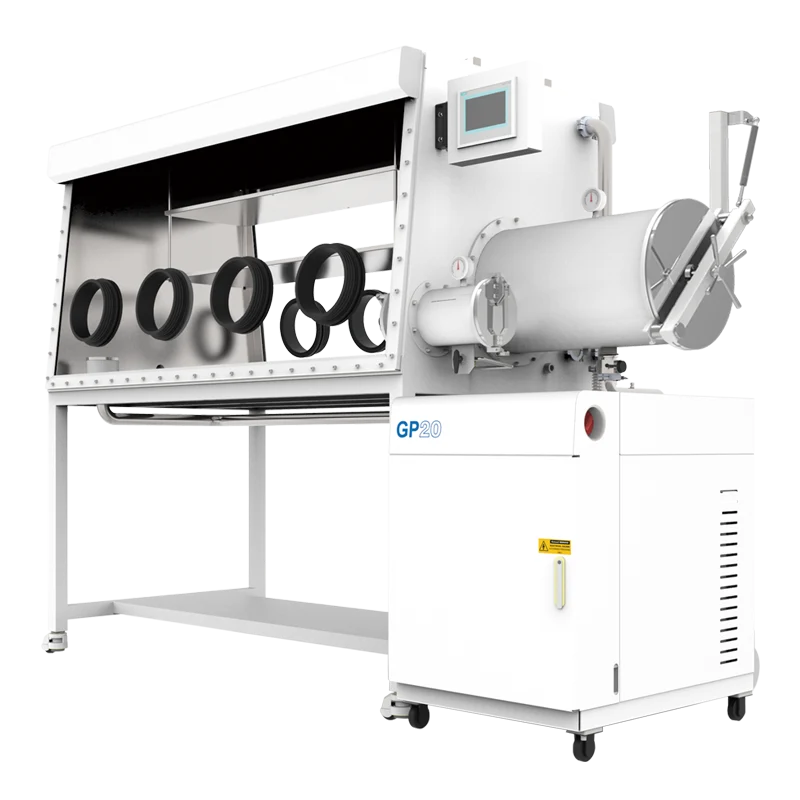
A four-station double-sided glove box with a gas purification system is a sealed working enclosure arranged for access from two opposite faces, with four operator stations and a closed-loop atmosphere treatment system that circulates internal gas through purifying material. The enclosure provides the controlled volume, the gloves and transfer chamber provide controlled access, and the purification loop manages moisture and oxygen in the recirculated atmosphere. Its purpose is not simply to keep dust out. It makes an air-sensitive process repeatable enough that the atmosphere becomes a controlled experimental variable.
The four-station double-sided glove box with gas purification system from TENCAN is a specific configuration in this category. The name identifies the layout and the presence of purification, but working dimensions, transfer chamber arrangement, purification capacity, and monitoring still need to be matched to the process. A similar enclosure without a purification loop is a different tool with a different operating discipline.
What Does a Four-Station Double-Sided Glove Box Do?
Inside the enclosure, the operator works through gloves connected to ports in the front panel. The box limits exchange with outside air, purges or evacuates the transfer chamber before materials enter, and circulates internal gas through a purifier. The double-sided arrangement places working faces on opposite sides of the enclosure. That can support collaboration, let two procedures face each other, or make better use of a long bench. It does not create two separate atmospheres unless the design actually includes independent compartments.
A Shared Atmosphere Across Two Working Faces
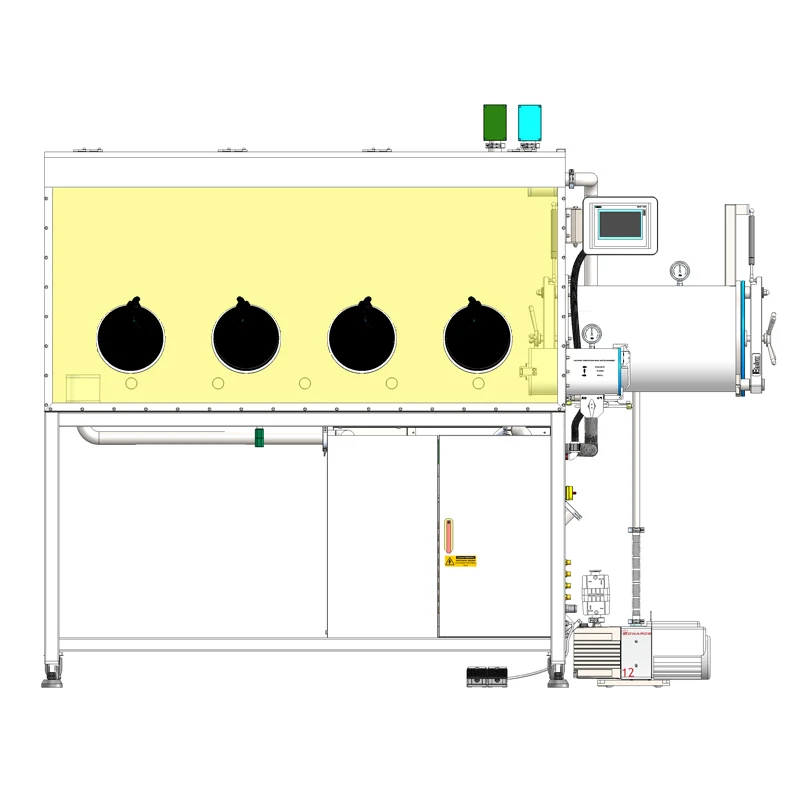
In the usual double-sided configuration, both faces open into the same internal volume. An open port, a glove change, a transfer, or a large solvent spill on one side can affect the atmosphere seen on the other. This is the main operational difference from a pair of small independent boxes. The shared volume is useful when samples or equipment must pass between teams without leaving the controlled atmosphere, but housekeeping and access discipline are also shared. The product drawing should show whether the two sides form one volume, whether a partition exists, and where the purification loop samples and returns gas.
Four Stations Are Access Points, Not Four Atmospheres
“Four-station” describes the number of operator access positions, not four separately controlled gas zones. The stations may be distributed across the two faces in a particular pattern, and glove port spacing determines how many people can work without interfering with each other. Confirm the station layout, the reachable internal depth from each station, and whether a station is intended for routine work, transfer, or equipment monitoring. More access points also mean more gloves, more seals, and more opportunities for a poor connection if maintenance is neglected.
How the Gas Purification Loop Works
A purification loop is a closed circuit, not a one-time flush. A circulator moves gas from the enclosure through a purification column or columns and returns it to the box. The purifying material captures water and oxygen; when its capacity is exhausted, it must be regenerated or replaced according to the manufacturer’s procedure. The loop works with pressure control, because the enclosure is not a perfectly rigid, perfectly sealed vessel during transfer, glove movement, and temperature change. The useful question is not only “what oxygen level can the box reach?” but “under what conditions, with what load, and for how long can it hold the target?”
Purification, Circulation, and Regeneration Are Separate Steps
Circulation is the movement of gas. Purification is the removal of water and oxygen by the active material. Regeneration is the periodic restoration of that material, usually with a controlled gas stream and heat. A running circulator does not prove that the purifier is working, and a regenerated purifier does not guarantee a clean atmosphere if the transfer chamber is used incorrectly or a glove leaks. Regeneration also has a schedule: it can affect available atmosphere or require a temporary change in box conditions, so the procedure and interlocks must be planned before the box is committed to round-the-clock work.
Pressure and Transfer Are Part of Atmosphere Control
Glove boxes are normally managed at a slight controlled pressure relative to the room, but the correct setpoint and control method depend on the design. Too little pressure difference makes ingress more likely when a port or door is disturbed; excessive pressure can stress seals, windows, and gloves. Transfer chambers are the other main boundary. A small chamber may be adequate for vials and small fixtures, while a larger chamber may be needed for a furnace, a cell stack, or a microscope stage. The purge method matters as much as the volume: a vacuum-assisted cycle and a simple gas purge are not equivalent, and the number of cycles needed for a given load should be established for the actual workflow.
Which Configurations and Components Matter?
Because the exact parameter set depends on the ordered configuration, the selection discussion should focus on the features that determine whether the box fits the work. These are not optional details; they define the usable system.
Enclosure, Access, and Materials
Check internal dimensions, usable height above the work surface, window material, and glove port size. A wide box with shallow depth may look impressive but can be awkward to reach from the back. Stainless steel is common for durable enclosures, but internal fittings, window seals, and polymer components must be compatible with the samples and cleaning agents. If the process involves a solvent, confirm the glove and seal materials, and ask whether solvent adsorption is required. A purification column designed for water and oxygen is not a general solvent scrubber.
Transfer Chamber and Pressure Control
The transfer chamber is where most atmosphere upsets begin. Ask for its internal size, door type, whether it is vacuum-capable, and what purge or evacuation sequence is recommended. Confirm how it is isolated from the main box and how pressure is recovered after a transfer. For a double-sided box, consider whether one chamber serves both sides or whether a second chamber would reduce traffic. A large chamber that is oversized for daily use can waste gas and time; a chamber that is too small can force operators to open the main box more often.
Trace Oxygen Monitoring
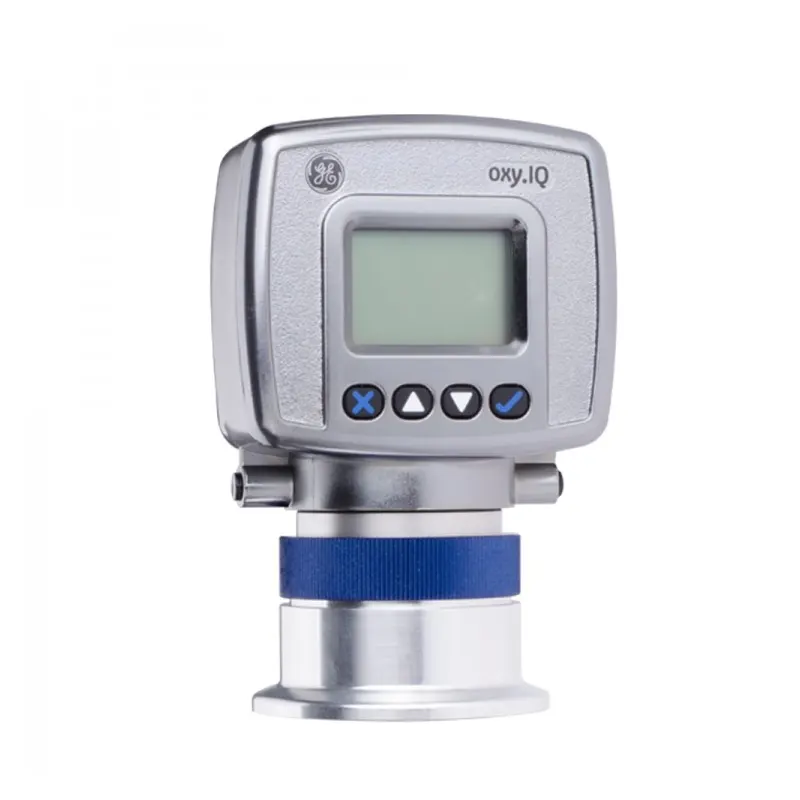
Atmosphere monitoring is a measurement system, not a decoration on the front panel. The TENCAN glove box trace oxygen analyzer is an accessory for measuring trace oxygen; it does not remove oxygen and it does not replace the purifier. When evaluating an analyzer, check the sensor principle, measurement range, lower detection limit, resolution, accuracy, response time, calibration method, sample flow, and sample point location. Resolution is not the same as accuracy. A display that changes in small increments can still be far from the true value if the sensor is not calibrated or the sample line leaks. Moisture measurement should be reviewed in the same way.
Which Specifications Should You Check?
Read the specification table as a set of conditions, not as a list of record-breaking numbers. A target oxygen or moisture value is meaningful only when the test load, purge procedure, measurement point, and stabilization time are stated. The same applies to leak rate, transfer chamber vacuum, and working pressure. If a catalog page gives a number without its conditions, request the test method.
| Item to check | Why it matters | What to confirm |
|---|---|---|
| Internal working volume | Sets reach, equipment fit, and the atmosphere volume that must be recovered after a transfer | Dimensions, usable height, shelf or rail layout, and clear access from each station |
| Station and face layout | Determines operator access and whether two sides share one atmosphere | Number and spacing of glove ports, window positions, and whether any partition exists |
| Transfer chamber | Controls the main exchange of air and moisture during material movement | Volume, door size, vacuum capability, purge or evacuation procedure, and recovery time |
| Purification loop | Determines water and oxygen removal capacity and regeneration planning | Column capacity, circulation path, regeneration requirements, and stated performance conditions |
| Pressure control | Protects seals and gloves while limiting ingress | Control range, alarm logic, sensor location, and response to door movement |
| Monitoring package | Shows whether the atmosphere is actually within the process window | Oxygen and moisture ranges, accuracy, calibration, sample points, and alarm setpoints |
| Material compatibility | Prevents damage to gloves, seals, windows, and purifier from solvents or process chemicals | Glove polymer, seal material, cleaning agents, solvent vapor load, and required adsorption |
| Utilities and integration | Determines installation cost and whether equipment can be used inside the box | Power, gas supply, vacuum, feedthroughs, heat load, and service access |
Where Is It Suitable, and What Are Its Limits?
A four-station double-sided purification glove box is appropriate when several people need to work in one controlled atmosphere, when samples must move between two sides of a process, or when a shared bench is more practical than several small enclosures. Typical work includes lithium metal and solid-state battery preparation, perovskite and OLED materials, semiconductor and electronic materials, air-sensitive synthesis, and metal or polymer powder handling where oxidation or moisture pickup must be limited. The box can also serve as a controlled interface before or after additive manufacturing steps, provided internal equipment and cleaning procedures are compatible with the enclosure.
What the Box Does Not Do
It does not make the workspace sterile, and it is not a biological safety cabinet or a fume hood. A purified atmosphere is not a substitute for local exhaust when toxic or volatile chemicals are handled, and HEPA filtration removes particles rather than water or oxygen. Solvent adsorption can reduce organic vapor loading, but it does not replace the water and oxygen purifier. A trace oxygen analyzer measures the atmosphere; it does not improve it. Nor is every gas inert toward every sample. Material compatibility and process safety must be assessed for the specific chemistry, especially with reactive metals, halides, and solvents.
Shared Volume and Human Load
A double-sided box with four stations can support more work, but more users and transfers increase the load on the purification system. Gloves, sleeves, wipes, tools, and sample containers all carry surface moisture and adsorbed air. A large box also takes longer to recover after a door opening than a small one, although the exact behavior depends on circulation design and transfer procedure. The right choice is not the largest box available; it is the smallest box that accommodates the workflow without forcing unnecessary door openings and awkward reaches.
How Should You Select and Integrate It?
Start with the process, not the catalog. Define the materials that will be exposed, the acceptable oxygen and moisture window, the longest period the box must hold that window without intervention, and the number of people who need access at the same time. Then map the physical workflow: where samples enter, where they are stored, which instruments sit inside, and which side of the box each operation occurs on. This usually reveals whether four stations are useful or merely add glove ports that are difficult to reach.
- Set the atmosphere target with conditions. State oxygen and moisture levels, the measurement method, the allowed recovery time after a transfer, and the load used for the test.
- Size the transfer chamber around the largest routine item. Ask for the recommended cycle and expected recovery; an oversized chamber can waste purge gas.
- Plan purification and regeneration. Confirm how regeneration affects the working atmosphere, what utilities it needs, and whether it can be scheduled without disrupting experiments.
- Specify monitoring points that represent the work zone. A sensor near the return line may not show the atmosphere at the far end of a double-sided box.
- Check glove and seal compatibility. Glove thickness affects dexterity and permeation; a thicker glove is not automatically better.
- Review installation and service access. The purifier, blower, valves, and sensors need room for maintenance.
- Ask for the drawing, utility list, operating manual, and commissioning procedure. Acceptance should use the actual transfer and monitoring routine, not only an empty-box purge.
Frequently Asked Questions
Does a Four-Station Double-Sided Glove Box Always Include Gas Purification?
No. The layout and the atmosphere system are separate choices. The TENCAN product referenced here is specifically named with a gas purification system, which indicates that purification is part of that configuration. A box with a similar appearance may have only vacuum and inert-gas replacement. Confirm the presence and type of purification loop, the purifier capacity, and the monitoring package before treating two boxes as equivalent.
Can a Trace Oxygen Analyzer Lower the Oxygen Level?
No. The analyzer measures oxygen in a sample stream. The purification loop removes oxygen from the circulating gas, and the transfer procedure limits how much air enters. Use the analyzer to verify performance and detect trends, not as a control device that changes the atmosphere by itself.
Is a Double-Sided Box Better Than a Single-Sided Box?
It depends on the workflow. A double-sided box can improve collaboration and shorten the path between two operations, but it also creates a larger shared atmosphere and more access points. If only one operator works at a time and the process is small, a single-sided box may be easier to control and maintain. Choose the layout that reduces door openings and unnecessary transfers, not the one with the most ports.
Can Solvents Be Used Inside the Box?
Only after checking the glove material, seal material, window construction, and the effect of solvent vapor on the purification system. Some processes require solvent adsorption and a specific cleaning procedure. A standard water and oxygen purifier is not designed to manage arbitrary organic vapor loads, and a solvent spill can damage materials or contaminate the purifier.
Does HEPA Filtration Make the Atmosphere Oxygen-Free?
No. HEPA filtration removes airborne particles. It does not remove water vapor or oxygen, and it does not replace the purifier. Particle control may still be important, but it is a separate function from atmosphere purification.
For a final check, compare the proposed box against the real workflow: the largest item that must pass through the transfer chamber, the number of people working at once, the solvents and reactive materials present, and the way oxygen and moisture will be verified. The main product page provides the starting configuration; accessory and utility choices should be confirmed against the actual drawing and operating procedure.
