
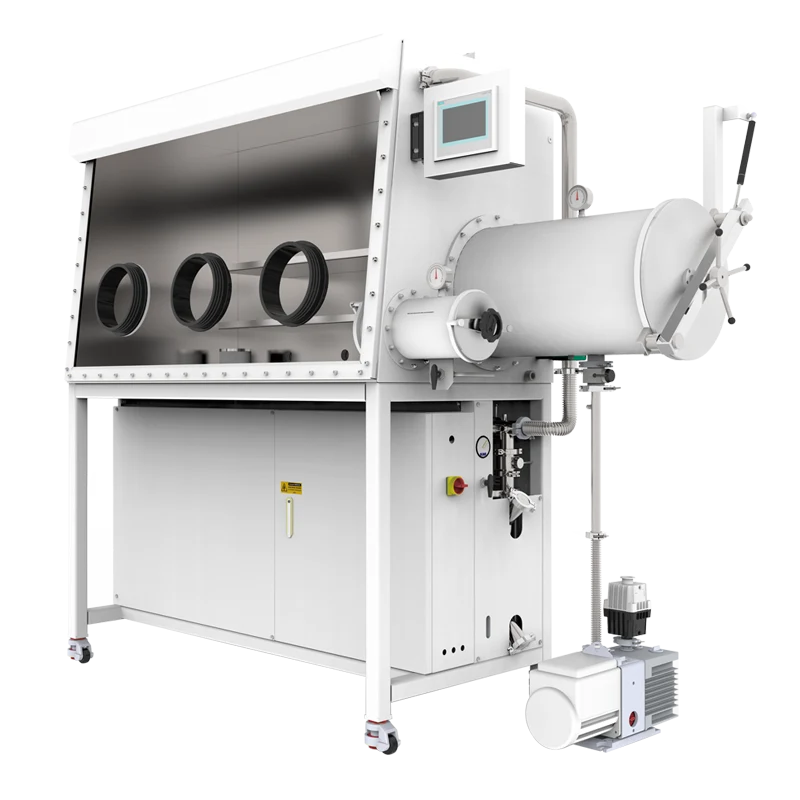
A three-glove single-sided glove box with gas purification is a sealed working chamber with three glove ports on one operating face and a closed-loop atmosphere-purification system. It creates a controlled inert environment for handling materials that react with ambient air, and it maintains that environment through circulation, purification, and monitoring rather than through a single gas fill. The chamber is the workspace, the purifier is the atmosphere-control subsystem, and the gloves are the operator interface.
What the System Does and Where It Sits in the Workflow
In a materials laboratory, the glove box sits between preparation and analysis. A sample may be opened, weighed, mixed, cast, assembled, or transferred into a sealed container inside the box before it ever meets ambient air. The purification system matters because the interior is not a static gas bag. Small leaks, gloves, transfer operations, and materials brought inside all introduce contaminants. Circulation through purifying material is what allows the atmosphere to be cleaned repeatedly during a working session.
The TENCAN three-glove single-sided glove box with gas purification system is identified as a purification glove box, which separates it from a simple vacuum glove box or an acrylic isolation box. A vacuum chamber can be evacuated and refilled, but it does not continuously circulate and clean its atmosphere. An acrylic box can provide a visible barrier, but its suitability for vacuum, solvent exposure, and purification depends on its actual configuration. This unit's defining feature is the combination of a three-glove workspace and a gas-purification system.
How the Gas-Purification Loop Works
Closed-loop circulation rather than one-time purging
In a purification glove box, gas is drawn from the chamber, passed through purifying material, and returned. Water is typically removed by adsorption, while oxygen is removed by reaction with a suitable purifying medium. A blower keeps the gas moving so that the working zone is not dependent on diffusion alone. The purifier columns have a finite capacity. Once they approach saturation, they must be regenerated or replaced according to the manufacturer's procedure.
Regeneration is a separate maintenance step, not the same thing as normal circulation. It commonly involves heat, vacuum, and a purge gas, and it should be carried out under the conditions specified for the equipment. A box that is circulating normally is not necessarily regenerating, and a box that has just been regenerated is not automatically ready for every sensitive process. Stabilization, leak checks, and monitoring all matter before critical work resumes.
Monitoring is part of the loop
Purification and measurement are different functions. A purifier removes contaminants; an analyzer reports what it detects. Oxygen and moisture sensors may be located in the main chamber, in a sampling line, or in a return path, and the reading depends on sensor location, gas flow, calibration, and stabilization time. A display showing a low value is therefore not, by itself, proof that every part of the chamber is at that value. Nor does a single measurement describe the box's performance under a heavy transfer load.
Zirconia oxygen analyzer as a monitoring accessory
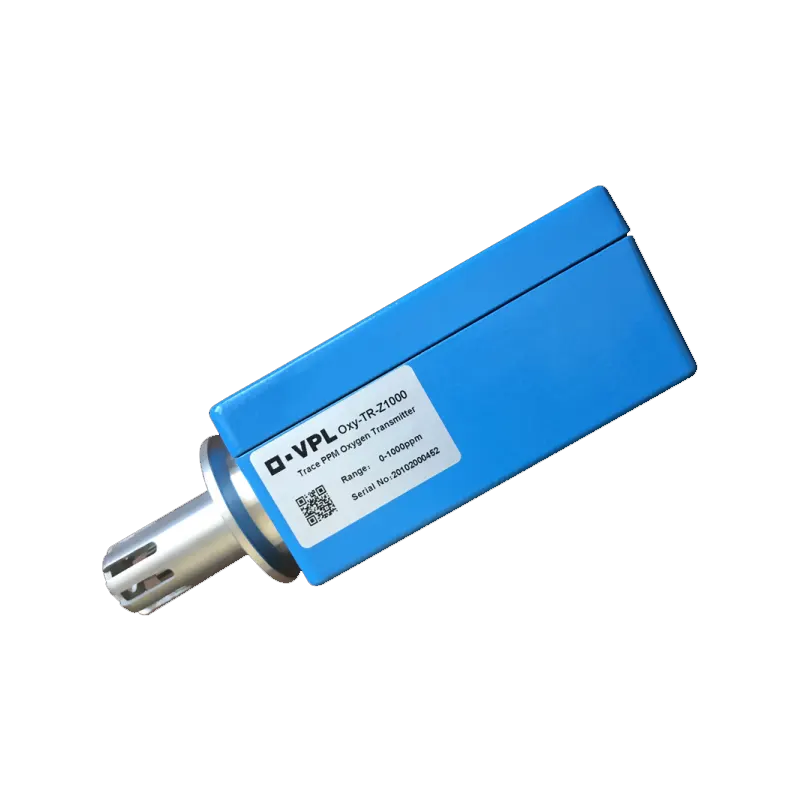
The glove box zirconia oxygen analyzer is relevant to this discussion because oxygen measurement is central to atmosphere control. Its role is monitoring: it does not remove oxygen and it does not replace the purification loop. A zirconia sensor must be matched to the expected gas environment, installed at a suitable point, and calibrated according to its instructions. Before integration, confirm the analyzer's interface, mounting arrangement, sample conditions, and calibration approach with the glove box configuration. It should not be assumed that every analyzer can be added to every box or that its display defines whole-chamber performance.
Why the Three-Glove, Single-Sided Layout Matters
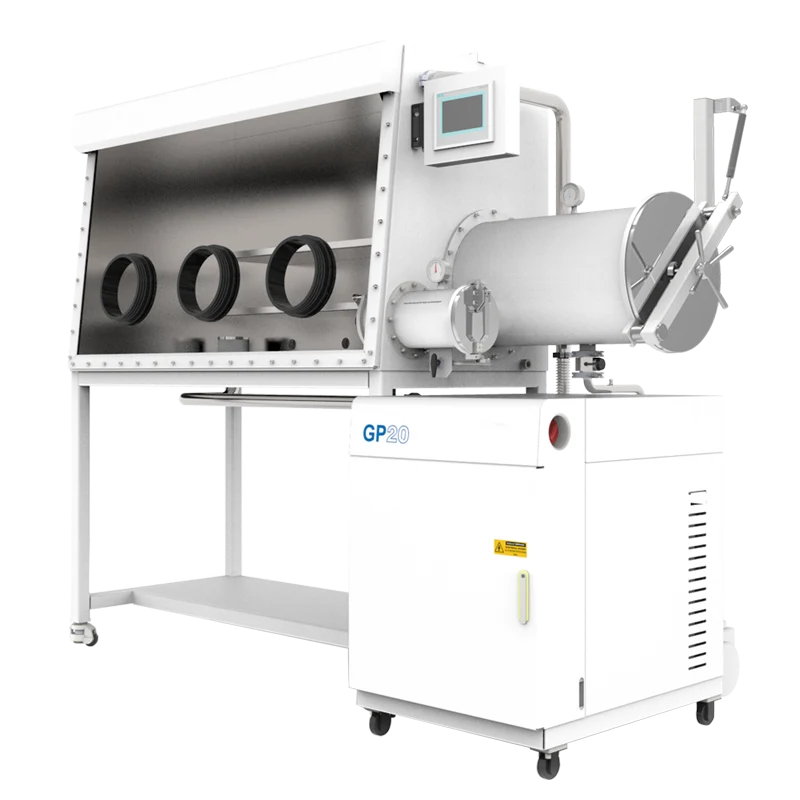
Three glove ports give the operator more than one access position along the working face. That can reduce reaching, support two-handed manipulation with an additional hand position for a tool or sample, and make it easier to arrange tasks across the chamber. The benefit is practical rather than automatic: useful reach depends on chamber depth, port spacing, glove size, and the height of the working surface.
Single-sided access means the operator works from one side of the box. This can simplify placement in a laboratory, keep the service side separate, and reduce the number of faces that must be kept clear for operation. The tradeoff is collaboration. A multi-sided box may allow people to work from different faces, while a single-sided unit concentrates activity on one front. That is not a performance defect; it is a layout choice with consequences for workflow, footprint, and equipment integration.
- Three ports support task sequencing and reach, but they do not necessarily mean three people should occupy the box at once.
- Single-sided access can improve space planning, yet it limits face-to-face collaboration compared with multi-sided designs.
- Glove port spacing and glove material affect comfort, dexterity, and the risk of seal damage.
Which Components and Configurations Deserve Attention
The product information identifies the model and its basic format, but it does not list every dimensional or performance value for a specific project. That is why selection should proceed from verified configuration data rather than from the model name alone.
Chamber, gloves, and viewing
The chamber must fit the sample, tools, and fixtures without forcing awkward reach. Glove selection affects chemical compatibility, permeation, flexibility, and replacement frequency. Viewing surfaces should allow inspection without opening the box, but their material and sealing details must suit the cleaning agents and solvents used nearby.
Transfer path and sealing
Materials enter and leave through a transfer path. If an antechamber is part of the selected configuration, its volume, vacuum capability, and sealing method become part of the workflow. The presence of an antechamber should not be assumed unless it is confirmed in the actual configuration. Leak-tightness is equally important: a well-purified box with a poor seal will consume purifier capacity and create unstable readings.
Purification capacity, utilities, and service
Purifier capacity, blower performance, and regeneration requirements determine how the system behaves under load. Utility needs, exhaust arrangements, and service access also affect where the box can be installed. A purification system that is difficult to service may become a bottleneck even if its nominal capacity looks suitable.
Instrumentation and records
Oxygen and moisture monitoring should be chosen for the information the process actually needs. Record the sensor type, measurement location, calibration procedure, and maintenance interval. If a zirconia oxygen analyzer is used, confirm that its operating conditions and interface are compatible with the box. Instrumentation supports decisions; it does not replace a leak-tight chamber or a functioning purifier.
Specifications to Verify Before Purchase
No single headline number defines a purification glove box. The following values should be verified for the exact configuration, with the measurement object and unit stated clearly:
- Internal working dimensions, glove port diameter and spacing, and usable height above the work surface.
- Chamber sealing and leak-rate basis, including the test method and the pressure or vacuum at which it is stated.
- Purifier capacity, regeneration requirements, and the conditions under which capacity is rated.
- Oxygen and moisture measurement range, resolution, accuracy, calibration method, and sensor location.
- Transfer chamber volume and vacuum rating, if a transfer chamber is included.
- Glove material compatibility, window material, and resistance to the solvents and cleaning agents in use.
- Electrical, gas, exhaust, and service requirements for the planned installation.
Keep units attached to the item being measured. Chamber pressure, antechamber vacuum, pump ultimate vacuum, leak rate, oxygen content, and water content are different quantities. Resolution is not the same as accuracy, and a value achieved under one set of conditions should not be applied to every process. Where a configuration or unit is unclear, omit the number and ask for confirmation.
Where It Fits, and Where It Does Not
A three-glove purification box suits work where samples must be handled rather than merely stored. Typical contexts include lithium and solid-state battery materials, perovskite and OLED devices, semiconductor-related materials, air-sensitive chemistry, advanced materials research, and some additive manufacturing preparation or post-processing steps. The common thread is a need for a sealed workspace with circulating purified gas and controlled transfer.
It is not automatically suitable for every sample or every hazard. Inert atmosphere is not the same as sterile conditions, a cleanroom classification, biological containment, or a fume hood. Solvent vapors require specific compatibility and vapor-management provisions; particle filtration does not remove water, oxygen, or solvent vapor. Sharp tools, high-temperature operations, reactive gases, and unusual materials should be reviewed against the actual chamber, glove, and purifier configuration. When a process falls outside the confirmed limits, the correct response is to modify the setup or choose different equipment, not to assume the box can handle it.
How to Select and Integrate the System
Begin with the sample and the operation, not with a model number. Define the largest item that must be manipulated, the required atmosphere, how often materials will be transferred, whether solvents or heat are involved, and how many people will work at the face. Then compare those requirements with the chamber dimensions, glove layout, transfer path, purification capacity, and monitoring package. Confirm which items are included and which are optional.
- List the materials and processes that will be exposed inside the box, including worst-case spills and solvent use.
- Map the transfer route and decide how often the chamber will be opened or loaded.
- Select monitoring that answers the process question, with a stated calibration and maintenance plan.
- Check utilities, service access, and the space needed for safe operation around a single-sided face.
- Plan training for glove use, transfer discipline, alarm response, and regeneration procedures.
Review the linked product page with TENCAN and ask for the exact configuration data that applies to your order. Confirm whether the zirconia analyzer is compatible with the intended atmosphere and interface, and verify all performance values for the supplied unit. A clear selection record is more useful than a long list of unverified claims.
FAQ
Does the purification system guarantee a fixed oxygen level at all times?
No. It supports atmosphere control, but the actual level depends on sealing, purifier condition, transfer activity, sensor location, and operating discipline. Performance should be verified for the specific configuration and process.
Can the zirconia oxygen analyzer be added to any glove box?
Not automatically. The analyzer must be compatible with the box atmosphere, mounting arrangement, sampling point, and calibration requirements. Confirm the interface and operating conditions before integration.
Is a three-glove box meant for three operators at once?
Not necessarily. Three ports provide access positions and reach, but comfortable occupancy depends on chamber size, task design, and internal clearance. One or two operators may work more effectively than three.
Does a single-sided box have lower atmosphere performance?
No. Single-sided describes the operating layout, not the purification capability. Atmosphere performance depends on sealing, purifier design, monitoring, transfer practice, and maintenance.
