
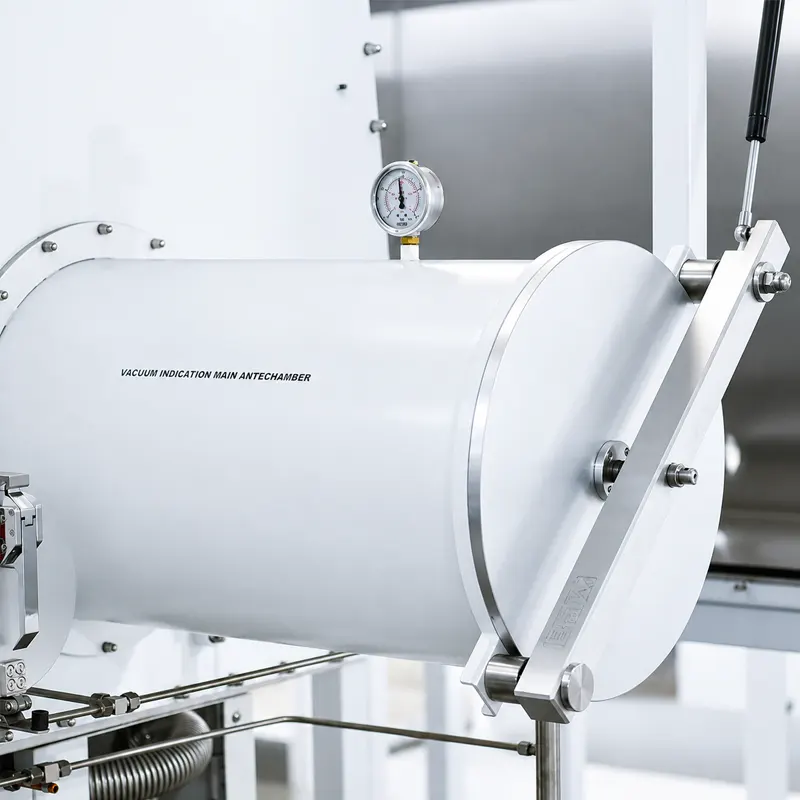
A large glove box antechamber is a transfer airlock mounted to a controlled-atmosphere glove box. It sits between the laboratory and the box interior, with an outer door and an inner door, and it gives operators a buffer volume for moving samples, tools, or equipment in and out without opening the main chamber directly to room air. Its purpose is not to purify the box atmosphere. It is to reduce the amount of air, moisture, and particles that enter during a transfer, and to keep the main chamber from being disturbed every time something needs to pass through. The Large Glove Box Antechamber from TENCAN Glove Box Systems is the accessory discussed here; its size makes it relevant to bulky items rather than routine small-sample traffic.
Why Transfer Is a System-Level Problem
A glove box is not protected only by its walls. It is protected by the way every opening is managed. Even a brief door opening lets room air enter, and that air carries oxygen, moisture, and particles. A purification system can remove contaminants from the circulating gas, but it has to process the load that reaches it. The more air that enters during a transfer, the longer the purification loop may need to restore the set condition. This is why transfer hardware deserves the same attention as the purifier itself.
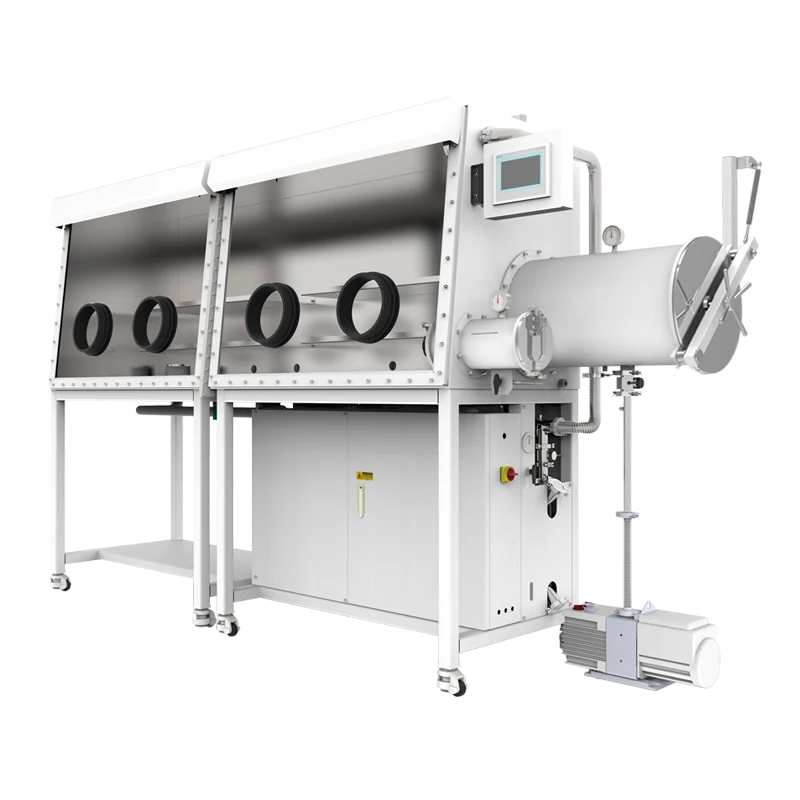
The two-station single-sided split-type glove box with gas purification system is an example of a system where continuous atmosphere control and batch transfer are separate functions. The purification loop manages the circulating atmosphere; the antechamber manages access. One does not replace the other. A large antechamber can reduce the number of direct door openings, but it also introduces a larger volume that must be exchanged before the inner door is opened.
What Does a Large Glove Box Antechamber Do?
Functionally, the antechamber is an airlock. It creates an intermediate volume between two sealed doors. The operator loads material through the outer door, closes it, and then brings the intermediate volume into a condition that is acceptable for the main chamber. Only then is the inner door opened. The main chamber is never directly connected to the room for the entire transfer, and large items can be staged without holding the inner door open.
The word large in the product name matters for workflow, not for purification performance. A larger chamber can accept equipment, fixtures, sample boxes, or several small items at once. That can reduce the number of transfer cycles and make better use of the box working time. The trade-off is that a larger chamber holds more gas and exposes more internal surface area, so purge or evacuation can take longer. It can also be heavier and occupy more bench or floor space, which changes how the box is laid out and serviced.
An antechamber is not a storage chamber. Keeping air-sensitive material in it does not provide the same environment as the main box, especially if the unit is not continuously purged or is opened frequently.
Where It Sits in the Glove Box System
The antechamber is normally attached to the glove box shell or its support frame. Its inner door faces the controlled workspace; its outer door faces the room. The installation has to leave enough clearance for the door swing, the item being carried, and the operator's hands and shoulders. For a large unit, the support structure and the interface to the box are as important as the chamber volume. A generous chamber that is difficult to reach or that loads the box wall unevenly is not an improvement.
This accessory sits on the transfer side of atmosphere management, not on the purification side. The box's gas purification system, circulation blower, and oxygen or moisture monitoring are separate from the antechamber. If the antechamber is purged, the purge gas and the main box working gas need to be considered together, but the antechamber itself should not be described as maintaining a low-oxygen atmosphere. It only limits the disturbance caused by access.
How the Transfer Works
The exact procedure depends on the build, but the principle is consistent. The material is prepared and contained; the outer door is opened; the material is loaded; the outer door is closed and sealed; the chamber atmosphere is exchanged according to the design; the inner door is opened only when the chamber is suitable for the main box; and the inner door is closed again before the next cycle. The manufacturer's operating instructions should define the actual sequence, waiting times, and acceptance criteria.
Atmosphere exchange may be purge-only, or it may use evacuation and refill. Those are different capabilities. A purge-only antechamber relies on displacement and dilution with working gas. A vacuum-assisted antechamber uses a pump to reduce the chamber pressure before refilling, which can remove more of the original air in fewer exchanges, but only if the chamber, doors, windows, and seals are rated for vacuum. The name Large Glove Box Antechamber does not by itself prove that a unit is vacuum-capable, so that point must be confirmed from the specification.
Pressure equalization also matters. If the inner door is opened while the antechamber and box are at very different pressures, the resulting flow can disturb the atmosphere, move lightweight items, or stress gloves and seals. A large chamber amplifies these effects because it contains more gas and exposes more surface area to moisture and oxygen.
Which Configuration Details Matter?
Chamber Size and Door Clearance
Useful capacity is not the same as external size. The dimensions that matter are the usable internal space, the clear opening of each door, and the path the item takes from the room into the box. A rectangular instrument may fit inside the chamber but still fail to pass through the inner door or around the box frame and gloves. Check the largest item, the carrying fixture, and the operator's hand position.
Door Sealing, Hinges, and Structure
Large doors need stiffness. If a door flexes, the gasket may not compress evenly, and a seal that looks closed can still leak. Hinge design, latch position, and gasket material all affect repeatability. Confirm how the seal is inspected, cleaned, and replaced. Sharp tools, abrasive powders, and solvent residue can damage sealing surfaces, so the transfer routine should include protection for the gasket.
Vacuum and Purge Provisions
Ask whether the chamber is intended for purge only or for vacuum service, and confirm the rating basis. A pressure or vacuum figure should state what it applies to, whether the chamber body, the door, the window, or the seal, and under what conditions. Ports for gas inlet, vent, vacuum, and monitoring are part of this decision. A gauge that displays a number is not necessarily calibrated for the range you need.
Materials, Ports, and Cleanability
The chamber material and surface finish affect cleaning and chemical compatibility. If solvents, acids, or reactive powders will pass through, the wetted materials, window, and seals need review. A particle filter removes particles, not moisture or solvent vapor; a solvent adsorber does not replace the box's oxygen and moisture purification. Ports, shelves, and internal corners should be reachable for cleaning so that residue does not become a persistent contamination source.
Manual valves and doors are common, but the workflow should still define who opens what and when. If an interlock is available, confirm what it prevents, such as both doors being open at the same time. Controls should be readable from the operator position, and alarms should be understandable. A large antechamber can become a bottleneck if its cycle time is longer than the box's actual transfer demand.
Which Specifications Should You Check?
Before ordering, ask for a dimensional drawing rather than relying on a photograph. The drawing should show external dimensions, internal dimensions, door clear openings, port locations, mounting points, and the direction of door swing. Then check:
- Load and support: the weight of the chamber, the item, and any shelf or fixture, plus how the unit is supported by the box or floor.
- Pressure and vacuum boundaries: the rated conditions for the chamber, doors, window, and seals, kept separate from the glove box working pressure and the pump's ultimate vacuum.
- Leak integrity: the specified leak rate or test method, the seal material, and the maintenance interval for gaskets.
- Gas and pump connections: port type, size, number, and compatibility with the intended working gas, purge gas, and any solvent vapor.
- Monitoring: whether a gauge, sensor, or analyzer is supplied, what it measures, and how it is calibrated. Resolution is not the same as accuracy.
- Materials and cleaning: chamber, window, seal, and shelf materials, plus the cleaning agents they tolerate.
- Controls and documentation: manual or automated operation, interlocks, alarms, spare parts, and the operating manual.
Do not treat the antechamber pressure rating, the glove box working pressure, the transfer chamber vacuum level, the pump's ultimate vacuum, and the box's leak rate as interchangeable numbers. They describe different boundaries and different tests. If a value is missing or its basis is unclear, omit it from the decision until the manufacturer confirms it.
Where Is It Suitable, and What Are Its Limits?
A large antechamber is suitable when the transfer task is larger than a standard small port can handle, or when several items need to be staged together. It fits research and production support work involving air-sensitive battery materials, perovskite and OLED devices, semiconductor samples, air-sensitive chemistry, advanced materials, and additive manufacturing operations that require inert handling. In those settings, its value is practical: fewer direct openings, less disruption, and a defined place to prepare items before they enter the box.
Its limits are equally practical. It does not create a low-oxygen atmosphere on its own, and it does not replace a gas purification system, a continuous oxygen monitor, or a moisture monitor. It is not a sterile barrier, a cleanroom classification, a biological safety cabinet, or a certified hazardous-waste enclosure. It cannot make every material compatible with every gas. Loose powders should be transferred in closed containers because powder can migrate into seals and ports. Solvent-laden items can desorb vapor into the chamber, so the need for solvent management and the compatibility of seals and windows should be reviewed before the first transfer.
Size is not automatically an advantage. A large chamber can increase purge gas consumption, extend cycle time, and make the overall box layout less efficient if most transfers are small. It can also encourage poor practice if users treat it as a storage cabinet. The right size is the smallest chamber that reliably accepts the real item mix with safe clearance and a workable cycle.
How Should You Select and Integrate It?
Start with a transfer list, not a product name. Record the dimensions, weight, shape, packaging, and frequency of the items that will pass through, then add the carrying fixture and the operator clearance. From that list, define the required internal volume and door openings. Next, map the interface to the glove box: mounting points, inner-door clearance, structural support, service access, and the route for gas and vacuum lines.
Then choose the exchange strategy. If the work is not highly sensitive to trace air and the chamber is purge-only, a simpler design may be adequate. If fast recovery or more complete exchange is needed, a vacuum-capable design may be appropriate, but only when the chamber and seals are rated for it and the pump is compatible with the gas and any condensable vapors. The pump, gauge, and valves should be selected as a system, not as unrelated accessories.
Before installation, obtain a drawing and written confirmation that the antechamber can be fitted to the intended glove box. Do not infer compatibility from appearance or from the fact that both products are sold by the same supplier. After installation, check the seals, confirm the door operation, establish a practice transfer with non-critical items, and document the procedure. Train users on the difference between the antechamber and the purifier, and keep spare gaskets and other wear parts on hand.
Frequently Asked Questions
Does a large antechamber include a gas purification system?
No. It is a transfer chamber. Gas purification is a separate function, as shown by the linked two-station glove box with a purification system. A purge connection on an antechamber is not the same as a closed-loop purification system.
Can it lower oxygen and moisture by itself?
It can limit the amount that enters the box, and purging can reduce contamination inside the antechamber. It does not actively remove oxygen and moisture from the main box atmosphere. That is the role of the purification system and its monitoring.
Is a vacuum-capable antechamber always better?
No. Vacuum-assisted exchange can be effective, but it adds pump and seal requirements, structural demands, and maintenance. A purge-only design may be sufficient when the process tolerates it. Confirm the rating instead of assuming that every large antechamber can be evacuated.
How can I judge whether it fits my glove box?
Compare the interface dimensions, door clear openings, mounting method, inner-door swing, and structural support. Then ask the manufacturer to confirm the fit for the specific box. A similar external size is not enough evidence of compatibility.
