
A large glove box antechamber is the transfer lock mounted on the wall of a glove box main chamber. It is the intermediate volume that lets samples, tools, small instruments and batch trays pass between the laboratory atmosphere and the inert working atmosphere without opening the box itself. Its purpose is not to purify gas; it is to limit how much air, moisture and oxygen is admitted each time something has to go in or come out, and to leave the rest of the job to the purification loop.
What Is a Large Glove Box Antechamber?
An antechamber — also called a transfer chamber, airlock, entry port or pass box — is a sealed compartment attached to the enclosure wall. It normally has two doors. The outer door faces the room; the inner door faces the glove box working space. They are used one at a time, so the main chamber is never directly connected to ambient air. That two-door arrangement is the entire point: a box opened directly to the room loses its atmosphere within seconds, and the purification system then has to remove the moisture and oxygen that rushed in.
Within the accessory family, the antechamber sits alongside gloves, glove ports, vacuum pumps, feedthroughs, filters, solvent adsorption units and analyzers as a component that supports the main system. It is not a standalone enclosure and it is not a purification device. Unless a specific design adds glove ports of its own, it offers no working space in which to manipulate samples.
The word "large" describes the internal envelope rather than the performance. A large chamber is sized so that items which cannot be squeezed through a small round port — a fixture, a crucible, a stack of substrates, a small instrument, a tool set, or a sealed transport container — can still be transferred. TENCAN lists a large glove box antechamber among its glove box accessories; the sections below explain how such a chamber works and what should be verified before specifying one.
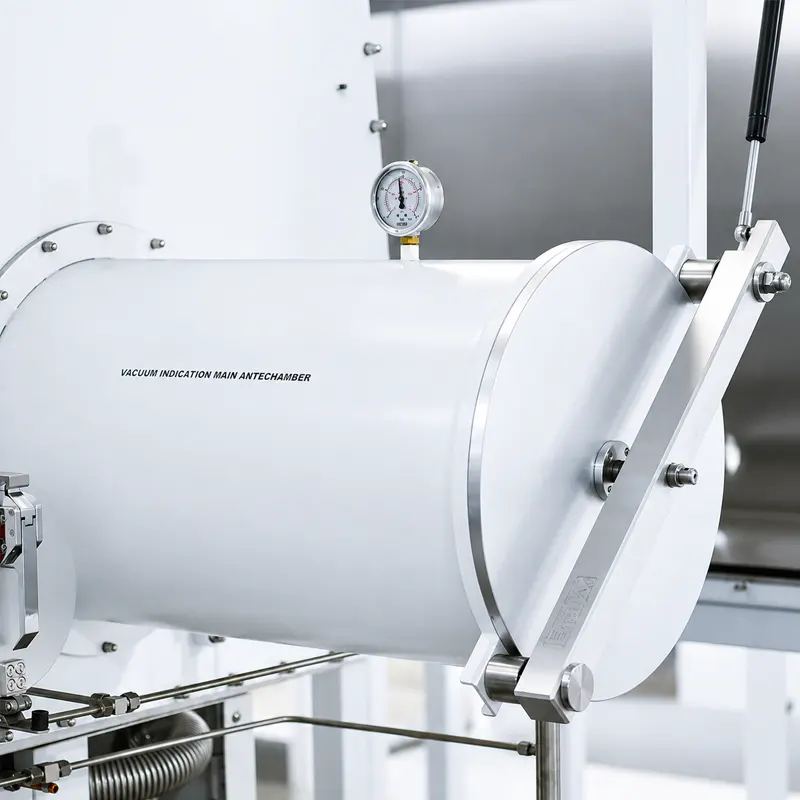
Mechanically, the assembly is usually straightforward: a chamber body, an outer door, an inner door, elastomer seals on both, a tray or shelf inside to support the payload, and a set of ports on the body for evacuation, gas refill and measurement. Chamber bodies for vacuum duty are commonly stainless steel; other constructions appear where the duty is milder. Door hardware may be hinged or sliding, and latches may be manual or, on automated designs, driven by actuators with interlocks.
What Does It Do and How Does It Work?
Function follows a fixed sequence. The chamber is loaded from the room side, closed, brought to the same gas condition as the box interior, and only then opened to the working space. Everything else in the design exists to make that sequence repeatable and to keep the two atmospheres apart while it happens.
The transfer cycle, step by step
- Place the payload on the tray or shelf with the outer door open, keeping the inner door closed.
- Close and latch the outer door so the chamber is sealed against the room.
- Evacuate the chamber with a vacuum pump, or sweep it with working gas if the chamber is a purge-only design.
- Backfill with working gas — nitrogen, argon, or another gas compatible with the process.
- Repeat the evacuation and backfill as many times as the procedure requires, with the last step leaving the chamber at or slightly below the box pressure so the inner door opens easily.
- Open the inner door, move the payload into the main chamber, and close the inner door again.
Some chambers are used purely as pass-through volumes, swept continuously with working gas and never evacuated. Others alternate evacuation and refill several times before each transfer. The choice belongs to the procedure, and it should be written down rather than improvised, because it determines both how clean the transfer is and how much gas it consumes.
Why the cycle is repeated rather than performed once
A single evacuation does not empty the chamber of air. It removes a fraction of the gas present, and the refill replaces that fraction with working gas, so each additional cycle multiplies the dilution of the remaining contamination instead of removing it outright. Surfaces behave the same way: the chamber walls, the tray and the payload itself hold adsorbed moisture and oxygen that desorb slowly after the gas phase has been exchanged. That is why cycle count, dwell time and payload preparation matter as much as the vacuum hardware.
How the antechamber relates to the purification loop
The water and oxygen level of the main chamber is maintained by the purification system: gas is circulated through purification columns while the atmosphere is monitored, and the purification material is regenerated periodically. The antechamber absorbs nothing. It reduces the quantity of contamination that reaches the loop during a transfer; the residual load remains the loop's job. The relationship runs in both directions. A large chamber cycled carelessly, or a payload carrying solvent or moisture, presents a heavier load than the same transfer made through a small port. Gas removed during evacuation also leaves the closed loop and must be replaced from the working gas supply, which is a real operating consideration on a system that runs frequent transfers.
Which Types or Configurations Matter?
Antechambers differ in ways that matter more than the product name: whether the chamber can be evacuated, what shape it is, how it is loaded and how the two doors are controlled.
Vacuum-capable and purge-only chambers
A vacuum-capable chamber is built to be evacuated, which means a body, doors and seals rated for external pressure, plus a pump matched to the internal volume and to the gas being handled. A purge-only chamber relies on gas sweeping and dilution without evacuation. Purge-only designs avoid vacuum-rated hardware and are simpler to operate, but they generally remove contaminants less effectively per cycle and consume more working gas. They suit duties where the atmosphere requirement is modest, or where the payload cannot tolerate evacuation. Whether a given large antechamber can be evacuated is a specification question, not an assumption to be made from its appearance.
Geometry: cylindrical, rectangular, pass-through and side-entry
Cylindrical bodies resist external pressure efficiently and seal with a simple round door, which makes them a common choice for vacuum duty. Rectangular chambers offer a more usable envelope for box-shaped items and racks, but flat panels and long seal runs need adequate stiffness to avoid deflection under vacuum. A pass-through chamber has doors on opposite ends, so material can be pushed in from one side and collected inside; a side-entry chamber mounts on the box wall with the outer door facing the operator. Reach, door swing and the height of the opening all decide how easily a heavy item can be handled without strain.
Doors, trays and interior access
Doors may be hinged or sliding, and some designs add a rail, roller tray or removable shelf so the payload can be slid into the box instead of lifted through the inner opening. A viewport, or a small set of glove ports on the antechamber itself, lets an operator reposition an item before the inner door is opened. Interlocks — mechanical or electrical — prevent both doors from being open at the same time. This is a protective feature for both the operator and the atmosphere, not a convenience.
Which Specifications Should You Check?
Internal dimensions, usable volume and door aperture
Check width, height and depth, or diameter and length, together with the clear opening of both doors. The smaller door is what the payload must pass through, so the largest diagonal of the item matters more than its nominal footprint. Allow for the tray thickness and for any interior fittings that reduce the usable space.
Vacuum rating, pump matching and cycle time
Distinguish between the chamber's design vacuum level, the working pressure reached in routine operation, and the pump's ultimate vacuum. These are three different numbers, and none of them is the water or oxygen content of the main chamber. A larger internal volume takes longer to pump down and longer to backfill, which directly affects cycle time and gas use. Confirm which pump type and capacity the chamber was designed for, how the pump is controlled, and whether the pump is included or supplied separately.
Seals, materials and gas compatibility
Door seals are elastomer O-rings, and the elastomer selection governs tolerance to solvent vapor and to reactive gases. Stainless steel bodies tolerate moisture and most common process gases; polymer or acrylic components have different compatibility and different vacuum limits. If the process involves solvent-laden samples, the seal and body materials deserve a direct question to the supplier rather than an assumption based on the main enclosure.
Ports, gauges and instrumentation
Look at port quantity, size and flange standard, whether a vacuum gauge is fitted, whether there is a dedicated vent or pressure relief, whether the chamber draws gas from a cylinder supply or from the box loop, and whether the cycle is manual or controlled by a sequence with interlocks. An analyzer on the main chamber measures the working atmosphere; it does not measure the antechamber, and it does not restore the atmosphere.
Mounting and structural interface
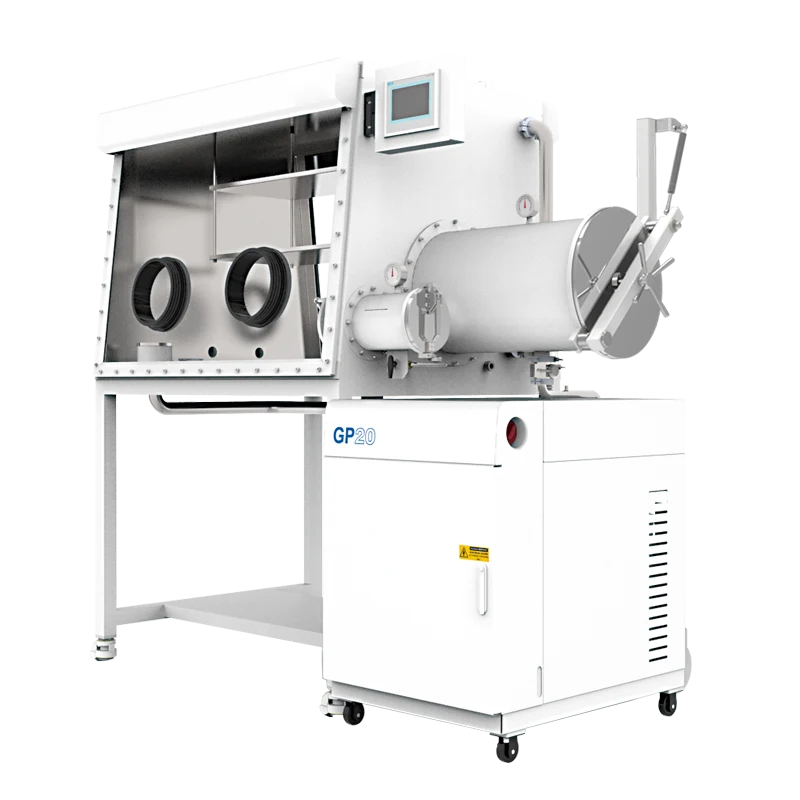
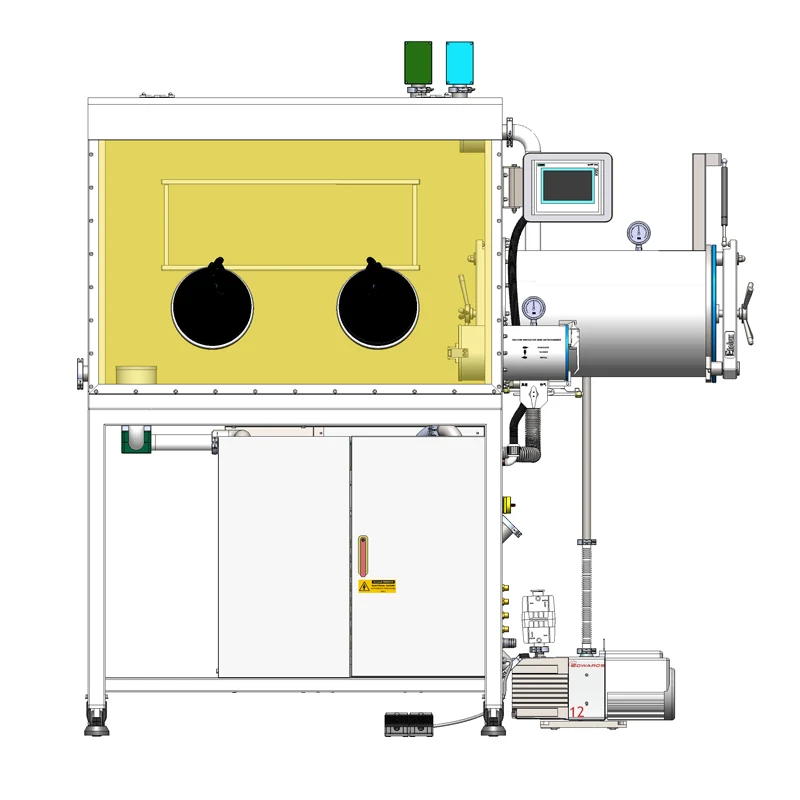
The chamber must attach to the box wall through a matching opening and flange pattern, and the wall must carry the weight of the chamber plus payload. Door swing, operator reach and the position of adjacent ports or viewing panels all need clearance. These are drawing-level questions that belong to the supplier's specifications rather than to inference from a product photograph.
Where Is a Large Antechamber Suitable, and Where Is It Not?
Situations where it earns its space
- Transferring equipment and fixtures that cannot fit through a small port: crucibles, molds, sample holders, small instruments and tool kits.
- Moving batches of substrates or wafers into a box for perovskite, OLED, semiconductor or two-dimensional-material work, where several items can be loaded in one transfer.
- Air-sensitive chemistry, including organometallic reagents and alkali metals, where exposure during transfer has to be minimized.
- Lithium and solid-state battery research, where metal foils, electrolyte materials and cells must move without contact with humid air.
- Additive manufacturing and post-processing, where printed parts or sealed containers of powder have to reach the inert workspace before handling.
- Pass-through routes between two work areas, when the chamber has doors on opposite ends.
Limits and boundaries
- It is not a purifier. It cannot lower water and oxygen by itself; it only reduces the contamination admitted per transfer.
- A larger chamber is not automatically better. More volume means more gas per cycle, longer evacuation and a larger wetted surface area that can hold adsorbed moisture.
- It is not a working chamber. Without its own glove ports, nothing can be manipulated inside it.
- It does not make a process sterile, cleanroom-classified or biologically contained. An inert atmosphere is not a cleanliness or biosafety rating, and particle filtration removes particulate matter rather than moisture or solvent vapor.
- Materials that outgas — solvents, porous parts, damp samples, some polymers — continue releasing contamination inside the chamber. A purge cycle cannot remove what a surface keeps releasing.
- Compatibility with a particular glove box is not automatic. Flange geometry, wall loading, gas supply, purification capacity and available space are all specific to the host enclosure, and a chamber should not be assumed to fit a system it was not specified for.
- A design vacuum rating is not a license to use the chamber as a vacuum oven or as a reaction vessel for aggressive chemistry.
How Should You Select and Integrate a Large Antechamber?
Work backward from the payload and the atmosphere the process actually needs, then check the host system against those requirements.
- Define the payload envelope and weight, including packaging and the tray, and identify the largest single item that must pass through.
- Define the atmosphere requirement after transfer: a rough purge is enough for some work, while moisture- and oxygen-sensitive samples need a defined cycle count and a purge gas of known quality.
- Decide whether the chamber must be evacuated or whether sweeping is sufficient, since this choice drives body construction, seals and pump requirements.
- Check the host system. Wall space, flange pattern, structural loading, gas supply and the capacity of the purification loop all have to be reconciled. A host platform such as the two-station double-sided glove box with gas purification system offers a broad wall area and a purification loop, but whether a given antechamber suits it is confirmed from drawings and specifications, not from the product family name.
- Decide who operates it and how: interlocks, cycle records, tray design, and the physical height of the opening for the people who will use it every day.
- Standardize the procedure. Minimize the number of items per transfer, dry or double-bag payloads where possible, respect the specified cycle count, and record each cycle so that atmosphere excursions can be traced.
Short Answers to Common Questions
Does the antechamber purify the atmosphere by itself?
No. It has no purification material and no circulation loop. It limits air ingress; the purification system of the main enclosure maintains the atmosphere.
Can a large antechamber bring water and oxygen to very low levels on its own?
No. Evacuation and backfill cycles dilute the contamination left in the chamber and reduce what reaches the box, but the residual load is removed by the purification loop. Cycle count, payload cleanliness and chamber sealing all affect the result.
How can I tell whether a chamber fits my glove box?
Compare the mounting opening and flange pattern, the wall panel that has to carry the load, the space required for door swing, and the proximity of existing ports and viewing panels. Ask the supplier for interface drawings before ordering.
When is a large chamber worth choosing over a small one?
When the payload or the batch size genuinely requires it. The trade-off is straightforward: a larger envelope, paid for with longer cycles, more gas per transfer and a larger internal surface that can hold adsorbed moisture.
Does it need its own vacuum pump?
Vacuum-capable designs generally do, and the pump must be matched to the chamber volume, the gas being handled and the working pressure the procedure requires. Corrosion resistance and the pump's tolerance to the process gas should be confirmed rather than assumed.
An antechamber is a modest-looking part of a glove box installation, but it sits on the boundary where the process is most exposed. Treating it as a component with its own dimensions, sealing, pumping and procedural requirements — rather than as an accessory that simply bolts on — keeps the working atmosphere stable and keeps transfers predictable.
