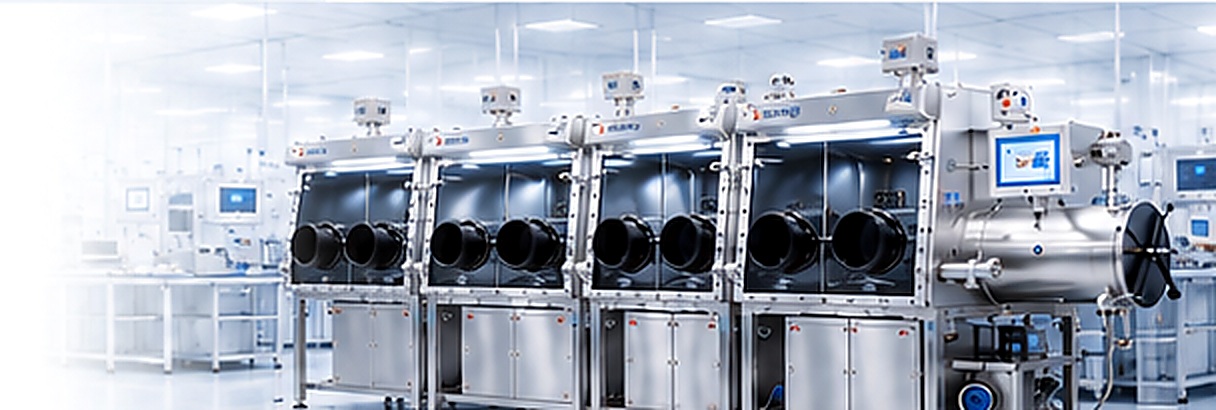
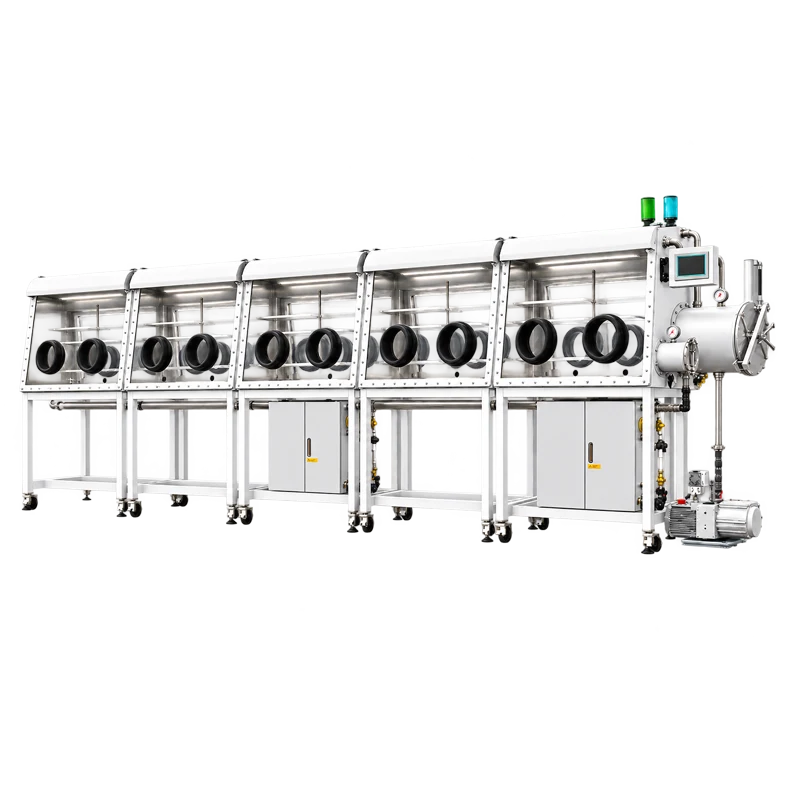
A ten-station double-sided split-type glove box with gas purification system is a sealed enclosure that provides ten operating positions, access from both long faces, a modular enclosure structure, and a closed-loop purification unit that continuously removes oxygen and moisture from the working atmosphere. The purification system sits outside the working volume — normally in a base cabinet or an adjacent frame — and connects to the enclosure through supply and return ducts. It answers a practical laboratory problem: how to give a research group many working positions inside one shared, continuously cleaned atmosphere, instead of spreading the same work across several small boxes that each need separate monitoring, regeneration and operating discipline.
What the Ten-Station Layout Changes in Practice
A two-port glove box is designed around one operator and one experiment. Stretching the same concept to ten stations changes several parameters at once, and they interact. The internal volume is far larger, so the circulation rate and the purification capacity must be matched to that volume rather than inherited from a compact design. A long enclosure also needs structural bracing, uniform lighting along its whole length, and a return duct path that keeps the atmosphere moving instead of allowing stagnant zones at the ends.
The more subtle change is social rather than mechanical. Ten stations share one atmosphere, which means one poorly sealed sample, one spilled solvent, or one glove punctured on a needle affects every user at the box. Long enclosures therefore reward disciplined transfer procedures and continuous atmosphere monitoring far more than a small benchtop unit does. When a group is planning a ten-station box, the questions worth asking early are who owns the atmosphere, how samples enter and leave, and how the group will detect a problem before the next experiment is loaded.
How the Gas Purification Loop Works
The phrase "with gas purification system" describes a closed loop rather than a filter. Understanding the loop helps when reading specifications, because each part of it has a different job.
The circulation path
Box atmosphere is drawn from a return duct, passes through a particle filter and a blower, then crosses one or two purification columns before being returned to the enclosure through a supply duct. A purification column normally combines two functions: a physical adsorbent, typically a molecular sieve, which captures water, and a copper-based catalyst, which removes oxygen by chemical reaction. The working gas in an inert box therefore circulates continuously during operation and is cleaned each time it passes the column. The loop is what makes a stable atmosphere possible at all; without circulation, water and oxygen released from samples would remain in the vicinity of the work.
Regeneration, and why two columns are common
Purification media have finite capacity. When a column approaches saturation it is taken offline, heated and purged with a regeneration gas, then cooled and returned to service. This is why glove box purification systems commonly carry two columns: one purifies the box while the other is regenerated, so the atmosphere is never left without cleaning. The regeneration gas composition, the temperature profile and the duration are set by the manufacturer and belong in the operating manual, not in improvisation on the laboratory floor. Regeneration also consumes gas and time, so the availability and purity of the regeneration supply, and the ability to exhaust the purge stream safely, are things to plan before installation rather than after.
What the loop does not remove
A purification system designed for water and oxygen does not address every contaminant. It does not remove nitrogen from the working gas — nitrogen is often the working gas itself. It does not remove solvent vapour, which is why solvent adsorption is treated as a separate function when solvents are used inside the box. It does not filter particles; that is the job of a HEPA element. And it cannot compensate for a leak: a purification system maintains a clean atmosphere inside a sealed box, but it cannot clean a box that is allowing laboratory air in. If water and oxygen readings drift upward with no change in workload, the leak path is usually the first thing to look for.
Double-Sided and Split-Type Construction
Working from both faces
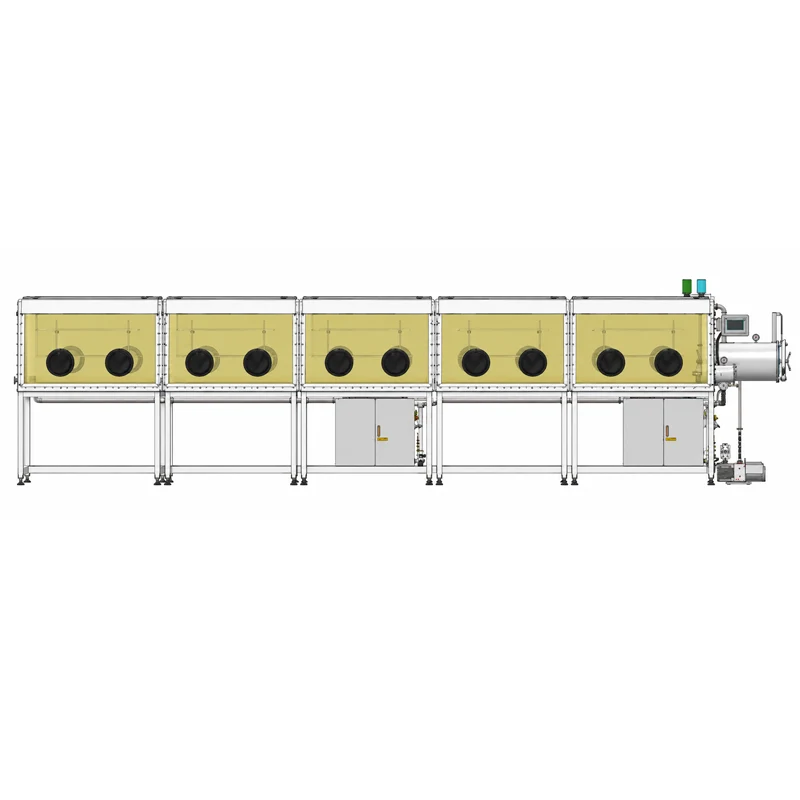
A double-sided enclosure has viewing panels and glove ports on both long sides, so two operators can work facing each other, or one operator can reach distant areas without walking around the box. In long purification boxes this is more than a convenience. It shortens the distance between an operator and a far part of the work zone, it allows a second person to help with a bulky sample without reaching over someone else's experiment, and it lets one side serve as a staging or instrument area while the other is used for active work. The trade-off is footprint: a double-sided box needs clear access on both sides, which affects room layout, lighting and where the purification cabinet can sit.
What a split enclosure implies
A split-type glove box is built as modules that are joined and sealed on site, rather than as one welded enclosure that must be moved through the building in a single piece. The practical benefits are transport and installation, since laboratory doors, corridors and lifts rarely accept a ten-station enclosure in one unit. The practical cost is that each joint is an additional sealing interface, and each sealing interface is a place to inspect and eventually to service. When comparing quotations, confirm how the modules are joined, what gasket material is used at the joints, whether every module has its own antechamber or shares one, and whether the purification loop serves all modules from a single circuit. If the modules share one loop, they also share one atmosphere, which brings the discipline requirements described above.
Monitoring the Atmosphere: Where a Trace Oxygen Analyzer Fits
Purification and measurement are separate functions, and confusing them is one of the most common misunderstandings in glove box operation. The purification system changes the atmosphere; an instrument such as a glove box trace oxygen analyzer reports what the atmosphere actually is. A trace oxygen analyzer is typically installed on a sampling line, either as a sensor mounted in the box or as an external instrument that draws a small sample through tubing. It is used to confirm that the loop is doing its job, to detect a gradual rise caused by a leak or an outgassing sample, and to document conditions during sensitive processes.
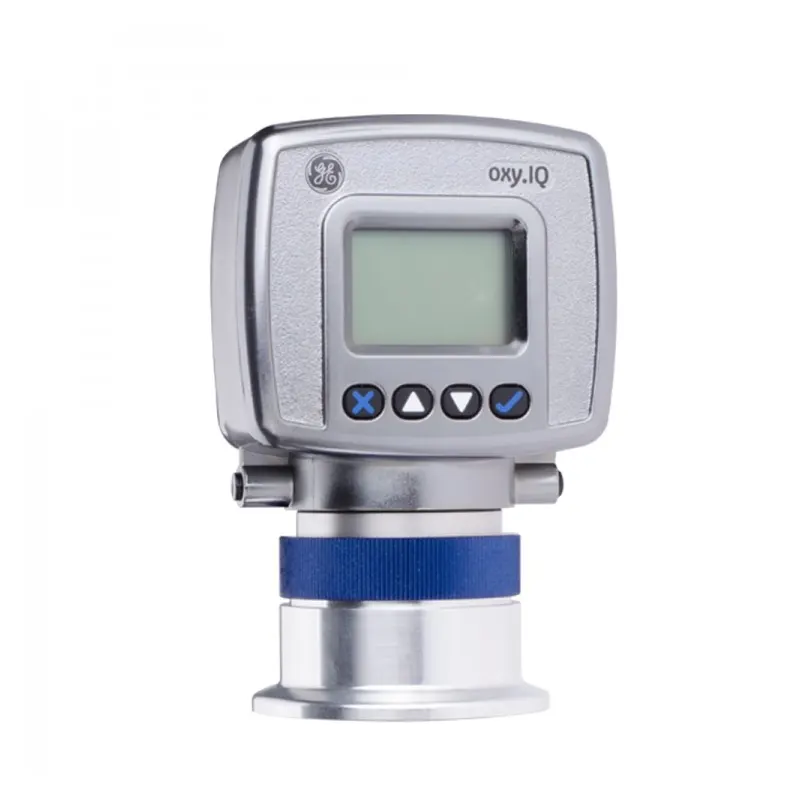
When specifying an analyzer, the numbers that matter are not all the same number. Measuring range should suit both ends of the working cycle: a wide range is useful during initial purging, while the low end is what matters during steady operation. Resolution and accuracy are different parameters, and a display with fine resolution does not by itself mean a fine measurement. Calibration with a certified reference gas, response time, sensor life and the effect of sample flow rate all influence what the reading means in practice. The sampling point also matters: a sample drawn from a stagnant corner of a ten-station enclosure may not represent the zone where work is carried out. An oxygen reading, finally, describes oxygen only. Water content requires its own measurement, and neither reading should be treated as a substitute for the other.
Specifications to Check Before You Specify
Atmosphere performance and how it is defined
Ask how each atmosphere figure was obtained and under what conditions: with a freshly regenerated column, with no sample load, in a closed and empty box. Values described as achievable should be distinguished from values guaranteed continuously during production work. Confirm the working gas, the control gas and the regeneration gas required by the system, and whether those supplies are available at the required purity in your building.
Transfer and antechamber capacity
An antechamber, not the purification system, usually determines throughput. Check its internal volume and door dimensions against the largest item you expect to move — a battery cell fixture, a microscope stage, a sealed transport container. Confirm whether the antechamber is a vacuum chamber served by a pump or a simpler purge chamber, how many antechambers the configuration includes, and where they are positioned on a long split enclosure. Small items are often better served by a mini antechamber so that the main chamber is not cycled for every sample.
Enclosure material, gloves and sealing
Stainless steel construction resists solvents and mechanical damage; transparent polymer enclosures offer visibility and lower weight with different chemical tolerance. Either way, gloves are the component most often in contact with the process. Glove material, thickness and permeation behaviour should be matched to the chemicals handled, since a thinner glove improves dexterity while generally offering less resistance to permeation. Glove port diameter, cuff design and O-ring material all need to match the gloves you intend to use, and spare gloves, seals and port hardware are normal consumables to plan for.
Utilities, feedthroughs and auxiliary equipment
Electrical and signal feedthroughs, gas and liquid lines, KF interfaces, and vacuum connections determine what can be operated inside the box. A vacuum pump should be selected for the gas it will handle and the load it will see, not only for the lowest pressure it can reach. Where processes generate particles or solvent vapour, HEPA filtration and solvent adsorption are separate add-ons with separate purposes. Where processes generate heat, cooling provisions inside the enclosure deserve early attention.
Where the System Fits, and Where It Does Not
A ten-station double-sided purification box suits work in which several people handle air- and moisture-sensitive materials in parallel: lithium and solid-state battery materials, perovskite and OLED device preparation, semiconductor and thin-film processing, air-sensitive synthesis and catalysis, metal and alloy powder handling before and after processing, and general materials research that cannot tolerate oxygen or water. The common thread is a process requirement that the atmosphere be controlled, monitored and continuously cleaned.
An inert atmosphere is not a sterile environment, a cleanroom classification, or a biological safety enclosure, and a glove box should not be presented as one. Two further limits are easy to overlook. First, not every gas is inert toward every material: nitrogen is not the right working gas for lithium metal, where argon is normally preferred, so the choice of atmosphere must follow the chemistry. Second, size brings a constraint of its own: ten stations may share one atmosphere and, in a split enclosure, one purification circuit. A single contamination event is therefore a group-level event, and the value of monitoring equipment and transfer discipline rises with the number of stations.
How to Select and Integrate a Ten-Station Purification Glove Box
Start from the process rather than the enclosure. Define the materials, the working gas, the atmosphere quality that genuinely matters for the experiment, and the maximum oxygen and water levels that the process tolerates. Then define capacity: how many users will work simultaneously, how large the largest sample is, how often samples enter and leave, and how much time the transfer procedure may take. Next, map the room: a double-sided split enclosure needs clear access on both sides, a route for the modules during installation, space for the purification cabinet and pump, and connections for power, vacuum, working gas, regeneration gas and exhaust.
Finally, ask the supplier to confirm the specific configuration in writing: dimensions and port locations on a drawing, the number and position of antechambers, glove material and port size, whether the modules share one purification circuit, and the conditions under which each atmosphere figure is measured. The relevant product page, ten-station double-sided split-type glove box with gas purification system, lists the current configuration and images for this model, and it is the right starting point for a quotation discussion, because the details that decide whether the box fits your work are configuration details rather than headline numbers.
Common Questions
Does this glove box purify its own atmosphere?
Yes — the purification system is part of the configuration, and it circulates the box atmosphere through purification columns that remove water and oxygen on a continuous basis. This is different from a vacuum glove box, which creates a controlled environment through sealing, evacuation and inert gas refilling, and from a transparent isolation box that has no purification loop at all.
Can a trace oxygen analyzer reduce the oxygen level?
No. An analyzer measures the atmosphere; it does not change it. Reducing oxygen is the job of the purification loop, of purging procedures and of the integrity of the enclosure. The analyzer is what tells you whether those measures are working.
Do all ten stations share one atmosphere?
In a split-type purification box, modules are usually connected so that the atmosphere is common to the whole enclosure, which is the main reason a single purification circuit can serve all stations. Confirm this for the specific configuration, because the arrangement affects both operating practice and how quickly a local contamination event spreads.
Can solvent processes be run inside the box?
Solvent use depends on the enclosure material, gasket materials, glove material and whether solvent adsorption is fitted. A water-and-oxygen purification loop does not remove solvent vapour, so solvent work should be planned with the appropriate auxiliary equipment rather than assumed.
Is an inert glove box the same as a cleanroom or a biosafety cabinet?
No. A glove box controls the composition of the atmosphere. Cleanroom classification, sterility and biological containment are separate standards with separate verification, and a glove box should not be described as providing them unless the specific system has been assessed against those standards.