
A six-station double-sided split-type glove box with a gas purification system is a sealed work enclosure that holds an inert atmosphere around air- and moisture-sensitive materials, with six operator stations distributed across two opposing faces so several people can share the same conditioned volume. The purification cabinet that circulates and cleans the atmosphere is built as a separate unit rather than folded into the box frame, and that separation is what "split-type" describes. The configuration answers a common laboratory problem: a group needs one continuously conditioned atmosphere big enough for parallel work, and it needs the purification hardware to be serviceable without turning the working volume into a maintenance site.
TENCAN Glove Box Systems builds this configuration within its gas-purification glove box range. The sections below explain what the system does, which parts of it actually change how the box is used, and where its capabilities stop.
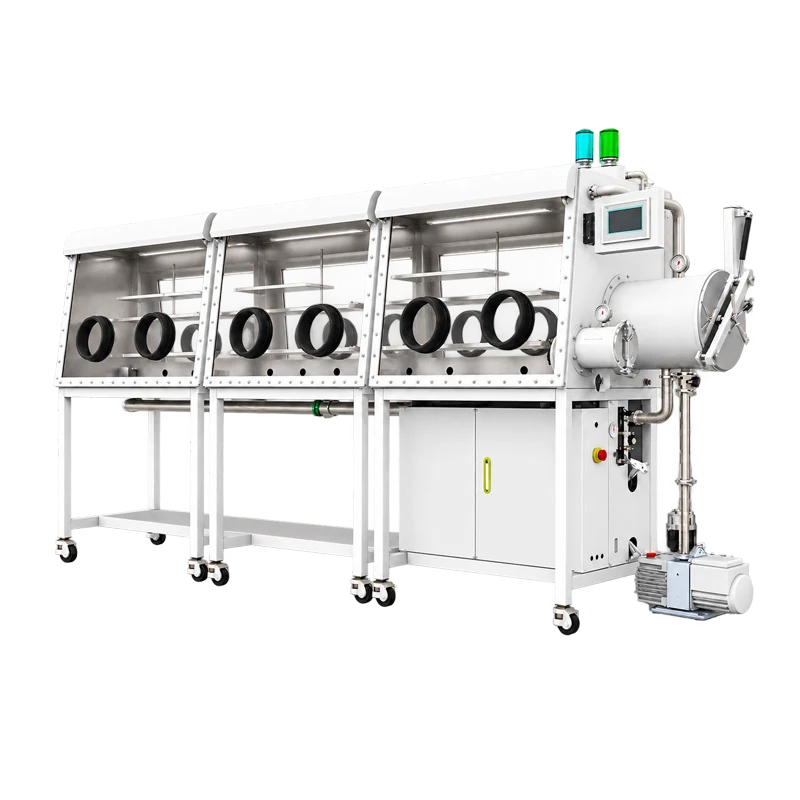
How the Purification Loop Works
Operators tend to think of a glove box as a box. In a purification system, most of the engineering sits in the loop attached to it. Three functions share the purification cabinet: moving the atmosphere, removing oxygen and moisture from it, and restoring the purifying media once it is spent. These are separate operations with separate hardware, and treating them as one thing is the source of most misunderstandings about what such a system can and cannot do.
Circulation
A blower draws gas out of the working volume, pushes it through the purifying column or columns, and returns it to the box in a closed circuit. Because the circuit is closed, the gas is not consumed the way a once-through purge gas is; the same inventory is repeatedly cleaned. Circulation rate, and the way return gas is distributed inside the box, decide how fast the atmosphere recovers after a disturbance such as an opened antechamber door, a glove change or a sample transfer. On a six-station enclosure this distribution matters more than on a benchtop unit: a poorly mixed zone at one end can read differently from the point where the analyzer samples, even when the loop itself is working correctly.
Purification
The columns contain media that bind oxygen and moisture. Both media have finite capacity and saturate with use; purification is therefore a consumable process, not a permanent property of the machine. An analyzer downstream of the columns reports the residual oxygen and moisture content of the circulating gas. Keep the division of labour clear: the column removes, the analyzer measures. A better analyzer does not improve the atmosphere, and a low reading does not mean the columns have unlimited life.
Regeneration
When capacity falls, the column is regenerated by heating it while a regeneration gas passes over the media and carries the released oxygen and water away. Regeneration gas is a separate supply from the working gas in the loop, and the cycle normally runs automatically once started, with interlocks that keep the box isolated while it proceeds. Do not treat a regeneration interval as a fixed rule; it depends on contamination load, on how often the box is opened and on the media installed. Follow the procedure written for the specific model rather than improvising temperatures or gas mixtures.
What the split layout changes
Placing the purification cabinet in its own frame keeps the blower, columns and heaters outside the working envelope. Service access is easier, and heat and vibration from the cabinet are not fed into the box structure. The trade-off is floor space plus one more thing to get right during installation: the ducting between cabinet and box must be leak-tight and correctly routed. A good column cannot compensate for a leaking interconnect, so the completed loop has to be pressure-tested as a whole. A split system is also laid out as a pair — cabinet position, duct runs and service clearances are decided before delivery, not rearranged afterwards.
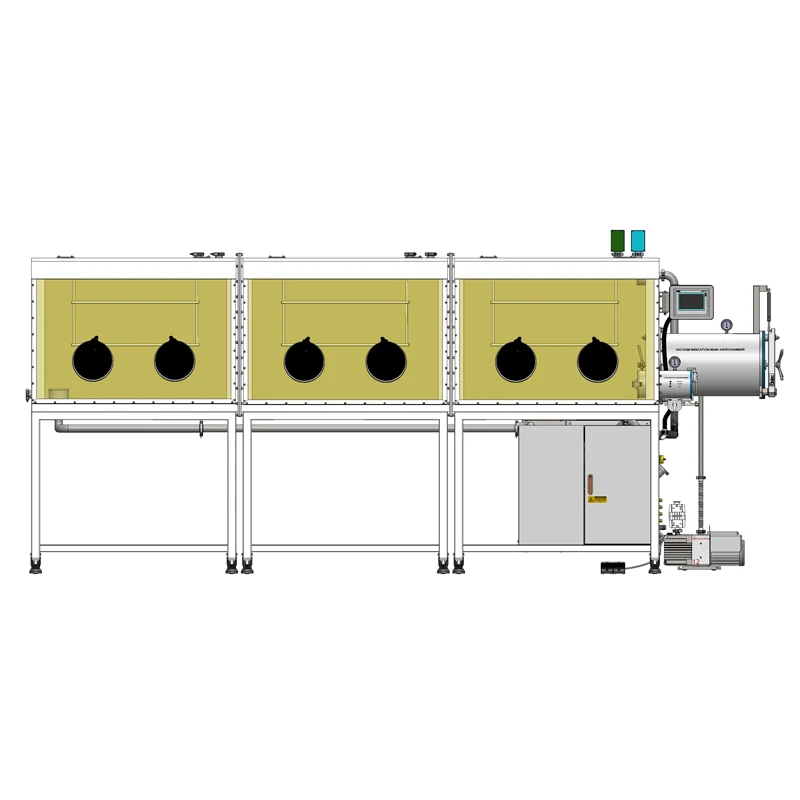
Which Configuration Details Change How the Box Is Used
Station count and sidedness
Six stations across two faces is a collaboration layout: one side can be occupied while the opposite side works on a different sample in the same atmosphere, and a double-sided box lets a long experiment be observed or manipulated from either side. What station count does not do is multiply throughput automatically. Every station shares one atmosphere and one purification capacity, so a heavily used six-station box accumulates a larger contamination load than a small two-port unit and demands correspondingly stricter transfer discipline. Single-sided and double-sided versions of the same internal volume differ in access and room layout, not in the kind of atmosphere they can hold.
Split versus integrated
An integrated box carries the purification unit on the same frame: compact footprint, less on-site plumbing, but all maintenance happens beside the working area. A split arrangement buys serviceability and layout freedom at the cost of space and installation work. Neither is intrinsically more precise; atmosphere quality follows the integrity of the loop in both cases.
Transfer and antechamber
Samples normally enter through an antechamber — a small vacuum-tight chamber with inner and outer doors — where a purge-and-evacuate cycle replaces air with working gas before the inner door opens. Antechamber volume and the number of transfer cycles set how much air reaches the main volume, and a larger chamber on a multi-station box supports bigger parts and several transfers per session. Antechamber size, evacuation capability and door arrangement vary between models, so confirm them for the exact unit rather than assuming.
Specifications Worth Confirming
Purification glove boxes are often compared on a single headline number. That is a poor basis for a purchase, because several different measurements get mixed together in conversation. Ask for each of the following separately, with its unit and the object it applies to:
- Box working pressure range — the small positive or negative offset the enclosure is designed to hold in normal use, not the same figure as antechamber vacuum.
- Leak rate or pressure-hold result — the evidence that welds, seals, ports and ducting hold gas; request the test method, not just a pass label.
- Analyzer range, resolution and accuracy — resolution is not accuracy, and a wider range usually costs sensitivity; state which analyzer covers which range and how it is calibrated.
- Antechamber vacuum level and pump match — what the chamber is evacuated to, with which pump, and how quickly, since ultimate pump vacuum and chamber vacuum are different quantities.
- Regeneration gas supply and cycle control — required gas, pressure and purity, plus what the operator must do during a cycle.
- Glove port size, glove material and spare seals — access, reach and chemical compatibility all follow from these.
- Feedthroughs and interfaces — electrical, signal, gas and KF connections, each with its own sealing method and rating.
- Filtration and solvent handling — particle filtration removes particles only, and solvent adsorption is a separate function from water and oxygen removal; do not treat either as atmosphere purification.
- Footprint, utilities and services — cabinet space, power, compressed gas and exhaust, plus clearance for future service.
Where a datasheet value is ambiguous, missing its unit, or clearly applies to a different model than the one being quoted, leave it out of the comparison and ask for clarification. A confirmed smaller number is worth more than an unverified impressive one.
Where the System Fits, and Where It Stops
Applications that match
A multi-station purification box suits work where several people handle air-sensitive materials in one conditioned space over long periods: lithium metal and solid-state battery component preparation, perovskite and OLED device fabrication, air-sensitive synthesis, oxygen-sensitive powder handling and post-processing in additive manufacturing, and general inert-atmosphere research that needs more bench area than a single-port enclosure provides. The shared atmosphere is an advantage when samples must be compared under identical conditions.
Boundaries
The enclosure is an atmosphere tool, not a containment certification. It does not make a process sterile, does not establish a cleanroom classification, and does not provide biological or chemical hazard containment; when the risk is toxic vapour rather than air sensitivity, a fume hood is the correct device. Inert also is not a synonym for compatible: some materials react with nitrogen, and some solvents attack glove or seal materials, so gas and wetted-material choices need checking case by case. Vacuum-only stainless enclosures and acrylic isolation boxes are distinct products with their own capabilities, not scaled-down versions of a purification system, and a standalone purification cabinet is a loop component for a compatible sealed enclosure rather than a complete glove box in itself.
Accessories and Integration Points
The box does not run in isolation. Three integration points decide how well it behaves day to day.
Vacuum and exhaust
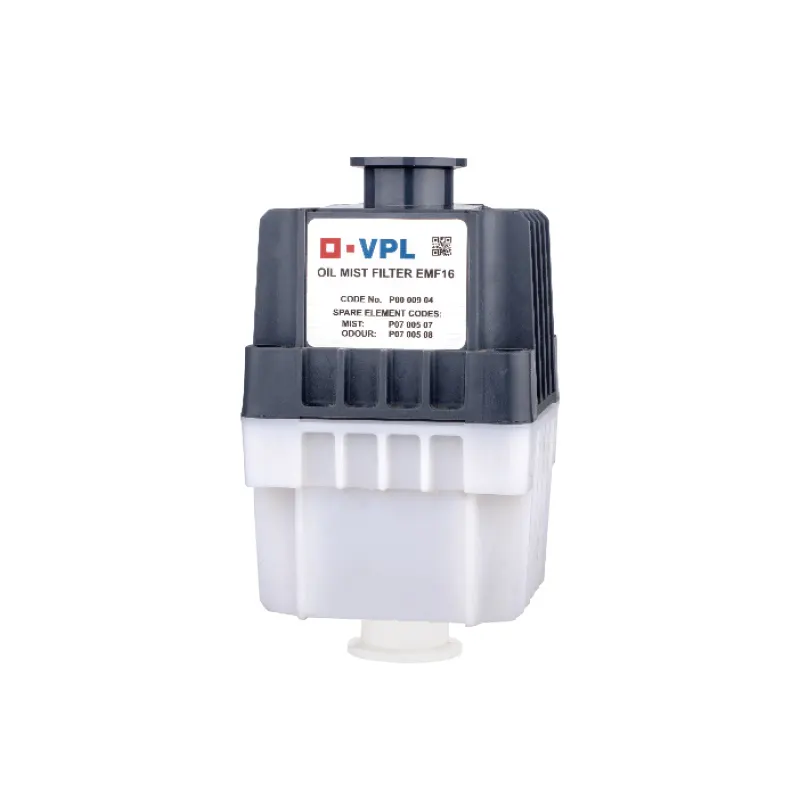
Antechamber evacuation needs a pump sized for chamber volume and cycle time, with materials compatible with the gas being pumped. If that pump is an oil-sealed rotary vane type, its exhaust carries oil mist; a vacuum pump oil mist filter on the exhaust captures the mist before it reaches laboratory air. Be precise about its role: it is an exhaust-side accessory that protects the pump and the room, and it has no effect on oxygen or moisture inside the box. It is also not universal — thread size, flow capacity and element type must match the pump actually installed.
Gloves and ports
Glove selection follows the chemicals handled: material, thickness and permeation behaviour against the specific solvents in use, plus length and size so the far corners of a six-station box remain reachable. A glove with poor chemical resistance becomes a leak path, and port rings and O-rings wear with every change — keep spares on site.
Instrumentation and feedthroughs
Analyzers, electrical feedthroughs, KF ports and signal connections are chosen by what has to cross the boundary: conductor count and current rating, tube diameter and vacuum compatibility, and the sealing method in each case. Every addition to the box wall is a potential leak, so each one should be leak-checked at installation and again after any modification.
How to Select or Integrate One
- Define the samples, the reason for the atmosphere, and the maximum tolerable exposure during transfer.
- Estimate simultaneous users and bench area, then choose station count and sidedness from that number rather than from a catalogue default.
- Decide the transfer path: chamber volume, number of cycles per session, and pump capacity to match.
- Agree in writing which analyzer covers which range, who calibrates it, and how accuracy is verified.
- Match pumps and exhaust accessories to the actual gas and load, including mist handling if an oil-sealed pump is used.
- Plan working gas, regeneration gas, power and exhaust before choosing the room, and reserve service clearance around the cabinet.
- Ask for the leak test method, the commissioning procedure and the maintenance schedule as part of the order.
Short Answers to Common Questions
Does a split-type purification glove box always include its purification system?
In this configuration the purification cabinet is part of the delivered system, which is why it is called a purification glove box. Do not extend that statement to every enclosure sold under the same family name: vacuum-only boxes and acrylic isolation boxes exist precisely because they provide controlled or isolated environments without a continuous purification loop.
Can a HEPA filter or solvent trap lower the water and oxygen readings?
No. Particle filtration removes particulate contamination, and solvent adsorption handles organic vapour; neither removes oxygen or moisture. Water and oxygen are handled by the purifying columns in the loop.
Does the oil mist filter improve atmosphere quality inside the box?
No. It works on the pump exhaust, reducing oil mist in the laboratory air and keeping oil out of the pump's surroundings. Its sizing depends on the pump, not on the box's internal atmosphere.
Do six stations mean six people can work at once?
Not automatically. Six stations describe access positions. Each additional pair of hands adds a transfer event and a contamination load to one shared atmosphere, and physical space around the box usually limits occupancy before the loop does.
I already have a sealed enclosure. Can I add purification to it?
Only after compatibility is verified — loop connections, valve and control interfaces, enclosure volume and leak-tightness all have to match the purification cabinet. A standalone purifier is a loop component, not a drop-in upgrade for an arbitrary box, and the supplier should confirm the pairing before any commitment.
