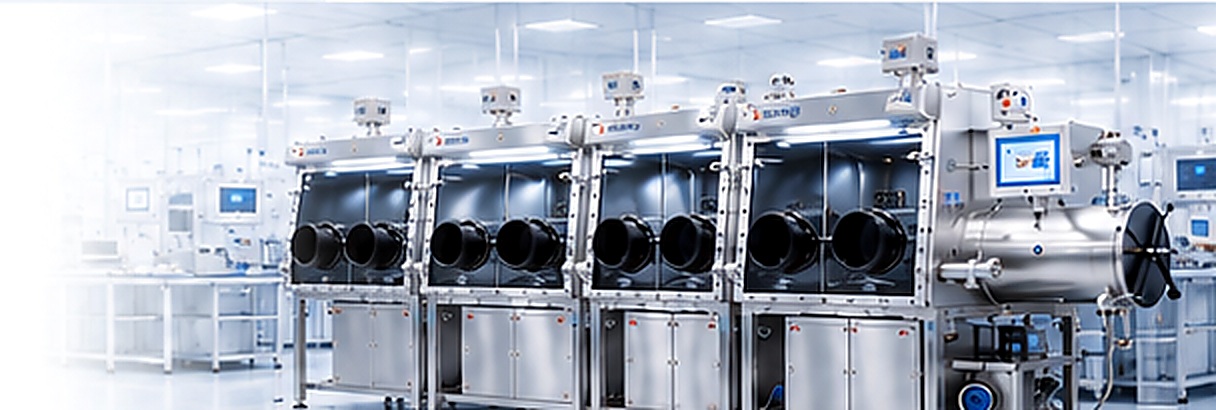
What is a Large Glove Box Antechamber?
From the core perspective, a large glove box antechamber is a specialized sample transfer interface attached to the main chamber of a glove box system. Researchers in lithium-ion battery materials, perovskite solar cells, OLED development, and other fields where water and oxygen are strictly prohibited use it to move samples, tools, and equipment into and out of the inert atmosphere without introducing contaminants. The antechamber maintains the integrity of the glove box's purified environment by undergoing a series of evacuation and purging cycles before the inner door is opened. For a dedicated product, you can explore the Large Glove Box Antechamber offered by Gloveboxs.
Core Function and Working Principle
The primary function of a large glove box antechamber is to convert the environment from ambient air (with ~20% oxygen and variable humidity) into the same inert gas atmosphere as the glove box interior (typically argon or nitrogen with H₂O and O₂ below 1 ppm). This conversion is achieved through a standard process called "three-pump-three-purge" or more cycles, depending on the sensitivity of the operation.
The working principle relies on a vacuum pump connected to the antechamber. When an item is placed inside, the outer door is sealed, and the vacuum pump evacuates the chamber to a deep vacuum level (e.g., -1 bar relative to atmosphere). Then, inert gas from the glove box is introduced to refill the chamber. This cycle is repeated multiple times to dilute and remove any residual air. The final step is to fill the antechamber with inert gas to match the pressure inside the main box, after which the inner door can be safely opened. The entire sequence is often controlled by a PLC or manual valve system, ensuring that the glove box atmosphere remains undisturbed.
Key parameters affecting the transfer efficiency include the vacuum pump's pumping speed (e.g., 12 m³/h), the antechamber volume, the number of purge cycles, and the leak rate of the chamber seals. A well-designed antechamber minimizes the overall impurity ingress to less than 1 ppm during a typical transfer.
Types of Glove Box Antechambers
Glove box antechambers are generally categorized by size and configuration. The two most common types are the large antechamber and the small antechamber. The Large Glove Box Antechamber typically has a diameter of 360 mm and a length of 600 mm (or similar), designed to accommodate bulky items such as beakers, flasks, toolkits, or even small instruments. The Small Glove Box Antechamber is usually about 150 mm in diameter and 300 mm long, intended for small tools, gloves, and lightweight samples.
The choice between large and small antechambers depends on the typical size of items being transferred. For a research lab that frequently handles large glassware or equipment, a large antechamber is essential. For applications where only small consumables are used, a small antechamber saves space and reduces inert gas consumption. Some advanced glove box systems also offer a loading port cover or a dedicated glove port cover for quick access; see the Glove Box Port Cover for additional sealing options.
Key Performance Indicators and Selection Tips
When selecting a large glove box antechamber, several performance indicators should be evaluated:
- Size and Volume: The internal dimensions determine what can be transferred. Standard large antechambers are around Φ360 mm × 600 mm, but custom sizes are available.
- Vacuum Level: The antechamber must achieve a deep vacuum (typically < 1×10⁻³ mbar) to effectively remove moisture and oxygen. The vacuum pump's performance, such as the Glove Box Vacuum Pump, is critical.
- Seal Integrity: Low leak rate (< 10⁻⁵ mbar·L/s) ensures minimal back-diffusion of contaminants. The antechamber door seals and O-rings must be of high quality.
- Material and Construction: Stainless steel (SUS 304) is common for corrosion resistance and durability. The inner surface should be smooth to avoid trapping particles.
- Control System: Manual or automatic? Many modern antechambers integrate with the glove box's PLC for automatic pump-purge cycles, reducing operator error.
- Accessories: Consider compatibility with vacuum pump oil mist filters, pressure transmitters, and feedthroughs (e.g., KF40 Ethernet Feedthrough) for electrical or gas connections.
For glove box systems that require frequent sample exchange, the regeneration speed of the antechamber is also important. A typical large antechamber can complete a full cycle (evacuation + purge) in 5–10 minutes, depending on the pump capacity.
Application Fields and Selection Suggestions
Large glove box antechambers are indispensable in any glove box setup used for:
- Lithium-ion battery research – transferring electrodes, electrolytes, and assembled cells.
- Perovskite solar cell fabrication – moving volatile precursors and devices.
- OLED and display materials – handling sensitive organic compounds.
- Semiconductor and quantum dot synthesis – air-free nanomaterial processing.
- Pharmaceutical and chemical synthesis – for moisture-sensitive reagents.
For a lab just starting with a single glove box, a large antechamber paired with a standard vacuum pump is a cost-effective choice. For high-throughput environments, consider a dual antechamber configuration or a fast-entry system. Always verify that the antechamber dimensions match the glove box side port (usually using KF or ISO flanges). The KF Vacuum Clamp and sealing rings are common accessories for installation.
References
- Large Glove Box Antechamber product page: https://www.gloveboxs.com/products/glove-box-accessories/large-glove-box-antechamber.html
- Small Glove Box Antechamber: https://www.gloveboxs.com/products/glove-box-accessories/small-glove-box-antechamber.html
- Glove Box Vacuum Pump: https://www.gloveboxs.com/products/glove-box-accessories/glove-box-vacuum-pump.html
- Glove Box Port Cover: https://www.gloveboxs.com/products/glove-box-accessories/glove-box-port-cover.html