
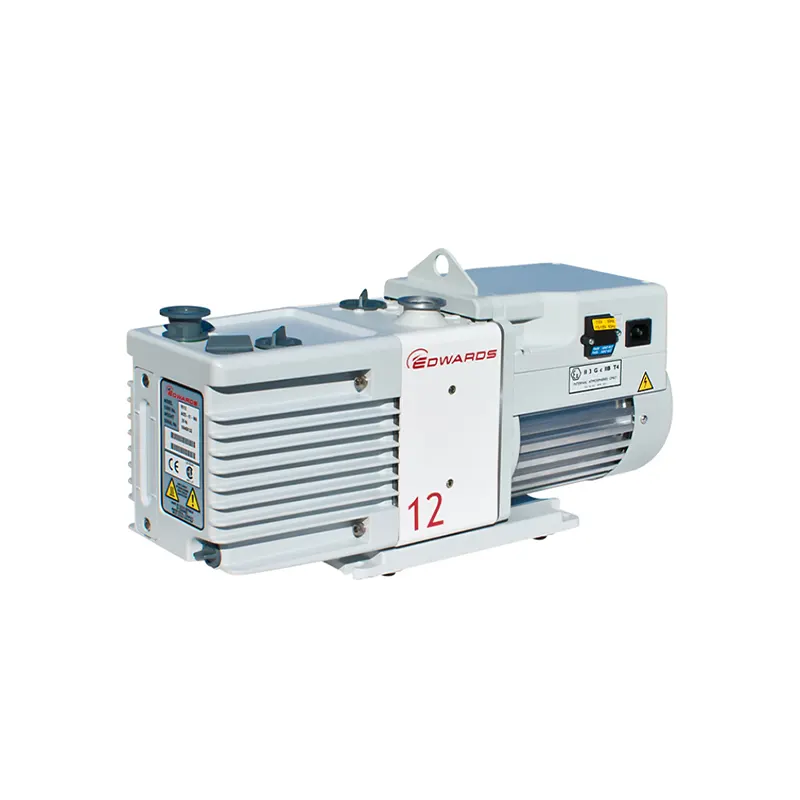
A glove box vacuum pump removes air from a sealed volume — most often the antechamber of a glove box — so that the volume can be refilled with inert gas instead of being opened to the laboratory atmosphere. It sits between the sealed enclosure and the exhaust line, connected through a valve and a flanged or hose connection, and it is what makes repeated purge-and-refill cycles possible when samples, tools or small equipment are transferred into a controlled atmosphere. The pump does not create the inert atmosphere by itself, and it does not remove moisture or oxygen from the working gas; those tasks belong to the purification system and the gas supply. Its job is mechanical: move gas out of a closed space on demand, without contaminating what remains.
What a Glove Box Vacuum Pump Does
Functionally, the pump performs one task: it lowers the pressure inside a closed volume that has been isolated from the main working space, so that the air or process gas held in that volume can be drawn out and discharged. The usual target is not a deep vacuum but a practical reduction in the amount of air that would otherwise be carried into the box. Once the pressure is reduced, the volume is refilled with working gas — nitrogen, argon or another specified atmosphere — and the cycle can be repeated as needed.
Because the pump works on an isolated volume, its performance is judged in context. The relevant questions are how much gas must be moved, how quickly the cycle should finish, and what pressure the connected volume must reach before refilling. A pump that looks generous on paper can still be a poor match if the connection is restrictive, the valve arrangement adds dead volume, or the exhaust path is long.
How Evacuation Fits Into the Antechamber Cycle
An antechamber — also called a transfer chamber or pass box — is the interface between the laboratory and the controlled atmosphere. It has an outer door, an inner door and an internal volume, and the two doors are never opened at the same time. A sample goes in from the outside, the outer door is closed, the chamber is evacuated and refilled, and only then is the inner door opened. The pump makes the first half of that sequence possible.
Repeated evacuation and refill
Air removal is normally done in stages rather than in one long pull. Each evacuation removes a fraction of the original air; each refill replaces it with working gas. After several cycles the residual air is small enough that opening the inner door does not disturb the working atmosphere noticeably. The number of cycles, the pressure reached at each step, and the purity of the refill gas all influence the result.
This is why a pump with a modest ultimate pressure can still be perfectly adequate. If the chamber only needs to be pumped down far enough for the next refill, the limiting factors are often the number of cycles an operator is willing to run and the volume of the chamber — not the deepest vacuum the pump can theoretically reach.
What evacuation cannot do
Evacuation removes gas. It does not remove moisture that has adsorbed onto internal surfaces, and it does not remove oxygen that has already entered the main working volume. Those are handled by the purification loop and by the overall gas management strategy. Confusing the two leads to unrealistic expectations: a pump cannot replace a purification column, and a purification column cannot evacuate an antechamber.
Where the Pump Sits in the Gas Path
The pump is normally mounted outside the glove box, connected to the antechamber or to a vacuum-type enclosure through an isolation valve, and discharging to a safe exhaust point. Between the chamber and the pump there is usually at least one valve, a connection through the chamber wall, and often a trap or filter that keeps particulates and condensable vapours away from the pump internals. The glove box vacuum pump is therefore part of a small subsystem rather than a standalone device: valve, line, trap, pump and exhaust have to work together.
Two details deserve attention during integration. First, the connection between chamber and pump must be leak-tight, because a leak on the suction side means the pump pulls laboratory air instead of chamber gas and the cycle never reaches its target. Second, the exhaust must be routed so that discharged gas does not return to the working area or interfere with other equipment nearby.
Configurations That Change the Choice
Vacuum pumps used in this role are not interchangeable, and the differences matter more than the headline pumping speed.
Oil-sealed rotary vane pumps
These are common general-purpose vacuum sources. They reach useful pressures for antechamber work and are widely supported. Their trade-offs are oil-related: oil can migrate as vapour if the pump is used outside its intended pressure range, and oil is a consumable that needs periodic attention. Where solvents or reactive vapours may be present, oil compatibility and vapour trapping become part of the selection.
Dry-running pumps
Diaphragm and other dry-running designs avoid oil in the pumped volume entirely. That simplifies exhaust handling and removes any concern about oil backstreaming into the chamber. In exchange, the achievable pressure and the pumping speed at a given size often differ from an oil-sealed equivalent, so the duty cycle has to be checked rather than assumed.
Single-stage and two-stage designs
Two-stage designs generally reach lower pressures than single-stage designs of similar size, at the cost of complexity and price. Whether that extra depth matters depends on what the connected volume must achieve. For an antechamber that is evacuated and refilled repeatedly, the practical requirement is usually a repeatable, moderate pressure — not the lowest number on a datasheet.
Whichever family is used, the configuration supplied with a given glove box should be confirmed against that system's own documentation, because the right pump depends on chamber volume, gas, cycle time and the process being run.
Specifications to Check Before You Order
- Required pressure in the connected volume. Work backwards from what the chamber needs, not from the pump's headline figure.
- Pumping speed against chamber volume. Larger chambers and faster cycle times need more displacement; a small antechamber does not benefit from an oversized pump.
- Gas and vapour compatibility. The pump sees the working gas plus anything that evaporates from samples or solvents. Materials of construction and sealing compounds must tolerate that mix.
- Ultimate pressure versus working pressure. These are different numbers. Ultimate pressure is measured under specific conditions and is not the same as the pressure reached in a real chamber with real connections.
- Connection and interface. Flange or hose type, seal material, valve arrangement and control signal all have to match the box. A pump that cannot be connected properly is not a pump that works.
- Exhaust handling. Where does discharged gas go, and does it need filtration or dilution before release?
- Service and consumables. Oil, filters and seals have replacement intervals; plan for them.
- Noise and heat. A pump running for many cycles a day is a continuous presence in the laboratory.
One caution applies to every item on this list: do not mix values that describe different things. Chamber working pressure, antechamber vacuum, the pump's ultimate vacuum, leak rate, and the water and oxygen content of the working atmosphere are separate metrics. A figure quoted for one of them does not describe the others.
Where It Fits — and Where It Does Not
A vacuum pump is appropriate wherever a sealed volume must be emptied before being refilled or opened to a controlled atmosphere. That includes antechamber cycles on glove boxes, vacuum-type enclosures in which the chamber itself is evacuated and backfilled, and evacuation steps that occur during equipment setup or maintenance.
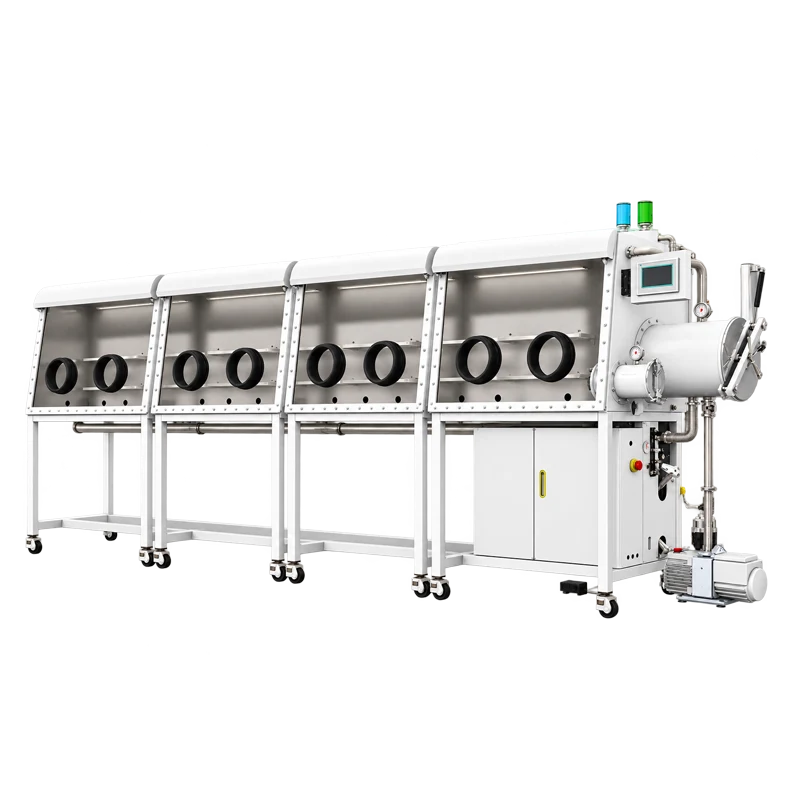
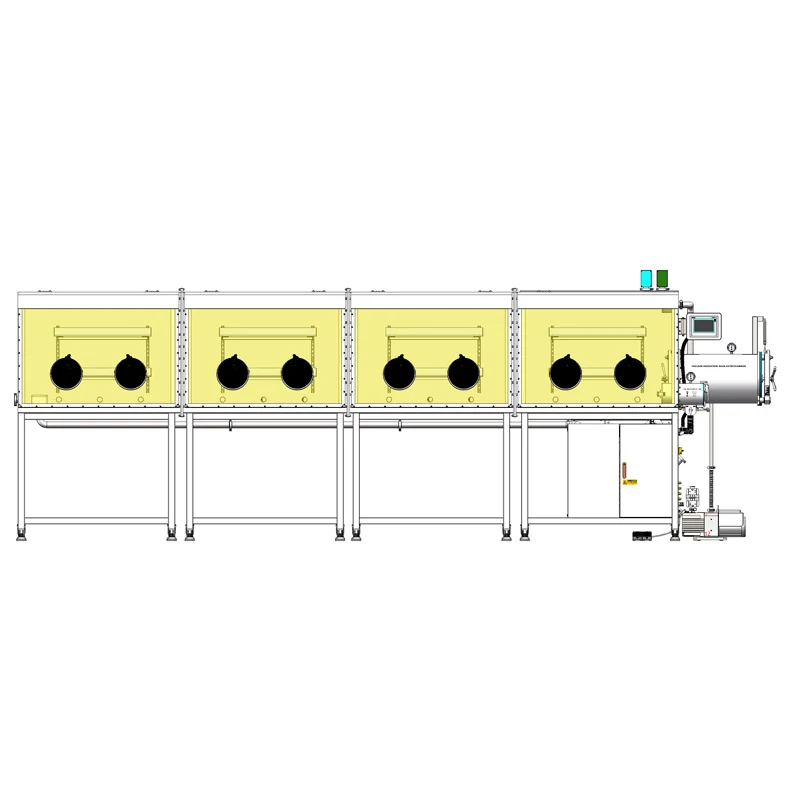
Background context helps here. A purification glove box such as the four-station single-sided split-type glove box with gas purification system keeps its working atmosphere clean through a closed-loop purification system — circulation, purification columns, monitoring and atmosphere management. Its evacuated transfer steps, and the pump that supports them, are a separate function from that loop. The two subsystems serve the same goal without being the same thing.
The limits are just as concrete. A pump does not purify gas, does not act as a particulate filter for the working atmosphere, and does not establish a sterile, cleanroom-graded or biologically contained environment. Inert atmosphere protection is not the same as those classifications, and no pump changes that. It also cannot be assumed that any pump can be attached to any enclosure: compatibility between the pump, the chamber, the valve layout and the local exhaust arrangement has to be verified for the specific system.
How to Select and Integrate a Pump
- Define the volume to be evacuated and the pressure it must reach.
- Decide the cycle time. That, not the catalogue, fixes the required displacement.
- List everything the pump will see: working gas, solvent vapours, particles, condensables.
- Choose the pump family on the basis of that list, then check the achievable pressure for the duty.
- Confirm the mechanical interface — connection type, seal material, valve position, control interface.
- Plan the exhaust route and any trapping or filtration ahead of the pump.
- Confirm which items are supplied with the glove box and which are ordered separately.
Questions Engineers Ask
Does a vacuum pump come with a purification system?
No. Water and oxygen removal comes from the purification loop and its columns. The pump removes air from isolated volumes so that refilling with working gas is effective.
Can a pump lower the box's oxygen and moisture levels?
Not by itself. Evacuation reduces the amount of air carried into the box during a transfer, which reduces the load on the purification loop, but the atmosphere inside the working volume is managed by the purification system and the gas supply.
How do I know whether a pump is compatible with my enclosure?
Check four things: the connection and seal between pump and chamber, the pressure actually achievable in that chamber, the materials' tolerance of the gas and vapours involved, and the exhaust arrangement. Where any of these is unclear, confirm the specification with the equipment supplier rather than inferring it.
When is a separate pump actually needed?
Whenever a sealed volume has to be evacuated as part of normal operation — most commonly an antechamber that is cycled many times a day, or a vacuum-type enclosure. If the system has no evacuation step, there is nothing for the pump to do.
What maintenance should be expected?
It depends on the pump family. Oil-sealed pumps involve oil and oil-related components; dry pumps involve seals and valves. Either way, the maintenance schedule belongs to the pump documentation, and service access should be planned at installation rather than after the first failure.
The useful question is not whether a pump is powerful, but whether it matches the volume, the cycle and the gas it will actually meet. Confirm those three, and the rest of the specification follows.
