
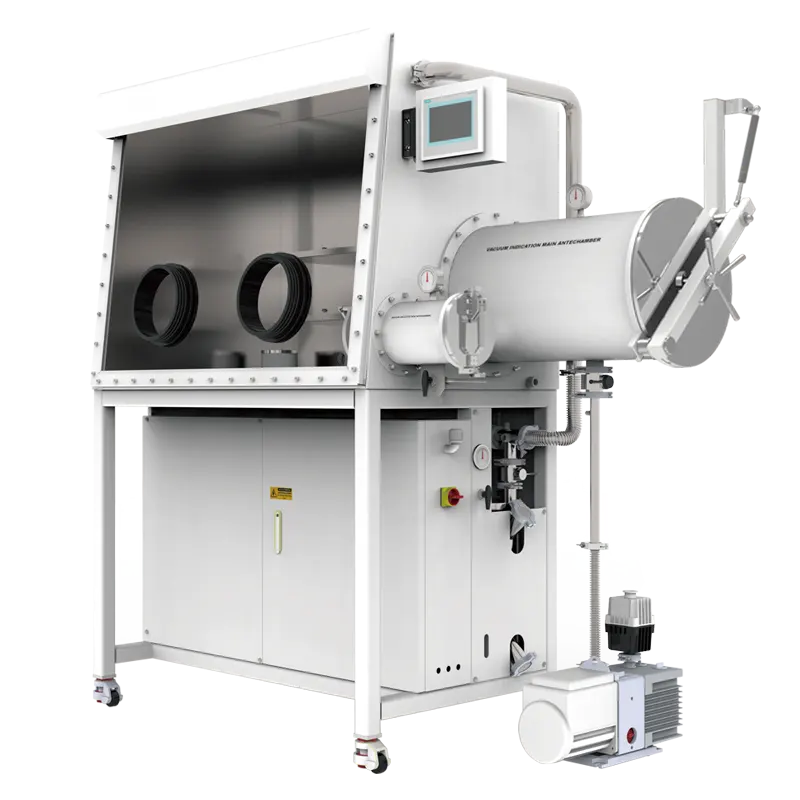
A single-station, single-sided glove box with a gas purification system is a sealed workspace for one operator, reached through one pair of glove ports, where a closed-loop purification system continuously circulates the internal atmosphere to reduce oxygen and moisture. It sits between the sample and the outside environment: the box provides the physical barrier, the antechamber provides controlled transfer, and the purification loop manages the reactive gases that would otherwise degrade air-sensitive materials. The linked Single-Station Single-Sided Glove Box with Gas Purification System is an example of this category. The problem it solves is not simply “keeping things dry.” It is about creating a repeatable, monitorable atmosphere for materials that change when they meet oxygen, water, or both.
What Does a Single-Station Single-Sided Glove Box with Gas Purification Do?
The name describes three design choices. “Single-station” means the enclosure is sized for one main working position rather than a row of connected workstations. “Single-sided” means the operator works from one side of the box, through one set of glove ports. “Gas purification” means the system is built to condition the internal atmosphere, not merely to fill the box with inert gas once. The combination is common in research and development because a smaller, single-user enclosure can be easier to place, easier to keep sealed, and more economical to operate than a large multi-station box.
Inside the box, the work zone is isolated from room air. Samples, tools, and small equipment enter through an antechamber, which limits how much outside atmosphere reaches the main chamber during transfer. The main chamber then holds a controlled atmosphere—usually nitrogen or argon—while the purification loop works to keep oxygen and moisture at the low levels required by the application. The box itself does not “purify” the gas like a filter removes particles. It provides the sealed volume in which purification can take place.
This distinction matters because glove boxes are often discussed as if all of them do the same job. A vacuum glove box may use evacuation and inert gas backfill to create a controlled environment, but that does not necessarily mean it has a continuous purification loop. An acrylic isolator may offer visibility and a physical barrier but may not be vacuum-rated or equipped with purification. A standalone gas purifier cabinet is not a complete glove box by itself; it needs a compatible sealed enclosure or process chamber to form a closed loop. For a single-station, single-sided purification glove box, the purification system is an integrated part of the atmosphere management, not an optional add-on.
How the Purification Loop Works
A purification loop is best understood as a recirculating gas circuit. Gas leaves the main chamber, passes through purification media, and returns to the chamber. In a typical regenerative system, the circuit includes a blower or fan, one or more purification columns, valves, sensors, and a controller. The columns remove water and oxygen through physical adsorption or chemical reaction, depending on the media. When the media approach saturation, the system is regenerated—usually by heating with a purge gas—so it can continue working. Regeneration is a separate process from normal circulation, and it must be managed so that it does not disturb the working atmosphere.
Atmosphere Circulation
Circulation keeps the atmosphere moving through the purification media instead of letting local pockets of moisture or oxygen linger around the samples. A single-station box has a relatively small internal volume, which can be an advantage: the loop can turn over the atmosphere with less total gas movement than a larger multi-station system. However, circulation must be balanced. Too little flow can leave stagnant zones; too much flow can stir up dust, disturb lightweight samples, or create unnecessary heat. The right balance depends on the box volume, the load inside, and the sensitivity of the work.
Purification Columns and Regeneration
Most closed-loop purification systems use regenerable media because disposable media would be impractical for continuous operation. One medium may target moisture, while another targets oxygen. The exact media and capacity are system-specific, so they should be confirmed from the product documentation rather than assumed from a generic description. Regeneration typically requires heat and a purge gas, and the interval depends on how much oxygen and moisture enters the box, how often the antechamber is used, and how well the gloves and seals perform. A box that is opened frequently, or that processes wet or oxygen-rich samples, will consume purification capacity faster.
Monitoring and Control
Sensors for oxygen and moisture are the feedback devices for the loop. They tell the operator whether the atmosphere is within the intended range and whether the purification system is keeping up. When reading sensor specifications, distinguish range from resolution and resolution from accuracy. A sensor may display a very small number without being able to measure that value accurately. Calibration, response time, and cross-sensitivity to other gases also matter. The controller may use sensor readings to start or stop circulation, trigger alarms, or indicate when regeneration is needed. The sensors measure the atmosphere; they do not purify it.
Which Configurations Matter?
For this product family, the most important configuration choices are station count, sidedness, antechamber design, and vacuum capability. A single-station, single-sided box is optimized for one operator and a compact footprint. It is a good fit when the work is focused, the samples are small to medium in size, and the priority is a stable atmosphere rather than simultaneous access by several people. A multi-station or double-sided box can support collaboration or longer process lines, but it also increases internal volume, sealing area, and the amount of gas that must be circulated and purified.
The antechamber is another key differentiator. Some antechambers are simple transfer chambers that are purged with inert gas; others can be evacuated before backfilling. Vacuum-capable antechambers reduce air ingress during transfer, but they require a compatible vacuum pump and vacuum-rated components. This is where accessories become relevant. If the vacuum line uses KF flanges, a KF Vacuum Clamp may be used to join KF-flanged parts, but the clamp must match the flange size, seal material, and the vacuum duty of the system. It is not a universal connector, and it should not be assumed to fit every glove box port without checking the port standard.
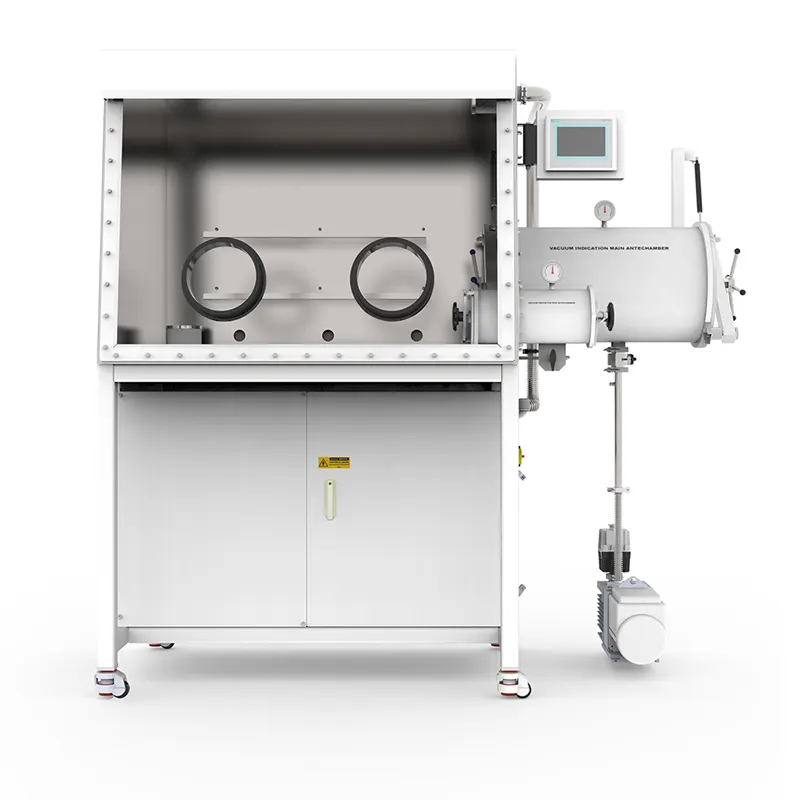
Purification system design also varies. Some systems are integrated into the base or rear of the box; others are separate cabinets connected by hoses or piping. The linked product is described as a single-station, single-sided glove box with a gas purification system, which places it in the integrated purification category. Even so, the exact layout, purification capacity, and interface details should be verified on the current product page. Do not infer continuous purification capability from the word “vacuum” alone, and do not assume that an acrylic or vacuum-only enclosure can be upgraded to full purification without checking the design.
Key Specifications to Check
Because glove box performance depends on the whole system, specifications should be read together rather than in isolation. The following checklist is useful when comparing a single-station, single-sided purification glove box with other options.
- Internal dimensions and working volume: Confirm that the chamber can hold the samples, tools, and equipment you plan to use. A single-station box is compact by design, so measure the largest item and allow room for manipulation.
- Glove port size and glove compatibility: Glove thickness, length, material, and resistance to solvents or chemicals affect dexterity and service life. The port diameter must match the glove and the cuff.
- Leak rate and sealing: A low leak rate helps the purification system maintain the atmosphere. Ask how leak rate is defined and under what conditions it is measured.
- Oxygen and moisture measurement: Check sensor range, resolution, accuracy, calibration method, and whether the display is suitable for the target atmosphere. Do not treat a displayed resolution as a guaranteed accuracy.
- Purification capacity and regeneration: Ask what media are used, how regeneration is performed, and what conditions increase consumption. This affects operating cost and uptime.
- Antechamber size and transfer method: The antechamber should accommodate the largest sample or tool that must pass through. If vacuum transfer is needed, confirm the vacuum rating and pump compatibility.
- Vacuum pump and port standards: Pumps must be matched to the gas load, chamber volume, and required vacuum level. Ports may be KF, ISO, or another standard; adapters and clamps must be correct for the flange and seal.
- Pressure control: Working pressure, antechamber vacuum, and pump ultimate vacuum are different values. Keep units and measurement points clear when comparing systems.
- Feedthroughs and utilities: Electrical, signal, gas, and cooling feedthroughs should be selected for the experiment. Each feedthrough adds a potential leak path, so it should be installed and tested properly.
- Solvent and material compatibility: Solvent vapors can affect seals, gloves, and purification media. If solvents are used, check whether solvent adsorption or other protection is required. HEPA filtration removes particles; it does not remove oxygen, moisture, or solvent vapor.
Where Is It Suitable, and What Are Its Limits?
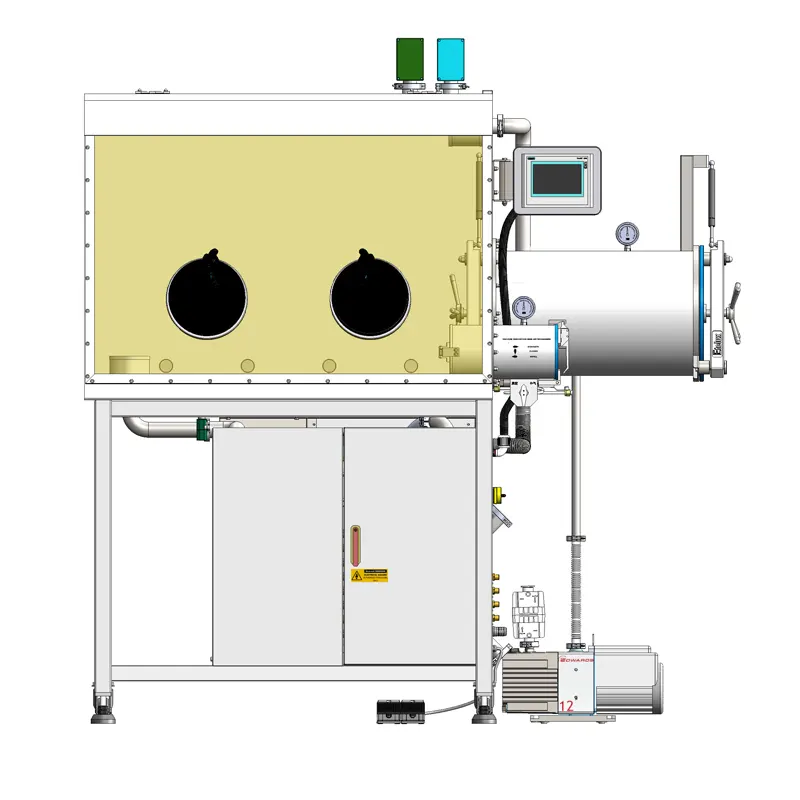
A single-station, single-sided purification glove box is suitable for focused laboratory work with air-sensitive materials. Typical uses include lithium and solid-state battery materials, perovskites, OLED and semiconductor materials, air-sensitive chemical synthesis, advanced materials research, and additive manufacturing steps that require controlled atmosphere before or after processing. It is also useful for storing and handling samples that must remain under inert gas for repeatable analysis.
The limits are just as important. The box is not a sterile environment, a cleanroom classification, a biological safety cabinet, or a hazardous-materials containment certified by default. It does not make every gas inert for every sample; some materials react with nitrogen, and some processes require argon or another gas for chemical reasons. It does not guarantee zero oxygen or zero moisture. It reduces and controls these contaminants within the capability of the purification system and the operating discipline. A single-station box is not intended for high-volume production or for multiple simultaneous operators. If the work involves corrosive gases, high solvent loads, or large equipment, a different configuration or additional safety review may be needed.
How to Select and Integrate the Right System
Start with the material and the process, not with the box size. Define the maximum acceptable oxygen and moisture levels, the gas type, the sample size, the transfer frequency, and whether vacuum is needed at the antechamber or inside the chamber. Then match those requirements to the purification capacity, internal volume, and port configuration. For a single-station, single-sided system, the compact size is an advantage for atmosphere stability, but it also limits how much equipment can be placed inside.
Integration should be reviewed early. If the box will connect to a vacuum pump, a gas manifold, an analyzer, or an external process chamber, confirm the flange standards, tubing materials, and control interfaces. Accessories should be selected for the function they actually perform. A vacuum clamp secures a KF connection; it does not improve purification capacity. A feedthrough passes signals or power; it does not manage moisture. An analyzer measures oxygen or moisture; it does not remove them. The main purification loop remains the system responsible for atmosphere control.
When evaluating a specific model, use the product page as the starting point and request the current specification sheet for details that affect your work. The Single-Station Single-Sided Glove Box with Gas Purification System is one configuration to consider when the goal is a dedicated, single-operator atmosphere-controlled workspace. Confirm dimensions, purification media, sensor specifications, antechamber type, and available ports before purchase. If KF vacuum connections are part of the plan, check the flange size and seal material against the KF Vacuum Clamp specification rather than assuming compatibility.
FAQ
Does a gas purification glove box always have purification columns?
A model described as having a gas purification system should include a purification loop, but the exact media, column arrangement, and regeneration method vary. A vacuum glove box or basic isolator may not have continuous purification at all. Check the product description and specification sheet for the specific model.
Can a glove box remove oxygen and moisture completely?
No. A purification system reduces oxygen and moisture to low levels, but the achievable level depends on the system design, leak rate, gloves, transfer practices, and the load inside the box. Claims of zero contamination should be treated with caution unless they are clearly defined and independently verified for the exact configuration.
What is the difference between an antechamber vacuum and gas purification?
An antechamber vacuum removes air from the transfer chamber before it is backfilled with inert gas. Gas purification continuously treats the main chamber atmosphere. They are complementary but separate functions. An antechamber vacuum does not replace the purification loop.
When do I need an accessory such as a KF vacuum clamp?
You need a KF vacuum clamp when you are joining KF-flanged vacuum components, such as a pump line, valve, or feedthrough. The clamp must match the flange size and be compatible with the seal and vacuum level. It is not a substitute for checking the port standard on the glove box.
Can I use a single-station box for multiple users?
It can be used by more than one person over time, but the design is optimized for one operator at a time. If two people need to work simultaneously, or if the process requires a long transfer path, a multi-station or double-sided configuration may be more suitable.
Practical Perspective
A single-station, single-sided glove box with gas purification is a focused tool: it creates a controlled atmosphere for one working position and uses a recirculating purification loop to manage oxygen and moisture. Its strengths are compactness, relatively low internal volume, and a clear separation between the working chamber and the transfer antechamber. Its limits are equally clear—it is not a universal containment solution, not a guarantee of zero contaminants, and not a substitute for matching the system to the material, the process, and the available utilities. The most reliable selection process is to define the atmosphere requirement first, then verify the box dimensions, purification capacity, sensor specifications, transfer method, and port compatibility against the actual product data.
