
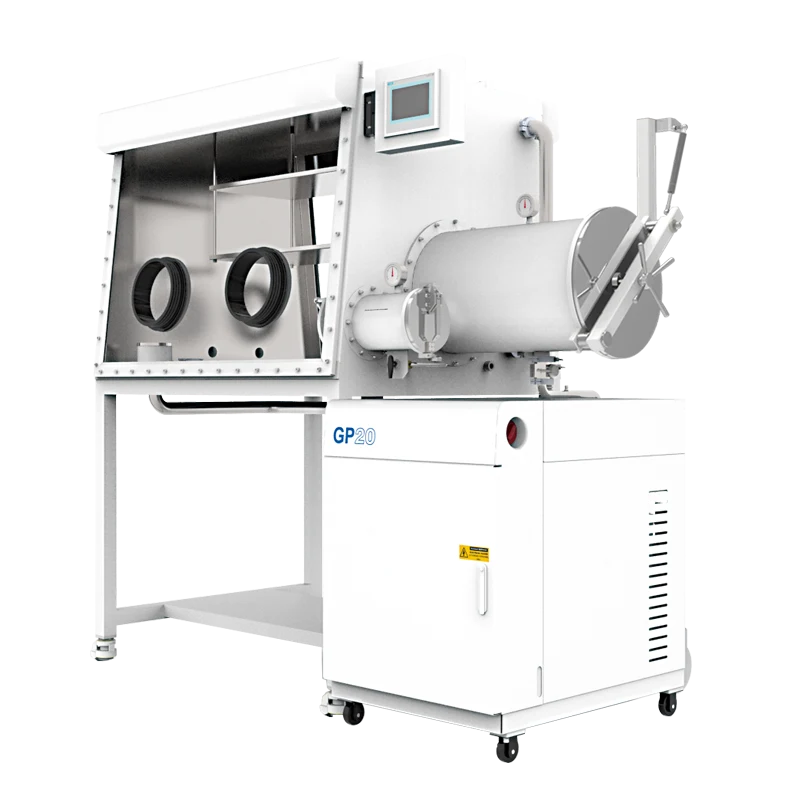
A two-station double-sided glove box with gas purification system is a sealed working enclosure with operator access on two opposite faces, combined with an integrated unit that continuously recirculates the internal atmosphere through purifying media. The enclosure provides the workspace; the purification system keeps that workspace usable. Together they let two people handle air- and moisture-sensitive materials for hours without opening the box to the room.
In a laboratory it sits at the center of a small gas circuit. Inert gas supply and regeneration gas feed one side, the enclosure and its antechamber occupy the middle, and vacuum, exhaust, and monitoring connections surround it. Samples enter through the antechamber rather than the main door, and operators reach the interior through gloves mounted in ports on the front faces. Pumps, analyzers, filters, feedthroughs, and gloves exist to support that loop or to extend what can be done inside it.
The problem it solves is not simply keeping air out. A sealed box with a single purge drifts back toward ambient moisture whenever it is loaded. Lithium and sodium metal, solid electrolytes, perovskite precursors, OLED stacks, and many organometallic catalysts react with water or oxygen at levels a simple purge cannot hold, and the reactions are often irreversible. A purification loop keeps the atmosphere at a defined condition through a working session, which is what makes repeated handling and multi-step experiments in one enclosure practical.
How Does the Purification Loop Work?
The loop is a closed circuit. A blower draws gas out of the enclosure, pushes it through a purifier column, and returns it to the box. The column contains regenerable desiccant and an oxygen-removing medium; these functions are usually handled by different materials in the same column or in separate beds. Because the gas is recirculated rather than consumed, the same volume of inert gas keeps working while the media slowly saturate.
From purge to steady operation
The loop does not take a box full of air to working condition on its own. First the enclosure is purged: air is displaced with inert gas, often assisted by vacuum and refill cycles through the antechamber and the box. Only when the bulk of the air is gone does circulation take over and pull the remaining moisture and oxygen down to the operating range. Confusing these two stages is a common planning mistake, because a purifier is efficient at polishing a mostly inert atmosphere but is not sized to strip the oxygen out of room air.
Periodically the purification medium must be regenerated. Regeneration means heating the column and sweeping it with a regeneration gas to drive off collected water and restore the active material. The specific gas, temperatures, and durations belong to the manufacturer's instructions for the exact unit and should be taken from that document, not inferred.
Working gas, regeneration gas, and control gas are separate things. The working gas fills and circulates through the enclosure. Regeneration gas passes through the column during the heating cycle and needs a safe venting path. Control gas drives valves or pneumatic functions. A site that treats all three as one supply can leave the box without the right gas at the wrong moment.
What the purifier does and does not do
The purifier removes water and oxygen. It does not remove particles, and it is not a solvent disposal device. HEPA filtration, when fitted, addresses particulate contamination and powder carryover; it has no meaningful effect on moisture or oxygen. Solvent adsorption media capture organic vapors that would otherwise circulate and degrade the working environment; they do not replace water and oxygen removal. Keeping these three functions separate in your planning prevents both undersized equipment and misplaced expectations.
Analyzers that measure moisture and oxygen are not purifiers either. A sensor reports the state of the atmosphere, and its reading is only as good as its calibration and its position in the loop. A sensor in well-mixed gas may read differently from one sitting in a dead corner near the antechamber door.
What the Two-Station, Double-Sided Layout Changes
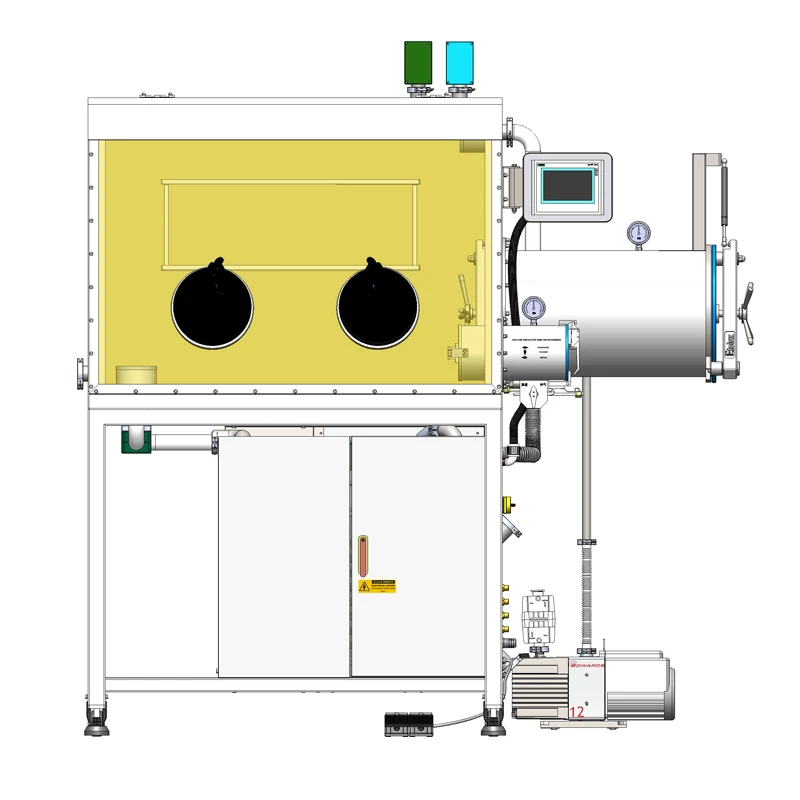
Two stations on opposite faces change who can work and how. Operators facing each other can pass tools and samples directly, watch an experiment from both sides, or divide tasks between a preparation position and an inspection position without walking around the enclosure. In a double-sided box the inner volume is reachable from both sets of ports, which matters when equipment is too deep to handle comfortably from one side, or when instruments inside need connections to the outside.
The layout also changes footprint and room planning. A double-sided enclosure needs clear floor space and lighting on both sides, and it must be positioned so neither face is blocked by benches, gas cylinders, or pumps. Two stations also mean two sets of ports, two glove pairs, and more sealing interfaces to maintain.
What the layout does not change is the atmosphere itself. Adding a second station does not automatically add purification capacity. Purifier sizing follows enclosure volume, the leak behavior of the box as built, how much material moves in and out, and the moisture and oxygen load those transfers bring. A large double-sided box with heavy traffic needs correspondingly more purification capacity or more frequent regeneration, and that judgment belongs to the configuration stage.
Which Components and Accessories Matter Most?
Glove ports and gloves
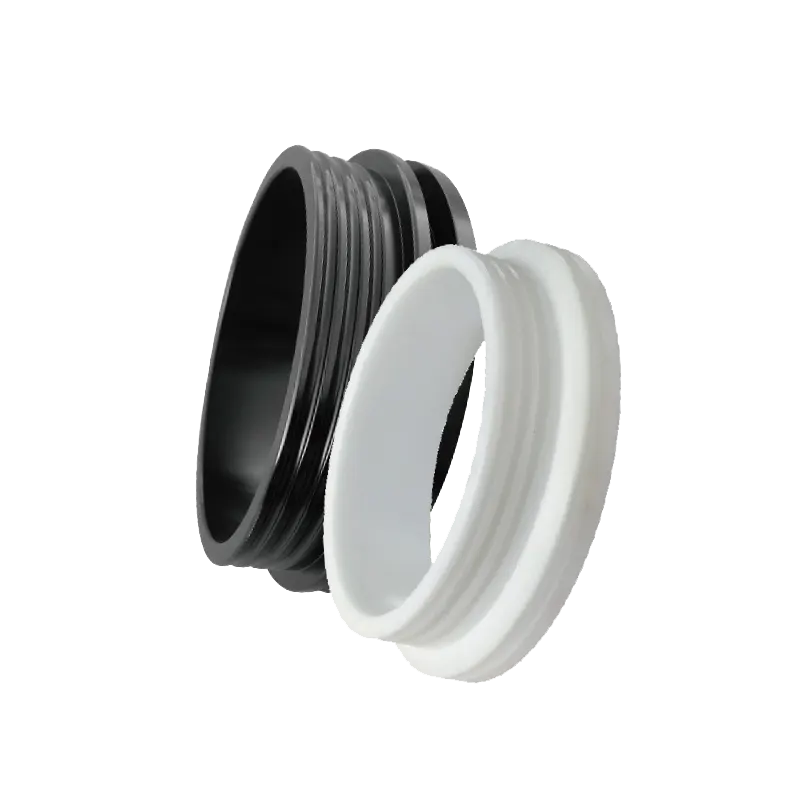
The ports are where the operator meets the atmosphere. A glove box glove port is the mounting interface: the ring and sealing arrangement that holds a glove in the enclosure wall and keeps that opening gas-tight. The port does not control moisture or oxygen. What it determines is whether a glove fits correctly, whether it seals reliably, and whether it can be changed without disturbing the rest of the box.
Selection comes down to details that match your box and your work. Port size and mounting style must match the enclosure opening and the glove cuff. Glove material and thickness must be compatible with the solvents, reagents, and powders you handle, and with the dexterity your tasks require: thin gloves improve feel but wear faster and may transmit more moisture through the material, while heavier gloves last longer and feel clumsier. Permeation behavior, not only puncture resistance, is the property that matters in a controlled-atmosphere box. Where a port carries a transfer or vacuum function instead of a glove, sealing and pressure requirements differ, and that should be confirmed against the enclosure specification rather than assumed.
Antechamber and the transfer path
Every item that enters brings air with it. The antechamber is where that air is removed by vacuum and inert-gas refill cycles before the inner door is opened. An antechamber that is too small limits what you can bring in; one that is too large takes longer to cycle and consumes more gas. Two antechambers, or one of larger volume, are common on multi-station boxes because they separate frequent small transfers from occasional large ones.
Monitoring, filtration, and vapor control
Moisture and oxygen analyzers, vacuum pumps, electrical and signal feedthroughs, HEPA filters, solvent adsorption units, and cooling devices all extend the enclosure's usefulness, and each has its own matching criteria: analyzers by range, resolution, accuracy, and calibration practice; pumps by gas compatibility and load; feedthroughs by connection type, count, and sealing; filters and adsorption media by what they actually capture. Treating filtration or adsorption as a substitute for purification is a common and expensive misunderstanding.
Which Specifications Should You Check Before Ordering?
Atmosphere performance
Ask for moisture and oxygen figures together with the conditions under which they apply: which sensor, where in the loop, what load inside the box, how long after a transfer. A figure described as reachable after extended circulation is not the same as a level held continuously during active work, and a sensor's resolution is not its accuracy. Confirm how readings are calibrated and how often, and confirm what the system holds while the box is in use, not only at rest.
Pressure, vacuum, and leakage figures
Several pressures appear in a glove box specification, and they are not interchangeable. Enclosure working pressure, often a small positive pressure relative to the room, protects against inward leakage. Antechamber vacuum describes the evacuation level reached during transfer cycles. A pump's ultimate vacuum is a property of the pump, not of the box. Leak rate describes how well the enclosure holds pressure over time, and the test method matters as much as the number. Keep each figure attached to the component and condition it belongs to, and treat any value whose unit or scope is unclear as something to clarify with the supplier rather than to quote.
Space, ergonomics, and utilities
Check internal working volume and dimensions against the largest item you will place inside, including clearance for reaching it through the ports, and check working-surface height for each operator. On the utility side, plan for electrical supply, vacuum, inert gas at adequate flow for purging, regeneration gas supply with safe venting, and any exhaust a regeneration cycle requires. Settle that infrastructure before delivery; retrofitting it in a crowded laboratory is far more disruptive than planning for it.
Where Is It Suitable, and Where Are the Limits?
The strongest fit is work that is both air-sensitive and repetitive: battery and solid-state electrolyte materials, perovskite and OLED fabrication steps, air-sensitive synthesis and catalysis, semiconductor and advanced materials research, and the handling or sieving of reactive powders. Here the value of a purification loop is not one low reading but a stable environment across many transfers and several hours of work.
The limits are equally concrete. An inert-atmosphere glove box is not a sterile enclosure, not a classified cleanroom, and not a biological safety or hazardous-material containment device; an inert gas says nothing about biological or chemical containment. Not every gas is inert toward every sample, since nitrogen can react with lithium metal and other reactive materials, so the working gas follows the chemistry. Volatile solvents raise the organic vapor load and may need dedicated adsorption media, and processes that introduce heat or outgassing add to what the atmosphere management must absorb. Materials needing high-temperature processing or very bulky, frequent transfers may be better served by other arrangements, or by accepting longer recovery after each transfer.
How Should You Select or Integrate It?
Start from the work, not the model number. Define the moisture and oxygen levels your materials need and how long they must be held; define how many people will work at the box at once; list the equipment that will live inside, with dimensions and utility needs; and estimate how much material moves in and out per day and in what sizes. Those answers determine enclosure volume, the number of stations, whether double-sided access is justified, antechamber size, and purification capacity.
Then confirm details that are easy to overlook: port diameter and glove size for each operator, glove compatibility with your solvents and powders, the location and number of feedthroughs, pump and gas supply arrangements, and the venting path for regeneration gas. Where an accessory is supplied separately, verify that its mounting and sealing match the enclosure it will be installed on. The two-station double-sided purification glove box and its accessories should be specified as a compatible set rather than assembled from unrelated parts. Ask what the delivered configuration includes, what the regeneration procedure requires, and which consumables you must stock.
Common Questions About Purification Glove Boxes
Does the box purify its own atmosphere?
In this configuration the purification system is part of the enclosure rather than an external add-on. It circulates the working gas through purifying media and holds the atmosphere during operation. It still depends on a proper initial purge and on correct regeneration of the media.
Can a purification system be added to a box that does not have one?
It depends on the enclosure. A purification unit must be matched to box volume, leak behavior, and existing connections, and it recirculates through a closed circuit with compatible fittings. Treat any such addition as an engineering decision confirmed by the supplier, not a universal upgrade.
Do glove ports influence moisture and oxygen levels?
Only indirectly. Ports and gloves are sealing interfaces, and a worn glove or a badly seated port seal is a real path for air ingress. The port neither measures nor removes water or oxygen; it protects the enclosure only as well as its seal and glove remain intact.
Does a HEPA filter lower the moisture level?
No. HEPA filtration removes particles. Moisture and oxygen are handled by the purification column, and organic vapors call for dedicated adsorption media.
