
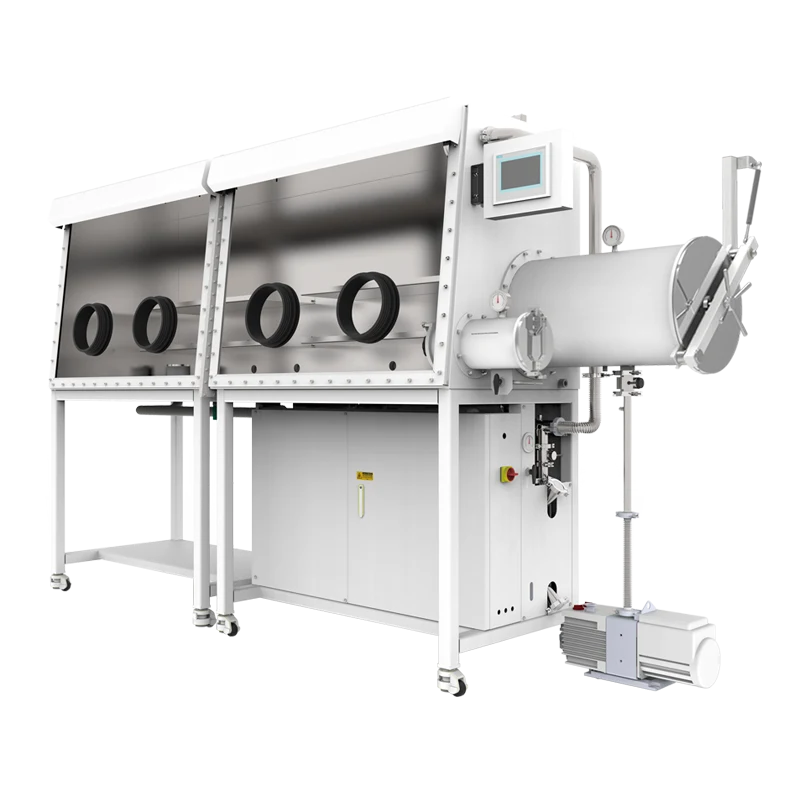
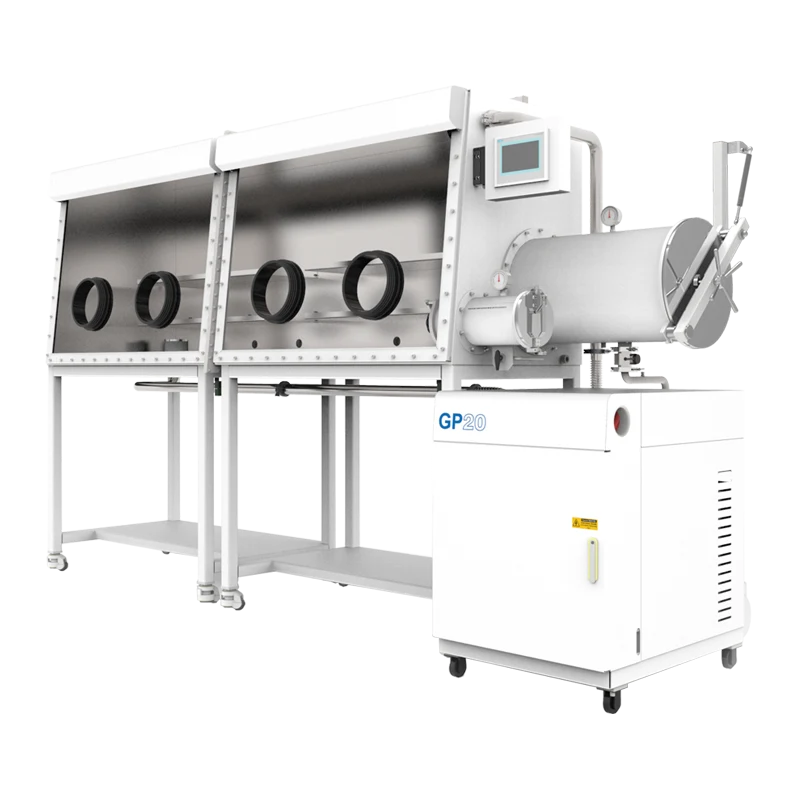
A two-station single-sided split-type glove box with a gas purification system is a closed-loop inert-atmosphere workstation built around three ideas: two operator positions sharing one working face, an enclosure and purification cabinet supplied as separate modules, and a continuously circulating gas loop that removes moisture and oxygen from the box atmosphere. It is not a vacuum chamber, and it is not merely an enclosure that was flushed with argon once. It exists so that a defined low-oxygen, low-moisture environment stays stable through hours of hands-on work — assembling lithium metal cells, weighing perovskite precursors, cleaving air-sensitive crystals — while the operator stays outside the box and touches the material only through gloves.
What Does the Purification Loop Actually Do?
A purification glove box is defined less by its enclosure than by its gas circuit. Box atmosphere is continuously drawn out, passed through a particle filter and a blower, pushed through one or more purifier columns, and returned to the enclosure. Inside a column, moisture is adsorbed on a regenerable desiccant such as molecular sieve, while oxygen is chemically bound, commonly by a copper-based catalyst. Because both media eventually saturate, each column is periodically regenerated in a separate step: the saturated column is heated while a regeneration gas passes through it, driving off adsorbed water and returning the catalyst to its active form. In a two-column arrangement, one column stays on purification duty while the other regenerates, so the loop can keep running.
Regeneration is the part most often glossed over in procurement discussions. It consumes gas, needs heat, and temporarily removes one column from service, so the system has a working rhythm rather than a constant output. A single-column system has to pause purification while it regenerates. Whether that pause matters depends entirely on how sensitive the process is and how long the exposure lasts — which is exactly the kind of question to settle with the supplier before, not after, installation.
The loop also does not establish the atmosphere in the first place. A box is initially purged, or evacuated and backfilled with nitrogen or argon, to displace air. Purification then defends that atmosphere against the small but continuous ingress that comes from glove permeation, antechamber transfers, door and port seals, and outgassing from samples, solvents and containers. A well-sealed box with a well-sized purifier is a balance between those losses and the column's removal capacity.
Four Processes That Are Not the Same Thing
- Gas replacement (purging): displacing air with inert gas to reach a starting point. It is a one-time or occasional action.
- Evacuation: pumping a chamber or antechamber down to remove air and volatiles before backfilling. It reduces the air load transferred into the box.
- Circulation purification: the continuous removal of oxygen and moisture by the purifier columns during normal operation.
- Regeneration: restoring a saturated column so it can purify again. It is maintenance of the purifier, not a purification step performed on the working atmosphere.
Two consequences follow. First, a HEPA filter removes particles only; it does nothing for oxygen or moisture, although it protects the blower and columns from dust. Second, a solvent adsorber captures organic vapour before it reaches the purifier media, but it cannot substitute for water and oxygen removal. Each element in the circuit addresses a different contaminant.
What “Two-Station, Single-Sided, Split-Type” Changes in Practice
Two Operator Stations Share One Atmosphere
Two stations mean two people can work simultaneously, but they also mean a larger working volume and roughly double the sources of contamination — twice the glove area, twice the material brought in, and more opening and closing of antechambers. Purge time at start-up scales with volume, and purifier load scales with both volume and activity level. Layout matters too: glove port spacing has to allow two operators to work without colliding, which is a physical constraint that a datasheet dimension will not settle on its own.
A Single-Sided Working Face
Single-sided means the operators stand at one face only, which suits a box placed against a wall and keeps the footprint compact. It also tends to give a simpler internal gas path, because the return flow does not have to serve two working faces. The trade-off is one-directional access: equipment that must be reached from the opposite side, or a process where two people need to face each other, generally points toward a double-sided layout instead.
Split-Type Construction
In a split-type system the enclosure and the purification cabinet are separate modules connected by gas lines rather than a single welded frame. This is largely an installation and service decision. A split layout can pass through a standard doorway in pieces, place the purifier where its heat and noise do not disturb the bench, and give maintenance access to the columns without entering the working area. The cost is a longer gas circuit, more joints and therefore more potential leak points, and a larger overall floor footprint that must be planned before delivery rather than after.
Which Specifications Should You Check Before You Order?
For a complete purifying workstation, the meaningful checks cluster around atmosphere performance, gas handling and physical integration:
- Atmosphere monitoring: the measurement range, resolution and calibration method of the oxygen and moisture analysers, and where the sampling point sits in the loop. Resolution is not the same as accuracy.
- Baseline stability: how the quoted oxygen and moisture levels were reached — after full regeneration, under what load — and what the supplier expects during normal working conditions.
- Leak tightness and working pressure: the enclosure's regulated operating pressure range and the conditions under which leak testing is performed. Working pressure, antechamber vacuum, pump ultimate vacuum and leak rate are four different quantities and should not be compared across each other.
- Purifier capacity and regeneration: number of columns, regeneration gas, heat source, and whether regeneration is automated or manual, since this determines how much of the schedule is lost to maintenance.
- Antechamber design: internal dimensions, whether it supports vacuum or purge-only transfer, and how many antechambers the configuration provides.
- Feedthroughs and interfaces: count and type of electrical, signal, gas and KF connections, so that instrumentation and process lines can be routed without drilling the enclosure later.
- Gloves: size, thickness, permeation behaviour and chemical compatibility with whatever solvents and precursors will actually be handled.
Reading the Numbers Without Over-Reading Them
Values quoted for one configuration are not automatically valid for every unit of the same family. A figure described as achievable under specific conditions — after regeneration, with a defined gas supply, at a given leak rate — should be treated as a target rather than a continuous guarantee for all applications. Where a datasheet is ambiguous, or where units seem inconsistent, the sensible move is to ask for the test conditions in writing rather than to assume the most favourable reading.
Where a High-Precision Pressure Transmitter Fits
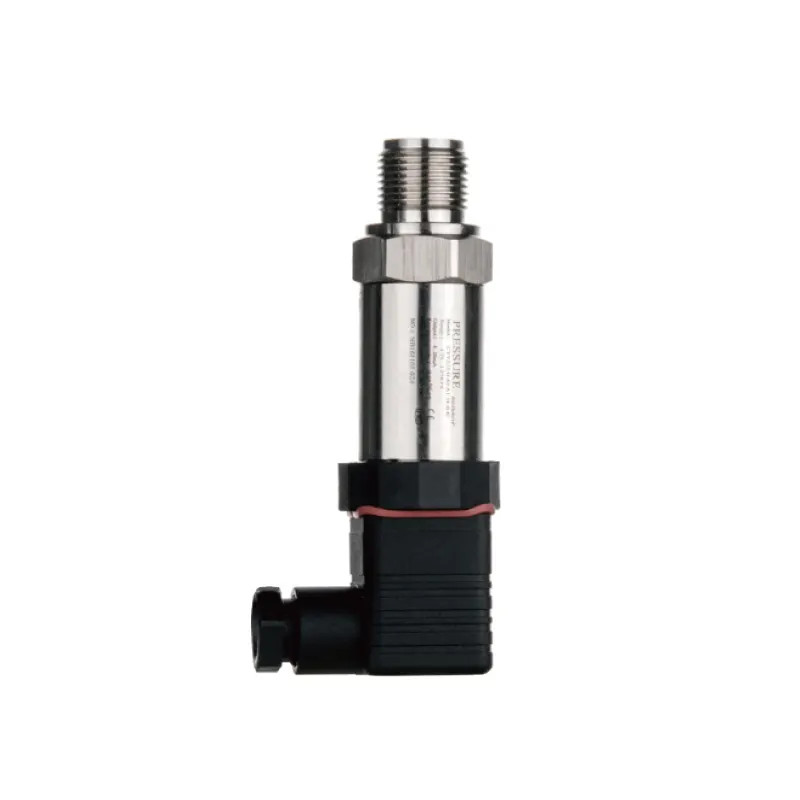
Atmosphere is only half of what a box must hold; the other half is pressure. A box is normally held slightly above or below room pressure by its control system, and that regulation depends on a pressure measurement. A high precision pressure transmitter converts the pressure inside the enclosure, or the differential pressure against the surrounding room, into a signal the controller can act on. When the measured value drifts outside the set band, the controller adjusts gas inlet or exhaust to bring it back.
Choosing one is a compatibility exercise rather than a performance contest. Check the measurement range against the pressures the box actually sees, the stated accuracy rather than only the display resolution, temperature compensation and long-term stability, the wetted materials and whether they tolerate the working gas and any solvent vapour, and the process connection — a transmitter with the wrong fitting cannot be fitted to an existing port. Finally, confirm the output signal and power supply match the box controller, or plan for a separate readout. A transmitter measures and reports pressure; it does not remove oxygen or moisture, and it is not a substitute for the purification loop.
Where Is It Suitable, and What Are Its Limits?
A two-station purification box earns its cost wherever air and moisture degrade a material or a measurement, and where more than one person needs access. Typical work includes lithium metal and solid-state battery assembly, perovskite, OLED and other thin-film device fabrication, air-sensitive organometallic and catalyst chemistry, semiconductor and two-dimensional material handling, metal powder handling and post-processing in additive manufacturing, and general storage or manipulation of moisture-sensitive samples.
The limits are just as concrete. An inert atmosphere is not sterility, not a cleanroom classification, and not biological or hazardous-material containment unless the unit was specified for that duty. Solvent handling is bounded by the capacity of the solvent adsorption stage and by glove compatibility. Large or heavy equipment may not pass through the available antechamber, which constrains what can be brought inside. Highly outgassing materials will consume purifier capacity faster than clean sample handling and shorten the interval between regenerations. And because regeneration takes a column out of duty, sensitive work should be planned around that cycle rather than scheduled across it.
One type distinction is worth keeping clear throughout: a box that relies on evacuation and inert gas backfilling to create a controlled environment is a different machine from one with a continuously regenerating purifier loop. The first holds an atmosphere; the second actively maintains it. Neither should be described in terms of the other's capabilities.
How Should You Select and Integrate It?
Selection usually comes down to a short list of questions with concrete answers. How many people work at the box at the same time, and for how long? Does the process need one working face or two? Is floor space available for a split layout with gas lines between the enclosure and the purifier, or must the system be a single frame? Which purge gas is available, and at what purity? How much atmosphere disturbance does the process tolerate during regeneration? What needs to be transferred in and out, and through what size of antechamber? Which instruments, sensors and process lines need feedthroughs now, and which might be added later?
Once those are answered, the remaining work is verification: confirm the atmosphere figures and the conditions under which they were obtained, confirm the regeneration scheme and its gas requirement, confirm port and fitting standards against every accessory that will be connected, and confirm the enclosure dimensions against the actual bench and doorway. Written confirmation of these points is worth more than a favourable headline number.
FAQ
Does a purification glove box always include the purifier?
Not automatically. In this product the gas purification system is part of the configuration named, but when comparing models it is always worth confirming that the purifier is included, how many columns it has, and whether regeneration is automatic or manual. Purge-only and vacuum-type boxes are separate categories and should not be expected to hold a continuously regenerated atmosphere.
Can a filter, adsorber or pressure transmitter lower oxygen and moisture?
No. HEPA filtration removes particles, solvent adsorption removes organic vapour, and a pressure transmitter measures pressure. Oxygen and moisture are removed by the purifier columns through the circulating loop.
How do I judge whether an accessory is compatible?
Match it on four points: the process connection and its standard, the measurement range or capacity against actual operating conditions, the wetted materials against the gas and any solvent vapour present, and the signal or power interface against the box controller. A part that fails any one of these cannot simply be connected and assumed to work.
What should be documented before installation?
The test conditions behind any atmosphere figure, the leak-test method and acceptance criterion, the regeneration gas supply and schedule, and the list of ports and fittings. These determine whether the system as delivered can meet the process as planned.
