
An eight-station double-sided split-type glove box with gas purification system is a sealed, recirculating inert-atmosphere workstation that allows several operators to handle air- and moisture-sensitive materials inside one shared controlled volume. It sits in the middle of an inert-atmosphere workflow: samples, tools and small instruments enter through an antechamber rather than through the open laboratory; the working gas is continuously circulated through a purification column that removes water and oxygen; and glove ports on both long faces of the enclosure let people work from either side at the same time. The point of this configuration is throughput. One large, continuously purified volume is generally easier to keep stable than several small boxes, each of which must recover its atmosphere after every opening.
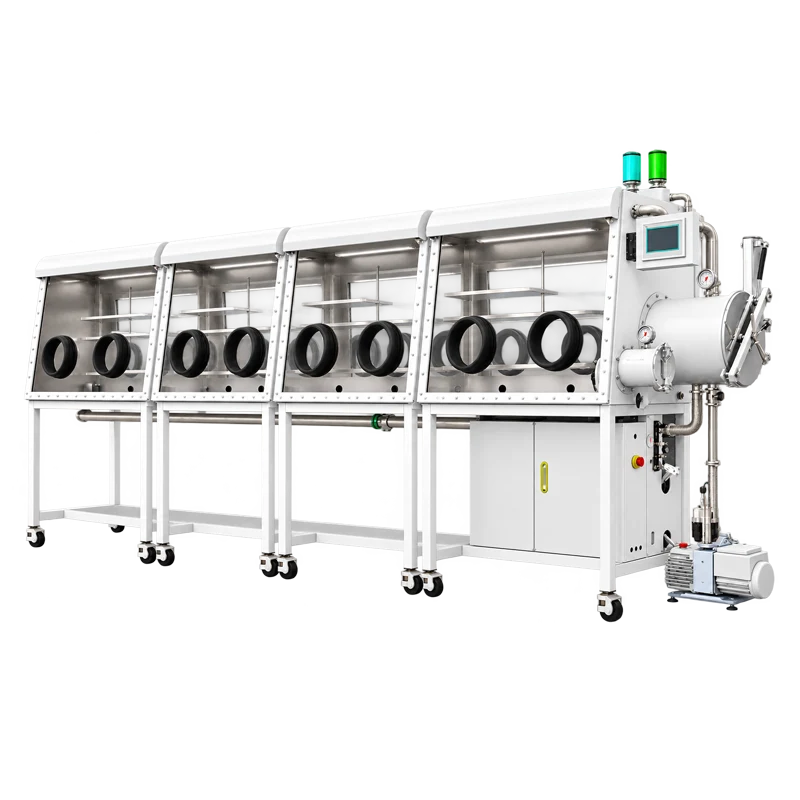
What Does the System Do, and How Does It Work?
Three functional paths have to work together inside this box: the working-gas loop that keeps the enclosure clean, the transfer path that brings materials in and out, and the monitoring and control layer that tells you what the atmosphere is actually doing. The product name covers the first two; the third decides whether they stay under control.
The working-gas loop
Most installations use nitrogen or argon as the working gas. A blower takes gas from the enclosure, pushes it through a purification column, and returns it to the box, so the same volume of gas is cleaned repeatedly instead of being consumed once. Inside the column, water is taken up by an adsorbent material and oxygen is removed by a catalyst that reacts with it. Both media are finite, which is why a purification system is a maintenance item rather than a permanent fixture. Once the media approach saturation, the column is regenerated — typically by heating it while a regeneration gas is passed through — and the box returns to service. Regeneration gas composition, temperature and cycle time are model-specific and should come from the manufacturer's documentation for the exact unit, not from generic rules of thumb.
A purification loop has a duty it can meet and a duty it cannot. Every time a glove port opens, an antechamber cycles, or a damp sample enters, the loop has to remove the water and oxygen that came in with it. That is why purifier sizing is tied to enclosure volume, glove-port count, transfer frequency and the humidity of the room around the box, rather than to the box footprint alone.
Why the double-sided layout matters
Double-sided construction means the enclosure carries glove ports on both long faces, so two operators can work facing each other on the same task. For workflows that involve passing a sample, a substrate or a tool between two people, or that require one person to hold a part while another manipulates it, this removes a round trip through an antechamber. It also means the box needs clear floor space and headroom on both sides — a requirement that is easy to overlook when equipment is planned around a single bench wall.
Why split-type construction matters
A split-type enclosure is built as separate modules rather than one monolithic shell. Practically, that helps with delivery and installation: individual sections can pass through doors, lifts and corridors that a single large welded box cannot. It also allows a laboratory to stage the build, and it offers some flexibility later if the working volume needs to change. What a split construction does not automatically provide is a single atmosphere. If the modules are joined and connected so that gas circulates through all of them, one purification loop can serve the combined volume; if they are sealed from each other, each section needs its own atmosphere management. Whether a given split system shares one loop or runs separate loops is a configuration question, so it should be confirmed with the supplier rather than assumed from the name.
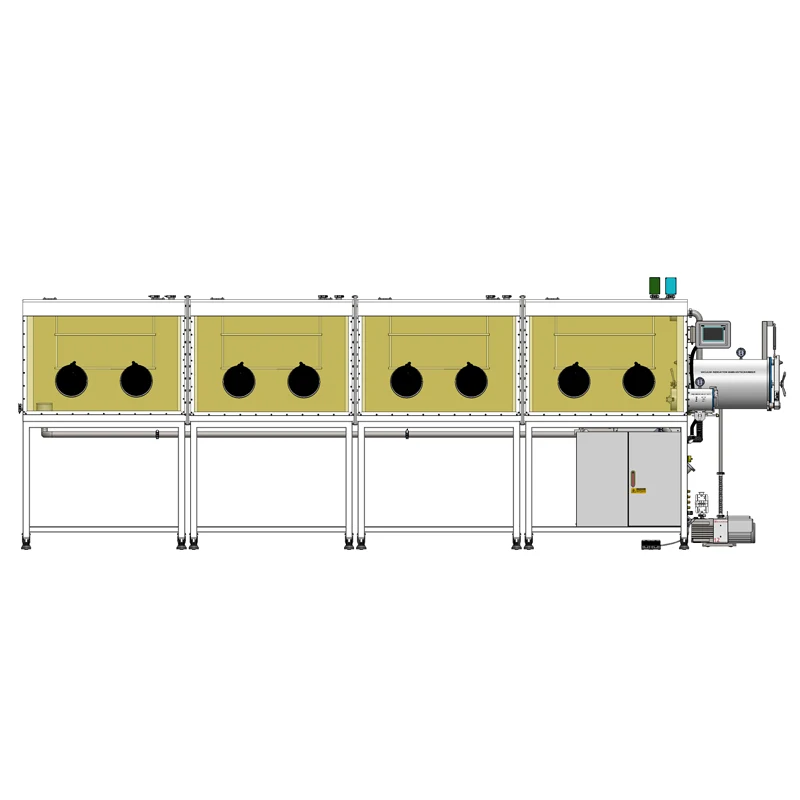
Which Configurations and Components Define the System?
Four choices shape what an eight-station purification glove box can actually be used for.
Station count and port distribution
“Eight-station” describes how many operator positions the enclosure provides. The distribution matters as much as the number: how many ports sit on each side, how far apart they are, and how much unobstructed working height and depth each position has. Two operators sharing one port have far less usable room than two operators with separate ports.
Enclosure, antechamber and transfer design
The antechamber is the interface between the laboratory and the inert volume. Its internal size determines what can be brought in — a coin cell, a vial rack, a small furnace, a microscope stage — and its cycle design determines how much atmosphere is disturbed with each transfer. Large items may need a larger antechamber or a dedicated transfer port, and frequent transfers may justify more than one chamber so that a slow purge does not block the workflow.
Purification capacity and regeneration provisions
The purifier's capacity determines how long the box can hold its atmosphere between regenerations, and how quickly it recovers after a heavy load. This is the number to ask about in terms of total enclosure volume and expected load, not as a standalone figure.
Instrumentation and control
Oxygen and moisture analyzers report the state of the atmosphere; pressure instrumentation reports the state of the enclosure relative to the room. A controller ties these readings to the blower, valves and alarms. As discussed below, these components measure the atmosphere — they do not purify it.
Which Specifications Should You Check?
Because glove box families vary widely, the useful approach is to check the properties that constrain your work, and to verify each one in the form the supplier can actually guarantee.
- Working volume and geometry. Internal dimensions, usable height under the gloves, shelf positions, and the footprint including the space needed on both operator sides.
- Glove ports and gloves. Port diameter and spacing, glove material, thickness and length. Glove selection is a compatibility decision — the polymer must suit the samples and solvents used, and it is a consumable that wears and permeates over time.
- Leak rate and leak testing. A leak rate is a property of the assembled enclosure, including gloves, seals, feedthroughs and valves. Ask for the test method and the conditions under which the figure was obtained.
- Working pressure range. The box normally runs slightly above room pressure to discourage inward leakage, and it needs a relief path. Working pressure is not the same figure as antechamber vacuum capability or pump ultimate vacuum.
- Atmosphere performance. Oxygen and water content, together with the measurement method, the analyzer used, and whether the figure is a steady-state value under a defined load. A displayed resolution of 0.1 ppm is not the same as an accuracy of 0.1 ppm.
- Transfer performance. Antechamber volume, how it is evacuated and refilled, and how many cycles a typical load requires.
- Utilities and siting. Electrical supply, vacuum or compressed gas, cooling provisions if any, exhaust routing, floor loading, and door widths if the enclosure arrives in modules.
Instrumentation: Measuring the Atmosphere, Not Cleaning It
Purification and measurement are separate functions, and confusing them leads to poor purchasing decisions. The purification column removes water and oxygen; the analyzers only report what is left. Neither an analyzer nor a pressure instrument changes the atmosphere.
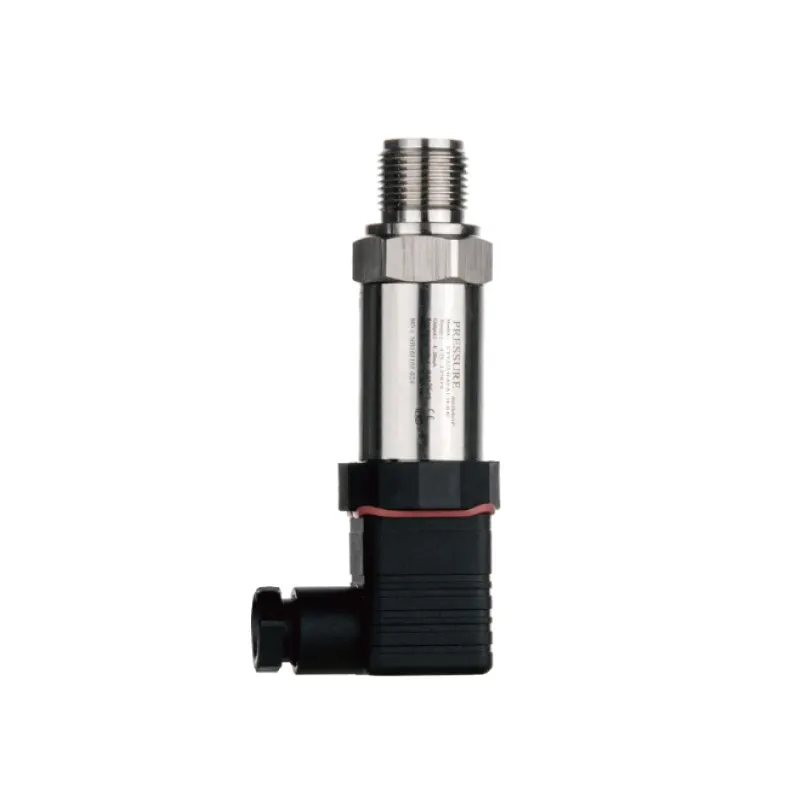
A typical example of the measurement layer is a high precision pressure transmitter, which converts the small pressure difference between the enclosure and the surrounding room into an electrical signal for a display, controller or data logger. Keeping the box at a stable, slightly positive pressure is one of the simplest ways to reduce the rate at which room air and moisture seep in, and the transmitter is what makes that condition visible and repeatable.
When specifying a transmitter for a glove box, the relevant questions are its measuring range, accuracy and long-term stability, the wetted materials and whether they suit the working gas, the process connection (often a small flange such as a KF fitting) and how it seals, the output signal and its compatibility with the box controller, and the calibration interval. A transmitter is an accessory: it reports on the enclosure it is fitted to, and it does not provide purification, vacuum or atmosphere control on its own. It should also be matched to the actual configuration — an instrument selected for one box connection style is not automatically suitable for another.
Where This Configuration Fits — and Where It Does Not
An eight-station, double-sided purification box suits work where several people share the same sensitive materials: lithium-ion and solid-state battery electrode and electrolyte preparation, perovskite and OLED device fabrication steps, semiconductor and thin-film handling, air-sensitive organometallic and catalyst chemistry, and the transfer, weighing and packaging of moisture-sensitive powders and precursors. It also fits post-processing steps where a part or powder must be moved between processes without exposure to air.
The limits are just as important. An inert atmosphere is not sterility, not a cleanroom classification, not biological containment, and not a substitute for hazardous-materials handling requirements. Purification media have finite capacity and can be overloaded by heavy transfer traffic, large damp loads or solvent vapor; if solvents are used inside the box, the system typically needs dedicated solvent management rather than relying on the water and oxygen purifier. Particle filters and HEPA filtration capture particulates only — they do not remove moisture or solvent vapor. Finally, not every gas is inert toward every sample, and not every material can be handled in the same working gas. Compatibility is an experimental question, not a specification line. Where a datasheet value, a unit of measure or a configuration detail is unclear, the correct action is to leave it out of the evaluation and ask for confirmation rather than to compare incomparable numbers.
How to Select and Integrate the System
Start from the work, not from the equipment list. Map out how many people will work simultaneously, what they will handle, how large those items are, how long a typical session lasts, and how often materials must cross the boundary. Then match:
- Station count and layout to the number of simultaneous users and the need for two-sided work.
- Enclosure volume and purifier capacity to each other, with margin for routine transfer traffic.
- Antechamber size and count to the largest object that must pass through and to the transfer frequency.
- Glove material and port geometry to the chemicals in use and the ergonomics of the task.
- Instrumentation to what you actually need to control: oxygen and moisture for the atmosphere, pressure for enclosure integrity.
- Service access for regeneration, media replacement, glove changes and leak testing.
Before purchase, ask the supplier for the leak test method, the conditions behind any atmosphere figure, the utilities the system requires, the dimensions that determine siting of a split module, and the recommended regeneration and maintenance routine for the specific unit. Full details of this configuration are described on the eight-station double-sided split-type glove box with gas purification system product page.
FAQ
Does an eight-station glove box always include gas purification?
In this model the purification system is part of the configuration, but that does not mean every large glove box has one. Inert enclosures also exist in simpler forms, such as sealed boxes that are repeatedly evacuated and refilled with inert gas — a different architecture that does not maintain a continuously purified atmosphere.
Can a pressure transmitter lower the water and oxygen content?
No. It measures pressure and provides a signal; the reduction of water and oxygen is done by the purification column and the circulation loop.
Do HEPA filters remove moisture or solvent vapor?
No. They retain particles. Moisture removal belongs to the purification loop, and solvent vapor needs its own management approach.
Can the box be used with solvents?
Sometimes, but it depends on glove and seal material compatibility and on whether the system is set up to deal with solvent vapor. Solvent carryover can degrade purification media, so this should be discussed with the supplier before use.
What should be confirmed before ordering?
Confirm whether the split modules share one atmosphere or run separate loops, purifier capacity relative to total volume, antechamber size, glove port dimensions, leak test method, utility requirements, and the siting and access dimensions for each module.
