
What an Acrylic Glove Box Is and Where It Fits
A GBT series acrylic glove box is a transparent, sealed working chamber with glove ports, built so that an operator can handle air- and moisture-sensitive samples while the interior atmosphere is displaced by an inert gas such as nitrogen or argon. It sits between the sample and the laboratory air: materials enter through the main door or a transfer port, the chamber is purged — and on vacuum-capable versions evacuated and refilled — and hands work through the gloves without reopening the box. The problem it solves is a practical one. It removes the bulk of oxygen and moisture from the immediate working volume at a fraction of the cost and footprint of a recirculating purification system, while keeping the sample fully visible from every side.
That transparency is precisely why the material of construction deserves as much attention as the seals. Acrylic is light, easy to machine and optically clear, but it is a polymer, not a metal. It adsorbs and slowly permeates gases, it has limited resistance to many solvents, and it cannot be treated as a permanent barrier in the way a welded stainless-steel chamber can. An acrylic box is therefore a controlled-atmosphere tool rather than a permanently sealed vessel, and its internal atmosphere will drift whenever fresh gas stops flowing.
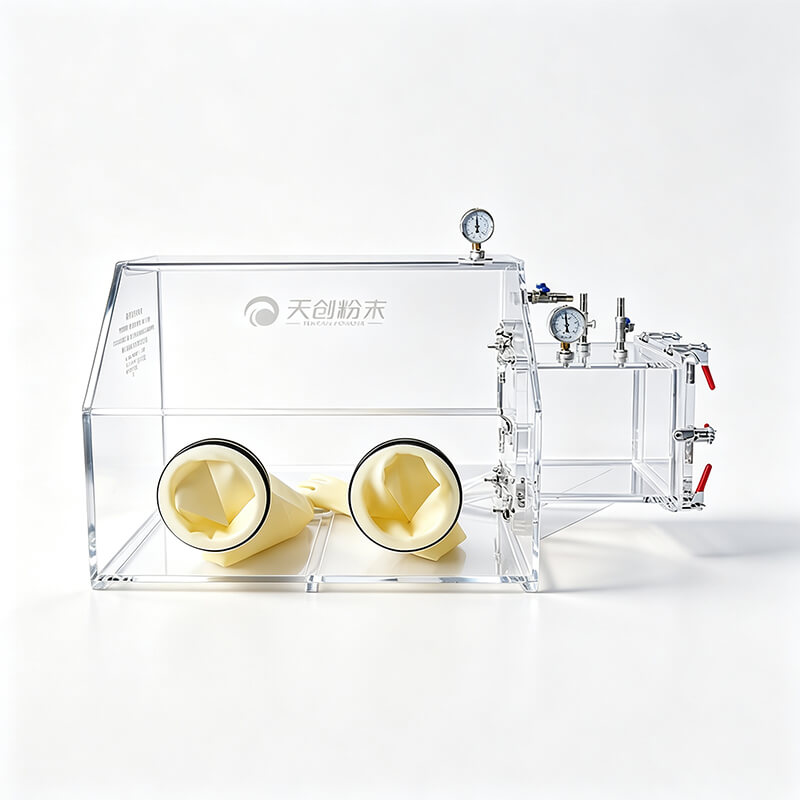
How the GBT Series Works
The working principle of the acrylic glove box is dilution and displacement. Every time the chamber is filled with inert gas and vented, the residual oxygen and moisture concentration is reduced by roughly the same factor; repeating this fill-and-purge cycle pushes the levels lower again. A vacuum-capable version shortens the process, because evacuating the chamber first removes a large share of the trapped air before the inert gas is admitted, so fewer cycles are needed to reach a comparable condition.
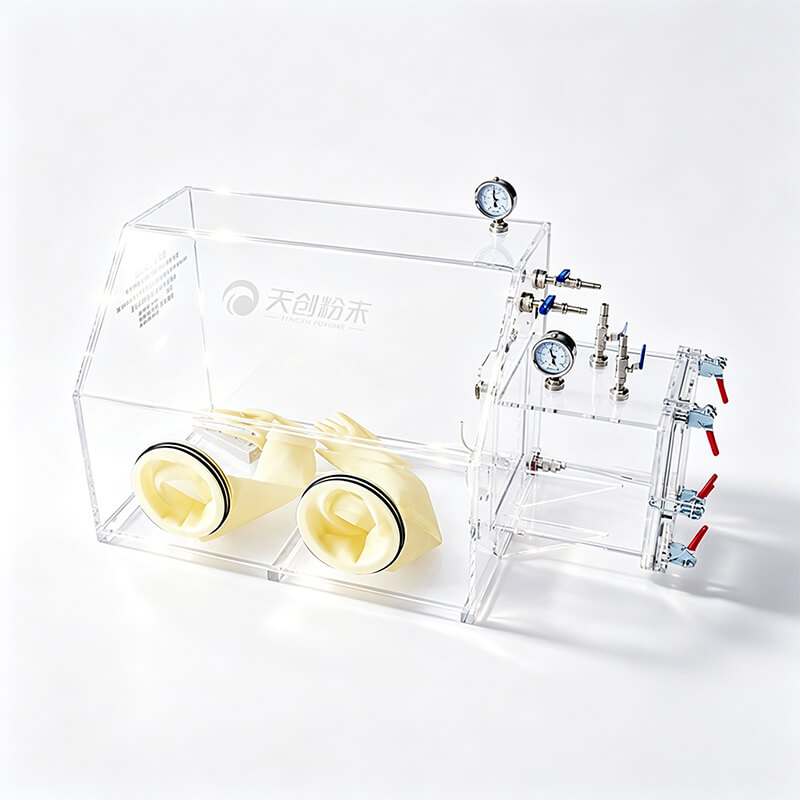
The structure that makes this possible is simple enough to describe: an acrylic enclosure with a sealed front panel, one or more glove ports fitted with gloves, gas inlet and outlet valves, a gauge or sampling point for judging the internal condition, and — depending on the configuration — an antechamber or transfer port that lets items in and out without exposing the main working volume to room air. The gloves are the only moving interface between the operator and the sample, which is why port diameter, glove material and glove thickness are not minor details: they determine reach, tactility and how quickly the glove itself absorbs or transmits moisture and solvent vapour.
Gas replacement is not gas purification
A common misunderstanding is that a sealed acrylic chamber with a nitrogen line attached behaves like a glove box with a purification system. It does not. Purge cycles replace the atmosphere; they do not regenerate anything, and there is no purification column, no circulation loop and no continuous monitoring loop unless such equipment is explicitly part of the configuration you order. If your process needs a sustained low-oxygen condition over many hours of open-door-free work, the purge-and-refill approach will gradually lose ground, and the correct answer is a chamber designed around continuous recirculation and regeneration rather than more purge gas.
Pressure, vacuum and what the walls can take
In normal operation an acrylic box works close to ambient pressure, usually held at a slight positive pressure so that any leakage moves outward rather than inward. Evacuation is a different duty entirely: it loads the panels and seals with an inward force that depends on the panel area and thickness. This is why the GBT series covers more than one mechanical build, and why vacuum capability should be treated as a property of the specific unit you are buying, not as a generic feature of acrylic enclosures. The box working pressure, the achievable vacuum level inside the chamber, and the ultimate vacuum of the pump you connect are three separate figures, and they should never be quoted interchangeably.
Which Configurations Matter
The differences between acrylic glove box configurations are structural, not cosmetic, and they change what the box can be used for.
Isolation-type chambers
These provide a physical barrier and a purged working volume. They are suitable for short handling steps, weighing, packing, sample transfer and teaching demonstrations, where the goal is to limit exposure to laboratory air rather than to hold a specification over a long working session.
Micro-vacuum and vacuum-type chambers
When the box is designed to tolerate evacuation, the purge process becomes faster and more repeatable, and the box can be used in workflows that involve several transfers per day. The trade-off is weight, cost and the need to observe the manufacturer's evacuation limits. Whether a given unit can be evacuated at all depends on the model and the acrylic wall thickness, so this is a question to settle with the specification sheet before ordering, not after the box is on the bench.
Ports, antechambers and access
Single-port and multi-port layouts change the number of operators who can work simultaneously. Adding an antechamber separates the dirty transfer step from the clean working volume and reduces how often the main chamber is opened. Neither option is universally better; a small chamber with a large antechamber may lose more usable volume than it gains in convenience.
Specifications to Verify Before Ordering
The useful specifications for an acrylic glove box are the ones tied to space, atmosphere, transfer and compatibility. Powder-processing metrics such as throughput or particle size have no place in this comparison.
| Item to verify | Why it decides whether the box works for you |
|---|---|
| Internal dimensions and working height | Determines how many samples, racks or instruments fit, and whether the operator can reach the far corners comfortably through the gloves. |
| Acrylic wall thickness and construction | Governs rigidity and whether the chamber can be evacuated, and how it behaves under repeated purge cycles. |
| Vacuum capability of the specific model | Decides whether you can use evacuation-assisted purging at all, and what limit must not be exceeded. |
| Glove port size and glove material | Sets reach and tactility, and influences how much moisture or solvent vapour the gloves themselves take up. |
| Number and type of gas valves and ports | Determines whether purging, venting and sampling can be done without improvising connections. |
| Antechamber presence and volume | Controls transfer frequency, purge gas consumption and how often the main volume is disturbed. |
| Seals and gasket material | Defines chemical compatibility and how quickly seals age under solvent exposure. |
| Instrumentation supplied | A gauge tells you the state of the box; if an oxygen or moisture analyser is added, its range, resolution and calibration matter more than its display. |
Two further points are worth writing into the specification conversation. First, chemical compatibility of the acrylic panels is a genuine constraint: solvents that attack or craze the surface shorten the life of the chamber, and the answer is not simply a thicker panel. Second, if an oxygen analyser is fitted, remember that resolution is not accuracy, and that the instrument measures the atmosphere — it does not improve it.
Where It Is Suitable, and Where It Is Not
An acrylic glove box earns its place in workflows where visible, low-cost protection is enough: handling air-sensitive inorganic and organometallic reagents, preparing lithium and solid-state battery samples before sealing, working with perovskite and OLED precursors, packaging moisture-sensitive powders, post-processing reactive metal powders from additive manufacturing, and routine operations such as weighing, sieving and mounting specimens that would otherwise be exposed for minutes at a time.
The limits are equally concrete. Acrylic permeates gases, so a long unattended hold at a low oxygen level is not a reasonable expectation from purge cycles alone. Solvent vapour compatibility must be checked against the panel and seal materials. Static charge can build on acrylic surfaces and needs to be managed when handling fine powders. And an acrylic enclosure with an inert atmosphere is not a cleanroom, a sterile environment, a biological safety cabinet or a certified containment barrier for hazardous materials — an inert gas is not automatically inert towards every sample, and inerting is not the same as decontamination.
Vacuum Equipment and Exhaust Filtration
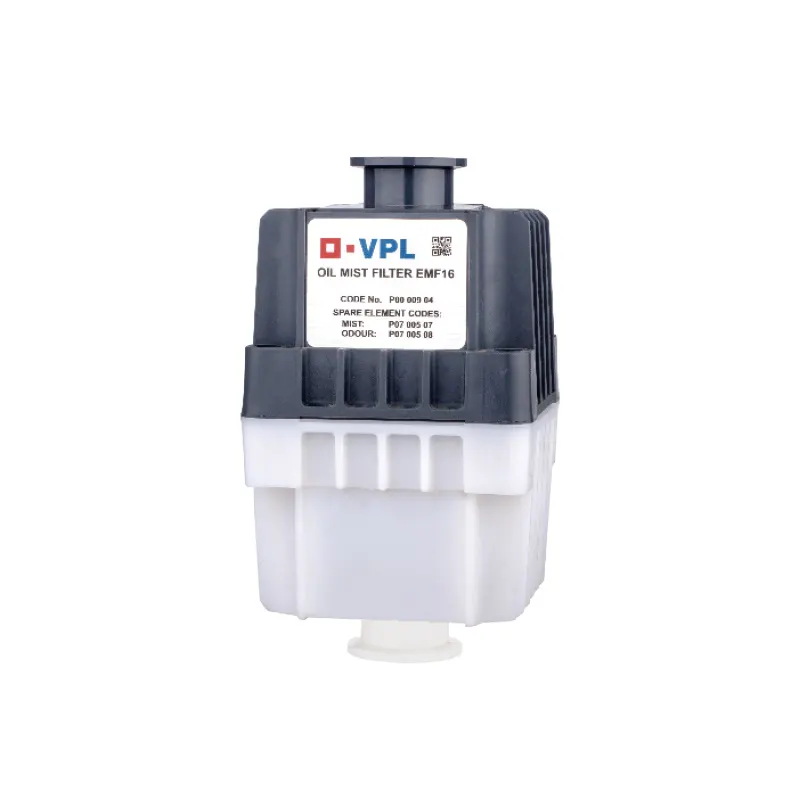
If the chamber is vacuum-capable, a pump becomes part of the system. Oil-sealed rotary vane pumps are common for this duty, and their exhaust carries a fine oil mist that is unpleasant in a laboratory and deposits on nearby surfaces. A vacuum pump oil mist filter is fitted on the exhaust side to capture that mist before it reaches the room. It is worth being precise about what such a filter does: it protects the laboratory air and the pump's surroundings, and it has no effect on the oxygen or moisture level inside the glove box. It also does not replace a cold trap or a solvent scrubber where condensable vapours are being pumped. Whether a particular filter suits your pump depends on the pump's gas flow, the connection size and the nature of the pumped gas, so those three items should be confirmed with the supplier before installation rather than assumed.
How to Select and Integrate the Box
Start from the sample, not the chamber. How long must the sample stay protected during a single session — minutes, hours or days? That single question separates a purge-only isolation box from a vacuum-capable one, and it separates either of them from a chamber built around continuous purification. Next, list the chemicals the samples contain and compare them with the acrylic panels, seals and glove material; if solvents are involved routinely, verify compatibility rather than hoping for it. Then map the mechanical envelope: internal dimensions, working height, port count and antechamber volume, against the racks, tools and instruments that must be inside. Finally, close the loop on infrastructure — gas supply and purity, valve and port sizes, pump capacity if evacuation is used, exhaust filtration, and any analyser you intend to fit.
The GBT series acrylic glove box page is the right starting point for confirming which configuration applies to your application, because the answer depends on the specific model and its construction rather than on the material alone. Where a data sheet is silent or ambiguous — for example on the permitted evacuation limit, seal material or port dimensions — treat the value as unconfirmed and ask, instead of extrapolating from another unit in the range.
Frequently Asked Questions
Does an acrylic glove box have a built-in purification system?
Not by default. Purification — a closed loop with a purifier column, circulation and regeneration — is a function of the chamber and its gas management equipment, not of an acrylic enclosure as such. A GBT box supplied without such a loop works by purge and, where applicable, evacuation; if the unit you are considering includes a purification loop, that has to be stated in its configuration.
Can it bring oxygen and moisture down to parts-per-million levels?
Repeated purge cycles reduce oxygen and moisture substantially, and evacuation-assisted purging reduces them further, but acrylic permeation and seal leakage set a practical floor that depends on the box, the gas supply and how the work is performed. Treat any specific figure as valid only for the stated conditions, and do not assume a value achieved briefly equals continuous in-service performance.
How do I know whether a vacuum pump or an accessory is compatible?
Check three things: whether the chamber is rated for evacuation at all, what connection and port sizes are provided, and what the pump is expected to handle in flow and gas composition. Compatibility is a property of the whole assembly, so a pump that performs well on one chamber may be unsuitable for another. When the information is not published, confirm it with the supplier instead of inferring it from the product name.
When is an antechamber or transfer port worth adding?
Whenever items enter and leave often enough that opening the main chamber would be disruptive — several transfers per day, or sensitive samples that should not see room air during loading. For occasional use, the volume lost to the antechamber may outweigh the benefit.
Is acrylic a problem for solvent work?
It can be. Many solvents affect acrylic surfaces through crazing or clouding over time, and seal materials age at different rates. Review the specific solvents against the chamber and seal materials, and keep aggressive chemistries out of a box that was not specified for them.
