
A vacuum pump oil mist filter is an exhaust-side accessory for a lubricated vacuum pump. It clamps or threads onto the pump's exhaust port and captures the fine oil aerosol that the exhaust stream carries out of the pump, so that oil does not settle as a film on the pump body, the bench, nearby instruments or the surrounding air. In a glove box installation the filter belongs to the vacuum service rather than to the box atmosphere: it sits after the pump, never between the pump and the box.
That position explains both its value and its limits. It does not change the vacuum level reached in an antechamber, does not remove water or oxygen, and does not treat the working gas inside the box. Its job is narrower and quite practical: keep the exhaust clean, keep oil inside the pump, and make vacuum maintenance predictable.
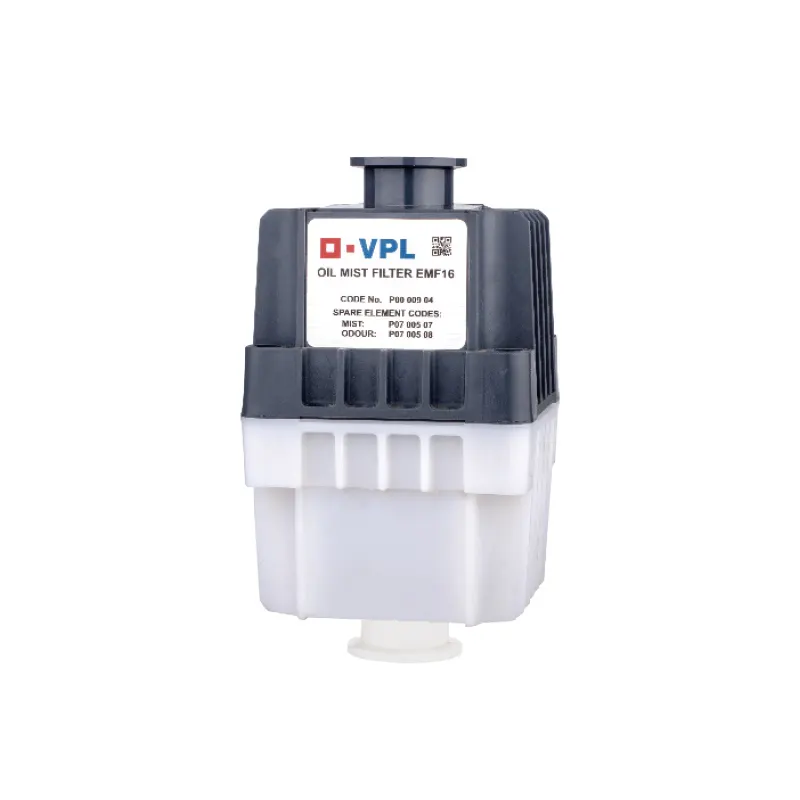
What Does an Oil Mist Filter Do, and How Does It Work?
A lubricated rotary vane pump uses oil for three jobs at once. The oil seals the small gaps between the vanes and the stator, it lubricates the sliding surfaces, and it carries compression heat away from the pumping chamber. All three functions depend on the oil being present and reasonably clean, and all three produce a side effect: the exhaust gas leaving the pump is not dry air alone, but a mixture of gas and entrained oil droplets.
Large droplets are heavy enough to fall out of the stream on their own, which is why an unmodified pump often leaves a visible sheen around the exhaust. The finer fraction behaves differently. Those droplets stay suspended, travel some distance with the exhaust, and deposit gradually on any cool surface they meet — pump housings, hoses, cable trays, wall panels and the room's general air. Over months of antechamber evacuation cycles, that accumulation is what lab staff notice first.
How coalescing capture works
An oil mist filter interrupts that path with a dense fibrous medium, usually a pleated or cylindrical element inside a closed housing. As exhaust passes through the medium, small droplets collide with the fibres, stick, and merge with other droplets. Once they have grown large enough, gravity takes over: the coalesced oil drains to the bottom of the housing, where it either collects behind a drain plug or is returned to the pump through a return line. Many housings also stage the separation, using a coarser pre-separator ahead of the finer coalescing element so that the final stage is not overloaded.
Because the exhaust must pass through a dense element, the housing also tends to soften exhaust pulsation and reduce exhaust noise. That is a by-product of the design rather than its purpose, but it is one reason oil mist filters are often fitted on pumps that sit close to working areas.
What the filter does not do
Three distinctions save a lot of confusion when specifying accessories. First, an oil mist filter works on oil aerosol; it is not a solvent trap and does not remove organic vapour from the exhaust. Second, it is not a water or oxygen purifier, and it has no effect on the sub-ppm atmosphere that a purification glove box maintains inside the working chamber. Third, it is not protection against oil backstreaming into the vacuum line. Backstreaming happens on the inlet side of the pump, when the pump is stopped or when inlet pressure rises, and it is addressed with different hardware — a foreline trap, a cold trap or a valve arrangement — not with an exhaust filter.
Where the Filter Sits in a Glove Box Vacuum Path
The flow order in a typical installation is straightforward: antechamber or vacuum chamber, isolation valve, vacuum line, pump inlet, pumping chamber, exhaust port, oil mist filter, room. Everything upstream of the pump is under vacuum; everything downstream is at or slightly above atmospheric pressure. The filter always belongs to the downstream side.
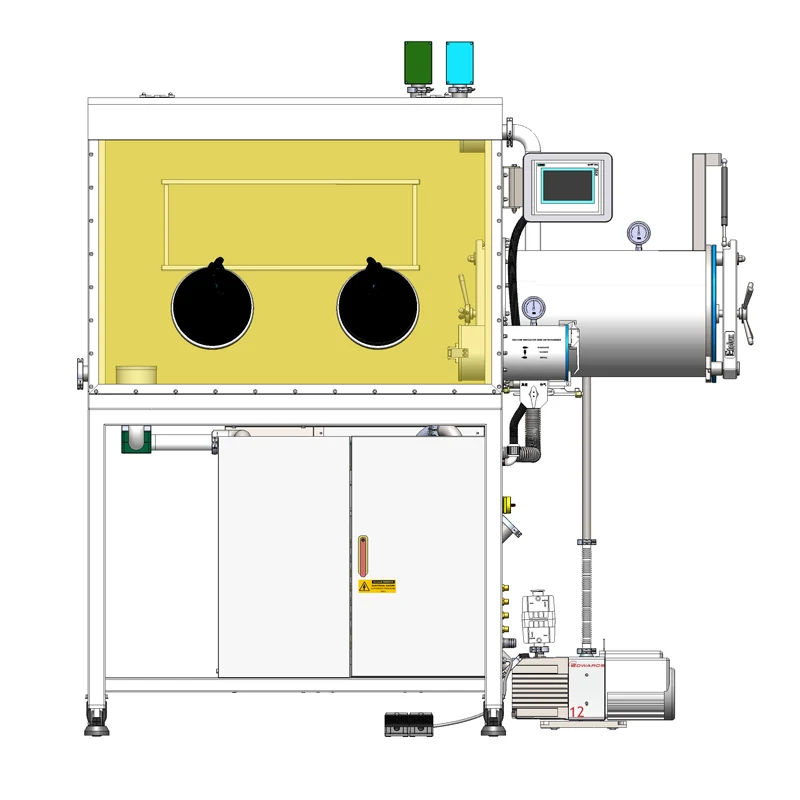
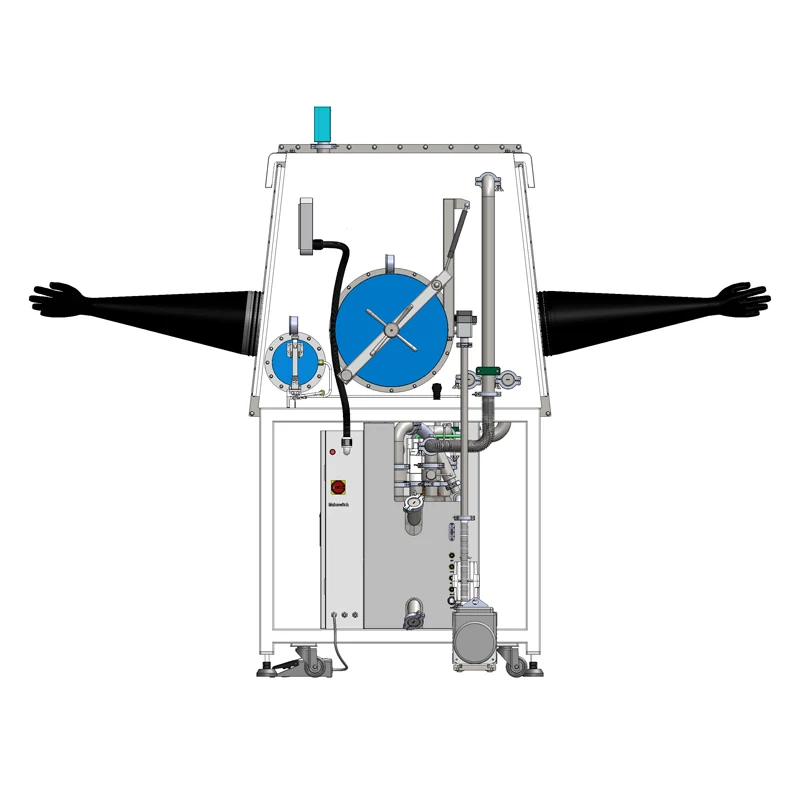
It is worth separating the two gas circuits inside a modern glove box. A purification glove box such as the two-station double-sided glove box with gas purification system keeps its working atmosphere in a closed loop: blower, purifier columns, sensors and returned gas. The vacuum pump is a separate service that evacuates the antechamber before it is backfilled with inert gas, and that supports vacuum-assisted operations related to the box. The filter therefore never touches the purified loop, and it cannot introduce contamination into it.
What it can do is influence cycle behaviour indirectly. A clean filter adds only a small pressure drop on the exhaust, which is negligible for a rotary vane pump. A saturated or blocked filter adds back pressure at the exhaust port, and rising exhaust pressure reduces the effective pumping speed of the pump. In practice that shows up as antechamber evacuation cycles that take longer than they used to, or as a pump that sounds and runs hotter than normal — a useful early warning if anyone is watching for it.
Which Configuration Details Matter?
Because oil mist filters are simple components, the differences between units come down to a handful of design choices rather than to long feature lists.
Element and housing
Replaceable-element designs let the housing stay in place while the coalescing medium is renewed; sealed disposable units are lighter and simpler but generate more waste. Housing material and seal material determine whether the unit tolerates the gases being pumped. For inert gas evacuation in a glove box lab, standard housing materials are usually adequate; where solvent vapour or mildly corrosive gases pass through the pump, material compatibility has to be checked rather than assumed.
Drain and oil return
Collected oil has to go somewhere. A drain plug means periodic manual emptying into a waste container; a return line feeds the oil back to the pump reservoir. Both work, but the return line requires a routing that does not trap oil or create a syphon, and the manual option requires enough clearance underneath the housing to place a container. Accessibility during installation planning is easier than retrofitting later.
Connection, orientation and mounting
Exhaust connections are commonly made with clamp flanges or threaded fittings in sizes matched to the pump port. Orientation and mounting hardware decide whether the unit hangs directly on the pump, sits on a bracket, or stands on the floor with a short hose. Vertical orientation generally favours drainage; horizontal mounting may require a specific element type or drain position.
Specifications to Check Before Ordering
The specification that is easiest to get wrong is the connection, because it is purely mechanical and can be measured on the existing pump. The specification that is easiest to overlook is flow, because an element sized for a small pump will impose excessive back pressure on a larger one.
| Parameter | Why it matters |
|---|---|
| Exhaust connection type and size | Determines whether the filter mounts directly on the pump port or needs an adapter hose; measure the actual port rather than assuming a nominal size. |
| Exhaust flow versus pump displacement | An element matched to the pump's displacement keeps pressure drop low; an undersized element raises back pressure and reduces pumping speed. |
| Oil type and seal compatibility | Mineral and synthetic oils, and gases carrying solvent vapour, behave differently towards seals and element materials. |
| Drain or return provision | Decides maintenance routine: manual emptying versus return to the reservoir. |
| Operating temperature and exhaust temperature | Hot exhaust affects seal life and element performance, particularly where the pump runs continuously. |
| Element availability | Consumable parts should be obtainable in the same sizes as the housing so that replacement is predictable. |
Where a datasheet states a pressure drop, note whether it refers to a clean element at a stated flow. A clean-element figure is a starting point, not a continuous guarantee, because pressure drop rises as the element loads with oil. Where values are missing or unit conventions are unclear, the sensible step is to confirm the working condition with the supplier rather than to extrapolate from another product.
Where It Fits, and Where It Does Not
Applications that suit an oil mist filter
Any glove box laboratory running an oil-sealed rotary vane or piston pump benefits from exhaust filtration. Typical duties include evacuating an antechamber before inert gas backfill, vacuum leak testing of box components, and supporting vacuum-assisted operations such as degassing or drying of air-sensitive material in a chamber outside the box. The accessory is also relevant when a pump sits in a confined space, when exhaust would otherwise be directed towards an operator position, or when the lab simply wants to stop the slow oil film that builds on surrounding surfaces.
Limits and mismatches
Oil-free pumps — scroll, diaphragm or dry piston designs — do not create oil mist, so this accessory has no role in that duty; if their exhaust still needs treatment, it is for a different reason, such as particles or process vapour, and it calls for different hardware. The filter is also not a substitute for atmosphere purification, not a solvent adsorption device, and not a containment measure for hazardous or toxic gas streams. It should not be treated as a safety barrier. Element materials have a finite service life and are consumables: unless the manufacturer explicitly states that an element can be cleaned and reused, replacing it is the correct course.
How to Select and Integrate the Filter
- Identify the pump model, its displacement and the size, type and thread or flange standard of its exhaust port.
- Confirm the gases the pump actually handles — inert gas only, or inert gas plus solvent vapour — and check element and seal compatibility against that list.
- Choose a connection that fits without adapters if possible; each added joint is another potential leak path on the exhaust side.
- Decide the oil-handling method: drain plug with a waste container, or a return line back to the pump reservoir.
- Plan the mounting location so the element can be replaced and the drain reached without dismantling the pump installation.
- Check the exhaust direction after installation: the outlet should not blow towards operators, and downstream ducting should not introduce its own restriction.
- Keep at least one spare element in stock and record the date of each change, so that slow changes in antechamber cycle time can be correlated with filter condition later.
Frequently Asked Questions
Does an oil mist filter improve the oxygen or water levels inside the glove box?
No. It works on the pump exhaust, which is physically separated from the purified working atmosphere. Oxygen and moisture levels inside the box are set by the purification loop, its columns and its monitoring, not by exhaust accessories.
Does it prevent oil from creeping into the vacuum line or the box?
No. Oil reaching the vacuum line or the antechamber comes from the inlet side of the pump and requires an inlet-side trap or valve strategy. An exhaust filter addresses the opposite end of the pump.
Can I fit one to any vacuum pump?
Mechanically, it depends on the exhaust port, its size and standard, and whether the housing can be supported. Functionally, it depends on the pump being oil-lubricated and on the element being sized for the exhaust flow. Both conditions should be checked before ordering rather than assumed from a similar-looking installation.
How do I know when the element needs replacing?
Three practical indicators: visible oil carry-over past the filter or a renewed film near the exhaust, a longer antechamber evacuation time than the baseline, and the manufacturer's recommended service interval reached. When these disagree, the shortest interval is the safer basis for scheduling.
Is the filter part of the box or part of the pump?
It is part of the vacuum service. The pump, the vacuum line, the valves and the exhaust accessories form one circuit whose only job is to move gas out of a chamber and let inert gas back in. Treating the filter as a pump accessory rather than a box component keeps the specification logic clear.
For laboratories that operate purification glove boxes, the value of an oil mist filter is easy to underestimate because it never appears in the atmosphere specifications and never touches the sample. It simply keeps the vacuum service in the condition it was designed for — clean exhaust, stable pumping speed, and a pump installation that does not slowly coat the room in oil.
