
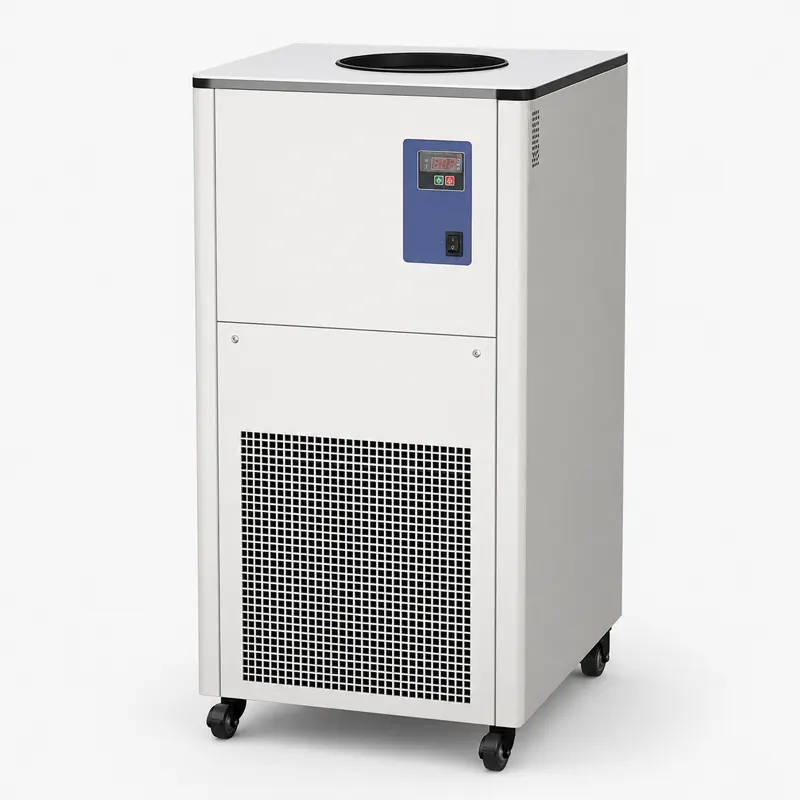
A precision recirculating water chiller is a closed-loop temperature-control unit that normally sits beside a glove box rather than inside its working atmosphere. It circulates a coolant — usually water or a water–glycol mixture — between its own reservoir and a heat-generating device, then draws the warmed fluid back and cools it again. In an inert-atmosphere laboratory the devices it serves are the ones that produce heat as a by-product: roughing or scroll vacuum pumps, analytical instruments, deposition sources and heated sample stages. Its purpose is thermal stability, so that equipment performance and process repeatability do not drift during a long run. It does not remove moisture, oxygen or solvent vapour from the box atmosphere, and it is not part of the gas purification loop.
What a Recirculating Chiller Does in a Glove Box System
A glove box supplies a controlled atmosphere. It does not supply a controlled temperature. Every device mounted inside the enclosure, or attached to it, generates heat: pump motors, power supplies, lamps, deposition sources, heated stages, electronics. In a sealed volume that heat has fewer escape routes than on an open bench, and it accumulates in the same atmosphere that the purification system is trying to hold stable. Temperature drift then appears where it is least welcome — in process repeatability, in instrument baselines, and in the service life of lubricants and elastomer seals.
A chiller addresses that problem at the source. Instead of allowing heat to spread into the box atmosphere, it captures heat in a fluid and carries it away.
Following the heat path
Coolant leaves the reservoir, passes through a pump, travels along the supply line to the item being cooled, absorbs heat in a cold plate, jacket or coil, and returns to the chiller. Inside the unit, heat moves from the coolant into a refrigerant circuit; the compressor and condenser then reject it into the surrounding room air. A temperature sensor placed at the reservoir or at the outlet feeds a controller, which adjusts the compressor, a hot-gas bypass valve or a mixing valve to hold the setpoint. Some units add a heater so they can also maintain a setpoint above ambient temperature.
Two details of that flow path decide how well the unit performs in practice. The first is loop volume: reservoir size and hose length act as a thermal buffer, so a larger volume generally smooths short load spikes but responds more slowly to setpoint changes. The second is the heat sink: a chiller removes heat from the equipment, but it delivers that heat to the laboratory, not to the box. Room ventilation and ambient temperature therefore remain part of the thermal design.
What a chiller is not
Three distinctions prevent most specification mistakes. Cooling is not purification: lowering the temperature of a pump or a stage has no effect on water or oxygen content in the atmosphere, and no chiller can replace a purification column, a vacuum cycle or a regeneration step. Cooling is not enclosure: the chiller is a utility that serves equipment and cannot create an inert environment on its own. And coolant temperature is not box temperature: the two are linked only through the equipment being cooled and the heat balance of the enclosure.
Where the Unit Sits and How It Connects to the Box
Because a chiller rejects heat to the room and needs air movement, service access and often a drain, it is normally installed outside the glove box, in the laboratory or a utility position. The coolant then has to reach the equipment, and the routing depends entirely on where that equipment is.
Cooling equipment outside the atmosphere
When the heat source is already outside the box — a roughing pump serving an antechamber, a compressor, a power supply in a separate cabinet — the loop stays outside as well. This is the simplest arrangement: flexible tubing with insulated lines, quick-connect or barbed fittings, and a drip tray beneath the chiller and pump. Line length still matters, because pressure drop grows with distance and with every bend, and long uninsulated lines gain heat from the room before the coolant even reaches the load.
Cooling equipment inside the atmosphere
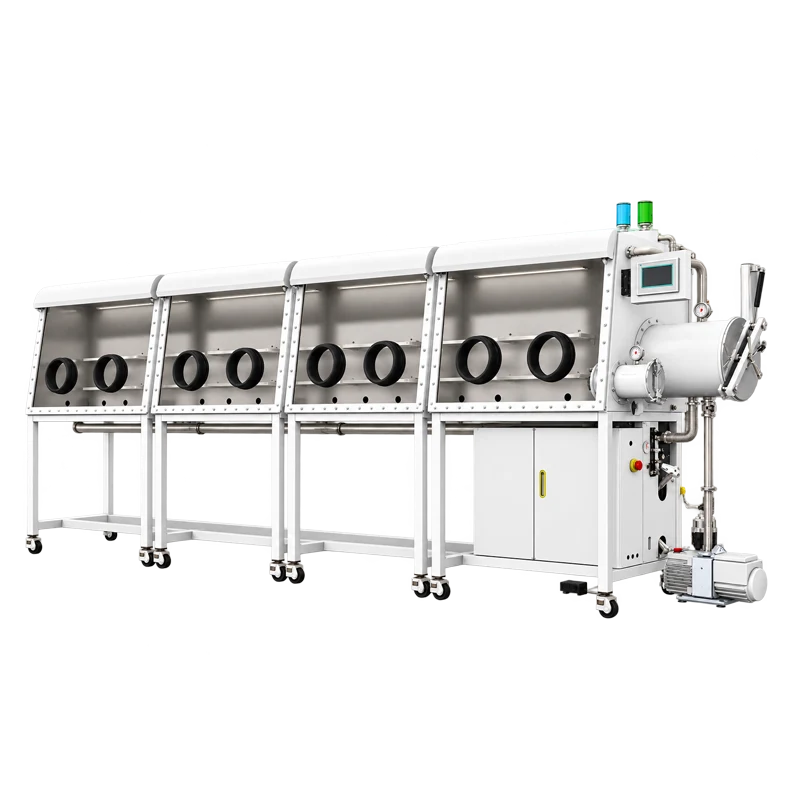
When the heat source is inside the working volume — a heated stage, a sputter source, a lamp housing — the coolant loop must cross the enclosure boundary. That crossing becomes a sealing question, not just a plumbing question, and it is usually handled with a dedicated port, feedthrough or antechamber pass-through designed for the purpose. A comparable installation can be seen on a four-station single-sided split-type glove box with gas purification system, where the split layout separates the working stations from the purification hardware. Any fluid connection inside an inert atmosphere is a potential contamination path: a weeping fitting or a burst hose introduces water — precisely the species the purification system exists to remove — and the resulting moisture load can force a regeneration cycle that would otherwise not have been needed. For that reason, fittings inside the box should be as few as possible, and the loop should be pressure-tested and reviewed before it is brought into the atmosphere.
Which Configurations and Components Matter Most
Recirculating chillers differ less in appearance than in the engineering behind four subsystems. Where only a single precision model is available for review, it is more useful to read that unit by its parts than to compare a list of catalogue numbers.
Refrigeration circuit and heat rejection
An air-cooled condenser depends on room air to carry heat away, so its practical performance is tied to ambient temperature and to the clearance around the unit; a water-cooled condenser instead hands the heat to a facility cooling-water loop, which is more compact but only possible where such a supply exists. Compressor type, refrigerant and condenser sizing together set the lowest stable temperature the unit can hold and how much capacity remains available when the room is warm.
Pump, reservoir and coolant path
The pump determines whether the loop can push coolant through a restrictive cold plate at a useful flow rate. Flow rate and pressure are different requirements: a long, narrow or convoluted path needs pressure, while a large thermal load needs flow. Reservoir volume buffers the load and gives the controller time to react. Wetted materials — reservoir, pump head, tubing, fittings — decide which coolants are acceptable and whether corrosion or biological growth will become a maintenance issue over time.
Control, monitoring and alarm interfaces
A precision chiller is judged by stability, not only by setpoint. Temperature sensors, PID control and display resolution all affect how tightly the setpoint is held. Equally important in a glove box installation are the protective functions: low coolant level, low flow, over-temperature and compressor protection. Dry contacts or a signal output that can be wired into the glove box control system let the chiller shut down a heat source or raise an alarm instead of failing silently while an unattended process continues.
Which Specifications Should You Check?
The specification sheet should be read against the load, not in isolation. The categories below cover what actually determines whether an installation works. Full configuration detail for the current model is listed on the precision recirculating water chiller product page.
| Specification category | What to confirm before ordering |
|---|---|
| Cooling capacity | Capacity falls as the setpoint drops, so ask for the figure at your working temperature rather than at a nominal rating point. |
| Temperature range and stability | Lowest achievable temperature, highest setpoint, and how tightly the unit holds a setpoint under your actual load. |
| Flow rate and pressure | Whether the pump delivers adequate flow through your real loop, including hose length, bends and fittings. |
| Reservoir volume and coolant | Buffer size, the recommended coolant, and whether that fluid suits the lowest temperature you intend to use. |
| Wetted materials | Reservoir, pump head, seals and fittings in contact with the coolant, and their resistance to corrosion and fouling. |
| Connections and line size | Fitting type and hose diameter, and whether they match the equipment, the feedthrough and the space available. |
| Alarms and interfaces | Which protective functions exist, and whether alarm contacts can be tied into the box or the process equipment. |
| Power, heat rejection, noise, footprint | Facility power, room heat load, sound level, and clearance for air flow and routine service access. |
Where Is a Recirculating Chiller Suitable, and Where Are Its Limits?
Duties it fits well
Typical duties include vacuum pumps used for antechamber evacuation or box pumping, analytical instruments whose detectors or electronics need a stable temperature, thermal stages for battery, solid-state or perovskite materials research, deposition sources and sputter targets, laser and optical assemblies, and heat-generating electronics mounted inside the enclosure. The common thread is a device with a defined heat load and an operating temperature that matters to the result.
Limits worth stating plainly
A chiller cannot control the box atmosphere. It does not filter particles, it does not adsorb solvent vapour, and it does not measure or reduce water and oxygen content. It does not cool an entire enclosure: a unit sized for a pump will not carry the thermal load of a whole working volume, and expecting it to do so leads to a setpoint that can never be reached. Capacity also depends on ambient conditions, so a unit that performs well in a cool room may fall short in a warm one. Coolant leaks inside an inert atmosphere are a contamination event rather than a simple spill. And a chiller does not make a process sterile, qualified or safe by itself; it is one utility in a system whose atmosphere is governed by other hardware.
How Should You Select and Integrate a Chiller with a Glove Box?
Start with the load, not with the chiller. The following sequence keeps the decision grounded in measurable requirements.
- Define the heat load of every device that will share the loop, in watts, at the target temperature — including intermittent consumers such as sources that only run during part of a cycle.
- State the temperature and the stability you actually need. A tighter tolerance and a lower setpoint both reduce the available capacity of any unit.
- Check the facility: ambient temperature, available power, whether a building chilled-water loop exists, how much heat will be dumped into the room, acceptable noise, and drainage.
- Define the interface, including whether coolant must cross the enclosure boundary and through which port or feedthrough, and how that crossing is sealed and inspected.
- Plan protection: alarms, interlocks that stop the heat source, a containment tray for the loop, and a schedule for checking fittings inside the box.
- Confirm the combination with the manufacturer, using the chiller specifications alongside the box documentation, so that supported installation conditions and any restrictions are verified in writing rather than assumed.
Short Answers to Common Questions
Does a chiller reduce water and oxygen levels in the box?
No. It removes heat, and heat is not the variable that water and oxygen sensors measure. Atmosphere control comes from the purification system, from vacuum and gas-replacement cycles, and from regeneration of the purification material. A chiller can indirectly help by keeping equipment cooler and reducing outgassing from hot surfaces, but that is a secondary effect, not a function.
Can the chiller be installed inside the glove box?
It is normally installed outside, because it rejects heat into the room and needs air flow and service access. Placing the unit inside the enclosure adds its own heat and its own footprint to the working volume you are trying to protect. Any internal arrangement should be discussed with the manufacturer before it is designed in.
Do I need a chiller if the pump is rated for continuous duty?
Continuous duty describes the motor, not the thermal environment. If the pump or instrument documentation states a maximum ambient temperature or a cooling requirement, the decision follows from that figure plus the measured temperature around the equipment. Instruments that drift as they warm up usually benefit even when no cooling requirement is stated.
What coolant should be used?
This is a manufacturer question, because the answer depends on the wetted materials of the unit and on the lowest setpoint. Water transfers heat well but freezes at low temperatures and can support biological growth; a water–glycol mixture extends the usable range but changes viscosity and heat transfer. Facility water is a separate case and should not be circulated through a unit built for a closed loop.
How do I know whether a loop is compatible with my glove box?
Check four things: the sealing method where the loop crosses the boundary, the pressure the loop will see, the materials exposed to the atmosphere inside, and the procedure for detecting a leak. If any of those four is still unclear, the installation is not yet defined well enough to order parts.
A recirculating chiller earns its place in an inert-atmosphere laboratory by doing one job predictably: carrying heat away from equipment that needs a stable temperature. Treat it as a utility with its own load calculation, its own sealing requirements and its own limits, and it will support long, repeatable glove box processes without ever being confused with the hardware that controls the atmosphere itself.
