
A four-station double-sided split-type glove box with gas purification is a modular sealed enclosure that gives several operators a shared inert atmosphere while a separate purification unit continuously removes moisture and oxygen from gas recirculating through the box. The enclosure provides the working volume, glove ports and transfer interfaces; the purification loop holds that volume within the moisture and oxygen limits a sensitive material requires. The two halves are designed together, but they are not the same thing, and knowing where one ends and the other begins is the first step in specifying or troubleshooting this class of installation.
Multi-station boxes are chosen when a project needs more bench space, more people or longer experiments than a single-station enclosure can support. The trade-offs are real: larger volumes, more glove ports and more sealing surfaces all add to the load the purification loop must manage. The reference configuration is described on the product page for the four-station double-sided split-type glove box with gas purification system.
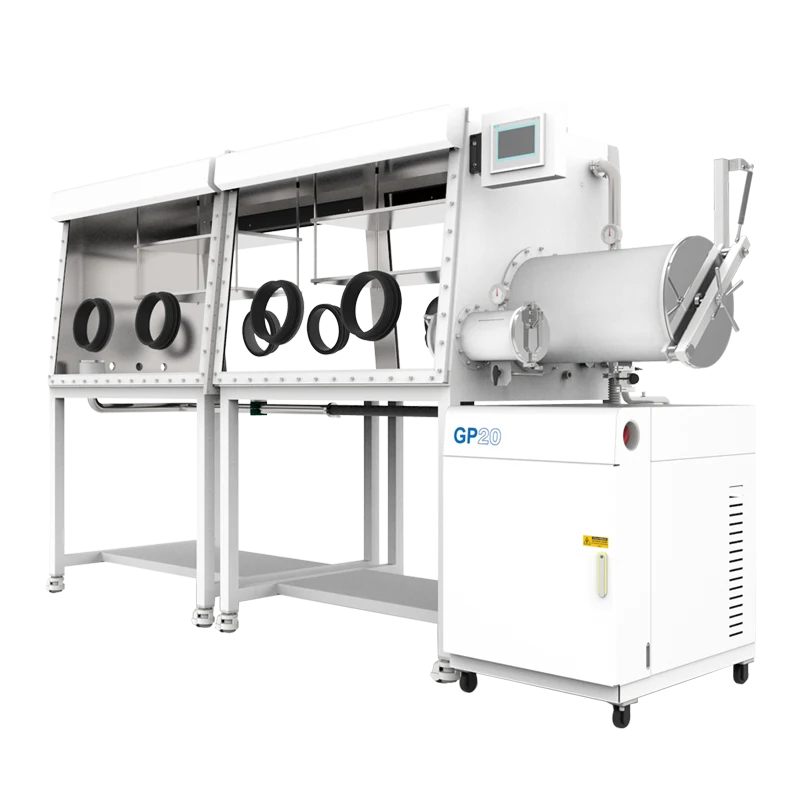
What the system does, and how the gas loop works
The enclosure is only half of the equipment. In a purified glove box, the atmosphere is not filled once and left alone: gas is drawn from the box, passed through one or more purification columns and returned. Because the gas is reused rather than vented, the arrangement is called a closed loop. A blower provides the driving force, the purification column holds media that captures water and oxygen, analysers measure what remains in the gas, and the control system decides when the media is saturated and needs regeneration.
Four processes are often confused, so it helps to separate them:
- Purging replaces the air inside a chamber with inert gas. It reduces oxygen and moisture, but only as far as the supply gas purity and the number of exchange cycles allow.
- Evacuation and backfill is the cycle used in an antechamber: the small chamber is pumped down and refilled with inert gas so items can pass in and out without exposing the main volume to air.
- Circulation and purification is what holds the main working volume at its setpoint over time, removing the moisture and oxygen that enter through gloves, materials and small leaks.
- Regeneration restores the purification media. It is a scheduled maintenance step carried out with the column isolated from the working volume, following the equipment manufacturer's procedure — not something to improvise while an experiment is running.
Solvent adsorption stands apart from all four. A solvent trap protects the purification media from organic vapour that would otherwise degrade it; it does not remove water or oxygen and cannot replace the purification column. A HEPA filter removes particles only. No single component here is a complete atmosphere control system.
What "four-station", "double-sided" and "split-type" change
These three words describe the mechanical arrangement, and each shifts the engineering balance.
Four stations
A station normally means one operator position with its own glove port pair, so four stations allow up to four people to work simultaneously on the same atmosphere — useful when synthesis, cell assembly and characterisation all have to happen under inert conditions on the same day. More stations also mean a longer enclosure, more gloves, more port rings and more seals. Every glove is a permeable membrane and every port a potential leak path, so the total ingress load rises with station count. A four-station box is chosen when the workflow genuinely needs the parallel capacity, not simply because more space looks safer.
Double-sided
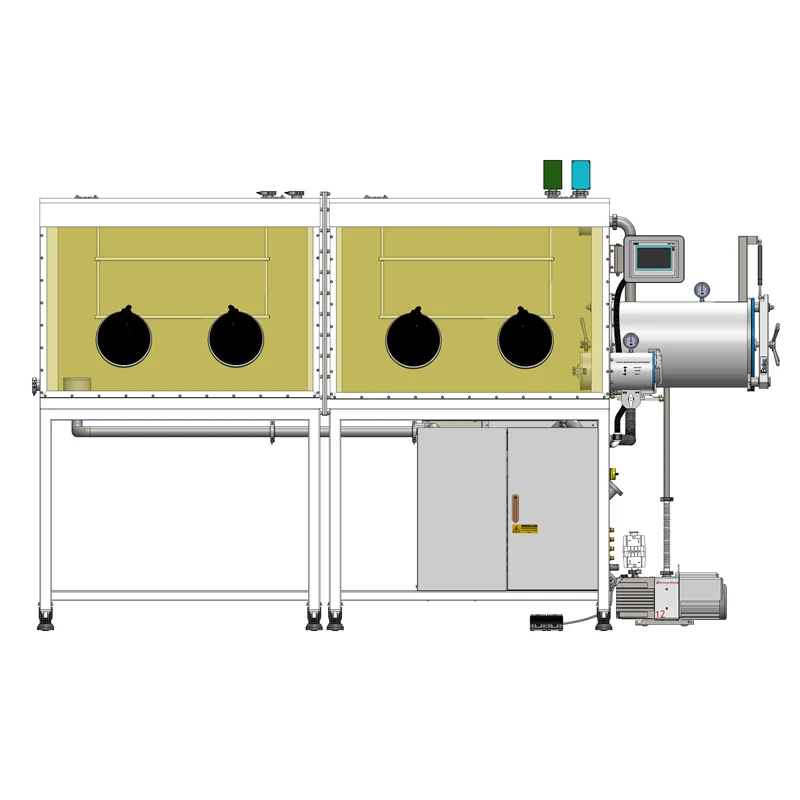
With glove ports on both long faces, operators can face each other across the same working volume. One person can prepare material while another performs the delicate step, and samples pass across the interior without an airlock cycle. The layout also affects the gas path: if the loop is fed and returned at one end, the far corners of a long enclosure can stagnate unless circulation rate and internal baffling distribute gas evenly. When reviewing a drawing, ask where gas enters and leaves and whether the return path covers the full length of the box.
Split-type
A split design separates the enclosure into sections that can be built, moved and assembled on site, and often allows the purification unit or auxiliary sections to be positioned separately from the main chamber. That matters for access, because laboratories rarely offer a wide clear route to the bench. A split structure can also be extended later with an additional section or transfer chamber. The trade-off is the sealing and alignment between sections, and the need to keep the gas path coherent across every joint. A split box must be assembled and leak-tested as one system, not commissioned module by module.
Which specifications should you check?
A quotation can be misleading because different numbers describe different parts of the installation. Ask what each value refers to and the conditions under which it was measured.
Atmosphere quality and measurement
Moisture and oxygen content are usually quoted as achievable values for the working volume. Two questions matter more than the headline figure: where the sample is taken, and which analyser is used. A reading from one point in a large box is not automatically representative of the far corner, and an analyser's resolution is not its accuracy. A specification also describes what the system can reach under defined conditions — fresh purification media, a well-sealed enclosure and limited outgassing from materials inside — not an unconditional guarantee for every experiment.
Pressure and vacuum: three different figures
Working pressure in the box, vacuum level in an antechamber and the ultimate vacuum of a pump are separate quantities and should never be quoted interchangeably. The enclosure is normally held slightly above or below ambient within a narrow regulated band; the antechamber needs a much deeper vacuum; a pump's ultimate vacuum describes the pump alone, before chamber, seals and gas load are considered. Leak rate is a fourth figure with its own units and test method. If a data sheet mixes these values or omits test conditions, ask for clarification rather than assuming the most favourable interpretation.
Transfer, access and interfaces
The antechamber is the interface between the laboratory and the controlled volume. Its usable dimensions decide what can be brought in without dismantling it, and its cycle sequence affects how often the box is disturbed. A small transfer port for tools and samples is usually worth adding. Electrical and signal feedthroughs, gas and vacuum connections, KF flanges, interior sockets, shelving and lighting should be defined early, because every interface is a sealing point.
Consumables that shape long-term behaviour
Glove material, thickness and length determine dexterity, permeability and solvent resistance, and must be chosen for the chemistry in use. Port rings, O-rings and door seals are the parts most likely to need replacement, so availability matters alongside price. Solvent traps protect the purification media, HEPA filters remove particles and cooling devices manage heat from equipment inside the box; each should be matched to a stated requirement rather than added by habit.
Where a pressure transmitter fits into the picture
Pressure is one of the few variables operators watch continuously, because the box only keeps its atmosphere while it keeps its pressure. A high precision pressure transmitter is the sensing element in that loop: it converts the pressure at its measuring point into an electrical signal, typically a current or voltage output, that the controller or data logger can read and act on.
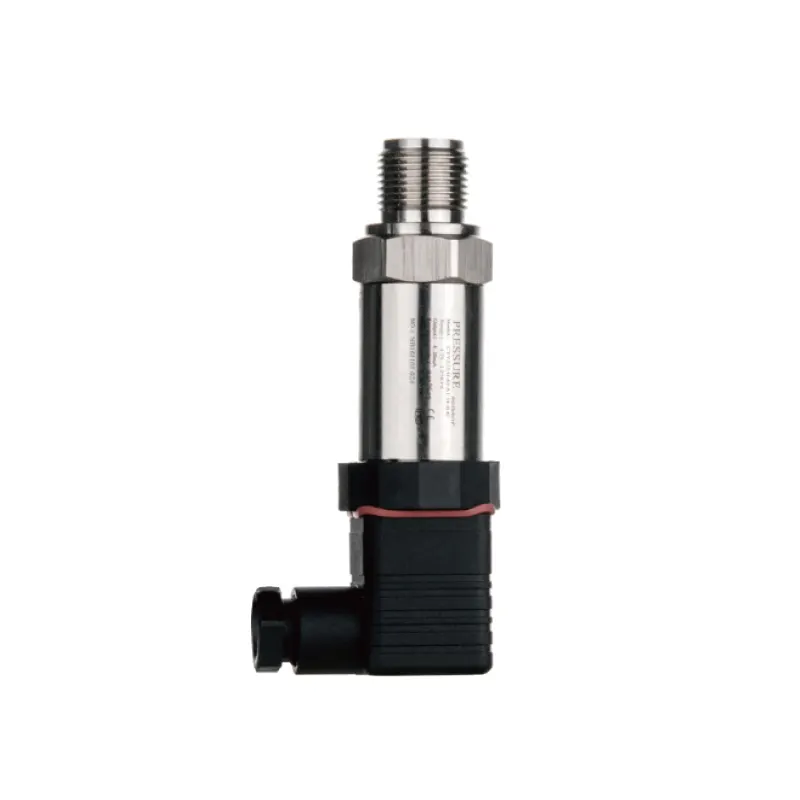
Be precise about what such a transmitter does. It measures pressure. It does not remove oxygen or moisture, it does not purify gas, and it is not a substitute for an oxygen or moisture analyser, because those instruments measure different quantities. Its value lies in providing a stable, repeatable signal so that slow drift, a developing leak or an unstable regulation cycle becomes visible before it damages an experiment.
- Range and reference. Box pressure is held within a narrow band, so an unnecessarily wide range wastes resolution; confirm whether the measurement is absolute or differential.
- Accuracy, resolution and stability. A fine display digit is not proof of accuracy. Ask for the accuracy class, long-term stability and calibration method.
- Wetted materials. Diaphragm and housing materials must tolerate the working gas and any solvent vapour present.
- Process connection. The thread or flange must match the port on the box or its piping; adapters add joints and leak paths.
- Signal and power. The output must match the controller or logger, and wiring needs its own sealed feedthrough.
- Environment. Temperature, humidity and vibration at the mounting point all influence the reading.
Compatibility is not automatic. A transmitter that suits one enclosure may be the wrong range, fitting or signal type for another, so box and instrument should be checked against the same specification before ordering.
Where this configuration suits the work, and where it does not
A multi-station purified box fits laboratories handling air- and moisture-sensitive materials at a scale where several people need access. Typical work includes lithium and solid-state battery materials, where lithium metal, sulphide electrolytes and some cathode precursors react readily with moisture; perovskite and OLED materials, where thin-film performance depends on controlled deposition and storage; semiconductor and air-sensitive organometallic chemistry; and additive manufacturing workflows in which reactive metal powders must be loaded, sieved or transferred without exposure to air.
The limits matter just as much. An inert atmosphere is not a sterile environment, a cleanroom classification, a biosafety cabinet or a certified containment system for hazardous materials. A glove box is not a substitute for a fume hood when large volumes of solvent are involved: solvent vapour has to be managed with appropriate adsorption provisions, and purification media can be damaged if it is not. "Inert" is also not a universal property — nitrogen, argon and other working gases behave differently with different samples and sealing materials, so suitability must be assessed for the specific chemistry.
How to select and integrate the system
Selection works best in the opposite direction from a product list: start with the work, then derive the equipment.
- Define the workflow. How many operators, how often, for how long, and which steps must take place inside the atmosphere.
- Define the material set. Which samples, solvents and powders will be present, and how much moisture or oxygen exposure they tolerate.
- Set the atmosphere target with its conditions — during operation, with materials inside and after transfers.
- Size the enclosure and transfer path. Match station count to people and the antechamber to the largest item that must pass through.
- Plan utilities and footprint. Gas supply and purity, power, exhaust for regeneration, floor loading, ceiling height and service access all have to fit the actual room.
- Plan consumables and service. Gloves, seals, filters, purification media, regeneration and analyser calibration are periodic tasks; ask for intervals and procedures in writing.
- Confirm interfaces. Feedthroughs, gas and pressure connections, signal wiring and instruments such as a pressure transmitter should be checked against the same drawing.
- Commission as one system, with leak, atmosphere and functional tests recorded on the assembled installation.
The reference configuration is described on the product page, where current drawings, options and accessories should be checked against your own specification before ordering. Where an item is listed without verifiable detail, treat general principles as a guide and confirm the data with the supplier rather than assuming a value.
Frequently asked questions
Does a purified glove box always include the purification system?
No. The enclosure and the gas purification unit are separate assemblies that are usually supplied together for this class of product, but the term "glove box" alone does not guarantee a closed purification loop. Confirm which unit, media and analysers are included.
Can purging alone keep oxygen and moisture low?
Purging reduces the initial concentration but is not continuous. Once the box is closed and materials are introduced, moisture and oxygen enter again through gloves, seals and the samples themselves, so only a running purification loop removes them on an ongoing basis.
Can a HEPA filter or solvent trap lower the moisture level?
No. A HEPA filter removes particulate contamination only, and a solvent trap protects the purification media from organic vapour. Neither removes water or oxygen, and neither replaces the purification column.
Is a pressure transmitter a substitute for an oxygen analyser?
No. The transmitter reports pressure; the analysers report what the atmosphere contains. Both are needed, because a box can hold perfect pressure while its moisture or oxygen level drifts upward.
Can extra stations or modules be added later?
A split-type structure is often chosen precisely to allow expansion, but additions change the gas path, the sealing arrangement and the load on the purification loop. Any extension should be reviewed as a system change, not as an isolated purchase.
Choosing a four-station, double-sided, split-type purified glove box comes down to one comparison: the number of people and the volume of work that need a controlled atmosphere, against the load the enclosure, its gloves and its transfer cycles place on the purification loop. Get that balance right, and the moisture, oxygen and pressure figures become achievable in daily practice rather than only on commissioning day.
