
A KF40 electrical test lead feedthrough is a sealed, flange-mounted port that routes electrical conductors through the wall of an enclosure without opening that enclosure to the outside atmosphere. In a glove box it normally sits in a spare flange port on the box wall, on an antechamber plate, or on a small auxiliary chamber. Its job is narrow but essential: it keeps measurement wiring connected to samples inside the inert atmosphere while the electronics — potentiostats, source meters, impedance analyzers, data loggers — stay outside. The flange body carries the mechanical and vacuum seal; the conductors built into it carry the signal.
What Does a KF40 Electrical Test Lead Feedthrough Do?
Every atmosphere-controlled experiment eventually reaches the same practical problem. The sample must stay under inert gas or vacuum, but the measurement instrument cannot. Running a wire through an open door or a loosely closed port defeats the purpose of the enclosure, and passing leads through a glove port creates an unreliable seal that is awkward to work around. A feedthrough resolves this by becoming part of the enclosure boundary itself: a rigid, clamped component with a defined sealing interface on the outside and insulated conductors on the inside.
Two functions are combined in one part. Mechanically, it must hold the pressure or vacuum differential that the enclosure experiences, and it must do so repeatably across temperature changes and mechanical handling. Electrically, it must provide a defined, insulated conduction path that does not degrade into a short, a ground loop, or an intermittent contact. A feedthrough that seals well but introduces unstable contact resistance will corrupt the very measurements it was installed to enable.
Where the feedthrough sits in the enclosure boundary
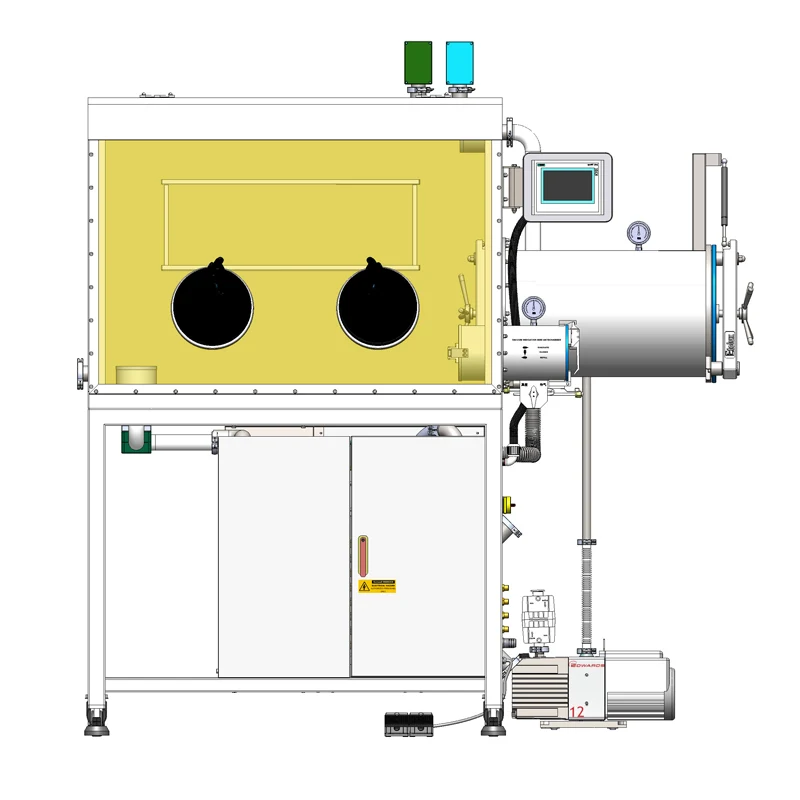
An accessory of this kind is a boundary component rather than a standalone apparatus. It has no working space of its own and no atmosphere of its own; the atmosphere is created and maintained by the host enclosure. On a purification glove box, the feedthrough is simply one more port on a wall that already carries glove ports, an antechamber, a vacuum or gas line, and instrumentation. The two-station double-sided glove box with a gas purification system illustrates the typical context: a closed-loop purification system continuously removes moisture and oxygen from the recirculating atmosphere, and the enclosure shell provides the mounting surface for any electrical interface.
How the electrical path is arranged
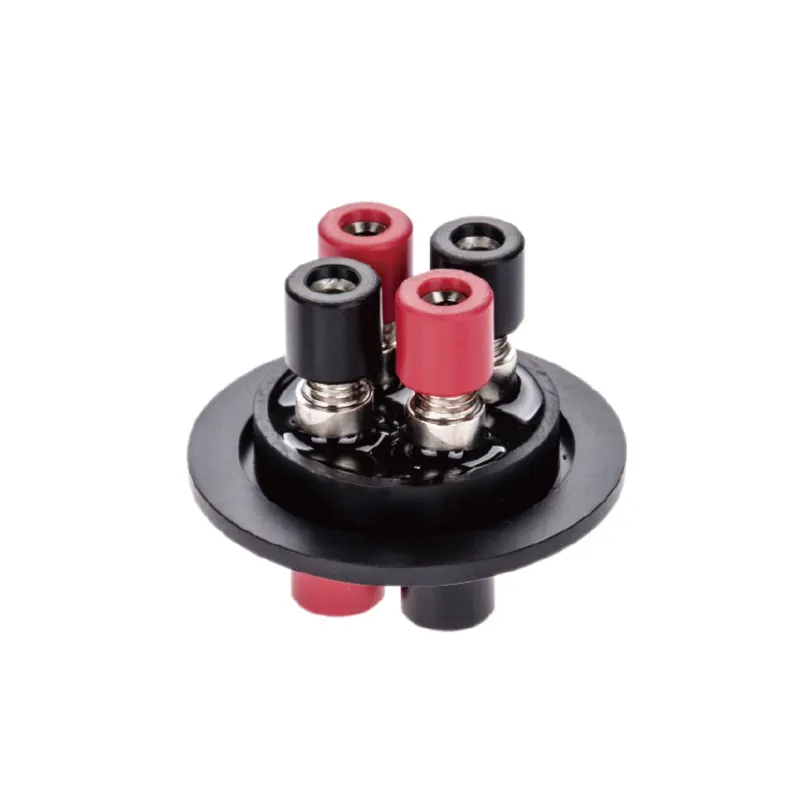
Inside the flange body, the conductors are held in an insulating body — commonly a ceramic or polymer insert — that separates them from the metal shell and from each other. On the atmosphere side, the conductors terminate in a way that lets the operator attach test clips, connectors, or a short flying lead to the sample inside the box. On the outside, they terminate at whatever the instrument expects. Because the conductors are fixed in the insert, the wiring inside the box is not disturbed when instruments are swapped outside, which is a genuine advantage in long-running experiments.
The number of conductors, their gauge, their insulation material, and their voltage and current ratings are properties of the specific item, not of the KF40 flange size. Two products with the same flange can differ substantially in what they can safely carry, so the datasheet rather than the flange designation should drive the purchase decision.
How Does It Pass Signals Without Breaking the Inert Atmosphere?
The KF flange sealing principle
KF, also written as ISO-KF or NW, is a family of standardized quick-connect vacuum flanges. A KF40 component is the size within that family whose nominal port is 40. Mating is straightforward: a centering ring carrying an elastomer O-ring is placed between the two flange faces, and an external clamp compresses the assembly so that the O-ring is squeezed against both faces. The clamp supplies the mechanical force; the O-ring supplies the seal. This is why the whole joint can be assembled and reopened by hand without special tooling, and why it has become the default interface for moderate-vacuum and controlled-atmosphere equipment.
Two consequences follow from that design. First, the seal is only as good as the O-ring material, its condition, and the surface finish of both flange faces; a scratched face or an aged O-ring will leak regardless of how tight the clamp feels. Second, the achievable vacuum level depends on the complete assembly. Where a system needs a lower ultimate pressure or a cleaner vacuum, metal-sealed flanges on a different standard are generally used instead. The KF40 electrical test lead feedthrough should therefore be judged as one element of a joint, not as a self-contained vacuum guarantee.
What the feedthrough does not do
An electrical feedthrough does not purify the atmosphere, and it does not lower oxygen or moisture levels. Those functions belong to the gas purification system, its purification columns, and the circulation loop that keeps gas moving through them. Likewise, a feedthrough is not a filter: it does not remove particles, solvent vapor, or reactive species from the gas. It is also not a substitute for an antechamber, which exists to move objects in and out with limited atmosphere exchange. Mixing these roles leads to badly specified systems — for example, expecting an electrical port to compensate for a leaking glove or an under-specified purification loop.
It is equally important not to treat a feedthrough as a universal adapter. A KF40 flange mates with a KF40 port of matching face geometry and with the correct clamp and centering ring. Whether a given enclosure offers such a port, or whether an existing port can be adapted, is a question for the enclosure supplier and must be confirmed against the actual drawing rather than assumed from a similar-looking product.
Which Specifications Should You Verify Before Ordering?
Because the accessory is small, it is easy to order on appearance alone. A short verification list prevents most installation failures.
| Check | What to confirm | Why it matters |
|---|---|---|
| Flange interface | KF40 face, centering ring and clamp type, available port on the enclosure | Determines whether the part can be mounted at all |
| Conductor configuration | Number of leads, gauge, insulation material, termination style | Sets what measurements the port can support |
| Electrical ratings | Voltage, current, and contact resistance stated for the item | Prevents overheating, arcing, or corrupted readings |
| Seal and vacuum data | Stated leak-tightness and the O-ring material supplied | Defines compatibility with the enclosure's operating pressure |
| Materials and cleaning | Wetted materials, solvent compatibility, cleaning procedure | Affects contamination risk for sensitive samples |
Flange and mechanical compatibility
Confirm that the enclosure provides a KF40 port, or that an adapter is available and acceptable. Check the clamp and centering ring are included or on hand, and check that the installed assembly does not collide with the glove ports, antechamber door, or internal shelving. Mounting a feedthrough where it blocks glove movement is a common and avoidable mistake.
Electrical and thermal ratings
Match the conductor configuration to the experiment: a two-lead port suits simple resistance or open-circuit potential measurements, while battery cycling, impedance spectroscopy, or multi-sensor work may need more conductors or shielding. Verify the stated voltage and current limits rather than extrapolating from the wire gauge alone, and note that a feedthrough used near a hot stage or a heated sample holder should be evaluated for the temperature it will actually see. Where a specification is unclear or appears inconsistent, treat the value as unconfirmed and ask the supplier for the applicable condition.
Atmosphere-side materials and cleanliness
Anything exposed to the box interior becomes part of the experiment. Insulation materials, O-rings, and any adhesives or lubricants used during assembly can outgas and slowly raise the impurity load on the purification system. For work with lithium metal, perovskites, OLED stacks, or air-sensitive catalysts, this matters more than the flange itself. Ask which materials are in contact with the internal atmosphere and what cleaning is recommended before first use.
Where Is a KF40 Electrical Test Lead Feedthrough Suitable — and Where Is It Not?
The natural applications are those in which electrical measurements must continue while a sample stays protected. Battery and solid-state electrolyte research, where cells are cycled inside an inert atmosphere, is a typical case. So is the electrical characterization of air-sensitive thin films, perovskite and OLED devices, organic semiconductors, and sensor materials that degrade in ambient air. Electrochemical and corrosion studies on moisture-sensitive metals, and long-duration monitoring of samples that cannot be repeatedly exposed, also fit the same pattern.
The limits are just as clear. A feedthrough cannot make a non-inert enclosure inert, and it cannot rescue an experiment whose atmosphere is already compromised by a leaking glove or an undersized purification loop. If the measurement requires an electrical connection to a component that must itself remain outside the box, a feedthrough is the wrong solution and a signal line to the external instrument is needed instead. If the application requires a certified cleanroom classification, biological containment, or hazardous-material enclosure, an ordinary vacuum feedthrough does not provide that certification.
How to Select and Integrate One Into an Existing Glove Box
Work from the experiment backwards. First define the electrical requirement: how many independent channels, what signal levels, whether shielding or a reference ground is needed, and whether the leads will be moved frequently. Then match that to the available conductor configuration. Next, confirm the mechanical interface on the enclosure, including the port position and whether a spare KF40 port exists. Finally, plan the installation and verification: assemble the joint with a clean, correctly sized centering ring, tighten the clamp properly, and leak-check the joint before the box is returned to service. Most glove box suppliers specify an acceptance procedure for new ports, and that procedure — not a general rule of thumb — should govern.
For readers who want the details of the accessory itself, the KF40 electrical test lead feedthrough page lists the specific configuration offered. Read it together with the enclosure documentation, because the two halves of the interface must agree.
Quick Answers to Common Questions
Does the feedthrough purify the atmosphere?
No. Purification is handled by the gas purification system and its circulation loop. The feedthrough only passes conductors through the enclosure wall.
Can I install it on any glove box?
Only if the enclosure has a compatible KF40 port, or if an approved adaptation exists. Port availability, position, and the acceptance procedure should be confirmed with the enclosure supplier before ordering.
Can one feedthrough carry several test leads?
That depends on the conductor configuration of the specific item. Multi-conductor versions exist, but the number, gauge, and ratings vary, so check the datasheet rather than assuming.
Will adding a feedthrough affect oxygen or moisture levels?
A properly sealed joint should not measurably change the atmosphere, but a poorly seated O-ring or a damaged flange face can introduce a leak. Leak-checking after installation is the practical safeguard.
Do I need a feedthrough if the sample stays sealed in a cell?
Not always. If the sample is fully enclosed in its own sealed cell and the measurement can be made outside, an internal connection is unnecessary. The feedthrough becomes useful when the sample must remain in contact with the box atmosphere while measurements run.
Treating a KF40 electrical test lead feedthrough as a defined interface — with a flange side, a conductor side, and a documented set of ratings — makes it far easier to specify. The part is small, but it decides whether a sensitive sample can be measured repeatedly without ever leaving its protected environment.
