What is a Pneumatic Vacuum Baffle Valve? A Pneumatic Valve for Automated Isolation in Glove Box Vacuum Systems
At its core, a pneumatic vacuum baffle valve is a specialized pneumatic valve designed to automatically open or close the vacuum line in a glove box system. It is used by researchers and engineers to reliably isolate the vacuum pump or antechamber from the main glove box atmosphere, preventing contamination and maintaining the required inert gas purity. By replacing manual valves with a pneumatic actuator, this valve enables hands-free, remote, or programmable control of vacuum processes, which is essential for high-throughput or sensitive material handling.
Core Function and Working Principle
The primary function of a pneumatic vacuum baffle valve is to connect or disconnect the vacuum line in a glove box system. It converts compressed air energy into mechanical motion to open or close a baffle plate, thereby controlling the flow of gas in the vacuum pipeline. The valve is typically installed between the glove box antechamber (or main chamber) and the vacuum pump, allowing the operator to evacuate the antechamber without disturbing the low water/oxygen environment inside the glove box.
The working principle is straightforward: compressed air (usually at 0.4–0.6 MPa) is supplied to a pneumatic actuator. An electromagnetic reversing valve switches the air direction, which moves the actuator piston up or down, driving the valve stem and the attached baffle plate. When the air pressure pushes the piston in one direction, the baffle plate lifts off the seat, opening the valve; when the air is exhausted and a spring returns the piston, the plate seals against the seat, closing the valve. This design ensures fast response (<1.5 seconds) and reliable sealing, with a typical leak rate of less than 1.3×10⁻⁴ Pa·L/s for rubber-sealed versions and as low as 1.3×10⁻⁵ Pa·L/s for bellows-sealed versions.
Key performance parameters that affect valve operation include the air supply pressure, the actuator stroke, the seat material (e.g., Viton or NBR), and the sealing method. The valve must maintain a low leak rate to preserve the glove box's inert atmosphere, especially during rapid pump-down cycles. Additionally, the valve's internal design minimizes gas entrapment, ensuring that no residual air is introduced back into the glove box.
Types and Configurations
Pneumatic vacuum baffle valves are available in several configurations to suit different installation requirements and vacuum system designs. The most common types are:
Straight-Through Type (Direct Path)
In this design, the valve body and the flow path are aligned in a straight line. When open, the gas flows directly through the valve with minimal resistance. This type is ideal for applications where high conductance and low pressure drop are critical, such as in main vacuum lines connecting the glove box to a large vacuum pump.
Angle Type (90° Path)
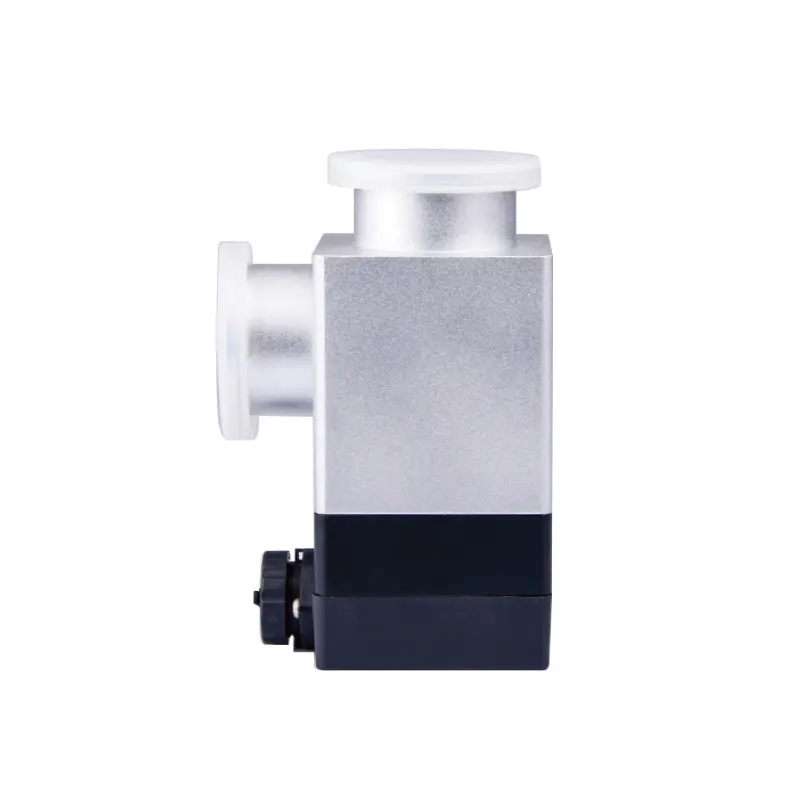
Angle-type baffle valves have the inlet and outlet at a right angle. This configuration saves space and allows the valve to be mounted closer to the chamber wall. It is commonly used in compact glove box designs where the vacuum pump is located near the bottom of the antechamber.
Three-Way Type (With Pre-Suction Port)
Some advanced baffle valves include a third port for pre-evacuation or bypass. This allows the system to rough-pump the antechamber through a smaller line before opening the main valve, reducing the pressure shock on the glove box atmosphere. This type is particularly useful for large antechambers or when handling extremely moisture-sensitive materials.
The choice between rubber-sealed and bellows-sealed versions depends on the vacuum level and the required leak rate. Bellows-sealed valves provide a metal-to-metal dynamic seal, eliminating elastomer outgassing and offering lower ultimate leak rates, making them suitable for ultra-high-vacuum (UHV) glove box systems.
Key Performance Indicators and Selection Criteria
When selecting a pneumatic vacuum baffle valve for a glove box system, users should evaluate the following critical parameters:
- Leak Rate: The valve's leak rate directly impacts the glove box's ability to maintain a low water/oxygen level. For most glove box applications, a leak rate ≤1.3×10⁻⁴ Pa·L/s is acceptable, but for high-purity environments, bellows-sealed valves with leak rates ≤1.3×10⁻⁵ Pa·L/s are recommended.
- Pressure Range: The valve must be rated for the vacuum range of the glove box system, typically from atmospheric pressure down to 1×10⁻⁵ Pa or lower. Ensure the valve's sealing mechanism can withstand repeated cycling under these conditions.
- Actuator Type: Single-acting (spring return) or double-acting pneumatic actuators. Single-acting valves fail closed (spring return) by default, which is safer for glove box applications because they automatically seal the vacuum line if the compressed air supply is lost.
- Connection Type: Common connection standards include KF (ISO-KF) quick-release flanges, ISO-BF (bolted flanges), and CF (conflat) flanges for UHV. KF connections are widely used in glove box accessories due to their ease of installation and maintenance.
- Body Material: Stainless steel (304 or 316L) is standard for corrosion resistance and low outgassing. Aluminum bodies are lighter but may not be suitable for aggressive chemicals.
- Seal Material: Viton (FKM) is preferred for high-temperature and chemical resistance, while NBR (Buna-N) is adequate for standard applications. Bellows seals eliminate organic elastomers entirely.
- Cycle Life: High-quality pneumatic baffle valves can exceed 100,000 cycles. Look for valves with hard-coated or ceramic-coated stems to reduce wear.
- Signal Feedback: Many modern valves include position sensors (e.g., magnetic reed switches or proximity sensors) to provide open/closed status to the control system, enabling automated sequences and alarm functions.
Additionally, the valve's flow coefficient (Cv) should match the pump's pumping speed to avoid excessive pressure drop during evacuation. A properly sized valve ensures efficient pump-down and minimizes the time the antechamber is exposed to the vacuum cycle.
Application Areas and Selection Recommendations
Pneumatic vacuum baffle valves are indispensable in any glove box system that requires automated vacuum transfer. Common applications include:
- Lithium-ion Battery Research: Automated antechamber evacuation for loading/unloading electrodes, electrolytes, and separators without exposing the main chamber to air.
- Perovskite Solar Cell Fabrication: Controlled vacuum cycles for solvent evaporation or substrate transfer.
- OLED and Display Materials: High-purity vacuum handling for moisture-sensitive organic compounds.
- Semiconductor and Optoelectronics: Integration with glove box vacuum pumps for wafer or sample transfer.
- Pharmaceutical and Chemical Synthesis: Safe handling of air-reactive or toxic substances under vacuum.
For beginners or small-scale labs, a standard straight-through valve with KF connections and NBR seals offers a cost-effective solution. For advanced research requiring ultra-high vacuum or frequent cycling, a bellows-sealed angle valve with Viton seals and position feedback is recommended. Always verify compatibility with the existing glove box port cover and control system to ensure seamless integration.
Reference
Pneumatic Vacuum Baffle Valve - https://www.gloveboxs.com/products/glove-box-accessories/pneumatic-vacuum-baffle-valve.html