
A six-station double-sided split-type glove box with a gas purification system is a sealed, inert-atmosphere workstation built for several operators working at once. It sits in the middle of an atmosphere-controlled workflow: samples arrive through a transfer chamber, then are weighed, mixed, assembled or inspected behind transparent panels while a closed-loop purification system continuously removes moisture and oxygen from the internal gas. The six stations provide the working positions, the double-sided layout lets two people work face to face, and the split-type frame means the enclosure is manufactured and delivered in sections rather than as a single shell. The combination answers a practical problem — how to keep a large number of air-sensitive tasks inside one controlled atmosphere without making every transfer a bottleneck.
The reference product for this article is the six-station double-sided split-type glove box with gas purification system. A vacuum pump from the accessories range appears later, because it supports sample transfer rather than the box atmosphere itself.
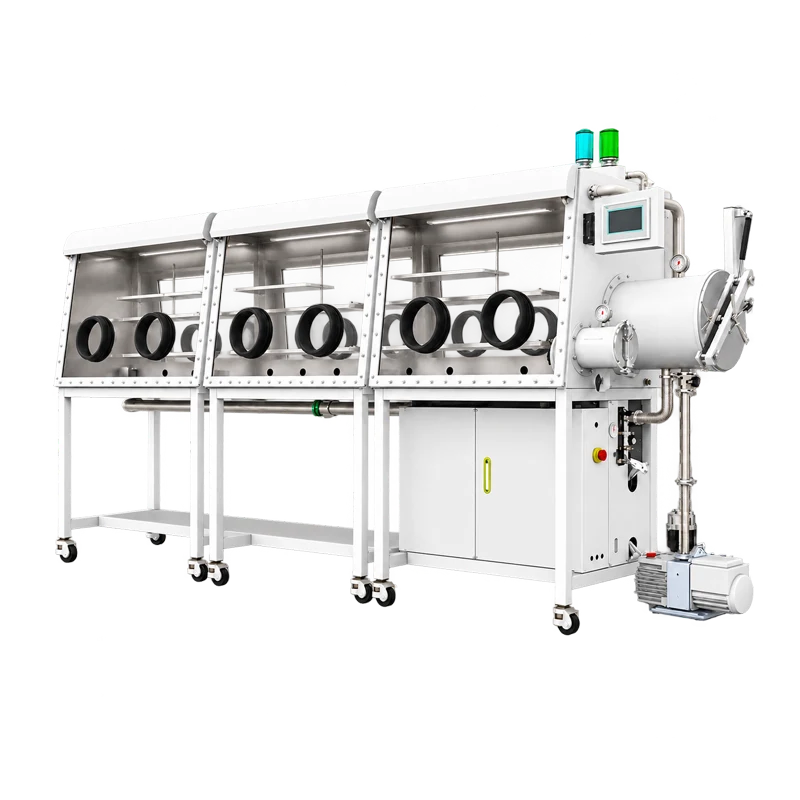
What the Station Count, Double-Sided Access and Split Frame Change
Six stations is a count of working positions, not of people in the room. In most layouts each station is a pair of glove ports with a defined port diameter and glove size range, and one operator normally works from one station. Six positions therefore support parallel work: one person loading a sample, another assembling a cell, a third inspecting a component, all inside the same atmosphere. The benefit is throughput and less waiting; the costs are that each port is another potential leak path, that gloves must be replaced when damaged, and that a larger internal volume takes longer to recover after a door opening or a heavy transfer load. When comparing a six-station enclosure with a smaller unit, the useful questions are not only “how many people”, but “how many transfers per hour, how much solvent vapour, and how long may the atmosphere take to recover”.
Double-sided access
Two working faces change ergonomics and footprint at the same time. Two operators can face each other and hand a part across the interior instead of routing it through the antechamber, which shortens assembly sequences and reduces how often the transfer chamber is cycled. It also doubles the aisle requirement: clear floor space is needed on both sides, and the face chosen for instruments, gas lines and electrical feedthroughs should be decided early, because those penetrations are built into particular panels. Ask whether both sides carry the same number of glove ports, whether one face is reserved for a pass-through or an instrument panel, and how sight lines work for inspection tasks — a view from the far side is not the same as a view from the near side.
Split-type construction
A split-type enclosure is assembled from sections joined at flanges, gaskets or a transfer connection. That construction helps when the box must pass through a laboratory door, a lift or a narrow corridor, and it allows staged installation or later extension. It also has engineering consequences worth understanding before ordering. Every joint is an additional sealing surface, so a leak test has to cover the sections and the joints, not only the assembled box. The routing of circulation and pressure equalisation between sections also matters: if a section can be closed off, the loop may no longer sweep it, and a purification system sized for the full volume cannot keep an isolated section in condition. Heavy components such as blowers, purification columns and control cabinets affect floor loading and service access as well. Whether the split is purely a manufacturing and shipping choice or a functional isolation feature is a question the supplier should answer in writing.
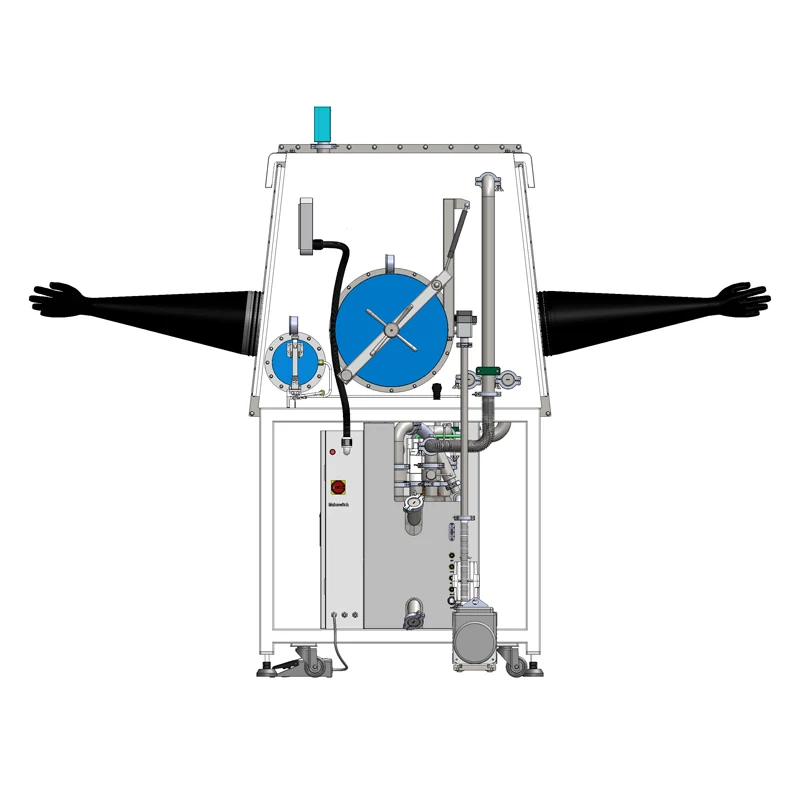
How the Atmosphere Loop Works
Circulation and purification material
In a purification glove box, gas is drawn from the enclosure, moved by a circulation blower through purification material that adsorbs moisture and removes oxygen, and returned to the box. Because the loop is closed, the same gas is reused; only small amounts leave through purging, glove permeation and transfer cycles. Purification media have finite capacity and must be regenerated periodically, typically by heating a column while a gas stream carries the released moisture away. The regeneration gas, its purity, the sequence and the timing all belong to the manufacturer’s documentation for that specific column and control system — they are not values to be assumed or improvised. A two-column design allows one column to be regenerated while the other continues cleaning, which matters when work runs around the clock.
Monitoring measures the atmosphere, it does not purify it
Oxygen and moisture analyzers report the state of the atmosphere; they do not change it. That distinction matters twice over. A reading is only as good as its calibration — resolution is not the same as accuracy — and a well-calibrated sensor at one sampling point says little about a far corner of a six-station box that the circulation loop reaches slowly. Second, the value quoted for a new enclosure usually describes a clean, empty box with fresh gloves and no transfers in progress. Real operating levels depend on sample load, solvent load, the number of door openings and how long an operator leaves the transfer chamber open. Ask for quoted values with the conditions attached, then judge whether the box can hold them during the work you actually plan.
Four operations that are not interchangeable
Gas purging dilutes contaminants with fresh inert gas. Evacuation removes gas from a defined volume with a pump. Circulation purification removes water and oxygen continuously through purification media. Regeneration restores the capacity of those media. HEPA filtration traps particles and does nothing about moisture or oxygen. Solvent adsorption traps organic vapour and does not replace water and oxygen purification. Confusing these operations produces expectations a system cannot meet; expecting a filter or a pump to lower a box’s water and oxygen content is the clearest example.
Specifications Worth Checking Before You Compare Offers
Most misunderstandings around purification glove boxes come from comparing numbers that describe different things. Box working pressure, transfer chamber vacuum, pump ultimate pressure, leakage rate, oxygen content and moisture content are separate parameters with separate units and separate objects. Keep each value attached to what it describes, and treat a value obtained on one model as a property of that model and configuration rather than a series-wide promise.
- Working pressure range of the enclosure, and whether pressure is controlled automatically or manually.
- Quoted oxygen and moisture levels, together with the conditions under which they were obtained: empty box or loaded, static or with transfers, and whether the figure is a one-off or a continuously maintained value.
- Leakage rate and test method — is the whole enclosure tested, each split section, each glove port and each feedthrough?
- Circulation and purification capacity relative to internal volume, station count and expected solvent or sample load.
- Transfer chamber volume and achievable vacuum, plus the cycle time for one complete purge-and-refill sequence; these are not the same as box pressure or as a pump’s ultimate pressure.
- Regeneration requirements: how many columns, whether regeneration is automatic, how long it takes, and whether the box keeps working meanwhile.
- Feedthroughs: electrical and signal connectors, tube ports, KF flanges, pin counts and sealing method.
- Glove specification: size, material, thickness, permeation behaviour against the specific solvents in use, and the replacement procedure.
- Analyzer specification: measurement range, resolution, accuracy, calibration interval and sampling point location.
- Pump compatibility: which volume is evacuated, the gas being pumped, the expected load, and whether one pump serves the box, the transfer chamber or both.
Where This Configuration Fits, and Where It Does Not
A six-station purification box is aimed at work where several people handle air- and moisture-sensitive materials in parallel: lithium metal and solid-state battery assembly, electrolyte preparation and cell stacking; perovskite, OLED and semiconductor-related handling and deposition steps; air-sensitive synthesis and catalysis; advanced materials research; and handling of powders before or after additive manufacturing. Multi-station capacity pays off when throughput and parallel handling matter more than a small footprint.
The limits are just as important. Inert atmosphere protection is not sterility, not a cleanroom classification, not a biosafety function and not a hazardous-material containment certification. Not every gas is inert towards every sample: some materials still react with nitrogen or with residual moisture, and some release vapours that purification media do not remove. Volatile solvents call for dedicated adsorption, and powders call for dust and static control measures that are separate from atmosphere control. A purification box also requires electrical power, cooling, a gas supply and routine maintenance of purification media, blowers and analyzers. Finally, site conditions matter: weight, floor loading, height clearance for the split sections and door width often decide whether a given enclosure can be installed at all.
Where a Vacuum Pump Fits Into the System
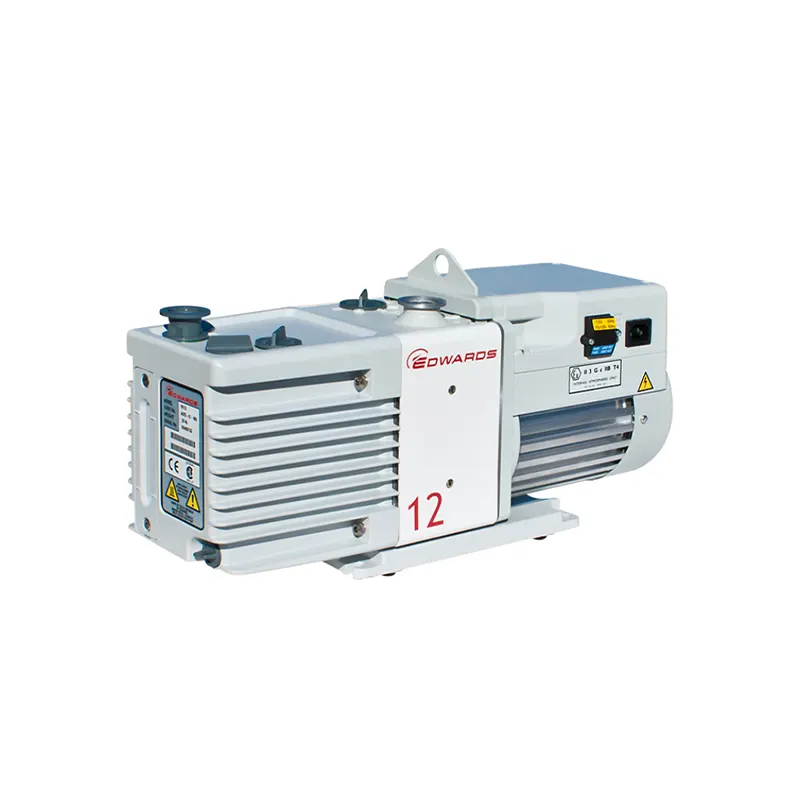
The glove box vacuum pump is an accessory, not an atmosphere-purifying device. It removes gas from a defined volume — usually the transfer chamber or a small evacuable zone — so that air can be replaced with inert gas before samples pass in or out. The pump therefore supports the transfer workflow, while the purification loop maintains the steady-state atmosphere. Selection depends on which volume is evacuated, how often, what gas is present, whether the medium is corrosive or condensable, the connection type, and whether the pump runs continuously or in short cycles. Oil-sealed pumps can backstream oil vapour into a chamber that communicates with an inert atmosphere, which is one reason dry or diaphragm designs are often considered for this duty; the suitability of a specific pump for a specific box should always be confirmed rather than assumed. Regardless of the pump, evacuation and refill only reduce contamination in proportion to the number of cycles and the purity of the refill gas — they cannot replace continuous water and oxygen removal.
How to Select and Integrate the Right Configuration
Work from the process backwards. Define which materials and which solvents will be handled, how many operators need to work at the same time, how many transfers happen per hour, and which analytical or process instruments must sit inside the enclosure. Those answers determine station count, whether a double-sided or single-sided layout is more sensible, whether the enclosure needs to be split for transport or for isolation, the transfer chamber volume, and the purification and circulation capacity the box requires. Only then compare offers.
Confirm with the supplier: the quoted atmosphere values and the conditions attached to them; the leak test method and its coverage of sections, ports and feedthroughs; the isolation logic between split sections and how circulation behaves when a section is isolated; the complete list of connectors and feedthroughs; the regeneration schedule and how it affects experiments; glove replacement and service access; and the boundary of supply, including which items are excluded. For each accessory, including a vacuum pump, confirm compatibility with the exact enclosure model rather than family-level claims.
Short Answers to Common Questions
Does every glove box include gas purification?
No. Purification glove boxes, vacuum glove boxes and transparent acrylic enclosures are different categories, and purification is not a given. Confirm whether the configuration you are considering includes purification columns, a circulation loop and water and oxygen monitoring.
Can an accessory lower water and oxygen by itself?
No. Gloves, valves, filters and pumps do not purify. Only the purification loop with its purification media removes water and oxygen, and its effect at any moment is limited by the capacity of that loop.
Can any vacuum pump be connected to any glove box?
Not automatically. Connection type, sealing, the gas being pumped, the load and the control interface must all match, and the manufacturer should confirm suitability for the specific enclosure.
Does a lower analyzer reading always mean a better box?
Not necessarily. Resolution differs from accuracy, calibration and sampling point location affect what a reading means, and a value recorded in an empty box does not describe behaviour during heavy transfer or solvent use.
What drives throughput in a six-station box?
Station count alone does not. Throughput depends on the duration of each process step, the transfer chamber cycle time, the number of transfers needed and how regeneration is scheduled around the work.
