
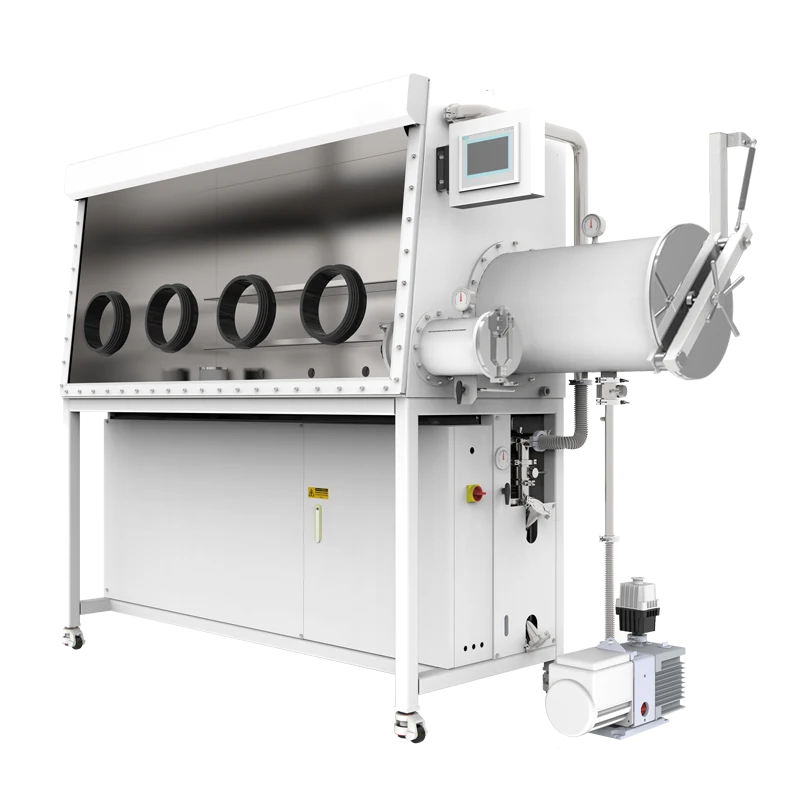
A two-station single-sided glove box with gas purification is a sealed working enclosure with two operating positions along one face and a closed-loop system that treats the recirculated atmosphere. It sits between the operator and an air-sensitive sample: gloves allow manipulation, the enclosure isolates the work area, and the purifier controls oxygen and moisture in the circulating gas. Its purpose is not only to fill a box with inert gas, but to maintain a defined and monitored atmosphere through handling, transfer, and routine process work. The product name identifies the layout and the presence of purification; it does not by itself establish chamber dimensions, antechamber volume, attainable oxygen or moisture levels, or solvent compatibility. Those details belong to the exact configuration.
What the system includes and where it sits in the workflow
The enclosure is the working volume. A transparent front window provides visibility, glove ports allow the operator to reach inside without opening the chamber, and the sealed shell limits exchange with the surrounding room. An antechamber, when fitted, is the main transfer interface: samples and tools pass through it so that the main chamber is not opened directly to the laboratory atmosphere. The antechamber is therefore part of atmosphere control, not merely a convenient door.
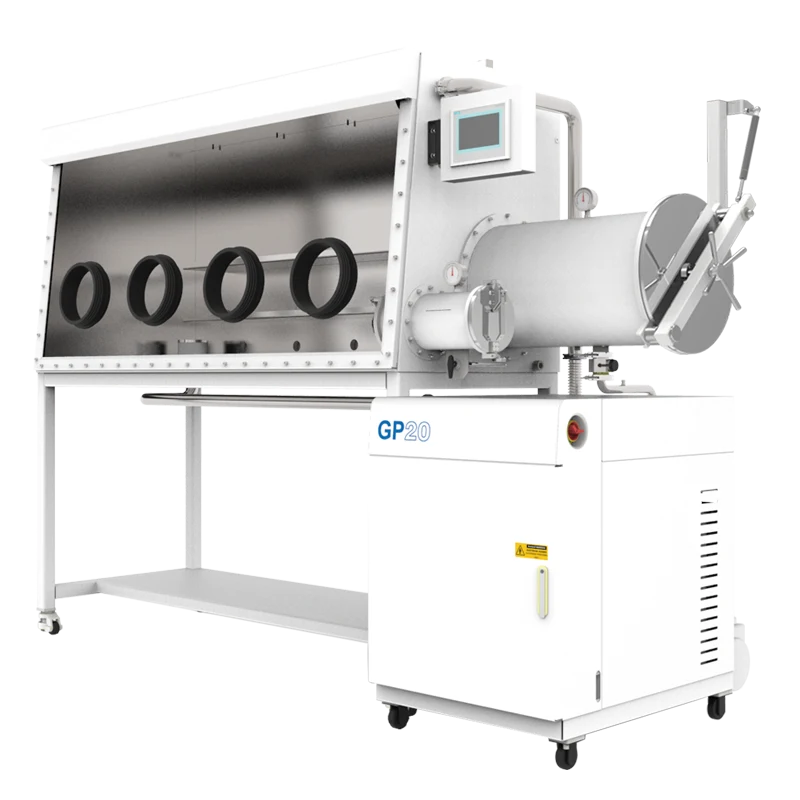
The purification unit is not a separate workspace. It is a gas-treatment subsystem connected to the box, with a circulation path, purification media, valves, sensors, and controls. The TENCAN two-station single-sided glove box with gas purification system combines this treatment function with a two-position, single-sided working layout. The purifier supports the atmosphere inside the enclosure; it does not create a second clean space of its own.
A complete system also needs a gas supply, pressure management, and a maintenance plan. Depending on the configuration, there may be feedthroughs for power or signals, shelving, additional transfer locks, or analytical instruments. Each item changes how the box is used and serviced, so the purchase specification should be read as a system description rather than as a model name alone.
How the gas purification loop works
Circulation and impurity removal
In a closed-loop purification glove box, gas is not used once and discarded. A blower draws atmosphere from the chamber, passes it through a purification column, and returns it to the working volume. The column typically contains media for water adsorption and oxygen removal, although the exact materials and arrangement depend on the design. Moisture removal is usually an adsorption process. Oxygen removal uses reactive media that bind oxygen from the gas stream. These are related functions, but they are not interchangeable: a solvent adsorbent does not replace water and oxygen media, and a particle filter does not remove either impurity.
The circulation rate, media capacity, and distribution of gas inside the chamber all affect how quickly the atmosphere responds after a door is opened, a sample is transferred, or a process releases vapor. A larger box or a higher transfer frequency does not automatically mean that a given purifier will recover at the same rate. Those effects should be evaluated together with the specified purification capacity and the operating procedure.
Regeneration and monitoring
Purification media has a finite capacity. Regeneration restores the media so that it can continue to remove impurities, but regeneration is not the same as normal circulation. It usually requires valves to isolate part of the circuit and a controlled sequence defined by the manufacturer. The procedure may involve heat, vacuum, or a reducing gas, depending on the purifier design. It should not be improvised from a general description, because the wrong sequence can damage the media or allow impurities to pass into the chamber.
Oxygen and moisture sensors measure the atmosphere; they do not purify it. A displayed value is meaningful only when the measurement point, sensor type, calibration, and stabilization conditions are known. Resolution is not the same as accuracy. A display that changes in small increments can still have a larger measurement uncertainty. For acceptance testing, define where the sample is taken, how the box is prepared, and how long the atmosphere is allowed to stabilize. Do not convert a resolution figure into a performance guarantee.
Pressure and transfer are separate functions
Chamber working pressure, antechamber vacuum, pump ultimate vacuum, leak rate, oxygen level, and moisture level are different parameters with different units and purposes. A pressure reading does not describe purity, and a pump specification does not establish the leak tightness of the box. Pressure regulation protects gloves, seals, and the enclosure while supporting transfer. If a vacuum antechamber is part of the configuration, its pump and valve arrangement must be matched to the required transfer cycle. Confirm the applicable values for the exact model rather than applying a value from one component to the whole system.
What the two-station single-sided layout changes
Single-sided access means the operator works from one face of the enclosure. A two-station arrangement provides two operating positions along that face. This can be useful for a single user who needs staging space, or for two users working on related tasks in the same controlled atmosphere. It does not create two independent atmospheres: both stations share the chamber, the purification loop, and the consequences of any transfer or solvent release.
The layout also affects ergonomics and planning. Reach, window height, glove-port spacing, and the position of the antechamber determine how comfortable the work is over a long session. A wider working face may improve collaboration, but it can also increase the chamber volume that the purifier must serve. Two stations do not double purification capacity. More operators or more open transfers can add moisture, oxygen, and solvent load, so the operating schedule should account for recovery time.
For a laboratory, the practical advantage of this layout is shared access without splitting the atmosphere into separate boxes. The limitation is that one user can affect the other. A solvent spill, a poorly purged transfer, or a glove change at one station can influence the whole chamber. Clear procedures for loading, purging, and cleaning are therefore part of the system, not optional housekeeping.
Which specifications and configuration details matter
Atmosphere and verification
- Specified oxygen and moisture levels, including the conditions under which they apply and how they are verified.
- Sensor type, measurement location, calibration interval, and whether the reading represents the working zone or a sample line.
- Recovery behavior after a transfer, a door opening, or regeneration. Ask how recovery is defined rather than assuming a single number describes all use cases.
- Purification media type and capacity, regeneration method, and the maintenance information needed to plan service.
Physical layout, transfer, and services
- Internal dimensions, window size, glove-port count and size, and the reach available at each station.
- Antechamber volume, door size, and transfer procedure. These determine what can enter the box and how much air is carried in with it.
- Working pressure range, pressure relief, leak-test method, and, if applicable, antechamber vacuum and pump performance.
- Electrical supply, gas supply, heat load, footprint, weight, and any exhaust or ventilation requirement.
- Material compatibility for the chamber, window, gloves, and seals. Solvents and reactive materials must be checked against the actual construction, not just the general product category.
Where it suits and where it does not
A purification glove box is appropriate when work requires a maintained atmosphere and repeated handling rather than a one-time purge. Relevant settings include lithium battery and solid-state battery materials, perovskites and other air-sensitive electronic materials, OLED and semiconductor research, air-sensitive chemistry, advanced materials, and some additive manufacturing post-processing steps. In these cases, the value of the enclosure is that samples can be manipulated, transferred, and observed while the atmosphere is actively managed.
The limits matter just as much. A glove box is not a sterile isolator, a cleanroom classification, a biological safety cabinet, or a certified hazardous-waste enclosure unless a specific configuration has been assessed for that purpose. It is not a substitute for a fume hood when toxic or highly volatile materials require local exhaust. Inert gas is not automatically inert toward every sample, and a low-oxygen reading does not prove that every material in the chamber is stable. Powders can contaminate surfaces and transfer locks; solvents can affect gloves, seals, and sensors; reactive materials may require additional controls. The process chemistry and the materials of construction should be reviewed together.
Organic solvent vapor adsorption: when the accessory is relevant
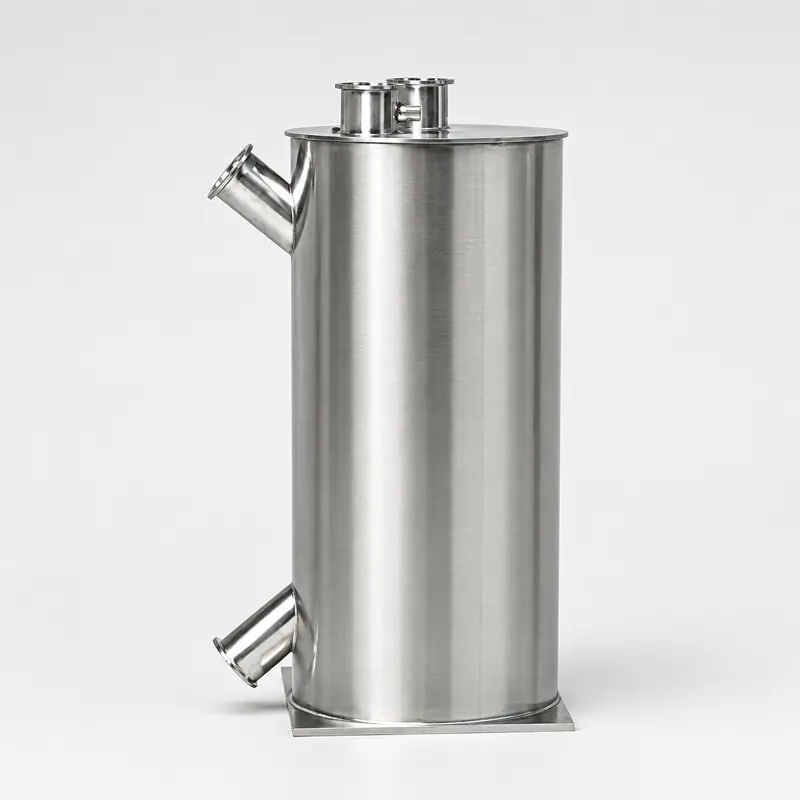
An organic solvent vapor adsorption system is an accessory for capturing organic vapors that enter the glove box atmosphere. It is relevant when a process uses solvents that can accumulate in the recirculated gas or interfere with other gas-treatment components. The accessory is intended to manage that solvent load; it is not a replacement for the water and oxygen purification loop, and it does not make an enclosure suitable for every solvent or every concentration.
Compatibility should be confirmed before use. The adsorbent, housing, seals, and connection method must suit the specific solvent, and the installation must not disturb the required circulation path. Service life depends on the solvent load and operating practice, so replacement or regeneration should be planned from the manufacturer information rather than guessed. If a process produces only a small, occasional solvent release, the need for a dedicated adsorption path may differ from a process that uses solvents routinely. The decision should be based on the chemistry, the frequency of use, and the approved configuration of the box.
How to select and integrate the system
- Define the atmosphere requirement in process terms: which materials are sensitive, what oxygen and moisture evidence is needed, and how the result will be verified. Avoid selecting solely from a headline number.
- Map the transfer workflow. Estimate sample size, transfer frequency, and whether antechamber pumping or gas exchange is needed. Transfer is often the largest practical disturbance to the atmosphere.
- List every solvent, powder, and reactive material. Ask which gloves, seals, and purification media are compatible, and whether organic vapor adsorption is required.
- Check the physical layout against the laboratory. Confirm reach, window position, station spacing, antechamber access, service clearance, gas supply, and electrical connections.
- Plan commissioning and maintenance. Include sensor calibration, media replacement, leak checks, glove inspection, and operator training in the ownership plan.
The TENCAN two-station single-sided purification glove box product page is the correct place to confirm the supplied configuration, available options, and current specifications. A quotation should identify the enclosure, purification unit, transfer arrangements, instrumentation, and accessories as separate line items so that responsibilities are clear.
Frequently asked questions
Does this glove box include gas purification?
Yes. The product name specifies a gas purification system. The exact purifier arrangement, media, controls, and attainable atmosphere should be confirmed for the supplied configuration.
Can it remove oxygen and moisture continuously?
Closed-loop circulation and purification can control both oxygen and moisture while the system is operating and correctly maintained. It is not an absolute zero guarantee, and performance depends on leakage, transfer practice, media condition, and measurement method.
Can I use organic solvents inside?
Only after a compatibility review. Some solvent work may require an organic solvent vapor adsorption system, and some solvents may be unsuitable for the gloves, seals, or sensors. The adsorption accessory does not replace water and oxygen purification.
Is a two-station box useful for one operator?
It can be. The second position may serve as staging space or allow a colleague to work alongside. The trade-off is a larger shared atmosphere and a larger footprint, so the layout should be matched to actual workflows.
Can purification be added to a box later?
Do not assume that a field retrofit is straightforward. Purification requires compatible connections, controls, pressure management, and validation. Ask the manufacturer about the specific enclosure before planning an upgrade.
