
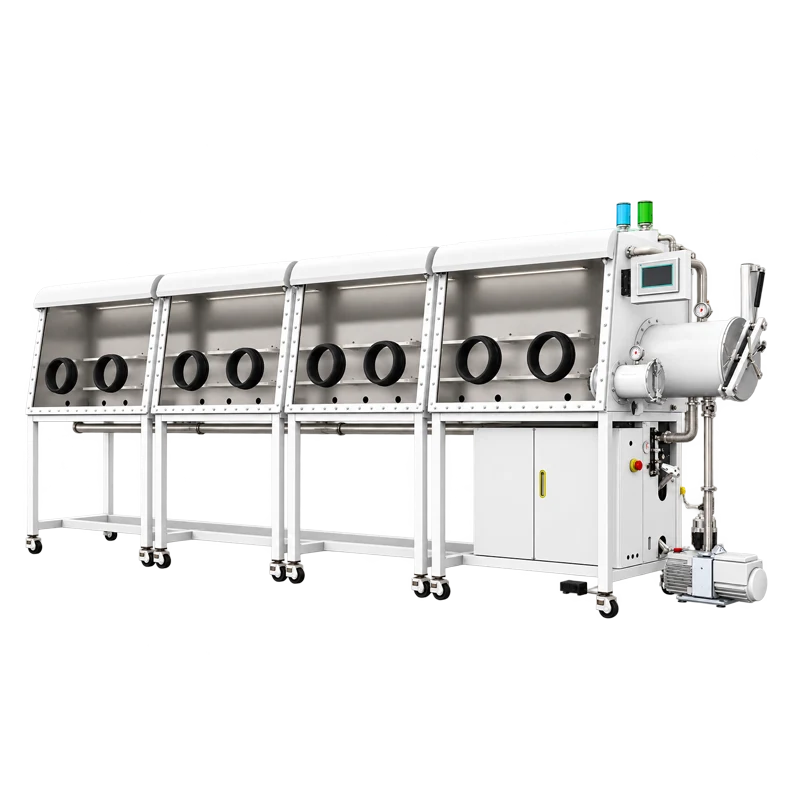
A four-station, single-sided split-type glove box with gas purification is a sealed enclosure for air-sensitive work, arranged for four operating positions on one face and built as a split-type cabinet. Its purification system recirculates the internal atmosphere through material that removes moisture and oxygen, while gloves let operators handle samples without opening the box to the room. It belongs between the sample and the laboratory environment: the cabinet provides the workspace, the airlock controls transfer, the purifier manages the atmosphere, and the monitoring system tells the team what that atmosphere is doing.
The configuration matters when one small box would become a scheduling bottleneck but a full cleanroom or walk-in enclosure is unnecessary. Four stations can support parallel preparation, assembly, inspection, or testing, provided the cabinet, purification capacity, and transfer path are sized for the actual workload. The name alone does not define working dimensions, achievable oxygen and moisture levels, airlock volume, or utility requirements. Confirm them against the current TENCAN specification before layout and procurement decisions.
What Does the System Do and How Does It Work?
The TENCAN four-station single-sided split-type purification glove box combines three functions that are often discussed as if they were one: containment, transfer, and atmosphere conditioning. The cabinet and gloves provide the contained workspace. The antechamber, sometimes called an airlock, provides a controlled way to move samples, tools, and small equipment in and out. The gas purification system provides the recirculating atmosphere. None of these functions replaces the others. A well-sealed box with no transfer discipline will still admit air; a large purifier cannot compensate for a leaking glove or an open door; and a monitor can report a problem without correcting it.
The working atmosphere is a loop, not a static gas charge
In a purification glove box, the internal gas is not simply filled once and left alone. A blower circulates the atmosphere from the working chamber through purification columns and back into the box. The column material adsorbs or reacts with water and oxygen, depending on the system design, and the loop continues until the measured concentrations reach the operating target. Valves isolate sections for regeneration, and sensors sample the atmosphere at defined points. The system also uses gas for different purposes: working gas fills and maintains the box atmosphere, control gas may operate valves or pneumatic components, and regeneration gas supports the restoration of the purification material. These streams should not be confused. Their purity, pressure, and connection requirements are part of the installation design.
Regeneration is a separate procedure, not a normal working mode. It restores the capacity of the purification material and must follow the manufacturer's procedure for the specific columns and controls. The details that matter are the regeneration interval, the gas supply and vent path, the temperature and flow limits, and the interlocks that protect the box atmosphere. Those details should come from the current manual, not from a generic rule. The same caution applies to any claim about achievable oxygen or moisture: a value may describe a fresh column, a stabilized working condition, or a particular test protocol.
What the four-station, single-sided, split-type labels mean
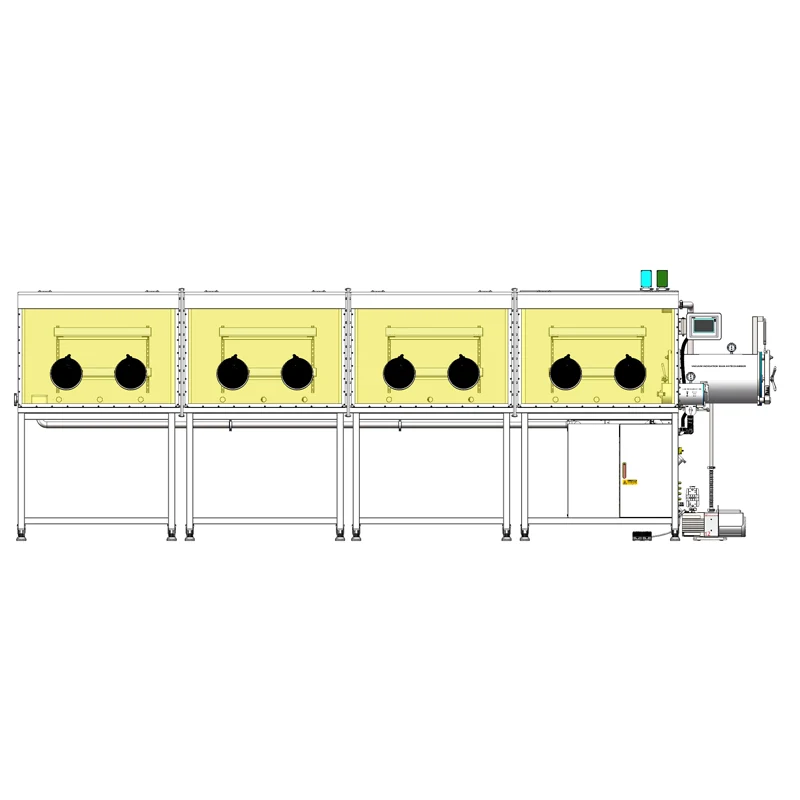
The four-station label describes the working layout, not a performance rating. The cabinet is arranged for four operator positions along one operating face. That arrangement can reduce walking and let a team share instruments, but it also creates a larger internal volume, more glove ports, and more potential leak paths than a smaller cabinet. Four positions do not automatically mean four independent atmospheres. Unless the design includes isolated compartments, the stations share one purification loop and one atmosphere. A solvent odor or a moisture ingress event at one station can therefore affect the whole working volume.
Single-sided means the operators work from one main side rather than facing each other across the box. This is often useful when the cabinet sits against a wall or when one side is reserved for services, controls, or a transfer area. It can improve supervision and simplify the room layout, but it also affects reach and sightlines. The internal depth, window angle, shelf position, and glove-port spacing determine whether the far corners are genuinely usable or merely visible.
A split-type cabinet is generally chosen for transport and installation. Large one-piece glove boxes can be difficult to move through doors, corridors, lifts, or tight laboratory layouts. A split design allows the enclosure to arrive in sections and be assembled on site. The benefit is logistical, not automatic. The joints, seals, fasteners, and site assembly procedure become part of the leak-tightness story. Before purchase, ask how the cabinet is divided, how the seals are protected during assembly, and how the completed box is checked for leaks and pressure hold. A split cabinet that is poorly assembled is still a leaking cabinet.
Which Purification Glove Box Configurations Matter?
The supplied material confirms one model family, so a list of invented model numbers would be less useful than the configuration choices that actually change the working envelope. The most important decisions are the working volume and station layout, the purification capacity, the transfer path, the monitoring package, and the accessory set.
Working volume should be judged from the operator's task, not from the external footprint alone. A four-station box may be laid out for long samples, benchtop instruments, or several small assembly trays. The internal height must accommodate the tallest item and the operator's hands and tools. Shelf position affects reach and airflow. Window size and angle affect visibility. The glove-port positions should match the way the team works: two hands at one position, shared access to a central instrument, or separate tasks at opposite ends of the cabinet.
Purification capacity must match the load. The load is not only the initial air volume. It includes air admitted during transfers, moisture and oxygen released by samples and containers, solvent vapors from compatible processes, and leakage through gloves, seals, and feedthroughs. A larger purifier can recover faster from a small ingress event, but it cannot make a poor transfer procedure acceptable. Ask for the intended working concentration range, the regeneration interval, the number of purification columns, and the expected recovery behavior after a defined transfer. If the supplier cannot state the basis for a performance value, treat the value as a target to verify, not a guarantee.
The transfer path is just as important as the purifier. A small antechamber limits what can enter; a large one can reduce transfer frequency but may take longer to purge. The door size, shelf, internal volume, vacuum capability, and purge procedure should be matched to the samples and tools. A vacuum antechamber is not the same as a vacuum glove box. The antechamber vacuum level, the box working pressure, the pump ultimate pressure, and the system leak rate are separate specifications with separate meanings.
Monitoring should be chosen for the decisions the team needs to make. Oxygen and moisture analyzers answer different questions from a pressure gauge. A pressure transmitter tells you about pressure, not about chemical purity. A HEPA filter removes particles, not water vapor or oxygen. A solvent adsorption unit can reduce organic vapors, but it does not replace the water and oxygen purification loop. Each accessory adds a function, a connection, and a maintenance task. The right set is the smallest set that supports the process and can be calibrated, serviced, and interpreted by the people on shift.
Which Specifications Should You Check?
For this type of cabinet, the useful specification review covers the workspace, the atmosphere loop, the transfer interface, the pressure and monitoring scheme, and the materials that come into contact with the process. The table below is a checking framework, not a substitute for the current datasheet.
| System area | What to verify | Why it matters |
|---|---|---|
| Working space and ergonomics | Internal dimensions, usable height, shelf, glove-port spacing, window, reach | Four stations are only useful if each position is comfortable and accessible. |
| Leak integrity | Leak-test method, pressure-hold criteria, seal details, split-joint assembly, door and feedthrough seals | Atmosphere control starts with a tight enclosure; leak rate is not the same as purifier capacity. |
| Purification loop | Column type and number, blower, valve sequence, regeneration method, gas supply requirements | Capacity and regeneration plan must match transfer frequency and sample outgassing. |
| Transfer | Antechamber volume, door size, shelf, vacuum or purge method, cycle time | The airlock is the main route for air ingress; its size and procedure affect recovery. |
| Monitoring | O2 and H2O sensor range, resolution, accuracy, calibration, sample points, alarms | Resolution is not accuracy; a reading is only useful if the sensor is calibrated and representative. |
| Pressure | Box working pressure range, transmitter range, accuracy, output, wetted materials, port, calibration | Box pressure, antechamber vacuum, and pump ultimate vacuum are different quantities. |
| Compatibility | Glove material and thickness, window material, seal material, solvent exposure, HEPA and solvent trap options | A glove box is not automatically compatible with every solvent, powder, or process gas. |
| Site services | Power, gas supply, vent or exhaust, floor loading, room access, commissioning space | Split-type cabinets still need a planned assembly and verification route. |
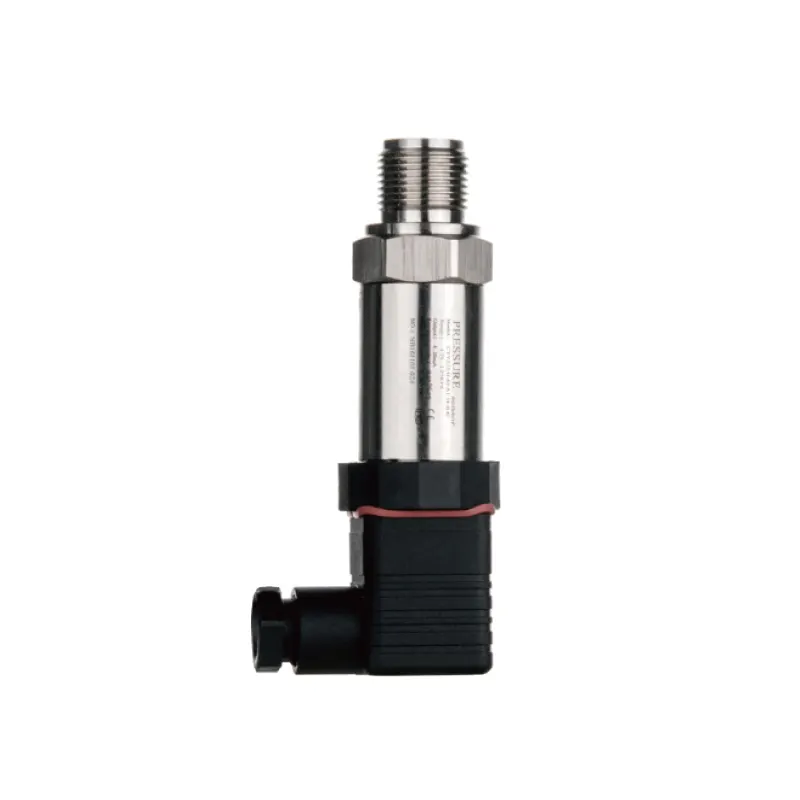
A pressure transmitter is an accessory, not a purification device. The high-precision pressure transmitter can provide a continuous pressure signal for the control system or for trend review, but its value depends on the range, accuracy, output signal, wetted materials, port type, and calibration. It must be compatible with the cabinet's pressure-management scheme and installed at a point that represents the pressure the team needs to control. A display with many digits is not evidence of accuracy. Ask for the accuracy statement, the calibration method, and the effect of temperature on the reading.
When comparing atmosphere data, keep the units and the object of measurement visible. Oxygen and moisture are concentrations in the box atmosphere. Pressure is a force per area in the box or in a service line. Leak rate is a flow under a defined pressure difference. Pump ultimate pressure is a limit of the pump, not a promise for the glove box. If a page mixes these quantities or leaves the test conditions unclear, do not fill the gap with an assumed number. Ask for the condition, the instrument, and the acceptance criterion.
Where Is It Suitable, and What Are Its Limits?
A four-station purification glove box is suitable for work that benefits from a shared, controlled atmosphere and a defined transfer path. Typical contexts include lithium and solid-state battery materials, perovskite and OLED device preparation, semiconductor and electronic materials, air-sensitive synthesis, advanced materials characterization, and additive manufacturing workflows that need controlled handling before or after processing. The common thread is not a particular industry. It is a process that is sensitive to moisture, oxygen, or both, and a team that needs more working room than a compact box provides.
The limits are just as important. The cabinet is not a sterile enclosure, a cleanroom classification, a biological safety cabinet, or a fume hood. It does not automatically provide protection from toxic gases, fine powders, or every solvent. HEPA filtration addresses particles; it does not remove water or oxygen. Solvent adsorption can help with organic vapors, but it does not replace the purification loop. A purifier has finite capacity and needs regeneration. The four stations normally share one atmosphere, so a spill, an incompatible solvent, or a poorly purged transfer at one position can affect the others.
Material compatibility should be checked before the first run. Gloves are a membrane, not an absolute barrier. Their material, thickness, size, and permeation behavior matter, as do the window, seals, and internal surfaces. Powders can migrate into seals and gloves; solvents can attack materials or overload the trap. Samples that outgas heavily or carry residue can shorten purification cycles. None of these issues means the cabinet is unsuitable. They mean the process needs a compatibility review, a transfer procedure, and a maintenance plan.
How Should You Select or Integrate It?
Start with the workflow, not the catalog. Count the people who need to work at the same time, the largest item that must enter, the frequency of transfers, and the longest continuous session. Then define the atmosphere target in terms of oxygen and moisture concentration, the acceptable recovery time after a transfer, and the instruments that must be inside the box. These requirements determine the working volume, airlock size, purification capacity, and monitoring package more reliably than a list of features.
- Map the stations. Decide what happens at each of the four positions and whether one central instrument or shared transfer area will create congestion.
- Size the transfer path. Check door dimensions, shelf loading, antechamber volume, and the purge or vacuum procedure against the real samples and tools.
- Match purification to the load. Include air ingress, sample outgassing, solvent exposure, and the intended regeneration interval in the discussion.
- Define pressure and monitoring. Separate box pressure, antechamber vacuum, and gas-supply pressure. Choose sensors for range, accuracy, calibration, and alarm function.
- Review compatibility. Confirm glove, seal, window, and internal material compatibility with the process, and decide whether HEPA or solvent adsorption is needed.
- Plan site assembly and acceptance. For a split-type cabinet, agree on the assembly sequence, seal protection, leak check, controller checkout, and training before the box is put into routine use.
The final selection should be documented as a configuration, not a model name alone. Record the working dimensions, port layout, airlock type, purifier arrangement, sensor package, gas connections, and accessory list. Then confirm each item against the current TENCAN quotation, drawing, and manual. That record becomes the basis for installation, training, and later service.
Frequently Asked Questions
Does this glove box include gas purification?
The model is specified with a gas purification system. The purification column arrangement, regeneration method, and achievable working atmosphere depend on the selected configuration and must be confirmed on the current datasheet. Purification is a loop function, not a property of the cabinet shell alone.
Can four operators work independently?
Four stations provide four working positions, but they normally share one atmosphere and one purification loop. Independent atmosphere control would require isolated compartments or separate systems. Teams should plan transfer and solvent use so that one station does not compromise the others.
Does a HEPA filter lower oxygen and moisture?
No. HEPA filtration removes particles. Water vapor and oxygen are handled by the purification loop, and organic vapors may require a separate solvent adsorption solution. An analyzer measures the atmosphere; it does not condition it.
Can a pressure transmitter improve atmosphere quality?
A pressure transmitter measures pressure. It can support monitoring, alarms, and control logic, but it does not remove oxygen or moisture. Selection depends on range, accuracy, output, wetted materials, port compatibility, and calibration.
Is a split-type cabinet easier to install?
It can be easier to move through confined spaces, but it introduces site assembly and joint sealing as critical steps. The completed cabinet still needs a leak check and a documented acceptance procedure.
