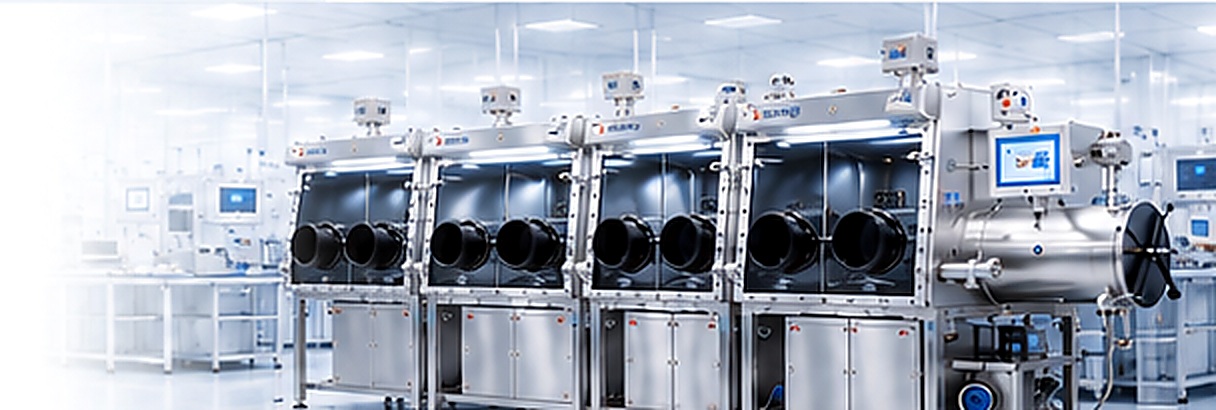
A three-station single-sided split-type glove box with gas purification is a sealed, atmosphere-controlled workstation for handling oxygen- and moisture-sensitive materials. The enclosure provides three working positions along one operator face, uses a segmented shell, and includes a purification loop that continuously circulates the internal gas through media that remove moisture and oxygen. It is used when a compact vacuum box or a basic isolation enclosure cannot offer enough working space, atmosphere stability, or monitoring for a multi-step laboratory process.
What the System Is and Where the Purification Loop Sits
The glove box itself is the physical barrier: a transparent enclosure with gloves, antechambers, a frame, and controls. The gas purification system is the conditioning loop integrated with or connected to that enclosure. It is not a gas generator, and it does not create a cleanroom. Its job is to reduce contaminants that enter through transfers, gloves, joints, and material surfaces, then return conditioned gas to the working volume.
That distinction matters during procurement. A purification loop cannot compensate for a poor seal, an unsuitable glove material, or a transfer procedure that admits large amounts of room air. Likewise, a well-sealed box without adequate purification is only an inert-gas enclosure. The two parts have to be sized and configured as one system. The TENCAN three-station single-sided split-type glove box with gas purification system is the reference product here; its title defines the layout and purification scope, while performance figures and utility requirements must come from the current configuration sheet.
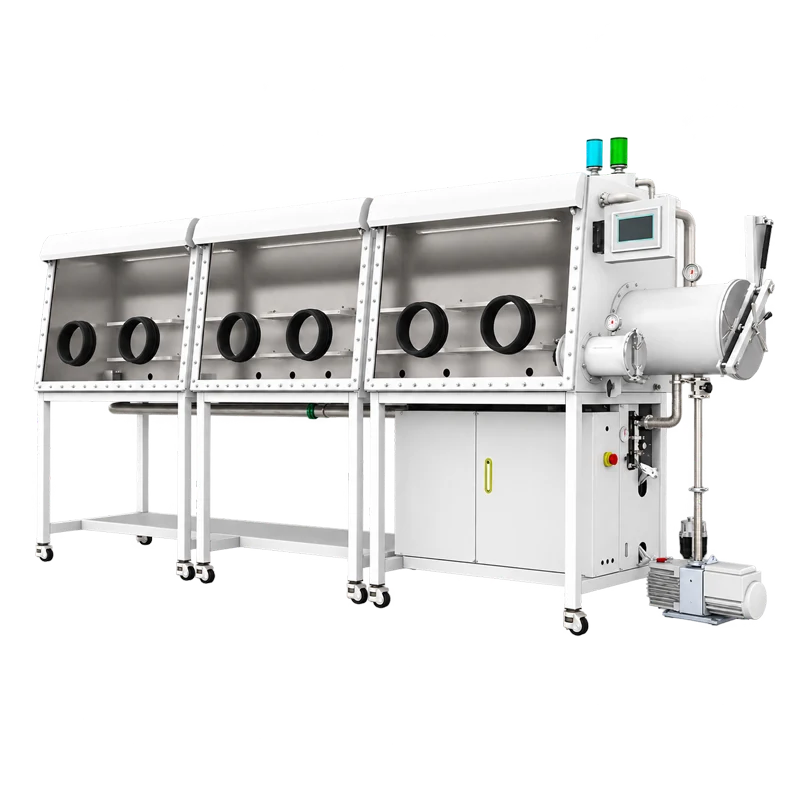
How the Three-Station, Single-Sided, Split Layout Works
Three working positions on one operator face
A single-sided layout puts the glove ports on one face. In a three-station version, the working width is divided into three operating positions, which can let one researcher move along a longer process or let several researchers share the enclosure. The stations normally share the same internal atmosphere. They are not three independent glove boxes unless the design includes separate chambers and gas circuits, and that should be confirmed rather than assumed.
Shared atmosphere has practical consequences. Work at one station can affect the others through glove movement, heat load, solvent release, or a brief opening of a transfer door. A larger enclosure also changes gas flow patterns. Ask for the glove-port spacing, internal dimensions, partition arrangement, and expected reach at each position.
What split-type construction changes
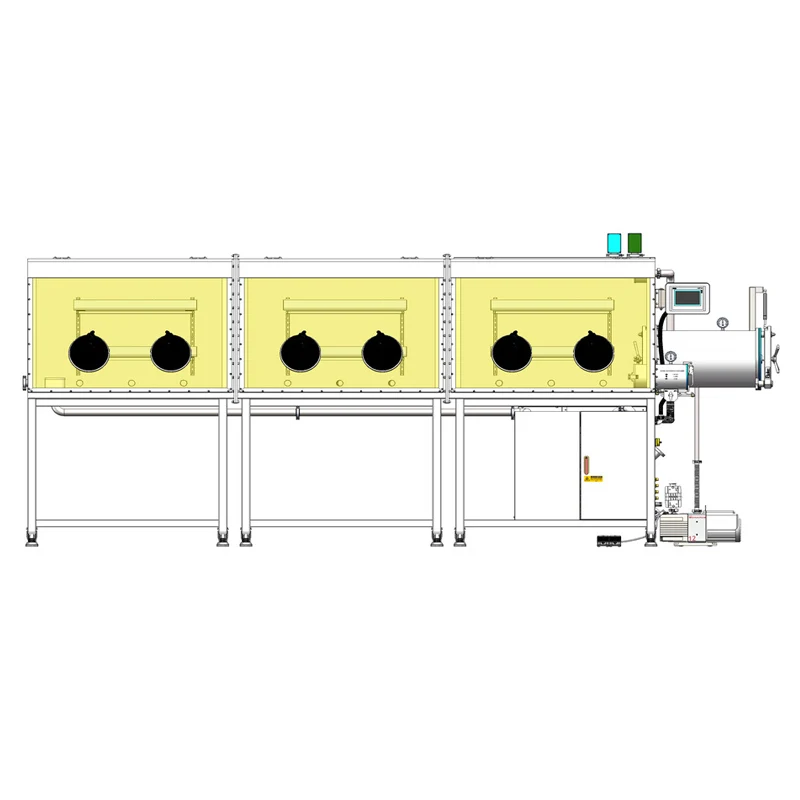
In this product name, split-type indicates a segmented enclosure rather than a single monolithic shell. That can make transport, doorway access, and installation easier in an existing laboratory. It also creates joints and alignment points that need proper sealing and assembly. The important questions are who performs final assembly, how the seals are verified, and whether the sections form one continuous atmosphere or have separately controlled zones.
A split enclosure is not automatically more flexible in operation. Its advantage is installation and layout; its risk is added sealing and service complexity. A single large workspace may be preferable for long samples or shared experiments, while separate zones may be preferable when cross-contamination is a concern. The supplier's drawing should make that boundary clear.
Transfer and material flow
Antechambers are the main route for introducing samples, tools, and small equipment. A vacuum antechamber is evacuated and refilled with working gas before the inner door opens; a purge-only chamber relies on displacement. Neither is a purification column. The transfer chamber reduces air ingress, but every cycle still adds a load that the purification loop must remove. Chamber volume and door size should match the largest routine item, not just a small sample vial.
How the Gas Purification System Maintains the Atmosphere
In a closed-loop purification system, a blower draws gas from the glove box, passes it through one or more purification columns, and returns it to the enclosure. Moisture is typically captured by adsorptive media; oxygen is removed by reactive media, with the exact arrangement depending on the design. Valves isolate the columns during regeneration. Regeneration is a separate procedure carried out under the manufacturer's conditions, not a normal operating mode that should be improvised.
Sensors monitor the atmosphere at defined sample points, and the controller uses those readings for display, alarms, and sometimes automatic valve action. The measured value applies to the sample point and the current load, not to every corner of the box at every moment. Purification performance depends on leak-tightness, glove condition, transfer frequency, materials stored inside, solvent release, and sensor calibration. For that reason, a target such as a low moisture or oxygen level should be tied to a test condition and a measurement location.
The system also differs from simple vacuum-and-refill operation. Vacuum exchange removes bulk air at the start, but it does not continuously remove contaminants that seep in afterward. A purification loop does that, within its capacity. It still cannot guarantee that every gas is inert to every sample, and it should not be described as providing absolute zero contamination.
Which Specifications Should You Check?
The model name is a starting point, not a specification sheet. The following items should be confirmed in the drawing, bill of materials, and control description.
| Area | Information to confirm | Why it matters |
|---|---|---|
| Enclosure and stations | Internal dimensions, glove-port count and spacing, split joints, partition or zone arrangement, window material | Determines reach, collaboration, sample size, and cleaning access. |
| Atmosphere control | Working gas, target oxygen and moisture levels, sensor locations, stabilization conditions, alarm logic | Connects the quoted atmosphere to a measurable operating condition. |
| Purification loop | Column arrangement, circulation path, regeneration procedure, required gas supply, service access | Establishes operating capacity and maintenance planning. |
| Transfer | Number and volume of antechambers, door sizes, vacuum and purge arrangement, pump matching | Sets material flow and the contamination load per transfer. |
| Sealing and materials | Gasket and glove materials, window and interior materials, solvent compatibility, HEPA or solvent-trap options | Affects chemical resistance, leak behavior, and whether particles or vapors are addressed. |
| Utilities and integration | Power, gas, exhaust, feedthroughs, data connections, footprint, floor loading | Prevents a good box from becoming an installation problem. |
Do not confuse pressure, vacuum, and purity
Working pressure inside the box, the vacuum rating of an antechamber, the ultimate vacuum of a pump, leakage rate, oxygen concentration, and moisture concentration are separate specifications. They use different units and test conditions. A pump's ultimate vacuum does not define the box atmosphere; an antechamber vacuum level does not define purification capacity; and a leak rate does not by itself predict recovery time after a transfer. Keep the original units and the object being measured.
Check how the measurement is defined
Resolution is not accuracy. A display may show a fine increment while the sensor's accuracy, drift, and calibration uncertainty are much larger. Ask how the analyzer is calibrated, whether the reading is compensated for pressure or temperature, where the sample is taken, and what maintenance is required. The same caution applies to oxygen sensors. A stable number on a controller is useful only when its measurement basis is known.
Where Is It Suitable, and What Are Its Limits?
The strongest fit is a laboratory with several air-sensitive tasks and a need for a wider working area. Examples include lithium-metal and solid-state battery assembly, moisture-sensitive electrolytes and cathode or anode materials, perovskite and OLED device work, semiconductor and electronic materials, air-sensitive catalysis and organometallic chemistry, advanced materials, and additive-manufacturing post-processing where oxygen or moisture affects the result.
Three stations can support a sequence such as weighing, sample preparation, and sealing without moving materials out of the controlled atmosphere. A single-sided layout can save depth in a room and keep operators on one side of the installation. These are layout benefits, not proof that the box suits every process.
Limits should be stated just as clearly. The enclosure is not a sterile isolator, a cleanroom classification, a biosafety cabinet, or a certified hazardous-materials containment system unless it has been specifically configured and documented for that duty. It does not make every gas inert to every sample. Solvents, acids, and reactive vapors can attack gloves, seals, and interior materials; solvent vapor needs an appropriate adsorption strategy and must not be treated as if it were moisture. HEPA filtration captures particles, not water or oxygen, and a solvent trap does not replace the purification columns.
Frequent large transfers, wet materials, damaged gloves, and poor housekeeping all raise the load on the purifier. Training and interlocks are part of the system boundary. Operators should follow the manufacturer's procedures for pressure, door sequencing, regeneration, and emergencies rather than treating the glove box as a simple cabinet.
The Role of a Moisture Analyzer
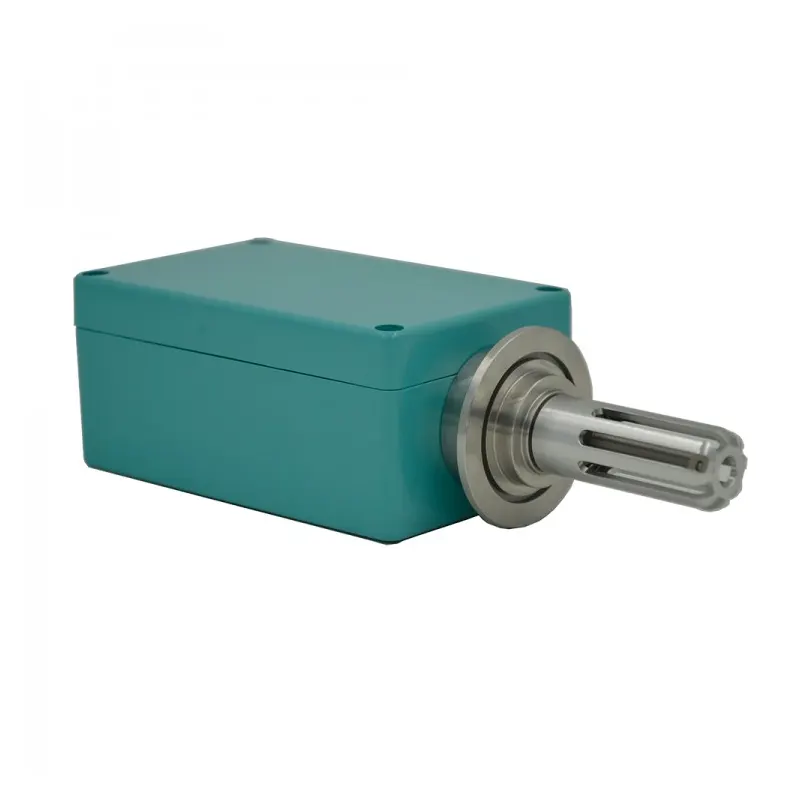
A moisture analyzer is a monitoring accessory, not a purification device. It answers the question "what is the moisture level at this sample point?" It does not lower that level. In a purification glove box, an analyzer can help track recovery after transfers, detect a rising trend caused by a glove leak, and support routine checks. It is useful only when its sample interface, range, materials, and calibration suit the box and the process.
A glove box moisture analyzer should be selected with attention to the measurement unit, range, resolution, accuracy, response time, pressure and temperature basis, wetted materials, output signal, and calibration method. Resolution alone is not a performance claim. Installation location matters as well: a sample point in a dead zone or downstream of a leak can give a misleading picture. Confirm that the fitting and signal interface are compatible with the glove box before adding the instrument.
How Should You Select or Integrate It?
Start with the process, not the catalog. Define the materials to be handled, the working gas, the target atmosphere and how it will be verified, the largest item that must pass through an antechamber, the number of operators, solvent use, heat load, and the expected transfer frequency. Then check the enclosure layout against the room: door width, corridor turns, floor loading, ceiling height, service clearance, gas supply, exhaust, and power.
For the purification system, ask for the circulation and column arrangement, regeneration requirements, recommended gas quality, monitoring points, and service intervals. The supplier should state which utilities are required and which consumables are field-replaceable. For a split-type enclosure, request the assembly method, joint sealing details, and the acceptance checks performed after installation. For a three-station box, confirm that all three positions are usable at the intended reach and that the partition, if any, does not restrict sample movement.
Before purchase, agree on a verification plan: what will be measured, where, after what stabilization period, and with which calibrated instrument. This is more meaningful than a single headline number. Also plan for glove replacement, filter or adsorber changes, pump maintenance, and sensor calibration; access for these tasks should not require dismantling the working area. The product page for the three-station single-sided split-type glove box with gas purification system is the place to confirm the current configuration, but the final selection should be based on the project's own material and atmosphere requirements.
FAQ
Does the purification system run continuously?
It can usually be operated as a closed-loop system during working periods, but the actual operating modes, startup sequence, and regeneration schedule must match the manufacturer's instructions and the application load.
Can a moisture analyzer lower the moisture level?
No. It measures moisture at a sample point. Removal is the job of the purification system; an analyzer provides trend data and alarm input.
Is a split-type three-station box the same as three separate glove boxes?
No. The title describes one enclosure with three working positions and a segmented shell. Confirm whether the sections share one atmosphere and one purification loop.
Can the box handle solvents?
Only after the glove, seal, window, and interior materials are checked for compatibility. Solvent vapor also requires an appropriate adsorption strategy; standard moisture and oxygen purification media are not a substitute for that.
What information is needed first for configuration?
Start with the materials, working gas, target atmosphere, largest transfer item, solvent use, operator count, and available room utilities. Those details determine whether the layout and purification capacity are appropriate.