
A precision recirculating water chiller is an accessory that removes heat from a load by circulating a temperature-controlled coolant and rejecting that heat outside the load. In a glove box installation, it sits on the utility side of the system—not in the gas-purification loop and not in the box atmosphere itself. Its job is thermal management: carrying heat away from equipment or a heat exchanger so that a process, instrument, or enclosure component can remain within its intended temperature window. TENCAN Glove Box Systems lists the Precision Recirculating Water Chiller in its glove box accessories range.
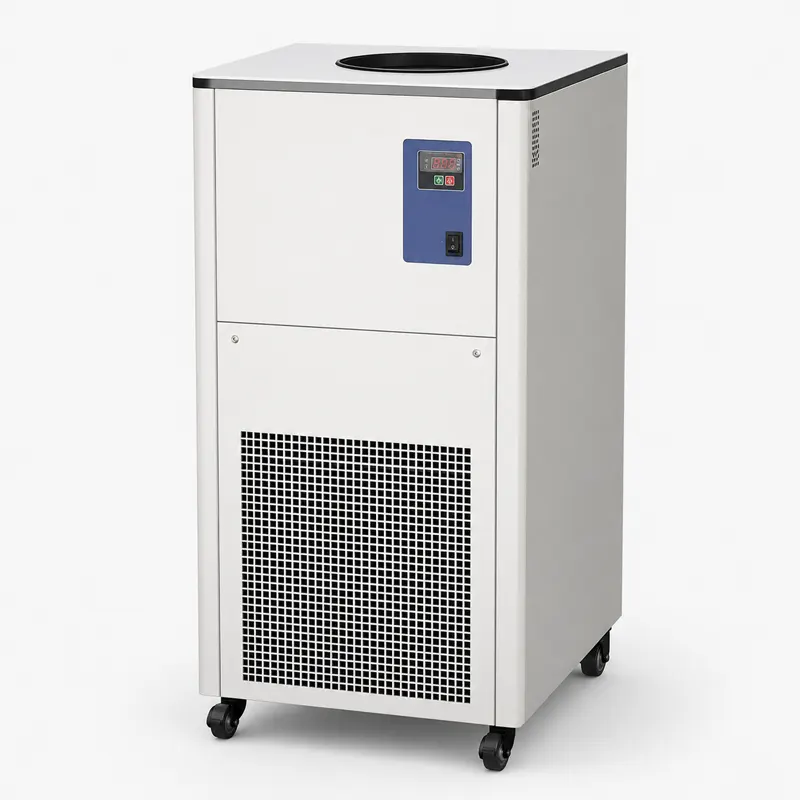
What does a precision recirculating water chiller do?
A recirculating chiller is defined by its heat-transfer path. Heat enters the coolant at the load, is carried back to the chiller, and is rejected to the room or to a facility-water circuit through a condenser or another heat exchanger. The chiller does not change the chemical composition of the glove box atmosphere. It may support a process that takes place in a controlled atmosphere, but it is not a source of inert gas, vacuum, or gas purification.
The useful way to judge the accessory is therefore by its thermal job: how much heat it can remove at the relevant temperatures, how steadily it holds the coolant temperature, and how safely the coolant can be routed to and from the load. A chiller that is impressive on a headline rating but poorly matched to the actual load, line length, or ambient condition will not deliver the same result in service.
Where the chiller sits in a glove box installation
In a typical installation, the chiller is external to the glove box and connects to a heat exchanger, cold plate, or cooled equipment through supply and return lines. If the heat-producing item is inside the box, the thermal path must cross the enclosure boundary without compromising its seals. That may involve a dedicated heat exchanger, a sealed feedthrough, or a secondary loop, depending on the design. The exact arrangement is project-specific, and it should be reviewed as part of the enclosure and utility plan rather than treated as a simple plug-in accessory.
Heat removal is not atmosphere control
Glove box atmosphere control and thermal control solve different problems. Gas purification removes water and oxygen from a circulating atmosphere; a vacuum system removes gas from a chamber; HEPA filtration captures particles; a solvent adsorber captures certain vapors. A water chiller manages heat in a coolant circuit. It does not lower the oxygen or moisture concentration in the box, and it cannot replace a purification column, a vacuum pump, or a leak-tight enclosure. The word “water” in “water chiller” refers to the coolant, not to control of water vapor in the glove box atmosphere. A coolant leak, in fact, would be a contamination event to prevent through proper design and maintenance.
How does a recirculating chiller work?
The supplied reference identifies the product as a precision recirculating water chiller but does not publish its individual performance values. The general principle is still useful: a pump moves coolant through the load, the warmed coolant returns to the chiller, and a heat-rejection system removes the absorbed heat before the fluid is circulated again. Sensors and controls regulate the cooling effort to hold the desired supply temperature.
The coolant loop
The coolant loop normally includes a reservoir or expansion volume, a pump, supply and return lines, the load-side heat exchanger, and fittings or isolation valves. Flow is driven by the pump, while pressure drop depends on the load, tubing diameter, length, bends, and fittings. A loop that is hydraulically mismatched may deliver too little flow, consume more pump energy than expected, or produce unstable temperatures. Wetted materials matter as well: the coolant must be compatible with the pump, heat exchanger, tubing, seals, and the load, and the circuit must be clean enough to avoid fouling or blockage.
The heat-rejection and control side
Heat picked up by the coolant must go somewhere. Depending on the model, that may be an air-cooled condenser with a fan, a facility-water heat exchanger, or another cooling source. The control system compares the measured coolant temperature with the set point and adjusts the cooling output, often through compressor cycling, a modulating valve, or another control element. Alarm and interlock functions are part of this side of the system because a loss of flow, high temperature, low level, or condenser fault can affect both the chiller and the connected load.
What “precision” should mean in practice
“Precision” is not established by a digital display alone. It should be supported by the temperature range, temperature stability, sensor accuracy, control resolution, and the behavior of the system under a changing heat load. A chiller can hold a steady temperature at one fixed load and still drift when the load steps up or down. For that reason, the useful question is not simply “How precise is it?” but “How stable is the supply temperature at my load profile, in my ambient conditions, with the specified coolant and flow?” The model datasheet and application review should answer that question.
Which configurations and components matter?
The supplied reference identifies one accessory rather than a published family with multiple variants. It is therefore more useful to think in configuration questions than to invent a model list. The following issues determine whether the chiller can be integrated successfully.
| Configuration question | Why it matters | What to confirm |
|---|---|---|
| How heat is picked up at the load | Direct cooling, a cold plate, and a secondary heat exchanger create different leak paths and service requirements. | The load type, whether it is inside or outside the box, the heat-exchanger arrangement, and the containment concept. |
| How heat is rejected | Air-cooled and facility-water arrangements place different demands on room ventilation, utilities, and ambient conditions. | The condenser type, required facility services, ambient limits, and heat rejection to the room. |
| Which coolant is approved | Coolant chemistry affects freezing protection, corrosion, conductivity, maintenance, and compatibility with wetted parts. | The approved fluid, concentration, replacement interval, and any restriction on generic water or glycol mixtures. |
| How the chiller is controlled | Set-point access, alarms, and remote signals determine how the accessory behaves during normal operation and faults. | Local or remote control, alarm contacts, communication options, and the response to loss of flow or power. |
| How the loop crosses the enclosure | Every penetration is a potential leak path and a possible route for contamination or condensation. | Connection type, sealing method, feedthrough rating, line support, and the inspection plan. |
These questions are more important than a generic feature list. A chiller is not made “glove-box ready” by its name; it becomes suitable for a particular installation only when the thermal, mechanical, electrical, and sealing details have been checked together.
Which specifications should you check?
The current supplied information does not list cooling capacity, temperature range, stability, flow, pressure, reservoir volume, connection sizes, electrical data, or dimensions for this chiller. Those values must come from the model-specific datasheet and be verified at the intended operating point. Do not substitute figures from another chiller or assume that a headline rating applies to every coolant temperature, ambient condition, and flow rate.
Cooling capacity at the real operating point
Cooling capacity should be checked at the coolant temperature, ambient temperature, flow rate, and heat-load profile that the application will actually use. A rating at one condition does not automatically describe another. It is also worth separating steady-state heat removal from pull-down or startup duty, because a chiller that holds a stable load may behave differently when it must remove a larger transient heat input.
Temperature, flow, and pressure together
Temperature performance depends on flow. A low-flow loop may produce a larger temperature rise across the load and less stable control, while excessive pressure drop can starve the load or force the pump to operate away from its intended range. Specify the required supply temperature, allowable variation, flow, and pressure drop as a set, then compare that set with the chiller curve and the load curve. Set-point resolution should not be confused with stability or measurement accuracy.
Materials, connections, and leak integrity
Check the wetted materials against the approved coolant and against any cleaning or maintenance chemicals. Confirm hose and fitting compatibility, connection size and type, and the mechanical support needed for the lines. Where the circuit serves equipment inside a glove box, the design should address leak containment, detection, and service access. Condensation is another boundary condition: a cold surface can collect moisture when it is below the local dew point, so insulation and temperature limits belong in the installation review.
Where is it suitable, and what are its limits?
A precision recirculating water chiller is most relevant when a glove box process or an adjacent instrument needs controlled heat removal through a liquid loop. Examples include equipment that produces heat during operation, loads that need a stable temperature for repeatable measurements, and thermal management tasks where heat must be moved out of an enclosure rather than released directly into it. The accessory is a sensible candidate only when the installation can support the coolant loop, the heat-rejection path, and the required maintenance access.
- Suitable context: a defined heat load, a compatible coolant circuit, a reviewed enclosure penetration, and a clear plan for heat rejection and fault response.
- Not a substitute for: gas purification, vacuum generation, HEPA particle filtration, solvent adsorption, or enclosure leak testing.
- Not automatically compatible: any particular glove box, feedthrough, instrument, or facility-water system. Compatibility is a configuration conclusion, not an assumption based on product category.
The limits deserve equal attention. The chiller cannot create an inert atmosphere, cannot remove oxygen or moisture from the box, and cannot make a leaking enclosure suitable for air-sensitive work. It also cannot compensate for a heat load that exceeds its capacity or for a facility that cannot reject the removed heat. If the coolant temperature is set below the dew point of the surrounding air, condensation on exposed cold surfaces becomes a design issue. During a power loss, pump fault, or control failure, the connected load may see a temperature rise; the risk should be assessed rather than assumed away.
A stainless-steel vacuum glove box such as the GBV-2 Stainless Steel Vacuum Glove Box illustrates the kind of closed enclosure that may require careful utility planning. The supplied chiller information does not state that the chiller is bundled with, validated for, or automatically compatible with that model. Any combination would need to be confirmed through the actual enclosure configuration, heat-load review, and connection details.
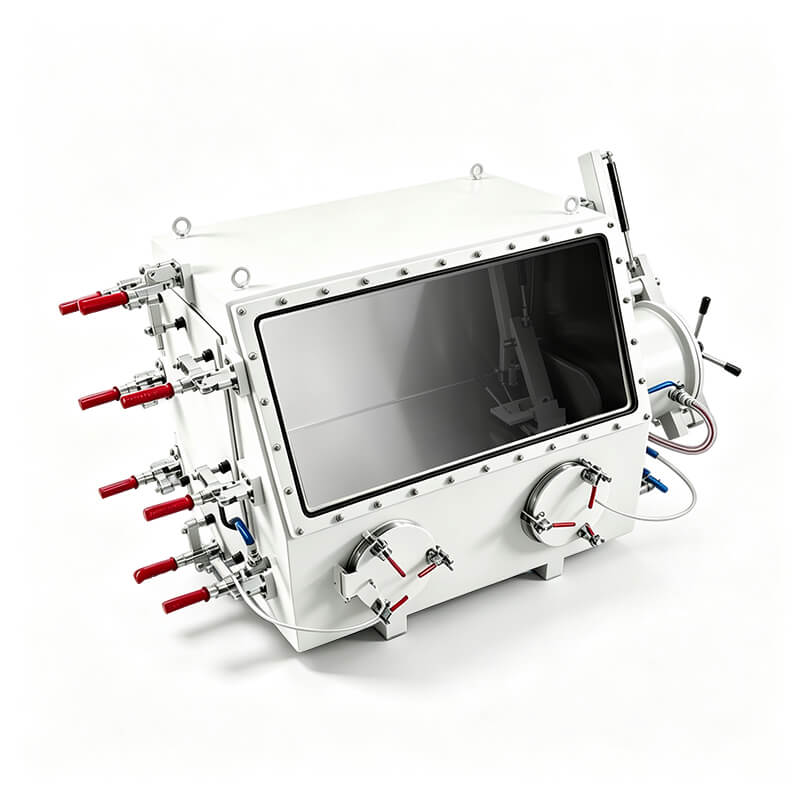
The distinction matters because a vacuum glove box and a recirculating chiller perform different functions. The GBV-2 product information describes a stainless-steel vacuum glove box, while the chiller is an accessory for thermal management. Neither product description should be used to infer a combined performance figure that has not been supplied.
How should you select and integrate it?
Start with the process rather than the accessory. Define the heat load, its duty cycle, the allowable temperature band, and the consequences of a cooling interruption. Then work outward to the loop and the facility.
- Define the thermal duty. Record steady-state heat, transient peaks, startup behavior, and the maximum allowable load temperature.
- Set the temperature and flow requirement. State the required supply temperature, stability, flow, and pressure drop at the load, not just at the chiller outlet.
- Choose the heat-transfer path. Decide whether the load is cooled directly, through a cold plate, or through a secondary heat exchanger, and identify the leak-containment concept.
- Verify the heat-rejection route. Confirm ambient conditions, room ventilation, facility-water availability if applicable, and the effect of heat rejected into the laboratory.
- Check materials and coolant. Confirm the approved fluid, wetted materials, filtration, and maintenance requirements with the chiller and load suppliers.
- Review the enclosure interface. Detail the feedthrough or heat exchanger, sealing method, line support, condensation control, and inspection access.
- Plan controls and faults. Define alarm contacts, shutdown behavior, restart procedure, and the response to loss of flow, over-temperature, or power.
- Document commissioning. Record the as-built loop, coolant, set points, alarm tests, and maintenance schedule so that later changes do not invalidate the design.
Frequently asked questions
Does a recirculating water chiller purify the glove box atmosphere?
No. It controls heat in a coolant loop. Gas purification, sealing, and atmosphere monitoring are separate functions.
Can the chiller lower oxygen or moisture levels in the box?
No. Oxygen and moisture control depend on the enclosure, gas supply, purification system if present, and leak integrity. A chiller does not remove either contaminant from the atmosphere.
Can it be connected to any TENCAN glove box?
Not automatically. The connection must be assessed for the specific enclosure, heat load, coolant path, feedthrough, electrical supply, and control interface. The supplied information does not establish a validated combination with the GBV-2 or another model.
Is a chiller the same as a HEPA filter or solvent adsorber?
No. HEPA filtration addresses particles, and a solvent adsorber addresses certain vapors. A chiller addresses heat. These accessories may coexist in an installation, but they are not interchangeable.
When is this accessory the right choice?
It is the right starting point when a defined load needs liquid-loop heat removal and the installation can accommodate the coolant circuit, heat rejection, sealing, and maintenance. Final selection should be based on the model-specific performance data and the actual system review.
