
A glove port sealing ring is the elastomeric ring that sits between the glove port flange and the glove cuff of an inert atmosphere glove box. Its position is easy to overlook, and its function is easy to state: it retains the glove in the port opening and keeps the joint between the flexible glove and the rigid port wall gastight. Every glove port is a deliberate opening in an otherwise closed enclosure, so this small ring forms part of the barrier that separates the working atmosphere inside the box from laboratory air outside.
What Does a Glove Port Sealing Ring Do?
The ring performs two mechanical tasks at once: it seals a static joint and it holds a moving part. Sealing is the obvious one. The glove is not bonded or welded to the port; it is clamped or captured against the port wall by the ring, and the ring deforms under that clamping force so that no continuous channel remains between the inside and the outside of the box. Retention is the second task. Operators push their hands in and out of the gloves repeatedly, the gloves flex at the cuff, and the ring has to keep the glove bead seated in the port instead of letting it pull free.
How the seal actually works
A glove port seal is a compression seal. The elastomer is squeezed between two rigid or semi-rigid surfaces — typically the port groove or flange on one side and a retaining collar or the glove bead on the other — so that the material is elastically deformed. That deformation is what produces contact pressure. As long as the contact pressure at the sealing line stays above the pressure difference across the wall, gas cannot pass. If the ring is under-compressed, a micro-channel can remain at the sealing line; if it is over-compressed, the elastomer takes a permanent set, hardens, and will not recover its shape the next time the glove is changed.
The direction of that pressure difference is worth thinking through. Many inert atmosphere boxes run at a slight positive pressure with the working gas, which presses the elastomer outward and helps the seal. Enclosures that also evacuate — for instance during pump-and-refill cycles, or when an antechamber is drawn down — reverse the differential at least locally. A ring that works well in a gently pressurised box is not automatically correct for a port that sees vacuum; the profile, the compound and the way the ring is captured all have to suit the actual duty, which is a question to settle with drawings and manufacturer data rather than by assumption.
Why this small part affects the whole atmosphere
Water and oxygen levels in a purified box are held down by the purification loop, but that loop removes what enters the enclosure; it does not prevent air from entering. A leak path at a glove port therefore forces the purifier to work against continuous ingress, and it often shows up indirectly — as drifting analyser readings, more frequent regeneration, or a purifier that seems to struggle even though the columns themselves are healthy.
Where the Ring Fits in a Glove Box System
Accessories around a glove box fall into distinct families: atmosphere management (purification columns, circulation blowers, monitoring), material transfer (antechambers, transfer chambers, vacuum pumps), interfaces (electrical and signal feedthroughs, gas and vacuum lines), filtration and vapour management, and finally sealing and retention parts such as gloves, glove ports, collars and sealing rings. The ring belongs to the last group. It neither measures nor modifies the atmosphere; it defines the boundary that the rest of the system works to maintain.
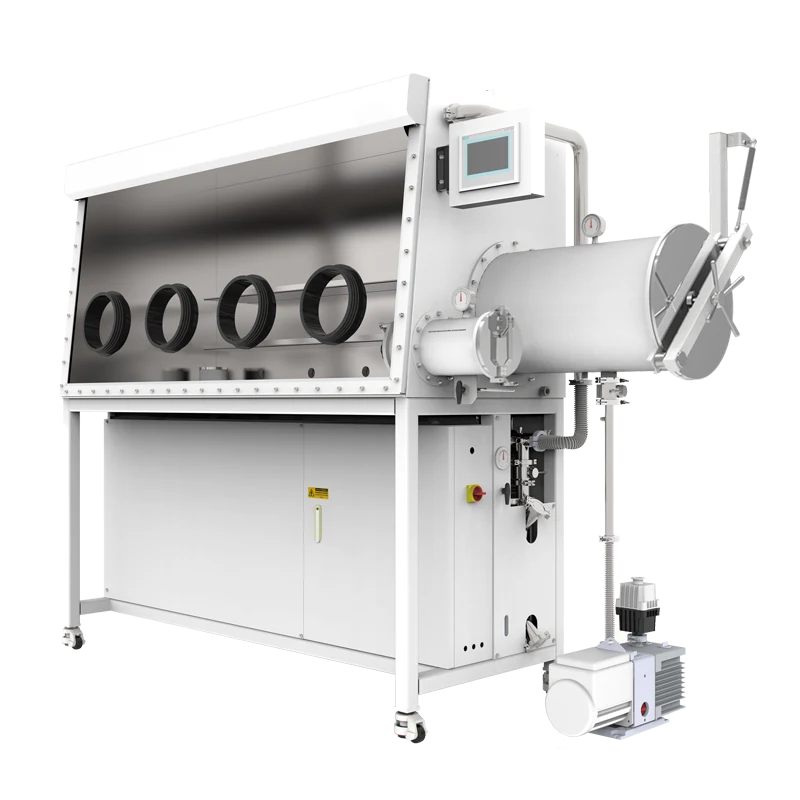
This becomes concrete on an enclosure with several glove ports on one face. A multi-station design such as the Two-Station Single-Sided Glove Box with Gas Purification System places more than one port on the same front panel, so the number of potential penetration points grows with the number of working positions, and each port needs its own correctly matched seal. Whether a given sealing ring suits a given enclosure still depends on the port geometry, the glove size and the retention method used on that model, so compatibility should be confirmed against the port drawing rather than inferred from the fact that both parts are sold for glove box use.
Which Types and Configurations Matter?
Elastomer compound and chemical compatibility
The compound decides which chemicals, temperatures and cleaning practices the ring can tolerate. FKM-type fluoroelastomers are widely chosen where solvent resistance and higher temperature capability are needed; EPDM suits water-based and polar environments but is a poor match for many oils; silicone offers a wide temperature window yet swells in some solvents; nitrile is common for general purpose sealing. Each option is a trade-off, and the compound named in a supplier's data sheet — not the general reputation of the material family — is what should be recorded for a particular order. Solvent vapours migrating from the box interior to the port area are a real exposure, so the list of chemicals used inside the enclosure belongs in the selection process from the start.
Cross-section and profile
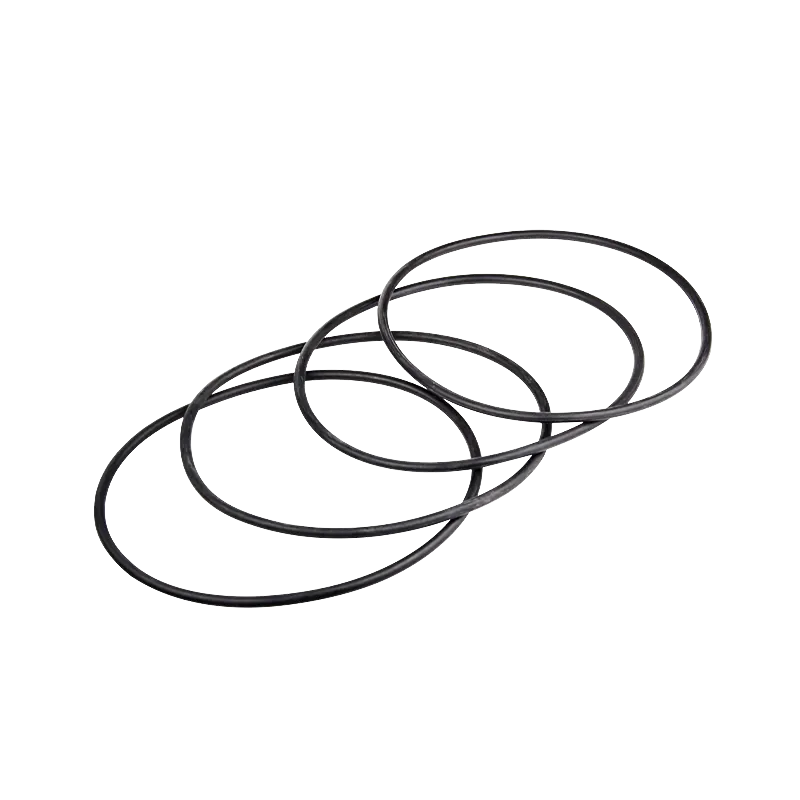
Sealing rings appear as simple O-rings, flat gaskets, moulded profiles with locating ribs, or shaped rings with a lip that engages the glove bead. The profile has to match the groove or seat in the port; a flat gasket will not seal reliably in a groove cut for an O-ring, and a plain O-ring cannot replace a moulded ring that is also performing the retention function. Profile also affects handling: designs that locate positively in the port are easier to seat by hand and are less likely to roll or twist during installation.
Port size, glove size and glove count
Ring dimensions follow the port bore and the glove cuff diameter, and both are tied to the glove size chosen for the operator and the task. A face with two working positions needs a seal at each port, and an enclosure fitted with different port sizes may need more than one ring size in stock. Ports configured for vacuum service may use a different seat design from ports intended only for a slightly pressurised box, which is another reason to match the ring to the port rather than to the enclosure's model name.
Which Specifications Should You Check?
Because a glove port seal is a fit-and-compatibility part, the specification that matters is the one that describes the joint, not a headline performance number. The following points define that joint:
- Port geometry: bore diameter, groove or seat dimensions, retaining collar or other retention method, and whether the port is intended for vacuum or only for a slightly pressurised inert atmosphere.
- Ring dimensions: inner diameter, outer diameter or cross-section, and overall thickness, taken from a supplier drawing rather than estimated from a photograph.
- Compound and hardness: the elastomer type stated for the specific part, and the nominal hardness, which governs how much force is needed to seat the ring and how it behaves under repeated compression.
- Temperature range: the normal working temperature of the box and of any cleaning or drying step the ring will experience.
- Chemical exposure: solvents, acidic or basic vapours and process gases present inside the enclosure.
- Outgassing behaviour: relevant for moisture- and oxygen-sensitive work, since an unsuitable compound can contribute its own volatile species to a low-humidity atmosphere.
- Glove interface: cuff or bead dimensions, glove thickness and glove material, because ring and glove function as one joint.
- Spares and identification: a clear part number and a small stock of replacements, so a worn ring can be changed during routine glove replacement instead of interrupting a running experiment.
Two descriptions should never be taken on trust: a blanket "vacuum-tight" claim and a hardness figure quoted without test conditions. Where a data sheet does not state the condition under which a value applies, the practical answer is to ask. The same caution applies to atmosphere instruments, where measurement resolution is not the same as accuracy, and to any seal specification that arrives without a defined duty.
Installation, Seating and Maintenance
A sealing ring performs correctly only when it is seated evenly and compressed as the port was designed to compress it. The sequence below describes general practice; the enclosure manufacturer's manual governs the actual procedure, including glove replacement intervals and leak test methods.
- Inspect the port before fitting anything. Old elastomer residue, dried solvent, powder or scratches on the seat are common causes of a leak that later gets blamed on the new ring.
- Clean the seat with a method that leaves no lint or film, and use only lubricants or sealants explicitly approved for the application; some greases contaminate a low-humidity atmosphere or attack the elastomer.
- Check the ring against the drawing and inspect it for damage in transit, since a twisted or nicked ring will not seal.
- Seat the ring in the groove or against the flange without stretching it beyond its elastic limit, then fit the glove so that the cuff is captured evenly all round.
- Compress the joint progressively and evenly. Uneven tightening distorts the ring and opens a local gap even when the fasteners feel tight.
- Verify rather than assume: a leak check on the assembled port, using the method specified for the enclosure, is the only way to know the joint is closed.
- Record the installation and inspect the ring whenever a glove is changed. Hardening, cracking, swelling, a flattened cross-section or a permanent set all indicate that the ring has reached the end of its useful life.
Where It Is Suitable, and What Its Limits Are
The ring is used wherever a glove has to be joined to a port in a controlled atmosphere: lithium and solid-state battery material handling, perovskite and OLED work, semiconductor and air-sensitive chemistry, advanced materials research, and powder handling inside an inert enclosure. All of these benefit from the same logic — fewer leak paths at the operator interface leave the purification loop with less to correct, and the ring is the part that closes the most frequently disturbed joint in the system.
The limits are equally clear. A sealing ring is a passive sealing component, not an atmosphere device: it cannot remove oxygen or moisture, and it cannot lower the water and oxygen levels of a box. Compounds that appear airtight to air are not automatically compatible with every solvent, and an elastomer that swells in a process vapour will fail at the port even if it was installed correctly. The ring is not a particulate filter, not a substitute for the enclosure's own leak-tight construction, and it confers no cleanliness class, sterility or biological containment. Fitting a sealing ring does not convert an enclosure that was not designed for vacuum into vacuum-rated equipment, and it does not make parts from different port designs interchangeable. Where hazardous substances are handled, the containment argument must rest on the enclosure design and the site's safety assessment rather than on an accessory.
How to Select or Integrate a Sealing Ring
Selection narrows to five questions. Which port is involved, and what are its seat dimensions and retention method? Which chemicals and temperatures will the ring actually see? Does the port ever experience vacuum, or only a slightly pressurised inert atmosphere? Which glove size and cuff geometry must the joint accommodate? And how many ports on the enclosure need a ring at the same time?
The answers convert directly into a specification: profile type, inner and outer dimensions, compound, hardness and quantity. Where a drawing or data sheet is missing, request it before ordering rather than matching by appearance, and review the glove port sealing ring as a defined part with stated dimensions. Ordering spares alongside the primary parts is routine in laboratories where a glove change cannot wait for a purchase cycle. On installation, treat the joint as a system of three parts — port, glove and ring — because a correctly specified ring paired with an incompatible glove cuff will still leak.
Short Answers to Common Questions
Does a sealing ring purify the atmosphere?
No. Purification is carried out by the gas purification system, its columns, the circulation path and the monitoring instruments. The ring only limits the routes by which outside air can reach the working volume.
Can it lower oxygen and moisture levels in a box?
It cannot lower them; it can only help stop them rising because of a leaking glove port. If water and oxygen readings drift, the purifier, the gas supply, the antechamber and the overall leak rate of the enclosure all deserve checking alongside the glove ports.
How do I judge whether a ring fits my port?
Compare the supplier drawing with the seat dimensions and retention method on the enclosure, and confirm with the manufacturer using the port bore and glove cuff size. Photographs and model numbers alone are not sufficient evidence of fit.
When should a ring be replaced?
At any sign of hardening, cracking, swelling, flattening, or a leak that persists after correct re-seating. Replacing it during a scheduled glove change avoids taking the box out of service later.
Does a two-station box need one ring or two?
Each glove port is its own joint, so a face with two ports needs a seal at each. Confirm the required quantity and size for the specific enclosure before ordering, since port designs can differ between models and across production revisions.
Atmosphere integrity in a glove box is a chain of joints, and a glove port is one of the few that is disturbed every working day. Specifying the ring from the port drawing and the process chemistry, seating it evenly, and replacing it before it hardens keeps that link predictable — which is precisely what the purification loop depends on.
