
A two-station double-sided glove box with a gas purification system is a sealed working enclosure with two operator positions on opposite faces, connected to a closed-loop purifier that continuously removes oxygen and moisture from the internal atmosphere. The box is the barrier and the workspace; the purifier is what keeps the atmosphere inside it usable. Together they solve a specific problem: handling air- and moisture-sensitive materials for hours, with more than one person, without exposing the samples every time someone reaches in, hands something over, or transfers an item in from outside.
What the System Is Made Of
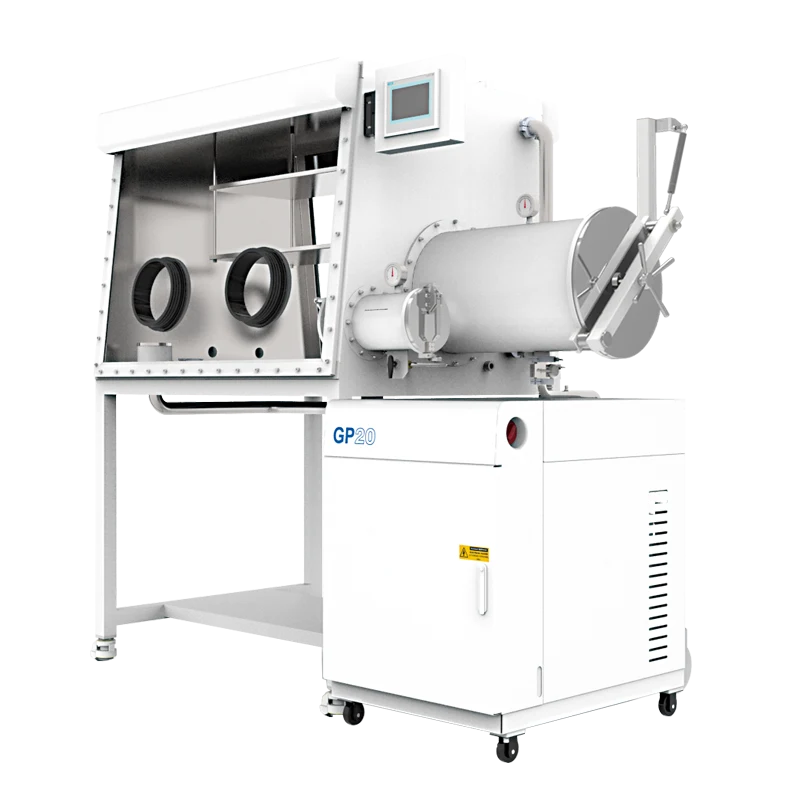
It helps to read the product as a flow path rather than as a single cabinet. The two-station double-sided glove box with gas purification system is normally built from these blocks:
- The glove box body. A rigid, sealed enclosure with a transparent window, two glove-port faces, and a frame that carries the ports, the doors and any feedthroughs. The two stations are the two operator positions; the double-sided layout puts one station on each face.
- The purification unit. A separate cabinet connected to the box by pipework. It holds the purifier columns, the circulation blower, valves and the control electronics. It is not a second working space.
- The antechamber. The small airlock used to move samples, tools and small equipment in and out without opening the box to room air.
- Monitoring and control. Oxygen and moisture analyzers, a pressure indicator for the box, and the logic that runs circulation, regeneration and alarms.
- Gas supply and regulation. The inert working gas (usually nitrogen or argon) and the pressure regulation that holds the box slightly away from ambient pressure.
- Consumables and interfaces. Gloves, port seals, door seals, KF or flange connections, electrical feedthroughs and filters.
The distinction matters at the buying stage: the atmosphere performance you experience is a property of the whole loop, not of the enclosure alone, and a strong box with an undersized purifier will drift upward in oxygen and moisture just as surely as a large purifier on a leaky box.
How the Purification Loop Removes Oxygen and Moisture
During normal operation the blower draws gas out of the box, pushes it through the purifier column, and returns it to the box. Inside the column, two different jobs are done by two different materials. A copper-based catalyst chemically binds oxygen; a molecular sieve or comparable adsorbent takes up water. Both materials are consumable — they fill up — and both must be regenerated or replaced on a schedule set by the load the box actually sees.
Regeneration is the part that is often misunderstood. The saturated column is heated while a reducing gas mixture is passed through it, which reduces the oxidized catalyst and drives the adsorbed water out. The exhaust has to go somewhere safe, which is why the regeneration vent path is a site-planning question and not a detail. The exact regeneration gas composition, temperature and timing belong to the manufacturer's documentation; they are not something to improvise from a general article.
Two consequences follow. First, a purifier with a single column must be taken out of service during regeneration; a design with two columns can keep one online while the other regenerates. It is worth asking which arrangement a given unit uses, because it decides whether your atmosphere is interrupted on a regular basis. Second, the analyzers only measure — they do not purify. An oxygen or moisture reading tells you what the loop is achieving at the sensor location at that moment; it does not tell you why the number is what it is, and on its own it does not guarantee that a sample sitting in the far corner of the box is experiencing the same condition.
Why Two Stations on Two Sides?
A double-sided box lets two people work in the same controlled atmosphere without one waiting for the other, and it lets an item be prepared on one side and used on the other without a trip through the antechamber. For training, for pair work, or for a workflow where one operator does weighing and another does assembly, that shared atmosphere is the entire point.
The layout has costs that are easy to overlook. Every glove port added is another seal and another glove, and gloves are one of the most common paths for moisture to enter a box — not because they fail, but because they are permeable and because they are handled constantly. A double-sided enclosure therefore carries roughly twice the port-related ingress risk of a single-sided one, and the purifier has to be sized for the box as configured rather than for a nominal size class. Reach is the other constraint: a deep box may put the far wall beyond comfortable arm's length, so the usable workspace per station is smaller than the interior dimensions suggest. Ask for the interior depth and check it against the tasks you plan to do with both hands inside.
Which Specifications Should You Check?
Workspace and access
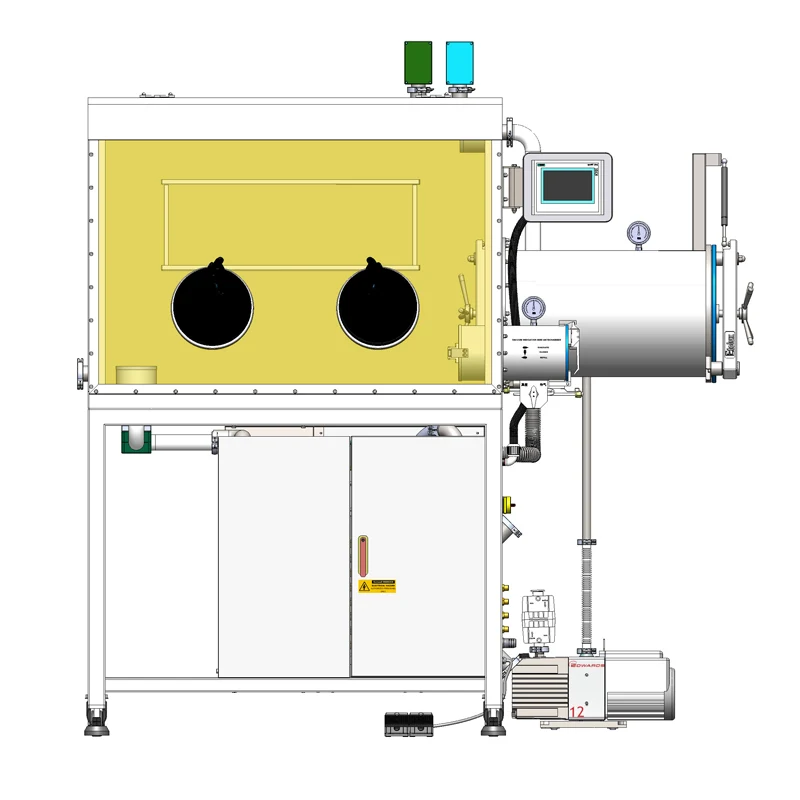
Look at interior width, height and depth, the number and diameter of glove ports per side, and the spacing of the two stations. Port diameter drives which gloves and which tools will fit; port count drives how many people can work at once. If your process needs a balance, a microscope or a press inside the box, confirm the load capacity of the floor or shelf and the clear height above it, and confirm whether a feedthrough is available for cables or sensors.
Atmosphere performance and how it was measured
Oxygen and moisture figures should always arrive with conditions attached: was the box empty and sealed, how long after commissioning, was the purifier freshly regenerated, where is the sensor located, and does the number describe the box atmosphere or the purifier outlet? A figure quoted for a clean, idle box is not the same as a figure you will hold with a warm sample, an open antechamber door and two operators working. Treat any single “best” number as a starting point for a conversation, not as a continuous guarantee across all loads.
Pressure, vacuum and leak rate are three different things
The box working pressure is a small offset from ambient, maintained so that leaks run inward rather than outward. The antechamber vacuum is the level that antechamber can be pumped to during a transfer cycle. The pump's ultimate vacuum is a property of the pump. Leak rate is a property of the enclosure and its seals. These are quoted in different units and are not interchangeable; mixing them up is one of the easiest ways to specify the wrong machine. Ask how leak tightness is verified and keep the original units with the original object.
Analyzer quality
Range, resolution, accuracy and calibration interval all matter, and resolution is not accuracy. A sensor that displays fine increments is not necessarily accurate to that increment. Ask what the analyzers are calibrated against, how often, and whether the calibration can be done on site.
Transfer, and why the antechamber deserves its own review
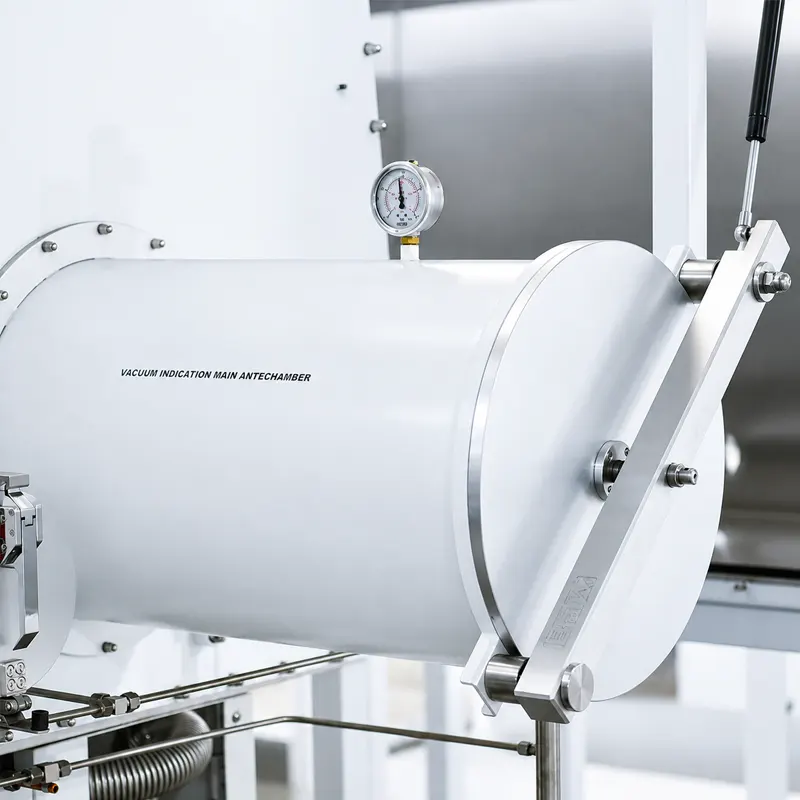
Most atmosphere losses in daily use come from transfers, not from steady-state operation. A large glove box antechamber is the accessory that decides whether a fixture, a small instrument or a batch of sample holders can enter the box at all. When reviewing one, check the clear door opening against your largest item, the inner volume against your typical batch, whether the chamber can be evacuated and refilled on a cycle, the shelf or tray loading, and whether the door and flange geometry match the box port you intend to use. A large antechamber shortens purge cycles by reducing how often the main box is disturbed, but it also adds volume that has to be evacuated each time — the trade-off is real and depends on what you move.
Where It Is Suitable, and Where It Is Not
A purification glove box of this type fits work where the material must stay below a defined oxygen and moisture level for the duration of handling: lithium metal and solid-state battery components, perovskite and OLED materials, air-sensitive organometallic chemistry, semiconductor and two-dimensional materials, and metal powders or additively manufactured parts that react with ambient humidity. It is also a reasonable home for long-term sealed storage of samples that would otherwise degrade on a bench.
Its limits are just as important. It is not a sterile environment, a cleanroom classification, a biological safety cabinet, or a certified containment enclosure for hazardous materials — an inert atmosphere is not the same claim as any of those. It does not make every gas inert with respect to every sample; some materials react with nitrogen, and argon is chosen for that reason. Solvent vapours need their own consideration, because a solvent trap is a separate function from water and oxygen removal and does not replace it. HEPA filtration removes particles and does nothing for moisture or oxygen. Heat-generating processes inside the box add load, and large or wet samples release gas and moisture that the purifier must then remove. And no purifier can outrun a leak: if room air enters faster than the column can strip it, the atmosphere degrades no matter what the display says.
How to Select and Integrate It
Start from the process, not from a model number. Define the oxygen and moisture level your material actually needs, how long it must hold, how often the box will be opened or transferred into, how many people will work at once, and what the largest object inside the box will be. Those five answers determine the box volume, the port layout, the purifier capacity and the antechamber size, in that order.
Then verify the boundary conditions on site: the purity and supply pressure of your house nitrogen or argon, the power available, the route for the regeneration exhaust, the floor space needed for the purification cabinet plus service access, and whether the enclosure will fit through the doors on the way in. Ask for the scope of supply in writing — whether gloves, the antechamber, the analyzers and the initial charge of purifier material are included — and ask what the atmosphere figures refer to. If a vendor cannot state the conditions behind a number, treat the number as promotional. The TENCAN two-station double-sided purification glove box is best evaluated exactly this way: as an enclosure, a loop and a transfer path that have to match your work.
Short Answers to Common Questions
Is the purifier part of the glove box or a separate machine?
In a purification glove box the purifier is a distinct cabinet connected to the enclosure by piping. It is part of the delivered system but not part of the working volume, which is why its capacity and service access need their own space.
Does the box reach its low-oxygen condition immediately after installation?
No. Commissioning involves purging the volume, running the loop and confirming leak tightness; how quickly a target is reached depends on the box volume, the purifier condition, the initial moisture load and the seals. Allow time for this instead of planning experiments on the day of delivery.
Is double-sided always better than single-sided?
Only if two people genuinely work in parallel or if material must move between two process steps in the same atmosphere. Otherwise the extra ports and gloves add cost and ingress paths without adding capability.
Do the oxygen and moisture analyzers keep the atmosphere clean?
No. They report conditions. Cleaning is done by circulation through the purifier material, and that material has a finite capacity that regeneration or replacement restores.
Can a larger antechamber be added later?
Possibly, but it depends on the port geometry, door opening and flange pattern of the existing box, and on whether the frame can carry the additional weight. Confirm compatibility with the manufacturer before ordering, rather than assuming a size class will bolt on.
