
A glove box moisture analyzer is an instrument that measures the water content of the atmosphere inside a glove box and presents that reading to the operator or control system. The Glove Box Moisture Analyzer listed by TENCAN Glove Box Systems belongs to the atmosphere-monitoring part of the installation, not to the purification loop that removes water. Its value is diagnostic: it shows how much water vapor is present, whether the reading is stable, and whether a purge, regeneration, leak check, or material transfer has changed the atmosphere.
The instrument should be selected as part of the enclosure's measurement and control architecture, not as a substitute for gas purification.
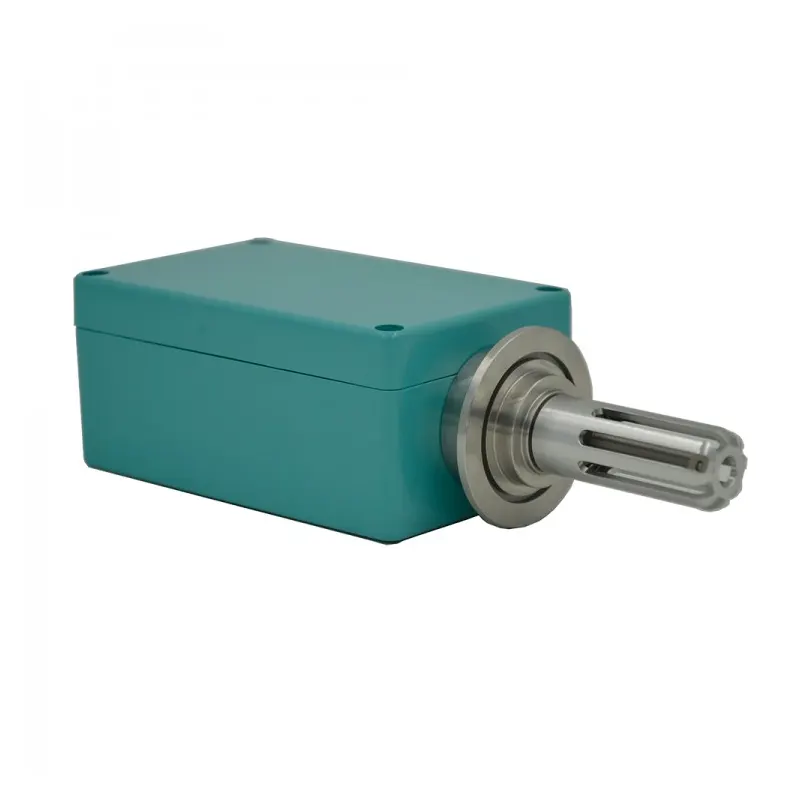
What the Analyzer Does in the Atmosphere-Control Loop
A purification glove box is a system, not a single box. The enclosure provides the working space; the circulation loop moves gas; the purification column removes water and oxygen; valves and controls manage regeneration; and sensors supply evidence about the atmosphere. The moisture analyzer belongs to the last group. It does not dry the gas, regenerate a column, or seal a leak. It tells the user what the water content is doing.
That distinction matters during operation. A reading can rise because a transfer port was opened, because a glove was changed, because a wet sample was introduced, because the purification unit is due for regeneration, or because ambient air is entering through a fitting. The analyzer cannot identify the cause by itself, but it provides the trend that helps an operator separate these possibilities. A stable low reading after a purge is useful evidence; a slow upward drift is a prompt to inspect the system rather than to assume the purifier is working.
Moisture data also supports records. Laboratories that run air-sensitive chemistry or battery-material experiments often need to show that an atmosphere was within a defined condition during a procedure. The analyzer supplies the measurement, while the facility supplies the acceptance limit and the calibration program.
How the Instrument Produces a Water-Content Reading
Although details vary by model, a glove box moisture analyzer performs four basic tasks. It brings a representative gas sample to a sensor, converts the sensor response into a water-content value, displays or transmits that value, and relies on calibration to keep the number meaningful. Some instruments mount the sensor directly in the glove box atmosphere; others draw gas through a sampling line. The current accessory listing should be consulted for the actual arrangement rather than assumed from the name.
Sampling details are part of the measurement. A filter may protect the sensor from dust; a pump or flow restrictor may maintain a defined sample flow; tubing and fittings may need to be compatible with the gas and with trace moisture. If a sample line is long, poorly purged, or made from a material that adsorbs and releases water, the reading can lag or become biased. An instrument can be accurate at its sensor and still give a misleading system reading if the sample path is wrong.
Moisture may be expressed as parts per million by volume, dew point, or another humidity unit. These scales describe the same water vapor content in different ways, but they are not interchangeable without the relevant temperature and pressure conditions. A specification should state its units and the conditions under which the value applies. Resolution deserves the same caution: a display that changes in small increments is not automatically accurate to that increment. Accuracy, repeatability, drift, and calibration uncertainty are separate properties.
Why Water Content Matters in a Glove Box
Water is one of the two common atmosphere contaminants in inert glove boxes, alongside oxygen. It can affect lithium metal, solid-state battery precursors, perovskites, OLED materials, semiconductor processes, air-sensitive catalysts, and hygroscopic powders. In some cases the damage is chemical; in others a thin water layer interferes with wetting, deposition, or interfacial contact. The correct moisture limit depends on the material and process, not on a universal number.
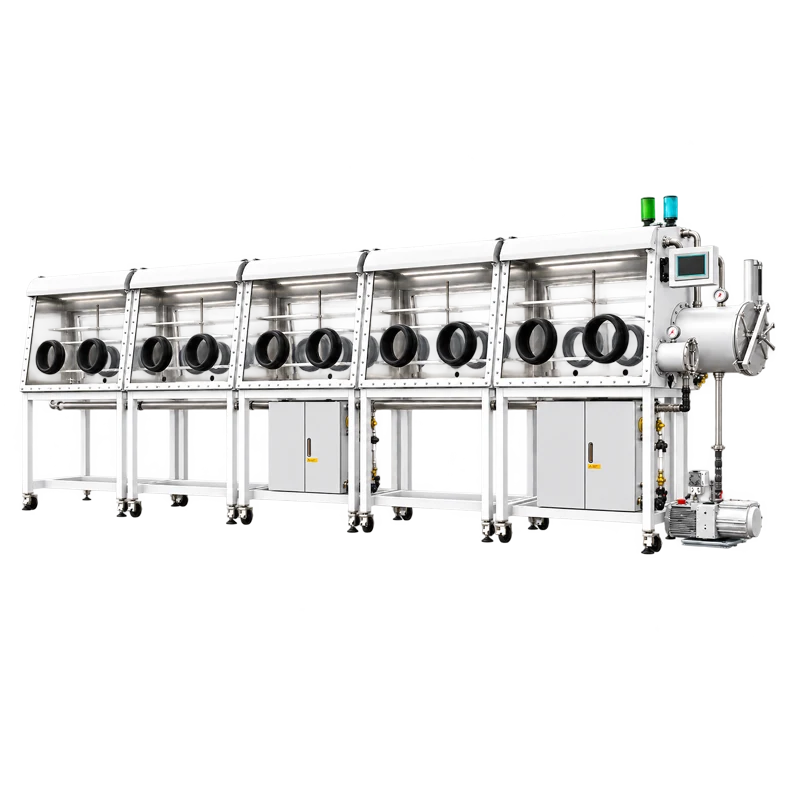
Water also enters through ordinary operations. Ambient air follows a transfer chamber, a faulty seal, or a glove change; solvents and samples carry moisture; some glove materials permeate water vapor slowly. A purification system removes water, but the analyzer is what shows whether removal is keeping pace with ingress. A large enclosure makes that evidence more valuable because the atmosphere is shared across work positions. The ten-station double-sided split-type glove box with gas purification system is an example of a multi-position enclosure in which gas circulation, sealing, and monitoring all have to be considered together; the analyzer would be a monitoring component, not the source of purification.
Water content is not a cleanliness rating. A low moisture reading does not make a box sterile, classify it as a cleanroom, or certify containment for hazardous materials. Those are separate requirements.
Which Specifications Should You Check?
The useful specification set is the one tied to the measurement task. For a moisture analyzer, the first questions are range, units, accuracy, and the intended sample conditions. A very wide range may be convenient for commissioning, while a narrow range may offer better resolution near the working point; the choice depends on whether the instrument is used for general troubleshooting or for routine verification at a specific moisture level.
| Specification area | Why it matters | What to confirm |
|---|---|---|
| Measurement range and units | The instrument must cover the working atmosphere and express it in a usable scale. | ppm(v), dew point, or other units; stated conditions; lower and upper limits |
| Accuracy and repeatability | Resolution alone does not show how close the reading is to the true value. | Accuracy statement, repeatability, drift, calibration method |
| Response time | Slow response makes purge and leak checks difficult to interpret. | Response under the actual sample flow and temperature |
| Sample interface | The analyzer must connect without creating a leak or a moisture trap. | Port type, tubing, filter, flow, pressure, return path |
| Wetted materials | Sensors and tubing can be affected by solvents, corrosive gases, or trace contaminants. | Material compatibility with the process atmosphere |
| Outputs and alarms | The reading may need to reach a trend recorder or control system. | Analog or digital output, alarm contacts, power supply |
| Calibration and service | A moisture reading is only useful if it can be checked and maintained. | Calibration access, interval, reference method, replacement parts |
Do not compare a moisture analyzer with a purifier by looking for the same numbers. The analyzer is judged by measurement performance and compatibility; the purifier is judged by removal capacity, regeneration, and gas circulation. A high-quality analyzer does not improve a weak purification system, and a strong purifier does not guarantee that the analyzer is correctly installed or calibrated.
Installation and Compatibility
The sample point should represent the atmosphere that the operator actually cares about. A location near a gas inlet may read cleaner than the working zone; a location in a stagnant corner may lag behind a transfer event. The installer also has to consider whether the sample is returned to the box, vented safely, or consumed by the instrument. Any connection through the enclosure wall must preserve sealing and strain relief, and any electrical feedthrough must match the instrument's power and signal requirements.
Pressure is a common source of error. The box, the sample line, and the sensor may operate at different pressures, and a gauge reading is not the same as the pressure at the sensing element. The user should confirm the allowable sample pressure, flow, and temperature with the supplier. Filters need to be accessible for replacement; calibration gas or a reference standard needs a safe connection point; and the sampling line should be arranged so that it can be purged without contaminating the working atmosphere.
Compatibility should never be inferred from a product name alone. The fact that a moisture analyzer and a purification glove box both appear in the same catalogue does not prove that a particular analyzer can be connected to a particular enclosure. Confirm the port, signal, pressure, gas compatibility, and mounting arrangement with the supplier before purchase. If the instrument is intended for a solvent-bearing atmosphere, ask specifically about sensor and tubing compatibility; a standard moisture sensor may not tolerate every vapor.
Types and Configurations to Compare
For a single accessory, the meaningful comparison is not a list of invented model numbers. It is a set of configuration questions. Is the sensor mounted in the box or in a remote sample line? Is the reading shown only on a local display, or also transmitted to a control system? Does the instrument include sample conditioning, or must the user provide it? Is the unit intended for continuous monitoring, spot checks, or commissioning? Each choice affects response time, maintenance access, and the amount of integration work.
Moisture sensors also differ in principle, and the principle affects tolerance to other gases, response, and calibration. The product page should be the reference for the supplied configuration; general descriptions of sensor technology should not be read as a guarantee for a specific unit. Where the data sheet is silent, ask rather than assume.
Where It Is Suitable, and Where It Is Not Enough
A glove box moisture analyzer is suitable for monitoring water content during inert-atmosphere operation, checking the effect of a purge or transfer, investigating slow atmosphere drift, supporting maintenance decisions, and recording atmosphere conditions for a process. It is useful in materials research, battery and solid-state electrolyte work, air-sensitive synthesis, and device fabrication where water is a known risk.
It is not a dehydration device. It cannot lower the water content by itself, and it should not be described as providing a guarantee of zero moisture. It is not an oxygen analyzer, although a box may need both measurements. It is not a leak detector in the sense of locating a leak; it can show that a leak or another ingress path may exist, but the operator still has to find it. It does not replace a solvent adsorber, a HEPA filter, or a purification column, because those devices perform different jobs. It also does not establish sterility, cleanroom classification, or biological safety.
Limits also come from the process. Condensation, reactive gases, high particulate loading, and some solvent vapors can affect sensors or sampling lines. The acceptable exposure must be confirmed for the actual instrument. A moisture reading is most trustworthy when the sample is representative, the line is clean and purged, and the calibration is current.
Selection and Integration Checklist
- Define the working moisture range and the units used by the process, then confirm that the instrument covers them.
- Ask for accuracy, repeatability, drift, and response time, not only display resolution.
- Confirm the sample port, tubing, filter, flow, pressure, and return path before installation.
- Check wetted materials against the process gas, solvents, and any reactive species.
- Plan calibration access and a maintenance routine before the analyzer is mounted.
- Do not assume compatibility with a host glove box; verify the interface with the supplier.
Frequently Asked Questions
Does a moisture analyzer remove water from a glove box?
No. It measures water content. Removal is performed by the purification system or by a purge procedure. The analyzer provides the evidence needed to judge whether removal is working.
Can it directly lower the water and oxygen levels?
No. Measurement and purification are separate functions. A low reading after purification shows that the atmosphere has changed, not that the analyzer caused the change.
Is ppm the same as dew point?
They are different ways to express water vapor content. Conversion depends on temperature and pressure, so a number should not be moved between scales without the stated conditions.
How can I judge whether the analyzer fits my glove box?
Confirm the sample interface, pressure and flow requirements, wetted materials, electrical connection, calibration method, and the range needed for the process. Catalogue names alone are not proof of compatibility.
