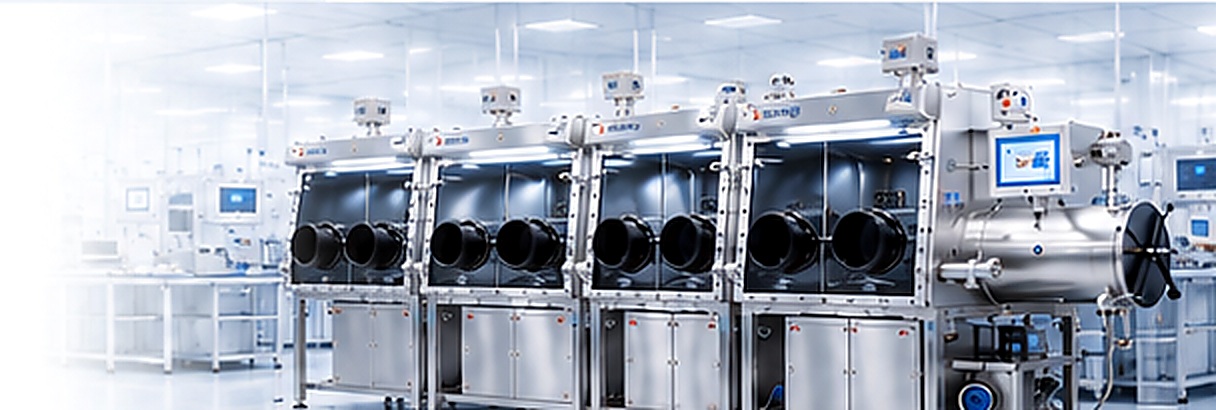
At the core of any advanced inert atmosphere glove box lies the ability to maintain extremely low levels of water vapor and oxygen. While the gas purification system removes contaminants, real-time verification of the environment is only possible with dedicated analytical instruments. A Glove Box Moisture Analyzer is a precision analytical instrument specifically designed to continuously measure and display the concentration of water vapor (H₂O) inside a glove box, typically at parts-per-million (ppm) or even parts-per-billion (ppb) levels. Used by researchers and engineers in fields such as lithium-ion battery development, perovskite solar cell fabrication, OLED material synthesis, and pharmaceutical handling, this analyzer ensures that the inert atmosphere remains within the stringent specifications required for moisture-sensitive processes.
Core Function and Working Principle
The primary function of a moisture analyzer is to convert the ambient water vapor concentration into a readable electrical signal. Inside the glove box loop, a small sample of the inert gas (usually argon or nitrogen) is continuously extracted and passed over a moisture sensor. The sensor element is often based on electrolytic (P₂O₅) or capacitive technology. In an electrolytic sensor, water vapor is absorbed into a phosphorous pentoxide coating and electrolyzed; the resulting current is directly proportional to the moisture content. Capacitive sensors measure changes in dielectric constant caused by adsorbed water molecules. Modern analyzers, such as the Trace Moisture Analyzer commonly used in glove boxes, can achieve detection limits below 0.1 ppm H₂O, providing real-time feedback to the control system.
The measurement process is integrated with the glove box’s circulation system. The analyzer is typically installed downstream of the purification column to monitor the output purity, or directly in the main box to measure the operating environment. The data is displayed on a touchscreen or transmitted to the PLC, allowing automatic regeneration of the purification column when moisture levels rise. Key operational parameters include response time (usually less than 60 seconds for a T90 step change), operating temperature range, and flow rate of the sample gas. A properly calibrated analyzer ensures that the glove box can maintain H₂O levels as low as <1 ppm, which is essential for sensitive operations like handling lithium metal or air-sensitive catalysts.
Types and Key Technologies
While most glove box moisture analyzers share the same general purpose, they come in different configurations to suit various accuracy requirements and environmental conditions:
Electrolytic (Coulometric) Moisture Analyzer
This type uses a P₂O₅-coated cell. The electrolysis current is linear with moisture content, making it highly accurate for trace levels (0.1–1000 ppm). It requires periodic maintenance and regeneration of the cell, but offers excellent long-term stability. Ideal for glove boxes in battery research where precise moisture tracking is critical.
Capacitive (Al₂O₃) Moisture Sensor
A compact and maintenance-free alternative. The sensor uses a thin film aluminum oxide dielectric that changes capacitance with humidity. It can measure from -100°C dew point up to +20°C, covering the full range of glove box operation. However, it may drift over time and requires calibration against a traceable standard. Common in multi-functional glove box installations.
Integrated Oxygen and Moisture Analyzers
Some units combine both O₂ and H₂O measurements in a single chassis, such as the Zirconia Oxygen Analyzer paired with a moisture module. This saves space and simplifies system integration, but each sensor technology retains its own characteristics.
Modern analyzers also include digital communication (RS485, Ethernet) for remote monitoring, data logging, and alarm outputs. The choice between types depends on the required detection limit, budget, and maintenance capacity of the user.
Key Performance Indicators and Selection Criteria
When selecting a Glove Box Moisture Analyzer, several critical specifications must be evaluated to match your application:
- Measurement Range and Detection Limit: For standard glove box work, a range of 0.1–1000 ppm is sufficient. For ultra-dry processes (e.g., solid-state battery assembly), a trace analyzer capable of <0.1 ppm is necessary. The Glove Box Trace Moisture Analyzer is designed precisely for such demanding applications.
- Accuracy and Repeatability: Look for an accuracy of ±5% of reading or better, and repeatability of ≤2% full scale. Calibration using certified gas mixtures is essential.
- Response Time: Fast response (T90 < 60 s) enables timely detection of moisture ingress during sample transfer.
- Operating Environment: The analyzer should withstand operating temperatures from 10–40°C and input gas pressures of 0.5–1.5 bar. Check compatibility with inert gases (N₂, Ar) and the presence of corrosive species.
- Maintenance: Electrolytic cells require periodic replacement of electrolyte (every 1–2 years). Capacitive sensors need recalibration. Evaluate the total cost of ownership.
- Integration: The analyzer should communicate with the glove box PLC via analog output (4–20 mA) or digital protocols for automatic regeneration control and alarm.
- Display and Data Logging: A clear touchscreen display with trend curves and built-in memory for data export (USB) simplifies quality documentation.
Additionally, consider the physical size, port configuration (e.g., 1/4" Swagelok connections), and whether the analyzer comes with a built-in pump for gas extraction. Many glove box manufacturers offer integrated brackets and quick-connect fittings for seamless installation.
Applications and Selection Advice
Glove Box Moisture Analyzers are indispensable wherever an inert atmosphere must be maintained below critical humidity thresholds. Typical applications include:
- Lithium-ion Battery Research: Handling electrolyte salts, lithium metal anodes, and cathode materials (NMC, LFP) demands H₂O levels <1 ppm to prevent hydrolysis and HF formation.
- Perovskite Solar Cells: Moisture degrades perovskite crystals; fabrication requires dry box environments with <0.5 ppm H₂O.
- OLED and Display Materials: Organic emitters and charge transport layers are extremely sensitive to water, needing continuous monitoring.
- Pharmaceutical & Chemical Synthesis: Air-sensitive organometallic compounds (e.g., Grignard reagents) and catalytic processes benefit from real-time moisture verification.
- Materials Science: Sintering of metal powders (additive manufacturing), MOF synthesis, and quantum dot processing all rely on low-humidity environments.
For basic laboratory glove boxes used for sample preparation, a standard capacitive analyzer with a range of 1–1000 ppm often suffices. For high-stakes research where moisture control directly impacts experimental outcome, invest in a trace-level electrolytic analyzer with data logging and automatic alarm. If your glove box already has a built-in oxygen analyzer, consider a combined unit to save cost and panel space. Always verify that the analyzer’s measurement range covers the target operating point (e.g., <1 ppm for lithium metal). Regular calibration against a dew point generator or certified gas standards is recommended every six to twelve months to maintain reliability.
Ultimately, a quality Glove Box Moisture Analyzer not only ensures process integrity but also protects years of research investment from moisture-induced degradation. It is a small but essential component of any serious inert atmosphere laboratory.