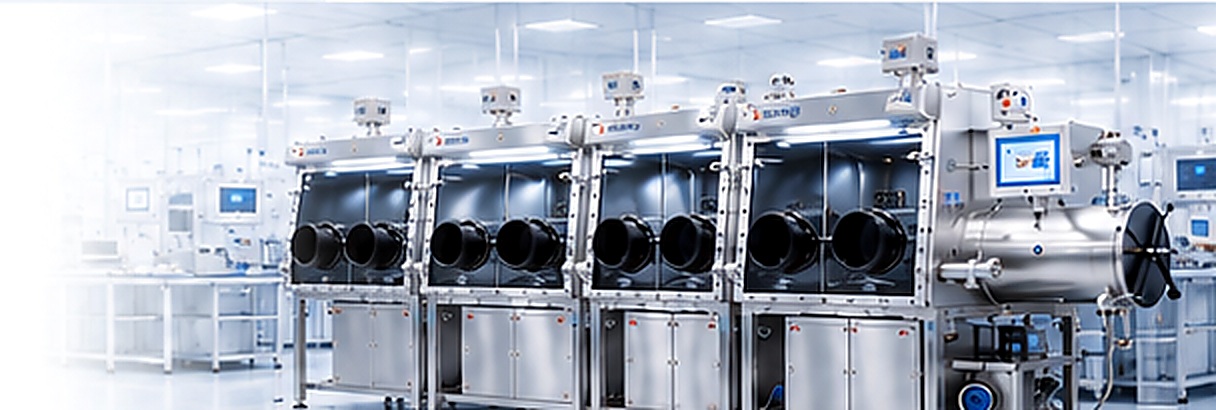
What is a Glove Box Turbomolecular Vacuum Pump?
At its core, a glove box turbomolecular vacuum pump is a high-performance vacuum pumping system tailored for use with inert atmosphere glove boxes. Researchers and engineers in fields like lithium battery technology, organic electronics, and semiconductor processing use it to rapidly evacuate the glove box antechamber or main chamber, removing residual moisture and oxygen before backfilling with ultra-pure inert gas. This process is critical for achieving and maintaining the extremely low water and oxygen levels (often <0.1 ppm) required for handling highly reactive materials.
Core Function and Working Principle
The primary function of a glove box turbomolecular pump is to transform the environment from atmospheric pressure to a high vacuum state (typically 10⁻⁵ to 10⁻⁷ mbar). Unlike standard rotary vane vacuum pumps, a turbomolecular pump uses a series of high-speed rotating blades (rotors) and stationary blades (stators) to impart momentum to gas molecules, effectively pushing them out of the chamber. This technology enables oil-free, clean vacuum without hydrocarbon contamination, which is crucial for sensitive glove box operations.
The working principle relies on molecular flow: when the rotor spins at tens of thousands of RPM, gas molecules collide with the blades and are transferred to the next stage, ultimately exhausted by a backing pump (often a dry scroll pump or rotary vane pump). The pump must be coupled with a precise control unit and vacuum gauges to sequence purging cycles in the glove box antechamber. A typical cycle involves: 1) closing the inner door, 2) evacuating the antechamber to high vacuum to remove water and oxygen, 3) backfilling with inert gas, and 4) opening the inner door. This cycle can be fully automated via the glove box PLC.
Comparison with Standard Vacuum Pumps
While a standard glove box vacuum pump (e.g., oil-sealed rotary vane) can reach medium vacuum (~10⁻³ mbar), a turbomolecular pump achieves high to ultra-high vacuum (10⁻⁶ mbar and below). This deeper vacuum more effectively desorbs water molecules from surfaces and removes trapped gases, significantly reducing the time needed to achieve low ppm levels inside the glove box. For applications requiring the lowest possible contaminant levels, a turbomolecular pump is indispensable.
Key Components and Technologies
A complete glove box turbomolecular vacuum pump system typically includes:
- Turbomolecular Pump Core: With either magnetic or oil-lubricated bearings. Magnetic bearing pumps offer longer maintenance intervals and vibration-free operation.
- Backing Pump: A dry scroll pump or rotary vane pump (see glove box dry scroll vacuum pump) that provides the necessary fore-vacuum (typically 1-10 mbar) for the turbomolecular stage to start.
- Control Unit: Integrated with the glove box PLC or standalone, managing pump speed, temperature, and interlocks.
- KF Vacuum Components: Standardized KF flanges, clamps, and bellows (e.g., KF vacuum clamp and KF stainless steel flexible bellows) ensure leak-tight connections.
- Cooling System: Water or air cooling to manage the heat generated by high-speed rotation.
- Vibration Isolation: Often mounted on flexible bellows to prevent mechanical vibration from affecting glove box operations.
Key Performance Indicators and Selection Criteria
When selecting a turbomolecular vacuum pump for a glove box, consider the following metrics:
- Ultimate Pressure: Expressed in mbar; a typical range is 10⁻⁶ to 10⁻⁸ mbar. For most glove box applications, 10⁻⁶ mbar is sufficient.
- Pumping Speed: Measured in liters per second (L/s) for nitrogen. Higher pumping speed reduces evacuation time for the antechamber.
- Pump Type: Magnetic bearing pumps are maintenance-free but more expensive; oil-lubricated pumps require periodic oil changes but are lower cost.
- Backing Pump Compatibility: The fore-vacuum pressure must be within the turbomolecular pump's specified range.
- Control Interface: RS-485, Ethernet, or analog interface for integration with the glove box controller. Some pumps offer remote monitoring.
- Leak Rate: The entire vacuum system must have a low leak rate (<10⁻⁵ mbar·L/s) to maintain performance. Refer to glove box port cover for sealing unused ports.
- Maintenance: Consider the replacement cycle of bearings or oil and ease of service access.
For most standard glove boxes, a turbomolecular pump with a pumping speed of 50–300 L/s and ultimate pressure of 10⁻⁶ mbar is adequate. However, for semiconductor or thin-film deposition applications requiring ultra-high vacuum, pumps with 10⁻⁷ to 10⁻⁸ mbar capability are recommended.
Applications and Selection Advice
Glove box turbomolecular vacuum pumps are used in environments where extremely low water and oxygen levels (H₂O < 0.1 ppm, O₂ < 0.1 ppm) are mandatory. Typical applications include:
- Lithium-ion battery research: Handling lithium metal, solid electrolytes, and electrode materials that are highly reactive with moisture.
- Perovskite solar cell fabrication: Preventing degradation of organic-inorganic halide perovskites during processing.
- OLED and display material development: Maintaining pure atmosphere for organic light-emitting materials.
- Semiconductor wafer handling: Air-sensitive oxide or metal deposition under high vacuum conditions.
- Metal-organic frameworks (MOFs) synthesis: Avoiding water or oxygen contamination during crystallization.
For users who only need occasional antechamber purging (e.g., small sample transfer), a standard rotary vane or dry scroll pump may suffice. However, if your glove box operates continuously with frequent material exchanges or processes that demand the lowest possible background contamination, investing in a turbomolecular pump will dramatically improve your atmosphere quality and reproducibility. Pair the pump with glove box moisture analyzer and trace oxygen analyzer to monitor the environment effectively.