
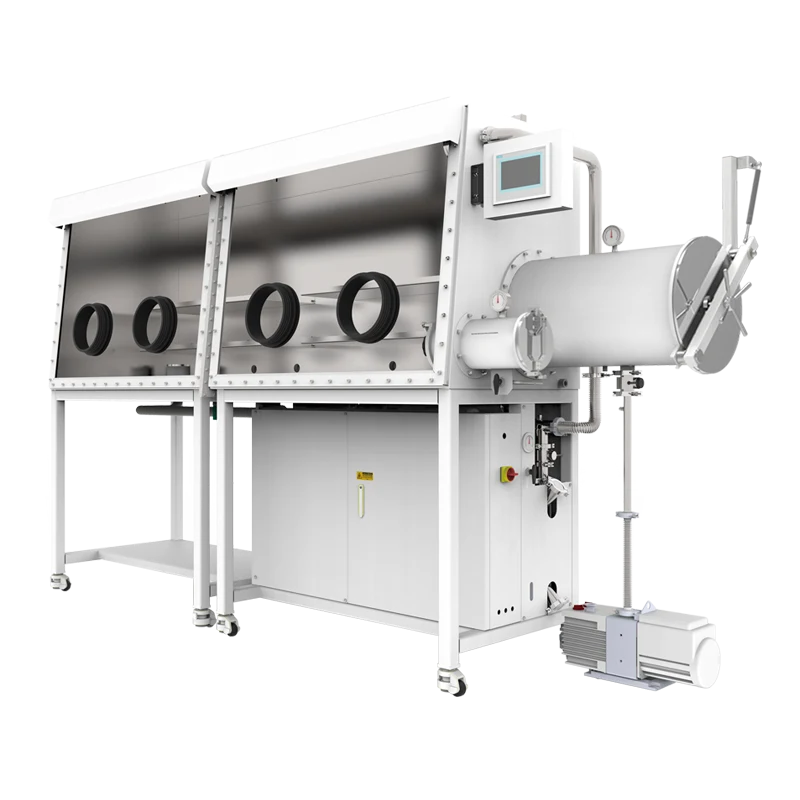
A two-station single-sided split-type glove box with a gas purification system is a sealed working enclosure that provides two operator positions on one face of the box while a closed-loop purification circuit continuously circulates the internal atmosphere through a purifying column to remove moisture and oxygen. It occupies the space between the operator and the sample: hands enter through gloves, the material stays inside, and the purifier does the chemical work of keeping water and oxygen out of the working gas. Its purpose is to make it possible to weigh, mix, coat, stack, seal, or assemble materials that would oxidize or hydrolyze within minutes in room air.
This article is about that specific architecture — two workstations, a single working face, an enclosure built from separable modules, and an integrated purification loop. It is worth saying what the machine is not, because terminology in this field is used loosely. It is not a fume hood, not a laminar-flow bench, and not a vacuum-only enclosure. Those distinctions decide which quotation is actually comparable to which.
What Is a Two-Station Split-Type Purification Glove Box?
Four parts of the product name carry most of the engineering meaning.
- Two-station means the front window carries two glove port positions, so two people can work at the same time, or one person can run a long procedure at one position while a second position holds a staged sample. In practice this doubles the number of hands that can be inside the atmosphere without doubling the size of the box.
- Single-sided means the glove ports are located on one face only. The operator reaches inward from that face, so the usable working depth is set by how far a hand and forearm can travel through the glove and how the internal fixtures are arranged. The opposite wall is usually where feedthroughs, vacuum flanges, shelves, or a stirrer mount are placed, because it is not needed for access.
- Split-type means the enclosure is manufactured as separate sections that are joined during installation. This is largely a logistical decision: a split box can pass through a standard doorway, a lift, or a corridor that a fully assembled monoblock enclosure could never negotiate, and it can be assembled inside a room that is already furnished. The joint between sections becomes a sealing interface, and like every seal on the machine it deserves attention during leak checking.
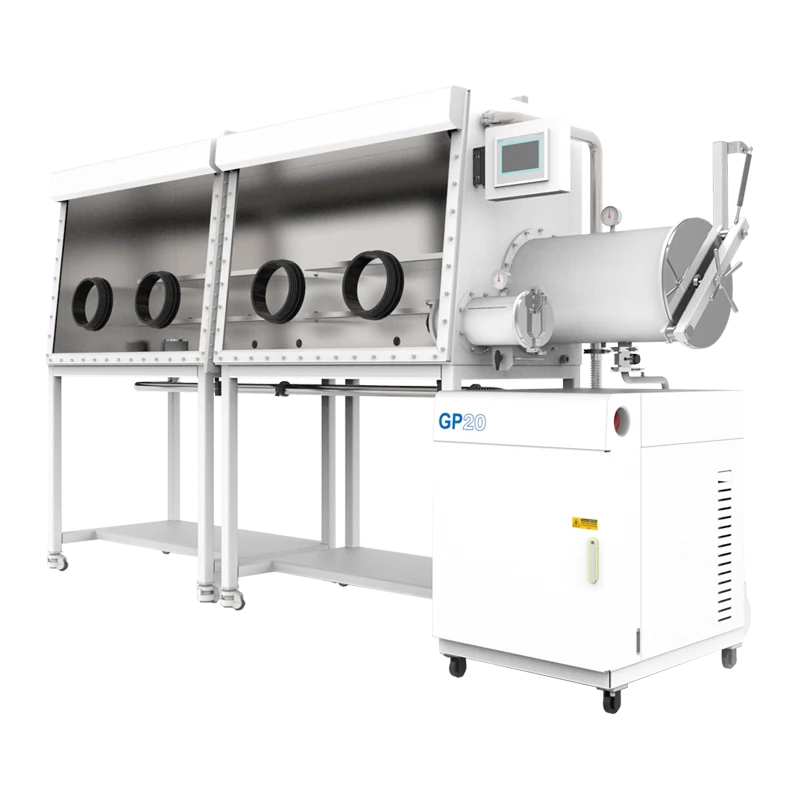
- With gas purification system means a regenerable purifier is plumbed to the box as a closed loop, not used as a one-time purge. The purifier holds the purification media and the circulation hardware; the box holds the working volume; the loop moves gas between the two.
A common misunderstanding is that any sealed box with gloves will behave like this one. It will not. A vacuum glove box relies on a sealed chamber, evacuation, and inert-gas backfill to establish a controlled environment; it may have no continuous purification circuit at all, and it should not be assumed to hold the same atmosphere over hours of work. If a process only needs a short transfer under nitrogen, that is a different class of equipment. If it needs a stable, continuously monitored atmosphere over a full working day, the closed-loop purification architecture is the one that matters. The configuration shown on the two-station single-sided split-type purification glove box page is an example of that class.
What Does It Do and How Does It Work?
The machine does two separate jobs, and they should not be confused with each other. The enclosure keeps the outside air out; the purification loop keeps the inside gas clean.
The working space and the two stations
The box is a rigid, gas-tight volume with a transparent front window, two glove ports, and a transfer path. Its interior is filled with a working gas — normally nitrogen or argon — at a slight positive pressure relative to the room, so that any leakage flows outward rather than inward. The two stations share that volume, which is an advantage when a process has two roles: one person dispenses and weighs a moisture-sensitive powder, the other positions and seals a cell, without a sample crossing an air gap between them. It is also a constraint worth recognizing: two operators share the same atmosphere, the same solvent load, and the same purge capacity, so a process that releases substantial solvent vapor at one station affects both.
The purification loop
Gas leaves the box, passes through a circulation blower, then through a purifying column, and returns to the box. The column contains media chosen for the two contaminants that matter most: a catalyst bed that reacts with oxygen and binds it, and an adsorbent bed such as a molecular sieve that takes up water. Because the loop is continuous rather than batch, it can keep working while the box is in use, slowly removing the moisture and oxygen that enter through glove changes, transfers, and micro-leaks. The media eventually saturate and must be regenerated or replaced according to the manufacturer's procedure; the exact regeneration conditions, gas mixtures, and temperatures belong in the equipment manual for the specific model, not in a general article. What matters at the selection stage is that purification is a maintenance commitment, not a permanent property of the hardware.
The split frame and the transfer path
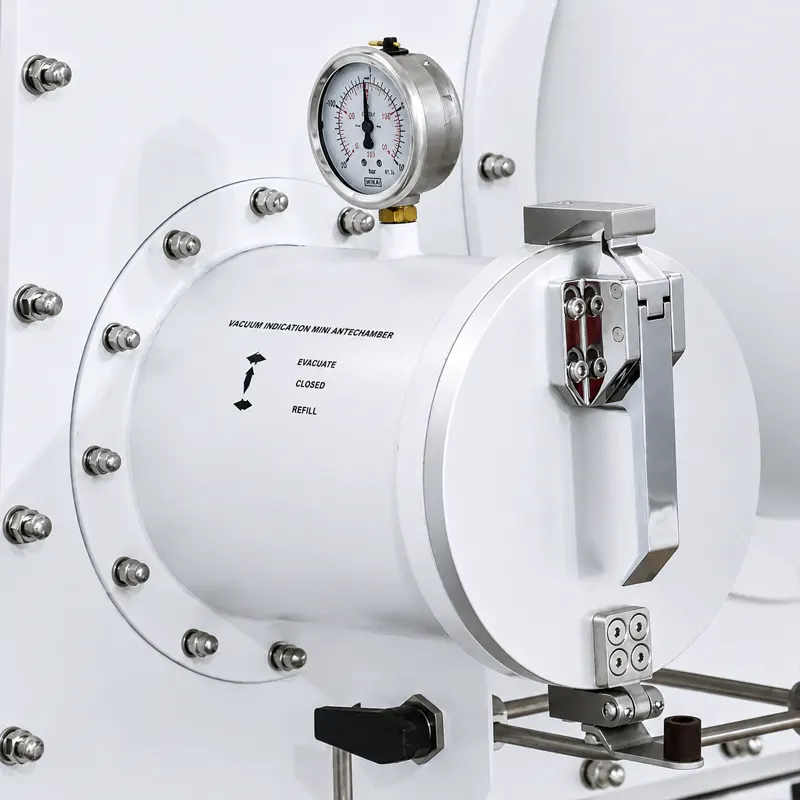
The split construction affects how the box behaves mechanically as well as how it ships. Each section has its own sealing face and its own structural stiffness, and the assembled box has to be leveled and supported so that the joint is not stressed. The transfer path — usually an antechamber with an inner and outer door — is the single most frequently used opening in the machine, and it is where most moisture actually enters during a working day. Every sample, tool, and consumable that goes in through that door brings adsorbed water and air with it.
Which Configurations Matter?
Within this family of equipment, a few choices change the daily experience far more than others.
Number of stations and which side they are on
A single-sided box puts all glove ports on one face. That suits a bench-length footprint against a wall, and it keeps both operators facing the same direction with the same view. A multi-station or double-sided arrangement puts ports on two opposing faces, which is useful when a process needs two people working simultaneously on opposite sides — for example, holding a substrate while another person seals it. The trade-off is floor space and the need to leave access on two sides of the machine.
Transfer volume and antechamber sizing
The antechamber is where the practical limits of a two-station box appear. If the chamber is small, it will cycle quickly and consume little gas, but it will not accept a large fixture, a cell stack, or a rack of substrates. If it is oversized for the parts actually used, each transfer costs more purge gas and time than necessary. A small glove box antechamber addresses the frequent-transfer case: it is intended for small samples and tools that pass in and out many times per day, so the main chamber does not have to be opened or cycled for every minor item. Compatibility depends on the port or flange geometry of the specific box, so the interface must be confirmed against the enclosure it will be fitted to rather than assumed.
Space, fixtures, and feedthroughs
Internal volume is often chosen for the process, not for the samples. A spin coater, a hot plate, a balance, or a small press all occupy the working volume and change how much room remains at each station. Electrical and signal feedthroughs, gas lines, and vacuum ports generally belong on the non-glove face, which is another reason to decide the fixture list before the enclosure layout.
Which Specifications Should You Check?
Atmosphere performance and the conditions attached to it
Oxygen and moisture figures are usually quoted as values the system can reach, and sometimes as values it can maintain. They are not the same statement. A reachable figure typically assumes a sealed, leak-checked box, freshly regenerated media, and an empty or lightly loaded chamber. A maintained figure under a real workload — with gloves, samples, solvent, and repeated transfers — will be higher. Ask which condition the number describes, and whether the box was monitored with calibrated instruments. Also keep resolution and accuracy apart: a sensor may display to a fine resolution without being accurate to that resolution, and both depend on calibration.
Leak rate, working pressure, and antechamber vacuum
These are three different quantities. Leak rate describes how fast the enclosure gains contamination through seals, welds, gloves, and fittings. Working pressure describes the small positive pressure the box is held at during operation. Antechamber vacuum describes how far the transfer chamber is evacuated during a cycle, which is set by the chamber, the pump, and the plumbing — not by the purification system. None of them can be substituted for another, and a strong antechamber vacuum says nothing about how low the main chamber's oxygen level will go.
Purification capacity relative to the box
A purifier has to handle the volume of the box, the leakage rate, and the contamination introduced per transfer. Two glove stations and a large antechamber increase the amount of air exchanged per working day. The relevant questions are how much media the column holds, how often regeneration is expected under your usage pattern, and how the box is monitored between regenerations.
Where Is It Suitable, and What Are Its Limits?
A two-station single-sided purification box fits laboratory work where a small team handles air-sensitive materials at a bench scale on a routine basis. Typical settings include lithium metal and solid-state battery research, where lithium foil and sulfide or oxide electrolytes react with moisture; perovskite and OLED material preparation, where precursor and thin-film quality depend on excluding water and oxygen; semiconductor and thin-film process development; air-sensitive organometallic and catalyst chemistry; and general advanced-materials work such as handling reactive powders, or preparing and post-processing metal powders used in additive manufacturing.
The limits are as important as the applications. Inert atmosphere control is not sterility, not a cleanroom classification, not biosafety containment, and not certification for hazardous materials. Removing oxygen and water does not remove particles, and a particle filter does not remove oxygen or water — those are separate functions that require separate hardware. Solvent vapor management is a third, separate problem: an adsorbent for organic vapors reduces the solvent load on the purification media, but it does not replace moisture and oxygen removal, and a box handling large volumes of solvent needs a design that accounts for it. Finally, no single working gas is inert toward every sample; argon and nitrogen differ in density, cost, and reactivity, and the choice should follow the chemistry rather than habit.
How Should You Select and Integrate It?
Work backward from the process. List every material that must be handled inside, its sensitivity, and how long it stays exposed. Then list the equipment that has to live in the box, because fixtures determine the internal volume. Then estimate transfers per day and the largest item that must pass through the antechamber, because that sets the transfer chamber size and the gas cost of each cycle.
Next, check the physical facts of the installation: door width and corridor turns for the split sections, floor area on the accessible side of the box, height for anything mounted above the enclosure, and service access for the purifier and the pump. Confirm how the box will be monitored, how the media will be regenerated, and which spare parts — gloves, seals, filters — will be stocked. Ask the supplier to state clearly which figures are reachable and which are maintained, and under what conditions. The two-station split-type purification glove box is a useful reference point for how these elements are combined, but the right configuration still depends on the sample, the fixture list, and the room it has to fit into.
Questions That Come Up Often
Does the purification system keep the atmosphere clean on its own?
No. It is one part of a system. The enclosure must be sealed and leak-checked, the transfer chamber must be cycled correctly, the gloves must be intact, and the media must be within their working life. A purifier cannot compensate for a leaking seal or a glove with a pinhole.
Can a small antechamber be added to a box later?
Sometimes, if the enclosure has a suitable port or flange and the manufacturer supports the addition. It depends on the specific box: the interface geometry, the structural reinforcement at the opening, and the gas and vacuum connections. This has to be verified against the actual enclosure rather than assumed from a general product family.
Is a particle filter a substitute for gas purification?
No. A HEPA filter traps particulate matter. It does not adsorb water vapor and does not remove oxygen. If a process generates dust, both functions may be needed, but they are handled by different components.
When is the split-type version the right choice?
When the assembled box cannot reach the installation room or when the room cannot be emptied of furniture during installation. In a laboratory with a wide service entrance, a monoblock enclosure avoids the extra sealing interface. Where corridors, lifts, or door frames are the binding constraint, the split construction is what makes the installation possible at all.
What should be confirmed before ordering?
The gas to be used, the fixture list and their power or signal requirements, the volume and weight of the largest item to be transferred, the expected number of transfers per day, the solvent load, the monitoring instruments, and the maintenance plan for purification media and gloves. These answers determine most of the configuration, and they are the questions a supplier should be able to walk through with you.
