
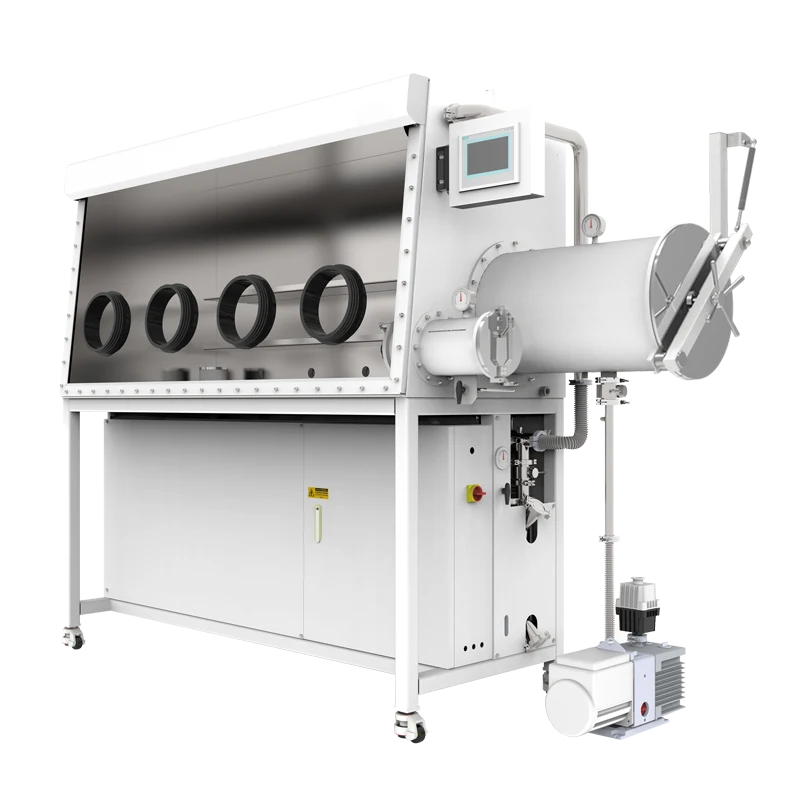
A two-station single-sided glove box with a gas purification system is a sealed working enclosure with two glove ports on one operator side, combined with a purification unit that continuously circulates and cleans the internal atmosphere. The enclosure and the purification loop are engineered as one system, so oxygen and moisture that enter through gloves, transfers, or small leaks are removed continuously rather than diluted once at start-up. For a materials engineer handling lithium metal, solid-state electrolyte precursors, perovskite inks, or air-sensitive catalysts, that difference decides whether a sample survives a working day or degrades while it is still being prepared.
What the System Actually Does
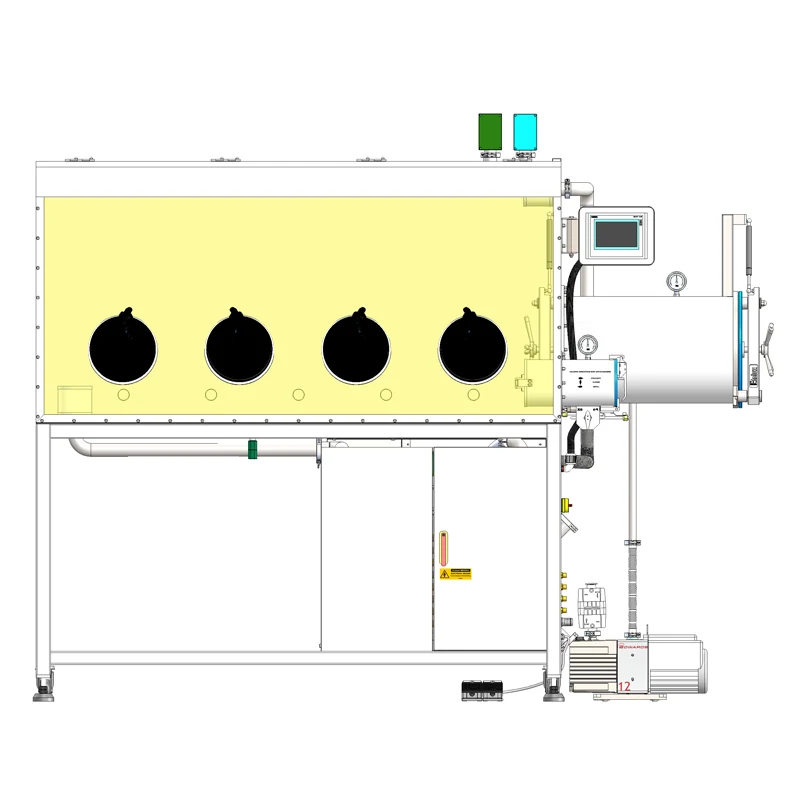
Inside the enclosure, the box holds a working volume at a slight positive pressure relative to the room, so any leakage tends to flow outward instead of pulling laboratory air in. The purification loop takes gas from the enclosure, passes it through purification columns that adsorb moisture and chemically bind oxygen, and returns it to the box. Monitoring instruments read the oxygen and moisture content, and the controller decides when the atmosphere has drifted far enough to require regeneration of the columns. The two glove ports give the operator direct manual access, while an antechamber (transfer chamber) lets samples, tools, and small instruments enter and exit without opening the main chamber to the room.
The decisive word in the product name is purification. A sealed enclosure with a gas inlet can be purged with nitrogen or argon, but its atmosphere degrades with every transfer and every minute of use. A purification box closes the loop: the same working gas is cleaned and reused, which is why it can hold a demanding atmosphere over long experiments instead of only at the moment of filling.
Working gas, control gas, and regeneration gas
It helps to separate three gas roles that are easy to confuse. The working gas is the nitrogen or argon filling the enclosure and circulating through the columns; its quality is what the analyzers report. Control gas operates valves, pneumatic actuators, or parts of the regeneration sequence — it does not become part of the box atmosphere. Regeneration gas is the reducing mixture used periodically to restore the oxygen-removal catalyst; it flows during a dedicated cycle and is exhausted, not circulated into the working space.
Mixing these roles up produces bad assumptions about gas supply, consumption, and safety planning — for example, plumbing a pneumatic valve circuit from the wrong supply, or expecting the box atmosphere to improve while a regeneration cycle is running. When reviewing a quote, ask which gas feeds which circuit, and which one your facility must provide.
How Closed-Loop Purification Works
Circulation is the backbone of the system. A blower draws gas from the enclosure, pushes it through the purification column, and returns it to the box, usually with the return path arranged so that clean gas reaches the working area rather than short-circuiting back to the outlet. Analyzers sample this stream, and the reading they produce is only meaningful if the sampling point and the circulation rate are consistent. A slow loop with a large box means a long recovery time after each transfer, even if the steady-state figure looks impressive.
Moisture removal and oxygen removal are different jobs
Columns in this class of equipment typically combine two functions: a regenerable desiccant or molecular sieve that captures water, and a copper-based catalyst that converts oxygen into a removable compound. Because the two media work by different mechanisms, their service lives and regeneration conditions differ as well. Particle filtration is a third, unrelated function — a HEPA filter removes particulates from the circulating gas and does nothing for water or oxygen. Solvent adsorption is a fourth: it protects the column media from organic vapors but cannot substitute for water and oxygen removal.
Regeneration is not a purge
Regeneration restores the purification media after they have loaded up; purging replaces the box atmosphere with inert gas. Neither replaces the other. A box that has just been opened to the room needs a purge phase first, because the purification loop is not sized to clear a full air volume quickly. A box that has been running for months needs regeneration, because the media have absorbed their practical capacity even though the enclosure was never opened. Confusing the two leads to slow atmosphere recovery and premature column replacement.
Two Stations on One Side: What the Configuration Changes
The configuration described here places two glove ports on a single operator face. That geometry is chosen as much for the experiment as for the person: two-handed manipulation of a substrate, handing a tool from one port to the other, staging a sample while a second operation continues, or simply giving a colleague access at the same face. It is not the same as a double-sided enclosure, where operators or equipment can work from opposite faces and the interior can be laid out with separate clean and dirty zones.
Working space and what it constrains
The internal volume sets what you can do at once: a spin-coater, a small furnace, a balance, or a microscope stage each consumes working depth and height, and the two ports must still reach every part of the layout. When comparing two-station boxes, compare usable depth, the height above the work surface, and the position of the antechamber door — not just the overall footprint. A slightly larger box that lets you place the antechamber away from the working zone often outperforms a smaller one on real throughput.
Transfer through the antechamber
The antechamber is the main interface between the laboratory and the controlled atmosphere, and it is where most contamination enters. Its volume, door design, and evacuation capability determine how quickly a sample can be moved in without dragging air along with it. Vacuum-rated antechambers allow repeated evacuation and refill cycles; simple pass-through chambers rely on gas exchange alone. What matters in practice is the cycle time you can tolerate per transfer, because that figure multiplies across every sample in a project.
Specifications Worth Checking Before You Compare Configurations
Atmosphere figures and their conditions
Oxygen and moisture values are the headline numbers, but they are only useful with their conditions attached: whether the figure is a steady-state value under normal operation or an optimized best case, what load was inside the box, how many transfers occurred, and which working gas was used. A value quoted for an empty box at rest tells you little about behavior during an active experiment. When a supplier publishes a single number without context, treat it as a starting point for discussion rather than a guarantee.
Pressure, vacuum, and leak rate are separate metrics
Box working pressure, antechamber vacuum level, pump ultimate vacuum, leak rate, and oxygen/moisture content describe different physical properties. Keep their units and their subjects intact. A tight enclosure with a modest pump can still reach a good antechamber vacuum slowly; a fast pump on a leaky enclosure will not hold atmosphere. If a datasheet mixes these categories, or a figure looks like a unit conversion error, the sensible response is to omit it and confirm the measurement conditions with the supplier before relying on it.
Purification capacity and circulation
Column capacity, nominal circulation flow, and regeneration interval together determine recovery speed after a transfer and how often the system interrupts work for maintenance. A box used for occasional sample inspection has different demands from one running continuous coating or cell assembly. Ask how the regeneration cycle is triggered — by time, by accumulated load, or by analyzer reading — and how long the box is unavailable during that cycle.
Instrumentation and access ports
For analyzers, distinguish range, resolution, accuracy, and calibration interval; a fine resolution does not imply a fine accuracy, and an uncalibrated sensor can be precise and wrong. For feedthroughs, electrical and signal connectors, and KF interfaces, the deciding factors are connection type, sealing method, and whether the added device interferes with circulation or pressure control. It is also worth confirming how many spare ports the enclosure provides, because instrumentation needs tend to grow after installation.
Where This Configuration Suits, and Where It Does Not
A two-station, single-sided purification box fits work that needs continuous inert protection with one or two operators and moderate sample throughput: lithium and solid-state battery materials, perovskite and OLED device fabrication, semiconductor and thin-film processing, air-sensitive organic and organometallic chemistry, advanced materials research, and post-processing of additively manufactured parts that react with air. It also suits laboratories that must keep several people working at one controlled station rather than spreading samples across several small enclosures.
Its limits are equally concrete. An inert atmosphere is not a sterile environment, a cleanroom classification, a biosafety barrier, or a hazardous-material containment certification — those require different design, validation, and documentation. Not every gas is inert toward every sample, and residual oxygen or moisture at any practical level may still be enough to affect the most sensitive chemistries. Volatile solvents, high heat loads, and aggressive reagents inside the box load the purification media faster and may require dedicated adsorption or filtration. Large equipment will not pass through the antechamber, and a vacuum-only enclosure without a purification loop is a different product category with a different performance envelope.
Accessories That Keep the System Working
Accessories matter because the enclosure is only as good as its weakest interface. Gloves are selected on size, material, thickness, and permeation behavior against the solvents and reagents in use. Feedthroughs must match the cable or tubing and hold their seal. HEPA filtration addresses particles, solvent traps address organic vapor, and analyzers report the atmosphere rather than improve it. A pump must be matched to the gas and to the load it will see, not just to a vacuum figure on a specification line.
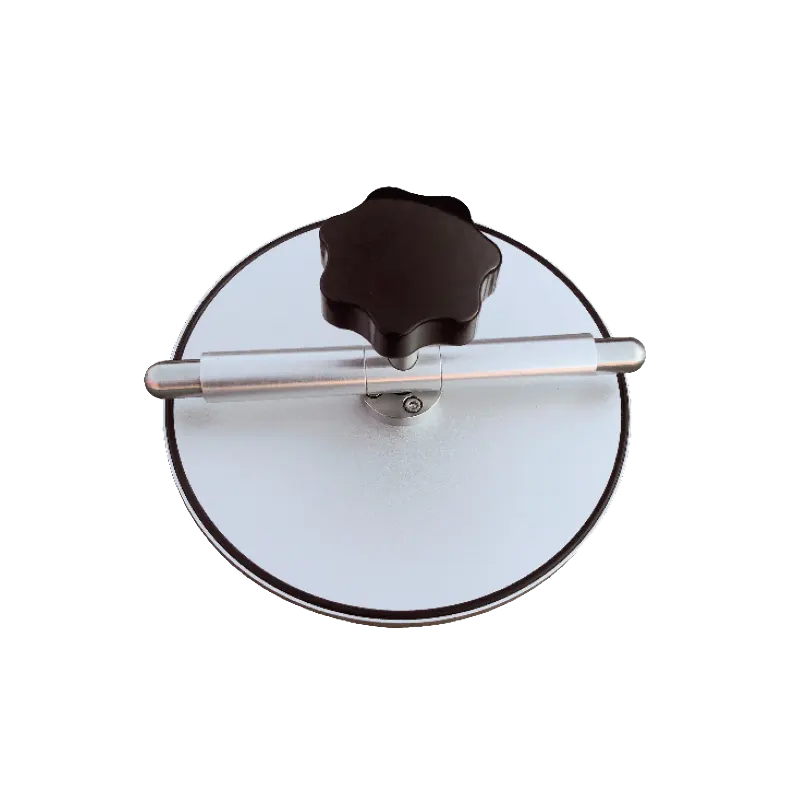
The Glove Box Port Cover is a small accessory with a narrow, clear job: it blanks off a glove port when no glove is mounted, or protects the port flange while gloves are being replaced. Because a glove port is a direct opening into the enclosure, an uncovered port is a leak path no matter how capable the purification loop is. When specifying one, check the flange diameter and mounting method so that it actually seats on your port geometry, and check material compatibility with the cleaning agents used in and around the box.
How to Select and Integrate the System
Start from the process, not the enclosure. Define the working gas, the maximum acceptable oxygen and moisture levels for your most sensitive step, the number of transfers per day, and the largest object that must enter the box. Those four answers determine antechamber volume, purification capacity, circulation rate, and working space. Then confirm the facility side: which gases are available at what purity, how much exhaust capacity exists for the regeneration cycle, and where the box will sit relative to vibration-sensitive instruments.
Finally, ask for the conditions attached to every performance figure, request the measurement method for oxygen and moisture, clarify which items are integrated and which are supplied separately, and check that any accessory you plan to add has a matching interface on the enclosure. A glove box is a long-lived platform; the choices that are hardest to change later are the working volume, the port layout, and the size of the purification system.
Full configuration details for the equipment discussed here are available on the Two-Station Single-Sided Glove Box with Gas Purification System product page.
Frequently Asked Questions
Does a two-station box always include gas purification?
No. Enclosures are built both with and without a purification loop, and the presence of two glove ports says nothing about the atmosphere system. Confirm that the configuration you are ordering explicitly includes the purification unit, circulation blower, analyzers, and regeneration function.
Can the purification loop clean the box quickly after it has been opened?
Recovery depends on how much air entered, the circulation rate, the condition of the purification media, and the load inside the box. A large ingress is normally handled by a purge phase followed by circulation, not by circulation alone.
Is the second glove port only for a second operator?
Not necessarily. It also supports two-handed manipulation across the working area, tool transfer between hands, sample staging, and glove maintenance. Whether two people can work productively at the same time depends on the working depth and how the load is arranged.
Do I need a port cover if gloves are always installed?
Not in normal operation. A cover becomes relevant when a glove is removed for replacement, when a port is deliberately left without a glove, or when a port must be blanked during maintenance so the enclosure stays sealed.
Can filters or traps be added after installation?
Often yes, but the result depends on whether the enclosure provides a suitable spare port and whether the added device affects circulation or pressure control. Confirm the interface and the effect on the loop with the supplier before ordering.
