
A six-glove double-sided glove box with a gas purification system is a sealed enclosure that gives operators working from opposite faces a single shared inert atmosphere, plus a closed-loop purifier that holds that atmosphere in place instead of letting it drift back toward lab air. The enclosure defines the working volume and the access points. The purification loop — blower, adsorbent columns, sensors and the plumbing that connects them — defines how stable the water and oxygen levels stay while work is going on. The two halves cannot be specified in isolation, because a six-port box moves a large volume of gas and the purifier has to be sized for that volume.
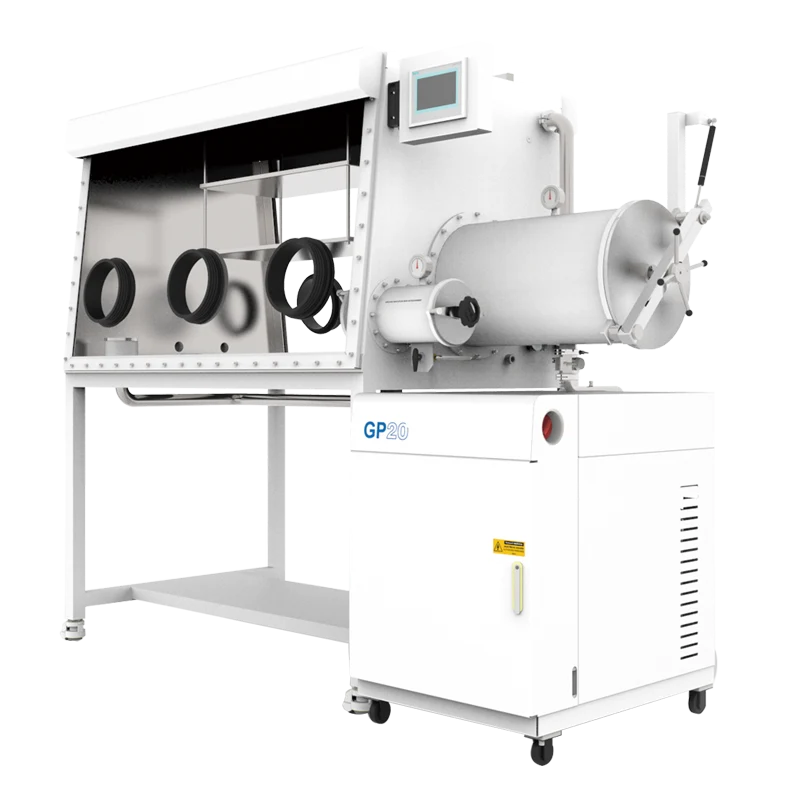
What Does a Six-Glove Double-Sided Glove Box Do?
Its job is to keep a sample, a device or a process in an atmosphere you choose rather than the one the room happens to have. Moisture and oxygen are the usual targets, but the same enclosure can also be used to exclude nitrogen-sensitive species, manage solvent vapour, or simply keep airborne contamination away from a surface. The double-sided layout adds a second working face, so two people can handle the same batch, pass samples across the interior without opening the box, or work independently at two stations that share one atmosphere. That shared atmosphere is the whole point — and also the main constraint, because anything one operator does, from opening an inner door to heating a sample that outgasses, is felt at the other face.
The enclosure: fixed volume, two working faces, one atmosphere
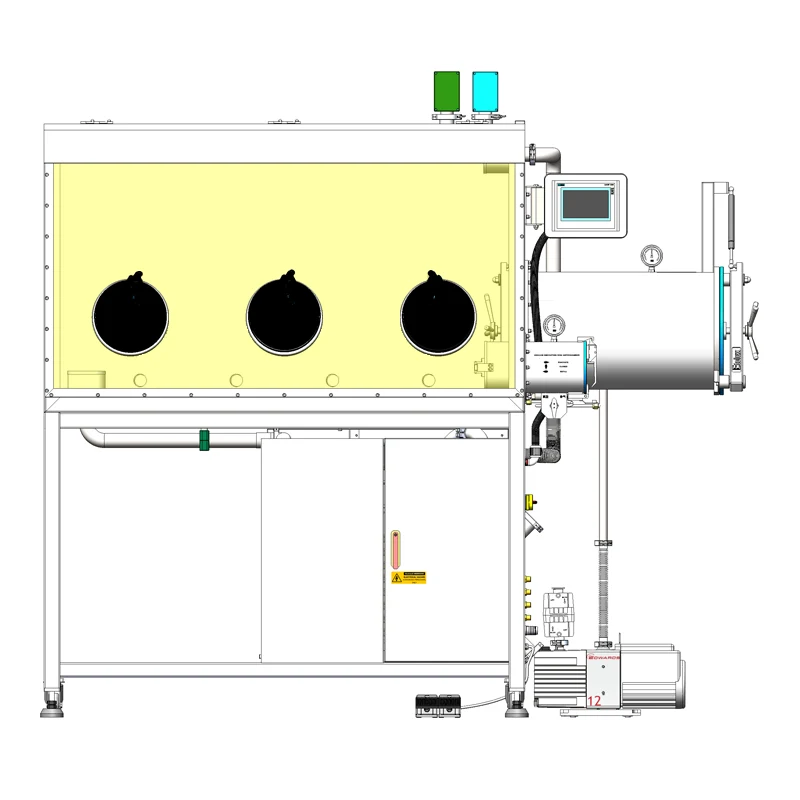
Six glove ports arranged as three on each long face produce two work positions with a shared central zone between them. Port diameter, spacing between ports and the height of the viewing panel determine what an operator can reach and how large an object can be manipulated. A box with six ports and a generous internal height can host a small furnace, a coating jig or an analytical instrument inside the atmosphere. A box with the same port count but a shallow interior cannot, no matter how capable its purifier is. When reading a specification, treat internal dimensions and port layout as the primary numbers and the atmosphere figures as conditional on them.
The purification loop: circulation, adsorption, regeneration
In a gas-purification glove box, the atmosphere is never static. A blower draws gas out of the enclosure, pushes it through a purifier column packed with material that takes up water and oxygen, and returns it to the box. Sensors sample the returning stream so the control system can judge whether the bed is still working. Because the loop is closed, the box is not consuming a continuous flow of fresh inert gas; it is cleaning the gas it already holds, which is what makes sustained low water and oxygen levels possible at all. The column eventually saturates and is restored by regeneration: taken offline, heated so captured moisture and oxygen are driven off, swept out with a regeneration gas, then cooled before it returns to service. Regeneration is a scheduled event, not a continuous process, and the gas used for it is not the same as the working gas inside the box.
Which Configurations Matter?
Configurations differ in ways that affect daily use far more than the model number suggests. Three variables usually decide it.
Number of glove ports and operator positions
Port count sets how many hands can be inside at once. Ports can also be blanked or fitted with different glove materials, so six ports does not have to mean six simultaneous users — it can mean four gloves in active use and two ports reserved for a feedthrough or an instrument interface. Check whether the ports sit on a flat or curved panel, whether gloves can be changed without breaking the seal, and whether the panel itself can be replaced if the layout turns out to be wrong.
Single-sided versus double-sided
A single-sided box gives one working face and is easier to place against a wall. A double-sided box needs access from both sides, which costs floor space and changes how the room is organised, but it enables two-person handling of long or heavy items, transfer between operators without an airlock cycle, and a natural split between a preparation face and an assembly face. Choose double-sided when the workflow genuinely involves two people or two stages; choose single-sided when it does not, since the second face is otherwise just extra surface area and extra glove ports to maintain.
Integrated versus split design
The purifier can sit under the box, beside it, or in a separate cabinet connected by ducting. Underslung units save floor space but complicate service access. Separate cabinets are easier to maintain and can in principle be shared, but longer circulation paths add joints and surface area where small leaks matter. A split arrangement is also relevant when the box must sit inside a fume hood or a restricted area that the purifier cannot share.
Which Specifications Should You Check?
Specification sheets for this class of equipment mix several different physical quantities. Sorting them before comparing anything prevents most of the confusion.
Working volume, port layout and ergonomics
Start with internal dimensions, usable volume above the floor plate, port diameter and spacing, and the position of any internal shelf or rail. Then ask where instruments would go and how cables would reach them. A box that meets an atmosphere target but cannot fit the furnace or the spin coater you plan to install inside it has solved the wrong problem. Operators also notice reaching distance: a deep box with ports near the front edge forces a stretch that becomes tiring across a long session.
Atmosphere performance: water and oxygen
The useful questions are not only "what value" but "under what conditions". Ask whether a stated water or oxygen figure was reached in an empty box at steady state with the circulator running, whether it is a point the system achieved once or a window it holds during operation, and how quickly it recovers after a transfer or after the box is opened. Leak rate, purifier bed capacity and regeneration interval are the three numbers that determine whether low figures are sustainable. A sensor's resolution is not the same thing as its accuracy, so a display reading to one decimal place is not evidence of a tight atmosphere. Where a value is ambiguous, or appears to mix units, leave it out of your comparison and ask the supplier to confirm the conditions instead.
Working gas, control gas and regeneration gas
Three gas roles are usually named on a purified system and they should not be confused. The working gas is the inert atmosphere inside the box. Control gas may drive pneumatic valves and pressurise parts of the loop. Regeneration gas is the stream that sweeps the purifier column during regeneration, and its composition is set by the adsorbent and the manufacturer's procedure — never assume one supply setting serves all three roles. The supply itself also has to be reasonably dry and low in oxygen before it enters the system, because a purifier is a polishing stage, not a bulk drying plant.
Transfer, sealing and pressure ratings
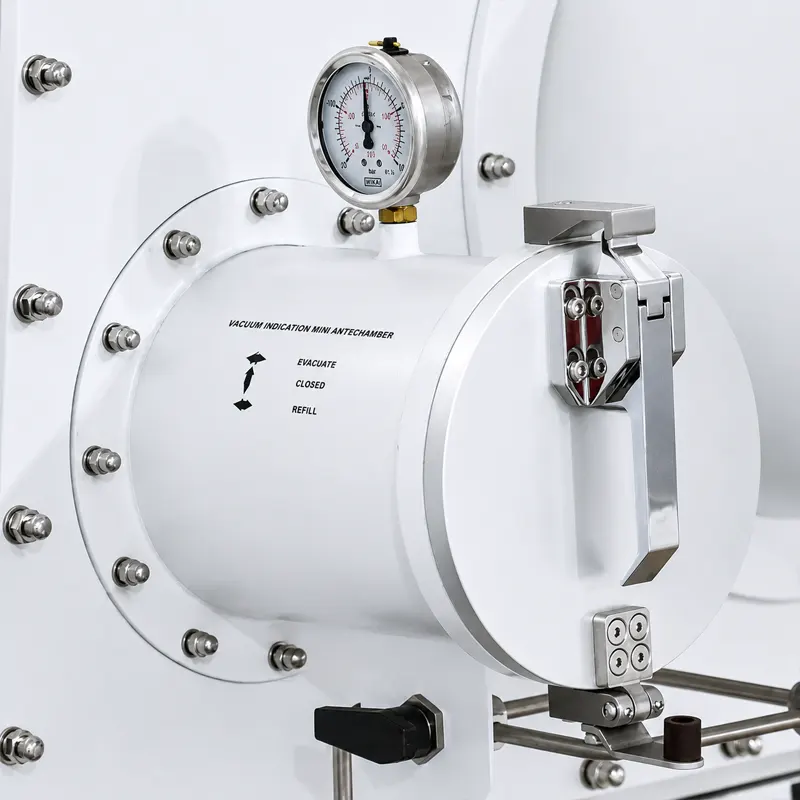
Transfer is where most atmosphere is lost. An antechamber, sometimes called a transfer lock or airlock, has a small internal volume, two doors and a port for evacuating and refilling with working gas; items cycle through it instead of through the main gloves. Its volume, door size, flange geometry and vacuum rating all have to match the box it serves. Note that several different pressures are routinely quoted on this equipment — box working pressure and its differential limits, antechamber vacuum, and pump ultimate vacuum — and they are not interchangeable. The same applies to leak rate, water content and oxygen content: three separate measurements, each with its own units and test conditions.
Where Is It Suitable, and Where Are the Limits?
The applications that justify a large, six-port, purifier-backed enclosure are those where the material cannot tolerate room air for more than a few seconds and where the handling step itself is complex: lithium metal and solid-state battery assembly, perovskite and OLED layer work, semiconductor process development, air- and moisture-sensitive organometallic or catalyst chemistry, additive manufacturing powder handling and post-processing, and general research on oxygen-sensitive surfaces. In all of these, the value of the box is that it removes the atmosphere variable from the experiment.
The limits are just as specific. An inert atmosphere is not a sterile environment, and it is not a cleanroom classification, a biosafety barrier or a certified containment boundary for hazardous materials. Purging with an inert gas does not make every material inert: some samples react with nitrogen, some with the trace species that remain, and some need a different residual level than the box is set up to hold. Particle filtration in the loop, such as HEPA filtration, removes particulate contamination; it does not remove water or oxygen, and it does not remove solvent vapour. Solvent adsorption, where fitted, addresses organic vapour and does not substitute for water and oxygen removal. Keeping these functions separate in your own mind is the difference between a box that performs and a box that is blamed for the wrong failure.
Scale is another boundary. A six-glove box suits batch and prototype-level work where each item is handled and observed. It is not a production line, and processes that need continuous throughput, high-temperature processing inside the enclosure, or very frequent large-object transfers usually need a different architecture rather than more glove ports.
Common Questions About Purified Glove Boxes
Does a double-sided box always include gas purification?
No. "Double-sided" describes the enclosure layout. Purification is a separate capability provided by the purifier, blower, sensors and control system, and enclosures exist in configurations without a continuous purification loop. When a product is described as a glove box with a gas purification system, the two elements are being offered together, and both should appear in the specification.
Can the box reduce water and oxygen by itself?
Only within limits. Sealing the box slows the ingress of moisture and oxygen, and a purge with inert gas displaces the initial air, but a stable low-level atmosphere over hours and days comes from continuous circulation through an active purifier bed. Purge, evacuation and circulation are three different processes with three different effects.
How do I judge whether an antechamber is compatible?
Match the mechanical interface first: flange pattern, port diameter, bolt spacing and door swing. Then check the vacuum rating against the pump you intend to use, and the internal volume against the largest item you expect to transfer. An antechamber that fits the flange but is too small for the sample, or too large for the pump, will slow every transfer for the life of the box.
When do accessories become necessary rather than optional?
Accessories follow the workflow. Electrical or signal feedthroughs are needed as soon as an instrument inside the box has to communicate with a controller outside it. A water or oxygen analyser is needed when you want to know the state of the atmosphere continuously rather than trust a schedule. Extra glove ports, a vacuum pump matched to the antechamber volume, or a solvent adsorber are decisions driven by what the box is doing, not by a general wish to add equipment. Each accessory has its own selection criteria: an analyser is chosen on range, resolution, accuracy and calibration practice; a pump on compatibility with the gas and the load; a feedthrough on connection type and sealing.
How Should You Select and Integrate the System?
Work from the process outward. Define what has to be manipulated, at what residual moisture and oxygen level, for how long, and how often it enters and leaves. That determines internal volume, port layout, transfer strategy and purifier capacity, in that order. Then check the practical constraints: floor space for both faces of a double-sided box, service access to the purifier, the room's own humidity and temperature, and whether the regeneration exhaust can be vented properly.
Integration is mostly about transfer discipline. Most of the water and oxygen that enters a working box arrives with the items themselves and with the gas exchanged during entry, so an antechamber sized for a realistic batch — plus a purge-and-evacuate routine that is actually followed — does more for atmosphere stability than a larger purifier. A small glove box antechamber is one example of this category: a compact transfer lock whose value depends entirely on matching the box's flange, its volume requirements and the pump behind it. Before ordering any accessory, confirm interface dimensions, material compatibility with your solvents, and the level of documentation the supplier can provide for the specific unit.
For the main enclosure, request the conditions behind every atmosphere figure, the leak-test method, the regeneration procedure and the maintenance interval for gloves and seals. A six-glove double-sided glove box with gas purification system is a configuration choice as much as a performance claim. The real question is not whether the box can reach a number on a datasheet, but whether it holds the level your material needs while two people are working inside it. Choose the layout for the workflow, the purifier for the volume and the load, and the accessories for the operations you cannot avoid — then verify every interface before the system is built.
