
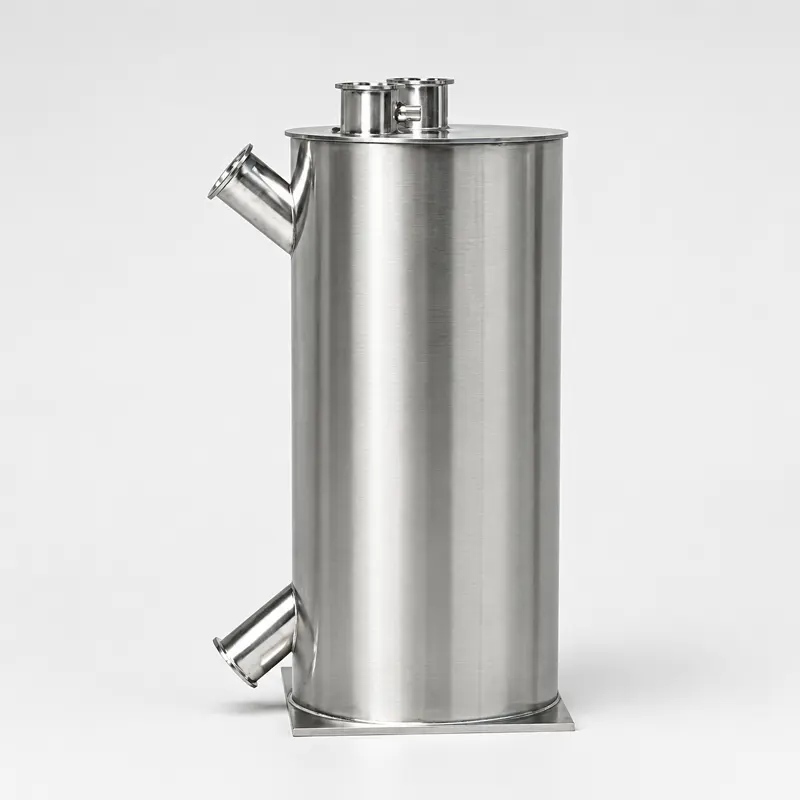
An organic solvent vapor adsorption system is a glove box accessory that captures organic solvent vapor from the circulating atmosphere before that vapor reaches the purification column, the water and oxygen analyzers, or the working space itself. It sits on the gas path — in-line with, or on a branch of, the box's circulation loop — and it addresses a specific conflict in daily laboratory work: many air-sensitive processes depend on organic solvents, yet the same solvents attack the materials that keep the atmosphere clean. The unit neither creates a controlled atmosphere nor removes water and oxygen on its own; it protects the components that do.
What Does an Organic Solvent Vapor Adsorption System Do?
Solvent vapor enters a glove box atmosphere whenever a researcher casts a film from a solvent blend, prepares an electrode coating or slurry, rinses a substrate, dries a sample, or simply stores an open solvent container inside the box or its antechamber. Once in the gas phase, those molecules travel with the circulating gas. They condense on cooler surfaces, adsorb onto gaskets and gloves, and — most consequentially — contact the media that are responsible for water and oxygen removal.
Purification media are selected for their affinity to water and oxygen, not for their tolerance of organic molecules. When solvent vapor reaches the column, it competes for active sites and can block, consume, or gradually degrade the working medium, depending on the chemistry involved. The practical symptoms are well known to glove box users: water and oxygen readings that no longer recover as expected after a session, shortened media life, and more frequent regeneration or replacement than the workload should justify. Solvent vapor also fogs viewing panels, deposits films on optical parts, and is absorbed by glove materials — a route to both shortened glove life and cross-contamination between experiments.
An adsorption unit interrupts that chain at the earliest practical point. Gas leaving the working space passes through an adsorbent bed, solvent molecules are retained on the surface of the medium, and the gas that continues toward the purifier carries a far smaller solvent load.
What the accessory protects in practice
- Purification media — the most expensive consumable in the loop, and the one whose performance determines the achievable atmosphere.
- Analyzers and sensors — water and oxygen measurements are only meaningful if the sensor itself is not being contaminated by condensed solvent.
- Windows, optics, and viewing panels — solvent films scatter light and are difficult to remove without abrasion.
- Gloves, seals, and tubing — elastomers swell and permeate; a solvent-laden atmosphere accelerates that process.
- Process reproducibility — a stable background atmosphere is a precondition for comparable results between runs.
How the Unit Works and Where It Sits in the Circulation Loop
The removal mechanism is adsorption rather than absorption: solvent molecules bind to the internal and external surface of a porous medium instead of dissolving into a liquid. Because the process is surface-based, capacity depends on the total surface area available, on the concentration of vapor reaching the bed, and on how strongly each solvent species competes for binding sites. Adsorption is exothermic and reversible in principle, which is why temperature and residence time matter as much as the mass of medium installed.
In a purified glove box, the circulation loop is a closed circuit: gas is drawn from the working space by a blower, pushed through the purifier column and particulate filtration, and returned to the box. A solvent adsorption unit is normally positioned on the upstream side of that circuit, so the gas meets the adsorbent before it meets the water and oxygen media. Some installations place the canister in a parallel branch controlled by valves, which allows the main loop to keep running while the canister is isolated. Which arrangement a given box supports depends on its piping, available connections, and control philosophy — it is not something to assume from a product photograph.
Why placement matters more than size
A large canister installed in the wrong position protects nothing. If the adsorption bed sits downstream of the purifier, the column has already seen the full solvent load. If it is installed without isolation valves, replacing saturated media means breaking the loop and exposing the box to the laboratory atmosphere. If the added pressure drop is not accounted for, circulation flow falls and the whole loop — purifier included — becomes less effective. Placement, valving, and flow resistance are therefore the first integration questions, not the last.
What adsorption does not do
Solvent removal is a separate function from particulate filtration, water removal, oxygen removal, and gas replacement. A HEPA filter retains particles and does nothing measurable to solvent vapor. A solvent adsorption bed does not dry the atmosphere or reduce oxygen, and it must never be presented as an alternative to the purification column. Nor is it a substitute for good solvent discipline: an open beaker of solvent left evaporating inside a small box can present a load that no accessory is designed to absorb continuously.
Which Configurations and Components Matter?
A single accessory type can be configured in several ways, and the differences are practical rather than cosmetic. The points below are the ones worth clarifying with the supplier before a unit is specified.
- In-line versus bypass installation — an in-line canister is simple and continuous; a bypass arrangement with isolation valves allows media exchange without opening the box to ambient air.
- Single versus dual canister — dual beds permit sequential use and replacement while the loop keeps running, at the cost of space and additional connections.
- Adsorbent type and quantity — different media favor different solvent classes. Many systems of this kind use high-surface-area carbonaceous adsorbents, but the actual medium and its installed mass for this model should be confirmed from the manufacturer's documentation rather than assumed.
- Connection standard — flange type and nominal size determine whether the unit can be tied into an existing loop without custom adapters.
- Regeneration or replacement provisions — some media can be regenerated with heat and a purge gas; others are exchanged as consumables. The two require very different maintenance routines and utilities.
- Monitoring — an indication of remaining capacity, or at minimum a documented change-out criterion, turns maintenance from guesswork into a schedule.
Which Specifications Should You Check Before Ordering?
Because the properties of this accessory are interface- and compatibility-driven, the specification review should focus on how it connects and what it will be exposed to — not on throughput figures borrowed from powder-processing equipment.
| Parameter | Why it matters | What to confirm |
|---|---|---|
| Connection type and size | Determines whether the unit can be integrated without adapters or new penetrations | Flange standard, nominal bore, and available ports on the box piping |
| Adsorbent medium and mass | Sets the working capacity and the solvent classes the bed can handle | Medium identity, installed quantity, and documented solvent compatibility |
| Design flow and pressure drop | An oversized pressure drop quietly reduces loop circulation | Rated flow range and expected resistance at the intended circulation rate |
| Materials of construction | Wetted parts and seals must survive the solvents actually used | Housing and seal materials, and any solvent class excluded by the supplier |
| Regeneration or exchange | Defines operating cost and downtime | Whether media are regenerable, and under what conditions |
| Leak integrity | The accessory becomes part of a closed loop; a leak is an atmosphere failure | Leak-test method and acceptable leakage rate for the assembled circuit |
| Monitoring or indication | Prevents using a saturated bed that has silently stopped working | Whether any indicator is supplied, and the recommended change-out criterion |
Where It Is Suitable — and Where Its Limits Lie
The accessory is relevant wherever organic solvents are handled inside a controlled atmosphere and the purification loop needs protection: solution-processed perovskite and OLED work, solvent-based precursor preparation, air-sensitive chemistry that uses anhydrous solvents, surface cleaning before deposition, and the handling of solvent-wet samples after processing. In each case the benefit is indirect but measurable — the purification column sees less contamination, and the atmosphere recovers more predictably after a solvent-heavy session.
The limits are equally concrete. The bed has a finite capacity determined by the mass of medium and the total solvent load; once saturated, it stops protecting anything and may, under changed conditions, release previously captured vapor. Water vapor competes with organic molecules for the same surface, so a humid laboratory or a poorly sealed antechamber shortens service life. Very volatile species and low-boiling solvents are harder to retain than heavier molecules. The unit offers no protection against toxic gas release, no fire or explosion mitigation, and no sterility or cleanroom classification; those are functions of ventilation, procedures, and the enclosure itself, not of an adsorbent canister. And an adsorbent bed that is saturated cannot be distinguished from a working one without monitoring — which is why a change-out criterion belongs in the specification, not in a folder.
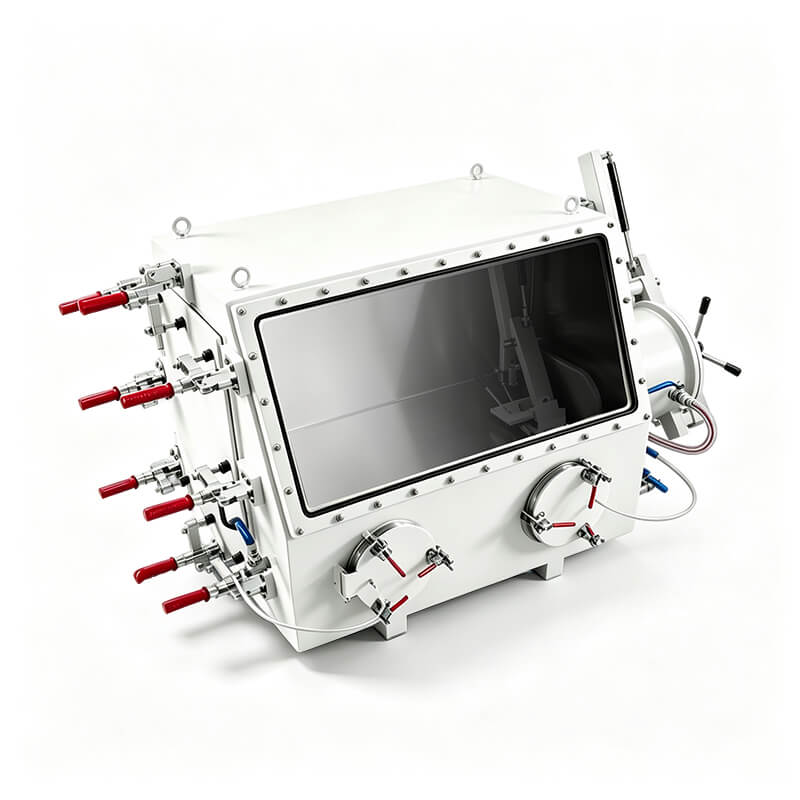
For systems whose atmosphere is established by sealing and vacuum–gas exchange rather than by continuous purification, the question is different again. A GBV-2 stainless steel vacuum glove box, for example, is built around a sealed chamber and repeated evacuation and inert gas backfill; whether a solvent adsorption unit can be applied to such a box depends on whether it has a compatible circulation path and ports. The two products should not be assumed compatible simply because both belong to the same family of equipment.
How to Select and Integrate the Unit
Start from the solvent inventory rather than from the box. List the solvents actually used, their approximate quantities per session, and how they are introduced — open vessel, syringe, sealed vial, or antechamber transfer. That inventory determines whether a single canister is proportionate or whether a dual-bed arrangement is worth the space.
Next, map the loop. Identify where gas leaves the working space, where the purifier sits, and which ports are free. Decide whether the unit will run in-line continuously or on a valved branch, and confirm that the added pressure drop is acceptable at the normal circulation setting. If the canister is to be exchanged without breaking the atmosphere, isolation valves on both sides are not optional.
Then agree on the maintenance contract with yourself: who checks the medium, against which criterion, and how spent media are handled. Finally, plan the commissioning sequence — leak test the assembled circuit, confirm circulation flow, and verify that water and oxygen recovery behaves as it did before the change. A full description of the accessory's intended installation is available on the organic solvent vapor adsorption system product page, and any figure that is not stated there should be requested in writing rather than inferred.
Frequently Asked Questions
Does the unit lower water and oxygen levels?
No. Water and oxygen removal is the job of the purification column. The adsorption unit reduces the solvent load reaching that column, which helps it perform as designed for longer, but it is not itself an atmosphere generator.
Can it be fitted to any glove box?
No. It requires a gas path, compatible ports, and space for the canister, and it must not compromise the sealing of the enclosure. Boxes built around vacuum and gas exchange without a circulation loop need a separate engineering assessment.
How do I know when the medium is saturated?
Look for the criterion supplied with the unit — an indicator, a documented service interval based on solvent load, or a trend in purifier performance. Rising water or oxygen recovery times after solvent work are a useful warning sign, but they are indirect evidence.
Does it replace a HEPA filter?
No. Particulate filtration and vapor adsorption address different contaminants and are normally used together, in the correct order, within the same loop.
Can I use it to vent large solvent volumes safely?
No. It is a protective accessory for normal laboratory solvent handling, not a ventilation or abatement device. Large evaporations belong in a fume hood, outside the glove box.
