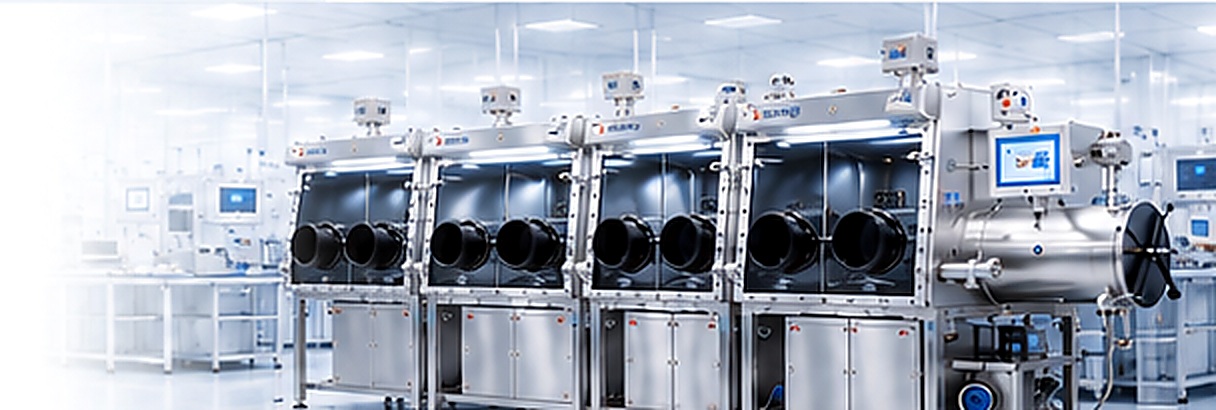
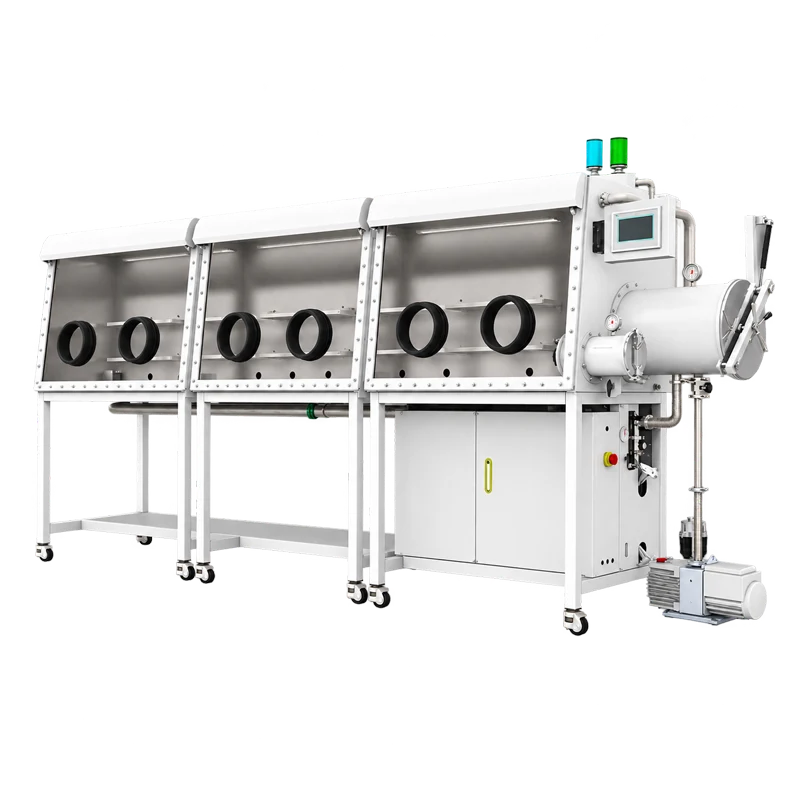
A three-station single-sided split-type glove box with gas purification system is an enclosed workstation with three glove-access positions along one operating face and a purification loop that circulates the internal atmosphere through media designed to remove moisture and oxygen. It sits between the operator and an air-sensitive sample, and between the sample and the room. Its purpose is to maintain a defined, monitored atmosphere during tasks such as weighing, mixing, assembly, testing, and transfer. The TENCAN three-station single-sided split-type purification glove box is one example of this configuration.
What does the system do and how does it work?
The cabinet is the first part of the system. A rigid enclosure, transparent viewing panel, glove ports, gloves, frame, and controls create a working volume that is isolated from the room. The atmosphere inside is not simply filled once and left alone. Samples, tools, gloves, and small leaks introduce moisture and oxygen, so the gas purification system has to keep correcting the atmosphere.
In a closed-loop purification design, a blower draws gas from the chamber, passes it through purification columns, and returns it to the chamber. One medium may adsorb water; another may remove oxygen by chemical reaction. Valves isolate the columns for regeneration, and a controller uses oxygen and moisture sensors to report the condition of the atmosphere. Working gas, control gas, and regeneration gas are separate functions and should not be treated as interchangeable. Regeneration restores the purification media; it is not the same as normal circulation, and it should follow the manufacturer's procedure rather than a generic sequence.
The three-station layout affects how the system is used. Three glove positions can support staged work, two operators, or one operator moving along a process. They do not create three independent atmospheres. All three stations share the same chamber gas, so a glove removed at one port, a solvent opened at another, or a large transfer at a third can affect the whole box. Single-sided access keeps operation on one face; the rear and side surfaces remain part of the sealed boundary and need service clearance. Split-type construction separates major assemblies so they can be transported and installed in parts. That is a layout and installation feature, not a performance rating. The joints, connections, and site assembly must still be leak-tested.
Which configurations and components matter?
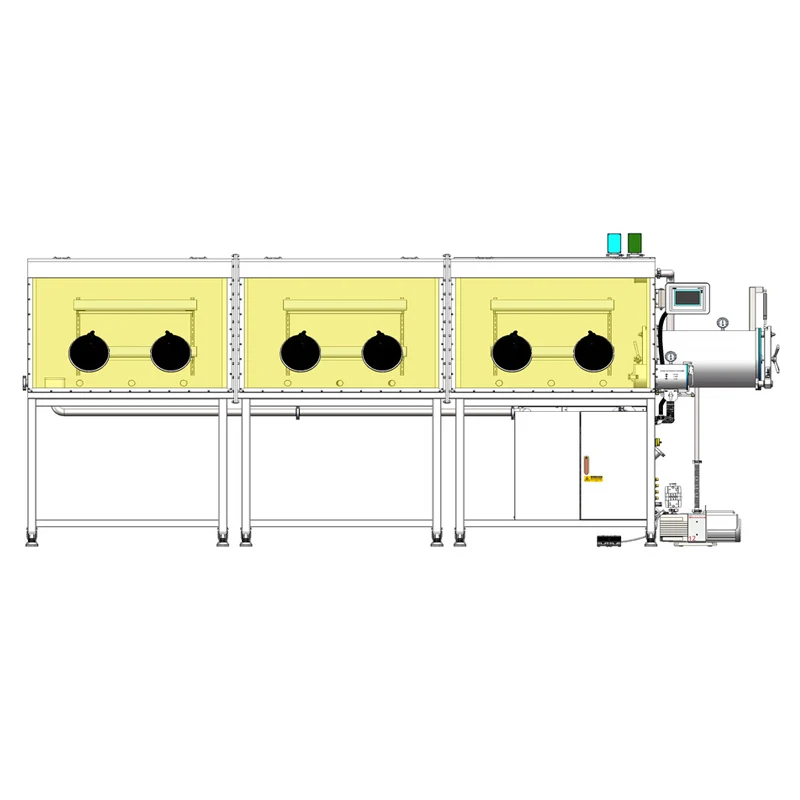
Three working stations on a single-sided cabinet
For a three-station box, check usable width, depth, height, port spacing, and glove length together. A cabinet can have three ports and still be uncomfortable if the working depth is too large for the operator's reach. If two people will work at the same time, confirm that the stations can be used simultaneously without crowding. Also confirm whether all three ports are intended for routine operation or whether one is mainly for service or transfer. The chamber atmosphere is shared, so the layout should separate clean assembly from solvent handling whenever possible.
Split-type construction
Split-type construction is useful when a full cabinet cannot pass through a doorway, lift, or corridor. It usually means the cabinet and purification or utility sections can be separated for shipping and reassembled on site. The important questions are what exactly is split, how the connections are sealed, whether the purge and sensor lines remain accessible, and who performs the final leak check. A split design that is difficult to align can create more sealing risk than a smaller one-piece box, so installation quality matters as much as the title.
Glove ports and gloves
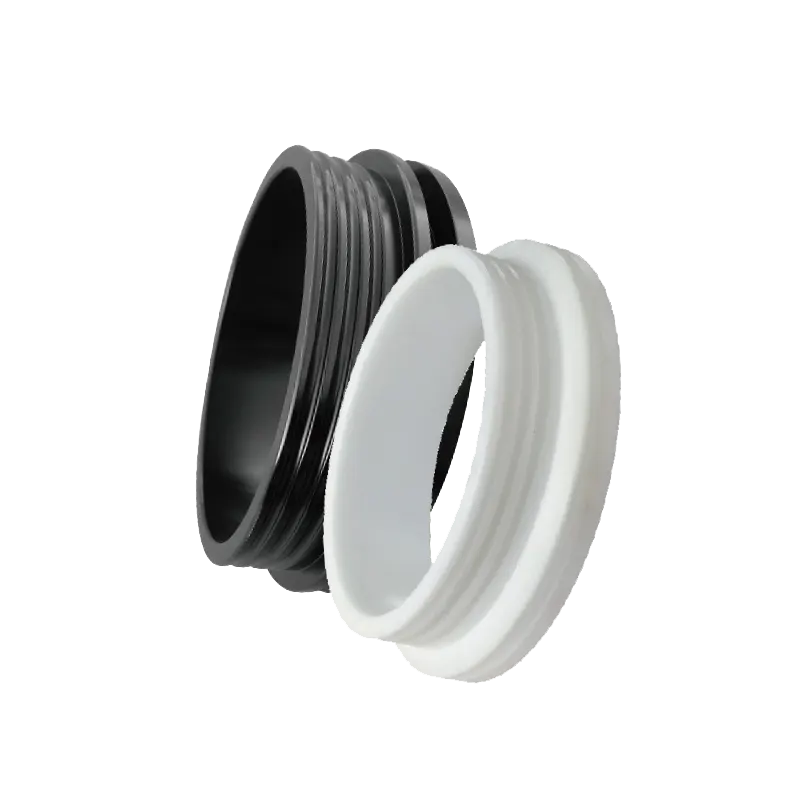
Each working station depends on a sealed glove port. The glove box glove port is the interface that holds the glove and seals the opening in the cabinet wall. It does not remove water or oxygen, and it cannot by itself maintain a low-moisture atmosphere. Port selection should match the cabinet wall, glove material, glove size, and chemical exposure. Check the mounting method, sealing arrangement, and replacement procedure. A glove that is too thick reduces feel; a glove that is incompatible with solvents can fail; a poorly fitted glove can leak at the cuff or restrict movement. The port and glove should be treated as a matched assembly.
Purification loop, controls, and monitoring
The purification system should be judged by capacity, redundancy, regeneration requirements, and the way performance is measured. Ask how many purification columns are used, whether one can be regenerated while the other remains in service, what gas is required for regeneration, and how often the media must be replaced. Ask whether the oxygen and moisture sensors are calibrated, what their range and accuracy are, and whether alarms and data logging are included. A sensor measures the atmosphere; it does not purify it. A HEPA filter removes particles; it does not remove water or oxygen. A solvent adsorber protects the purification media and reduces solvent vapor, but it is not a substitute for water and oxygen removal.
Transfer and ancillary hardware
Do not assume that a transfer antechamber, vacuum pump, feedthrough, or solvent trap is included unless the current configuration says so. If an antechamber is fitted, check its volume, door size, vacuum capability, and operating sequence. If power, signal, gas, or cooling lines must cross the cabinet wall, specify feedthroughs during selection rather than improvising later. HEPA filtration, solvent adsorption, and cooling devices solve different problems; adding one does not automatically improve the others.
Which specifications should you check?
The product title defines the architecture, but detailed dimensions and atmosphere values must come from the current datasheet for the exact configuration. Use a checklist that keeps different measurements separate.
- Usable workspace and station geometry: internal dimensions, port spacing, glove length, sightlines, and simultaneous use of three stations. External footprint is not working volume.
- Atmosphere performance: stated oxygen and water ranges, test conditions, stabilization time, and whether values are typical or guaranteed. Keep units attached to every value. Display resolution is not measurement accuracy.
- Leak integrity and pressure: cabinet working pressure, leak-test method, and pressure-control strategy. These are not the same as antechamber vacuum or pump ultimate vacuum.
- Purification capacity and regeneration: media type, capacity, cycle, regeneration gas, purge demand, and redundancy. Confirm the load and duty cycle behind any capacity statement.
- Sensor type and calibration: measurement principle, range, resolution, accuracy, calibration interval, and alarm setpoints.
- Transfer: antechamber volume, door size, vacuum capability, and cycle time if included. If not included, plan how samples and tools will enter.
- Glove port and glove compatibility: port size, mounting, wall thickness, glove material, chemical resistance, and replacement method.
- Contamination control: solvent adsorption, HEPA filtration, or both, selected for the actual contaminant rather than as a generic upgrade.
- Utilities and site integration: power, gas supply, exhaust, footprint, floor loading, and split-type assembly. Confirm who verifies leak integrity after installation.
If a value is missing, conflicting, or shown without a condition, do not fill the gap with an assumption. Ask for the measurement method and the configuration it applies to. A guaranteed value for one model is not a promise for every box of the same name.
Where is it suitable, and what are its limits?
A three-station purification glove box is suitable for work that needs a shared controlled atmosphere and more than one operating position. Examples include lithium and solid-state battery materials, perovskite and OLED device work, semiconductor-related processes, air-sensitive chemistry, advanced materials, additive manufacturing post-processing, and research groups that prepare or test several samples in sequence. The box is most useful when the process fits its working volume and when the purification system is sized for the sample load, solvent use, and transfer frequency.
Its limits are equally important. It is not a sterile enclosure, a cleanroom classification, a biological safety cabinet, or a hazardous-waste containment system. Inert gas protection is not automatically protection for every sample; the gas, glove material, and solvent must be compatible with the work. Purification reduces moisture and oxygen but does not guarantee absolute zero, and performance should be read from the stated conditions rather than from an adjective. A glove box is not a fume hood, and a HEPA filter is not a solvent removal system. A solvent adsorber is not a water-and-oxygen purifier. The three stations share one atmosphere, so they cannot be described as independent chambers. A split-type cabinet is not infinitely reconfigurable, and a vacuum-only or acrylic isolation box should not be assumed to have the same continuous purification capability as a system designed around purification columns.
How should you select and integrate it?
Start with the process, not the product name. Define how many operators will work at once, the largest sample or tool that must enter, the required oxygen and water limits, the solvents used, the transfer frequency, and whether analytical instruments, heating, cooling, or electrical feedthroughs are needed. Then compare those requirements with the current three-station purification glove box configuration and ask for drawings, utility requirements, performance conditions, and maintenance items.
Plan the room as well as the box. Split-type modules need a route for delivery, space for assembly, access to connections, and clearance for the doors and gloves. Gas supply, exhaust, power, and cylinder restraint should be arranged before commissioning. During acceptance, confirm leak testing, purge and regeneration procedure, sensor calibration, glove installation, and operator training. Keep a maintenance plan for gloves, seals, filters, purification media, and sensors. The most reliable installation is one where the atmosphere performance, transfer routine, and service access have all been checked against the actual workflow.
Short answers to common questions
Does the purification system create absolute zero oxygen?
No. It reduces and maintains moisture and oxygen within a stated range for a defined configuration and test condition. Absolute zero is not a practical or verifiable claim.
Do the three stations have independent atmospheres?
No. They are glove-access positions on a shared chamber. A change at one port can affect the whole box.
Can a glove port be added to any cabinet?
Only if the cabinet wall, opening, sealing method, and glove are compatible. A port is a sealed mechanical interface, not a universal add-on, and it does not improve purification.
Is HEPA filtration a substitute for gas purification?
No. HEPA filtration addresses particles. Water and oxygen control depends on the purification loop and the integrity of the enclosure.
What does split-type mean in practice?
It means major sections can be separated for transport and installation. The benefit is access and logistics; the requirement is careful reassembly, sealing, and leak verification.