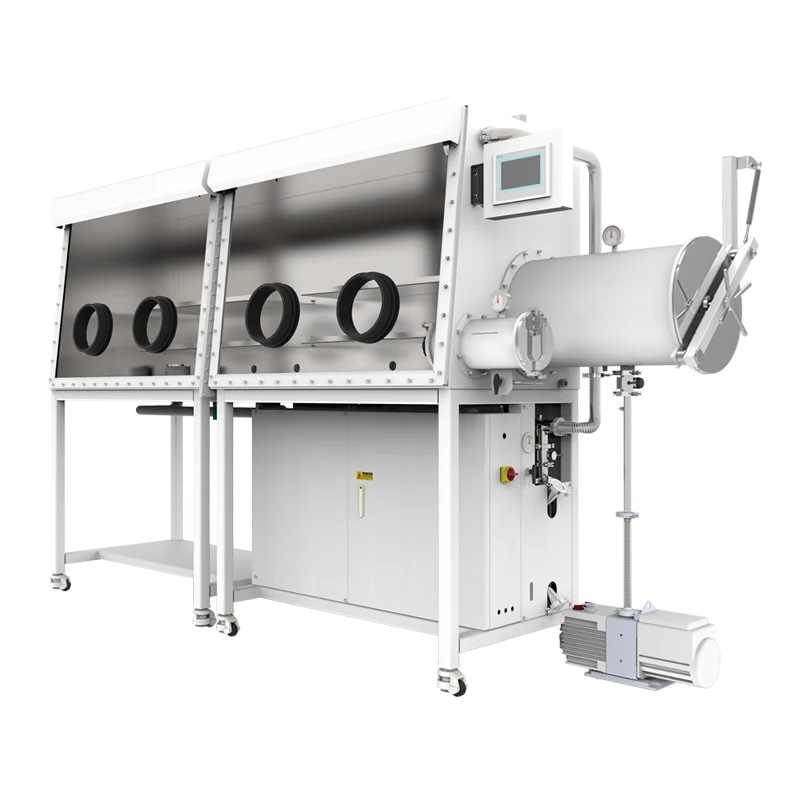
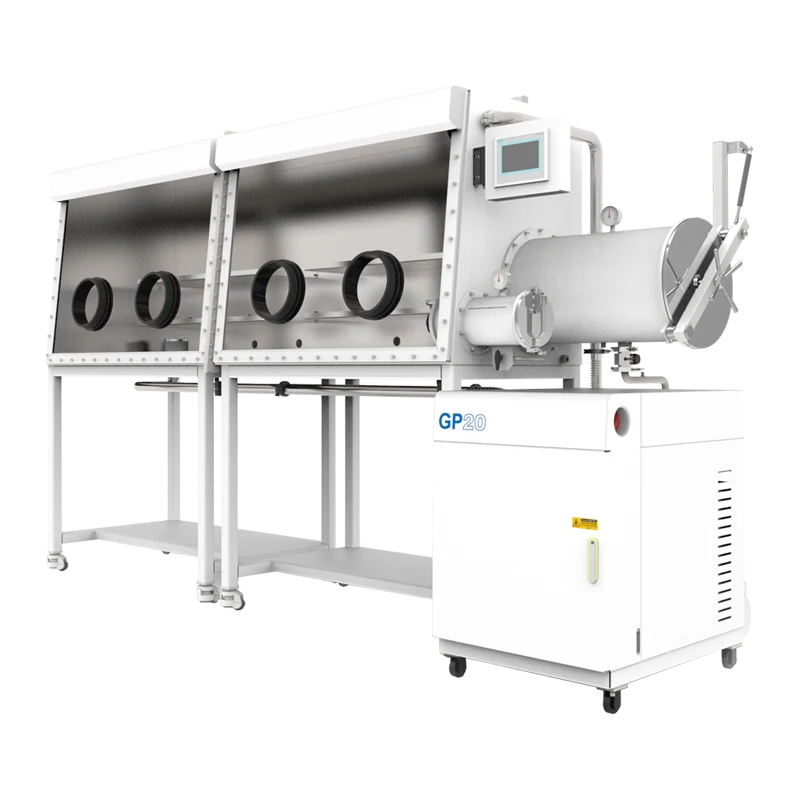
A two-station single-sided split-type glove box with gas purification system is a sealed workstation with two operator positions along one working face, connected to a separate purification cabinet that continuously circulates the internal atmosphere through a purifier column. In the workflow of a laboratory it sits between the outside air and the sample: material enters through an antechamber, hands work through gloves, and the circulation loop holds oxygen and moisture at whatever level the process requires. It addresses a practical problem rather than a purely scientific one — two people need to work at the same time on air-sensitive material, and the cabinet has to fit into a room where one large monoblock box would be awkward to install, service or relocate.
What "two-station, single-sided, split-type" actually describes
The name is a statement about geometry and layout, not about atmosphere quality. Three separate decisions are packed into it, and each one has consequences that matter more than the label.
Two stations on one working face
A two-station box places two pairs of glove ports along the same side of the main chamber, so both operators share one atmosphere and one working volume. That is useful when a process needs two people — one transferring material, one handling it inside — or when a single station would become a bottleneck. The trade-offs are real. Every additional port is another seal to inspect, more gloves introduce more permeation and outgassing, and two operators add heat, moisture and particle load to the same volume. A box with two stations is not automatically twice as capable as a single-station box: the purification loop has to be able to absorb the extra load, and the antechamber cycle time has to keep up with what two people bring in.
A split cabinet rather than a single monoblock
In a split-type arrangement the main chamber, the purification module and usually the antechamber are distinct units joined by circulation piping and electrical connections. The layout is chosen for the room, not for the product photo: the purifier can stand beside or behind the box, at a height that makes column service easier, and it can be separated from instruments that dislike vibration. Transport through doors and corridors is simpler when the largest single piece is smaller, and later expansion is easier because modules can be added or repositioned.
The cost of that flexibility is connection complexity. Every joint between modules is a potential leak path, longer circulation lines add internal volume and pressure drop, and the installation needs a floor plan rather than a footprint. Alignment, leveling and pipe routing have to be planned before delivery, and commissioning takes longer than for a one-piece cabinet.
What it does: the closed purification loop
The purification system is the active part of the installation; the box itself only provides a sealed volume. In operation, atmosphere is drawn out of the main chamber, passes through particulate filtration, enters the purification column, and is returned to the chamber. Inside a typical column, a desiccant such as molecular sieve removes water, while a copper-based catalyst removes oxygen by chemical reaction rather than by simple adsorption. Because the oxygen removal medium is consumed chemically, it must be regenerated periodically, and the water removal medium must be heated and dried. Without a working loop, a sealed glove box is just a container that gradually fills with the water and oxygen released by gloves, walls, samples and everything carried in through the antechamber.
Working gas, control gas and regeneration gas are not the same thing
These three gas duties are often confused. Working gas fills the box and circulates through the purifier — normally nitrogen or argon. Control gas drives pneumatic functions and sets pressures in parts of the system. Regeneration gas is used only during the periodic cleaning of the purification column, when the box is isolated from the purifier. During regeneration, the box atmosphere is not being purified, so transfers and sensitive work should be planned around that window. The specific gas composition, flow and conditions for regeneration belong to the equipment documentation for the exact configuration, not to a general rule.
Monitoring is not purifying
Oxygen and moisture analyzers report on the atmosphere; they do not improve it. A displayed value, and even its resolution, is a measurement rather than a guarantee. Analyzer accuracy depends on range, calibration and where the sample is drawn from, and a reading taken at one point does not necessarily represent the whole chamber — particularly in a split layout with long circulation lines.
Which specifications should you check?
Working space and ergonomics
Look at usable interior width, depth and window height, glove port size, glove material and thickness, and the reachable depth from each station. In a two-station box, ask how the two working areas are divided and whether an internal partition or interlock limits reach. For a split layout, check the distance between modules, pipe routing, service clearance around the purifier, and whether each module will pass through the doors on the route to the lab.
Atmosphere performance and the conditions behind it
Purification performance depends on column capacity, the leak rate of the assembled system, how much material is carried in, and how often the loop is regenerated. Any water or oxygen figure quoted for a machine applies to a specified configuration under specified conditions; it should not be read as a permanent guarantee for a whole series or for a different module combination. Ask what the value refers to — the main chamber alone, the chamber with the antechamber open, or a defined test condition — and ask how the atmosphere behaves after a transfer or after a long idle period.
Leak rate, working pressure and vacuum are different quantities
The box normally works at a slight positive pressure so that any leakage moves outward. The antechamber is evacuated and refilled during transfers. The pump has its own ultimate vacuum. Leak rate is a property of the whole assembled system. Oxygen and moisture content is the result of all of the above. These numbers are not interchangeable, and each applies to a different object; mixing them up is the most common mistake when comparing quotations.
Antechamber capacity and transfer cycle
Check the antechamber volume, whether it uses vacuum-and-gas cycles or gas dilution, and how long a full cycle takes. Powdered samples require attention to particle carryover, and porous or solvent-wet items release large amounts of vapour and water when introduced, so pre-drying and a solvent strategy matter more than the cycle count on paper.
Circulation and vacuum hardware
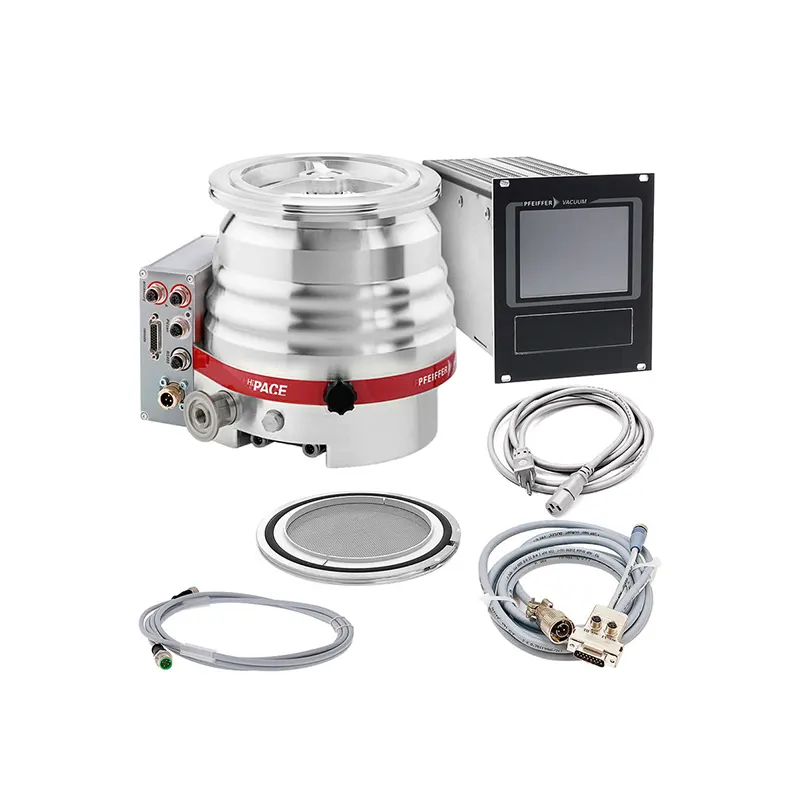
This includes the circulation blower, valves, and the pumps serving the antechamber and regeneration. Many purge cycles only need a pump sized to the antechamber volume and the required cycle time. When a process calls for deeper vacuum — for instance evacuating a small chamber further before backfilling, or preparing a sample for a vacuum-sensitive step — a turbine-based high-vacuum pump may be considered, such as the Glove Box Turbomolecular Vacuum Pump. It is not a drop-in upgrade for every cabinet: flange standard, chamber volume, gas load, control interface and the pressure rating of the antechamber all have to be confirmed with the manufacturer first, because changing the vacuum level can also change outgassing behaviour and therefore purge times.
Where it suits, and where the limits are
Typical applications follow one theme: the material degrades in air, and more than one pair of hands is useful. That includes lithium metal and solid-state battery materials, sulfide electrolytes, perovskite and OLED materials, air-sensitive organometallic synthesis, semiconductor process steps, metal powders for additive manufacturing, and general air-sensitive materials research. In all of these, the box protects the sample from the ambient atmosphere; it does not make the sample inert to every gas, and the choice between nitrogen and argon should follow the material supplier's guidance rather than habit.
The limits deserve equal attention. A purification glove box is not a sterile environment, not a cleanroom classification and not a biological safety cabinet. An inert atmosphere protects the material, not automatically the operator, so toxic or radioactive work needs separate assessment. Solvent vapour from wet samples can be carried into the purification column, where it may interfere with the catalyst or shorten media life, which is why solvent adsorption arrangements exist and why solvent handling should be planned as a separate function: a solvent trap does not remove water or oxygen. HEPA filtration removes particles, not moisture, oxygen or solvent vapour. Because both stations share one volume, volatile cross-contamination between two simultaneous experiments is possible. And the antechamber limits throughput regardless of how many glove ports are installed.
How to select and integrate it
A workable sequence is: list the materials, their forms and their solvents; define the acceptable oxygen and moisture range and how quickly excursions must be corrected; count simultaneous operators and estimate how many antechamber cycles per day the work requires; measure the room, including footprint, door widths, ceiling height, and the availability of nitrogen or argon, power and exhaust for regeneration; agree the module positions with the supplier using a layout drawing; confirm which items are included and which are options; and plan commissioning, analyzer calibration, glove replacement and spare seals before the box arrives. Once running, base regeneration on analyzer readings and the manufacturer's instructions rather than on a fixed calendar, and keep a log of atmosphere values against the operations that preceded them.
Questions worth putting to the supplier in writing include the conditions behind each atmosphere figure, the antechamber type and cycle logic, the available feedthroughs and interfaces for additional pumps or filters, and the supply requirements for regeneration gas.
Short answers to common questions
Does a purification glove box maintain a low-oxygen atmosphere on its own?
No. It needs a working gas supply, electrical power, a regeneration gas supply and a correctly commissioned, leak-tight assembly. The purifier maintains the atmosphere; the installation determines whether it can.
Can a turbomolecular pump be added to any antechamber?
Only after the flange, chamber pressure rating, gas load and control interface have been checked. Compatibility is not implied by the pump being catalogued as a glove box accessory.
Does an oxygen or moisture reading tell me how clean the box is?
It tells you what the sensor sees at its sampling point after calibration. It does not replace a leak test or a load assessment, and measurement resolution is not the same as accuracy.
Can two experiments run independently at the two stations?
They share one volume, so volatile materials from one station can reach the other. Plan physical separation or scheduling for incompatible chemistry.
How often does the purification column need regeneration?
It depends on leak rate, the load introduced and the target level. The interval should follow analyzer readings and the equipment documentation, not a fixed timetable.
Confirming the details that matter
The general principles above explain how a two-station single-sided split-type purification glove box works and where its boundaries lie, but the module dimensions, antechamber options, purification configuration and achievable atmosphere values are specific to the unit being quoted. Those details are documented on the Two-Station Single-Sided Split-Type Glove Box with Gas Purification System product page, and any figure that affects your process decision should be confirmed there or with TENCAN directly, together with the conditions under which it applies.