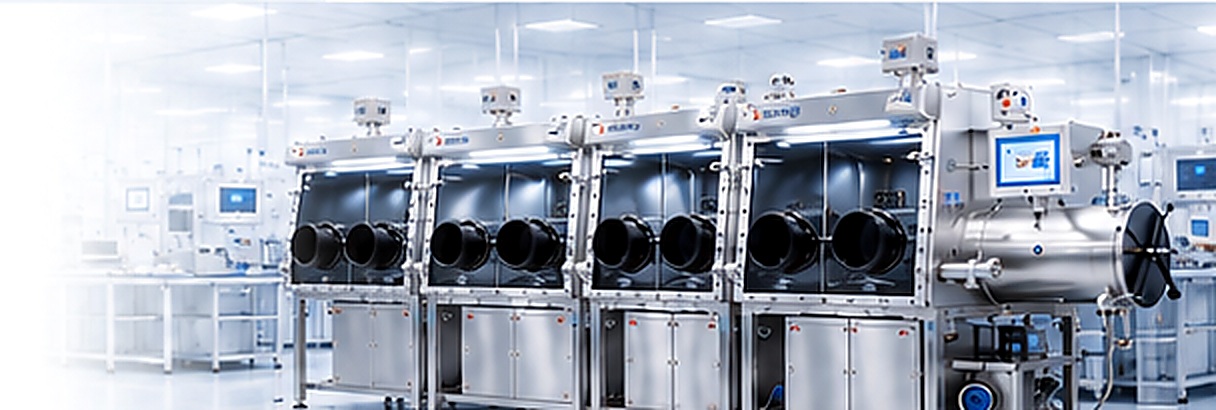
A two-station double-sided glove box with gas purification system is a sealed enclosure with two operator work positions, glove access from both the front and rear faces, and a closed-loop purification circuit that continuously removes moisture and oxygen from the internal atmosphere. It sits at the center of an inert-atmosphere workflow: the enclosure defines the protected volume, the antechambers move samples and tools across the boundary, and the purification loop with its monitoring instruments holds the gas at the level the work requires. The problem it solves is practical — many materials react with air or moisture faster than a person can finish handling them, and the box provides a conditioned space plus a controlled way to transfer items in and out without exposing the whole interior.
Enclosure, airlocks and purification circuit are designed as one system rather than a cabinet with add-ons, which is why two boxes with similar exterior dimensions can behave quite differently once the doors are closed.
What does it do, and how does it work?
Three functions run at the same time in a purifying glove box: containment, transfer and atmosphere conditioning. Knowing where each one happens makes a specification much easier to read.
Containment: the sealed working volume
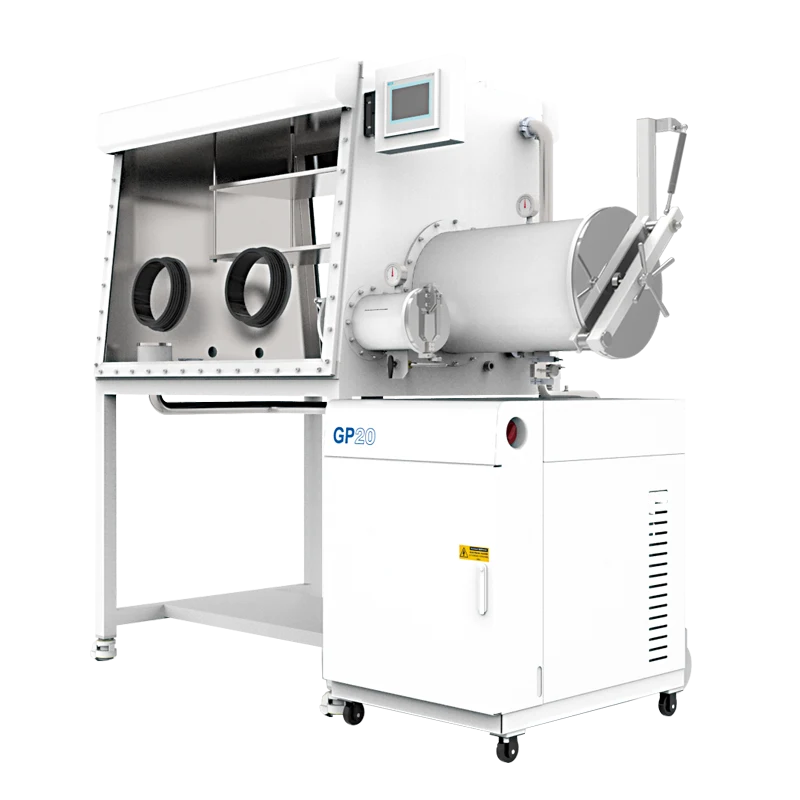
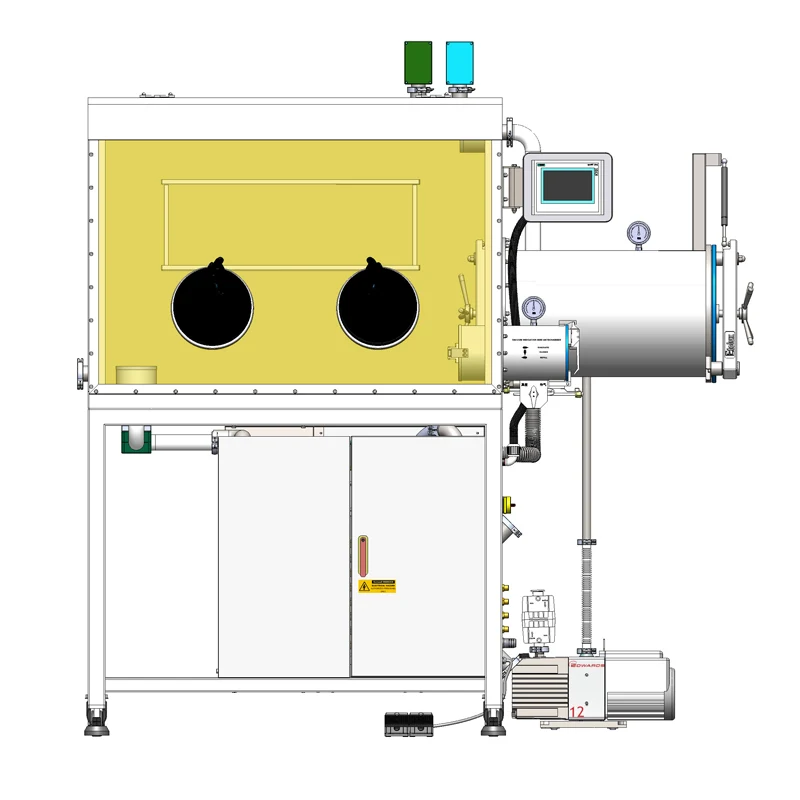
The enclosure is a gas-tight shell with a viewing panel, glove ports and gloves, internal lighting, electrical or signal feedthroughs and one or more airlock doors. A two-station box splits the interior into two working positions, so two operators can each work at their own station or one operator can move between them without walking around the equipment. On a double-sided box the gloves are mounted on two opposite faces, which allows the same sample to be handled from both sides — useful when one person holds a tool while another manipulates the substrate, or when the box stands between two laboratory areas.
Sealing quality sets the baseline for everything else. The lower the leakage rate of the shell and its door seals, the less work the purification loop has to do and the more slowly the atmosphere drifts when circulation stops. Leak rate is a property of the box and its joints, not of the purification column, and it is normally verified at installation with a pressure-rise or similar test.
Conditioning: the closed-loop purification circuit
Working gas is drawn out of the enclosure, pushed by a circulation blower through one or two purification columns and returned to the box. Each column holds a regenerable desiccant for moisture and a medium that binds oxygen, so a single pass reduces both contaminants at once. Because the gas is circulated rather than consumed, the same inventory of nitrogen, argon or helium stays in the box for long periods, and only the small volumes lost through airlock cycling and minor leaks have to be replaced.
The column does not purify indefinitely. After it has taken up a certain amount of water and oxygen it is regenerated: heated while regeneration gas flows through it to carry the released moisture away and restore the oxygen-removing medium, then cooled and returned to service. Regeneration is a separate operating mode with its own gas, temperature and timing requirements, and while it runs the box is not being purified. A two-column system can alternate columns so circulation continues during regeneration; a single-column system pauses purification. Neither arrangement should be described as purifying while a column is being regenerated.
Transfer: airlocks and glove ports
Samples, tools and small equipment enter through an antechamber, usually called an airlock or transfer chamber. The usual sequence is to open the outer door in ambient air, close it, evacuate the chamber with a vacuum pump, refill it with working gas, repeat as needed, then open the inner door. Each evacuation-and-refill cycle dilutes the air left in the chamber, and the number of cycles determines how much residual oxygen and moisture is carried inside. Airlock discipline — waiting for the complete cycle instead of opening the inner door early — therefore influences atmosphere quality more than most hardware choices.
Glove ports and gloves are the routine interface and are consumable parts. Their material, thickness and length determine dexterity, abrasion resistance and chemical compatibility, and permeation through the glove material is a real pathway for moisture and oxygen. Gloves are therefore inspected for pinholes and replaced on a schedule rather than when they visibly fail.
Which configurations matter?
Two stations on one side, or two sides
A two-station box with gloves on one face gives two operators a shared atmosphere in a single larger volume, which is efficient when both work on the same process. A double-sided version adds glove access on the opposite face; that changes how the box can be positioned in a room and how many people can work at once, but it also means more glove ports, more seals and more panel area that must remain leak-tight.
Integrated or split purification
The purification unit can be built into the box frame or housed separately and connected by ducting. An integrated layout shortens the gas path and saves floor space; a split layout moves noise, heat and regeneration gas handling away from the workspace and can simplify servicing. The split version adds duct runs, joints and circulating volume, all of which belong in the comparison.
Which specifications should you check?
Enclosure, transfer and purification contribute different things, so the specification has to be read in groups rather than as one performance number.
| Item | What it tells you | What to confirm |
|---|---|---|
| Working volume and station layout | How much equipment stays inside and how many operators can work at once | Whether internal height and depth accept your tools, fixtures and instruments |
| Glove port count and position | Reach, dexterity and number of simultaneous operators | Glove size, material and compatibility with your solvents or reagents |
| Antechamber size and cycle sequence | How large an object can be transferred and how long a transfer takes | Pump capacity, target vacuum level, number of purge cycles, auxiliary airlock |
| Purification capacity and regeneration mode | How long the loop runs before regeneration and how the box behaves during it | Regeneration gas supply, temperature, timing, and whether a second column allows uninterrupted circulation |
| Moisture and oxygen analyzer data | Whether the measured atmosphere meets the process requirement | Range, resolution, accuracy and calibration interval — resolution is not accuracy |
| Leak rate, pressure control and feedthroughs | How stable the atmosphere stays and how equipment inside is powered or connected | Leak-test method, working pressure range for box and airlock, number and rating of spare ports |
Two cautions apply to every row. Keep the quantities separate: box working pressure, airlock vacuum, pump ultimate vacuum, leakage rate, oxygen content and moisture content are different measurements with different units and different objects, and mixing them makes comparison meaningless. Then treat any stated achievable value as configuration-specific — a figure obtained on one box, at a particular leak rate with a particular column and analyzer, is not a continuous guarantee for a different configuration.
Where is it suitable, and what are its limits?
A continuously purified, two-station box suits work in which the material must stay protected for hours or days and two people or two processes share one atmosphere. Typical settings include lithium and solid-state battery materials, perovskite and OLED device fabrication, semiconductor and air-sensitive chemistry, and advanced-materials research where oxidation or hydrolysis changes the result.
The limits follow from the same design. A purified glove box is an atmosphere-control tool — not a cleanroom, not a sterile environment, not a biological safety cabinet and not a certified hazardous-materials enclosure; those are different standards requiring different equipment. It removes moisture and oxygen from the gas inside but does not remove solvent vapour, which needs dedicated solvent adsorption and separate management of the adsorbed load. Particle filtration is a third, separate function: a HEPA filter captures particulates and cannot lower moisture or oxygen. Nor is any single gas inert for every sample; nitrogen is unsuitable for materials that react with it, and argon is not a universal substitute.
Where accessories such as vacuum clamps fit
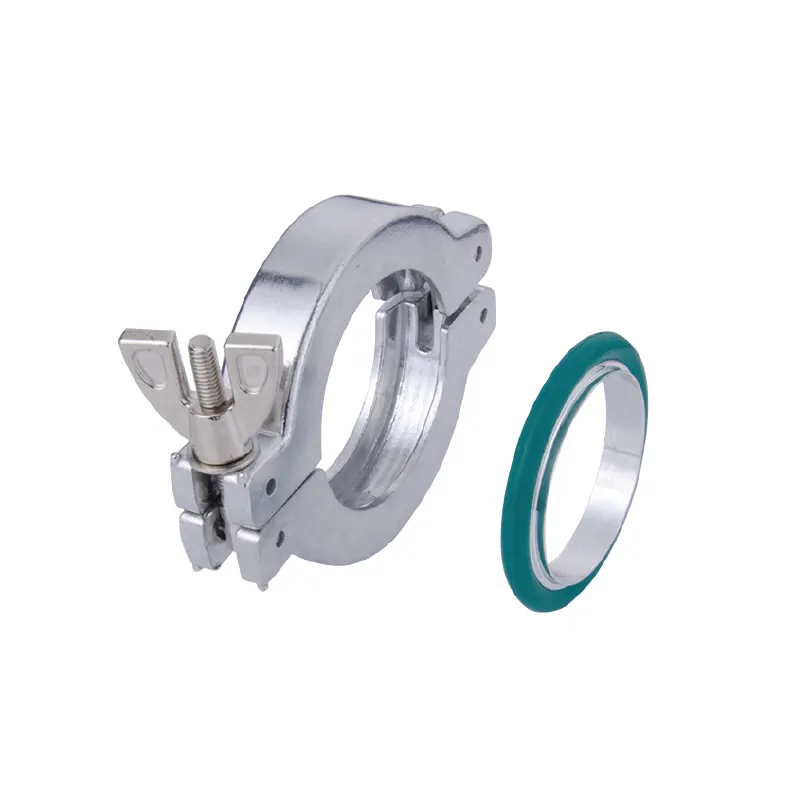
Accessories make sense only when their function supports the system. The clearest example is vacuum plumbing: airlock evacuation, gas lines and pump connections rely on flanged joints that must seal reliably and come apart for maintenance. A KF vacuum clamp is used exactly there. KF connections join two flanges through a centering ring with an O-ring, and the clamp holds the assembly together — the ring makes the seal, the clamp supplies the mechanical compression. Because these joints open whenever a pump, valve or line is serviced, the clamp is a routine part of keeping the transfer circuit leak-tight.
Selecting one is a sizing exercise, not a performance claim: confirm the flange nominal diameter so the clamp matches the connection, the clamp material and finish for its environment, and the elastomer in the centering ring for compatibility with the gases and any solvent vapours present. A clamp does not improve a pump's vacuum level and does not remove moisture or oxygen. The same logic applies to analyzers, valves, feedthroughs and additional airlocks — each supports a specific function of the system rather than replacing it.
How should you select or integrate it?
Work backwards from the material. Define what the sample tolerates: maximum moisture and oxygen exposure, whether solvents, particles or heat are involved, and how long the material stays inside. Then define the workflow: how many operators, how large the largest item entering the airlock is, how often transfers happen, and whether any instrument must remain inside. Only then compare boxes.
A short checklist for the enquiry:
- State the target atmosphere as a moisture and oxygen level, together with the measurement method you will use to verify it.
- Give the dimensions and weight of the largest object that must enter, so the antechamber is sized realistically.
- Estimate how many transfer cycles are foreseen per day, since airlock cycling is the main source of atmosphere disturbance.
- Ask whether the purification columns regenerate in place, what gas and utilities regeneration needs, and how the box behaves while it runs.
- List the feedthroughs, gas lines and cooling required inside, and confirm that spare ports are available.
- Request the leak-test method and the working pressure range for the box and the airlock, described separately.
When an answer quotes a number, ask which configuration produced it and under what conditions. That question separates a specification from a sales figure.
Short answers to common questions
Does a two-station double-sided box always include purification?
No. Enclosures of this shape also exist without a purification circuit, relying on initial inert-gas flushing instead. This product combines the enclosure with a gas purification system, and the presence of purification should be confirmed rather than assumed from the box shape.
Can the enclosure itself lower moisture and oxygen?
Only through the purification circuit and its circulation. Panels, gloves and seals contain the atmosphere; the columns remove the contaminants; the analyzers measure the result. Removing any one of the three breaks the chain.
When is a second purification column needed?
Usually when the process cannot tolerate a pause in circulation, or when regeneration would otherwise interrupt work too often. Two columns let one regenerate while the other purifies. The requirement depends on the contamination load, which is why transfer frequency and material outgassing belong in the calculation.
How do I judge whether an accessory is compatible?
Match it to the specific interface it serves — flange size and seal material for vacuum hardware, range and calibration for analyzers, size, permeation and chemical resistance for gloves. Compatibility is defined by the connection and the application, not by the brand.
The takeaway
A two-station double-sided glove box with gas purification is a system of three parts: a sealed enclosure with two working positions on two faces, transfer airlocks that move material across the boundary, and a closed-loop purification circuit with monitoring that holds the atmosphere where the material needs it. Choose it by matching volume, transfer size, circulation and regeneration behaviour, and sealing quality to the actual workflow — and verify the numbers, their units and the configuration they came from before you commit.