
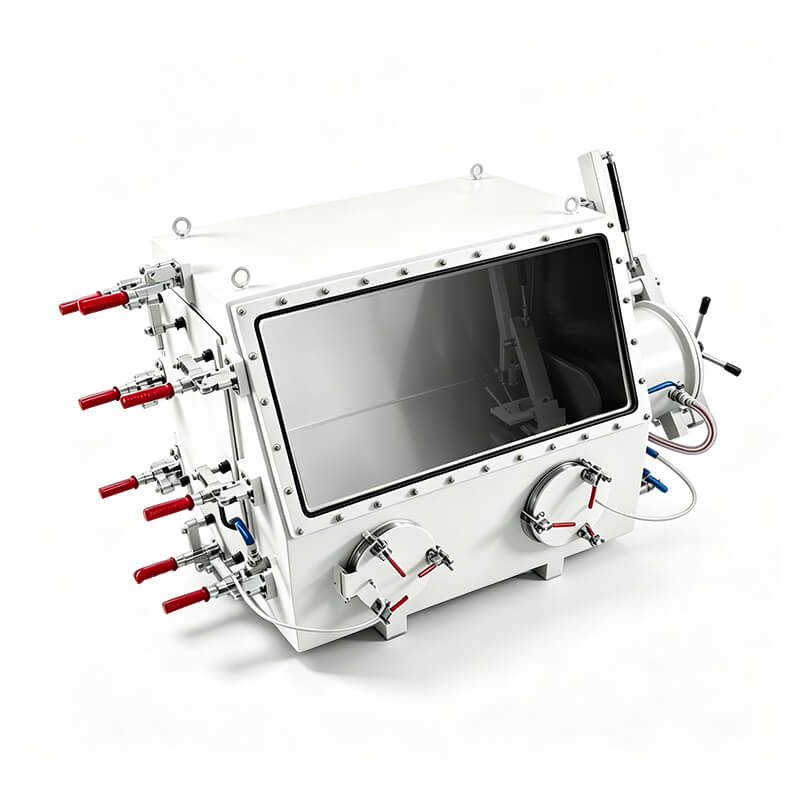
A GBV-2 stainless steel vacuum glove box is a sealed stainless steel enclosure with glove ports that allows an operator to handle air-sensitive materials while the internal atmosphere is controlled by vacuum and inert gas exchange. It places a controlled chamber between the operator and the sample: the gloves provide manual access, the chamber isolates the work zone, and the vacuum and gas system reduces the air inside. The GBV-2 product page identifies the model as a stainless steel vacuum glove box; the delivered configuration, achievable atmosphere and accessory set must be confirmed from its current specification.
What does a stainless steel vacuum glove box do?
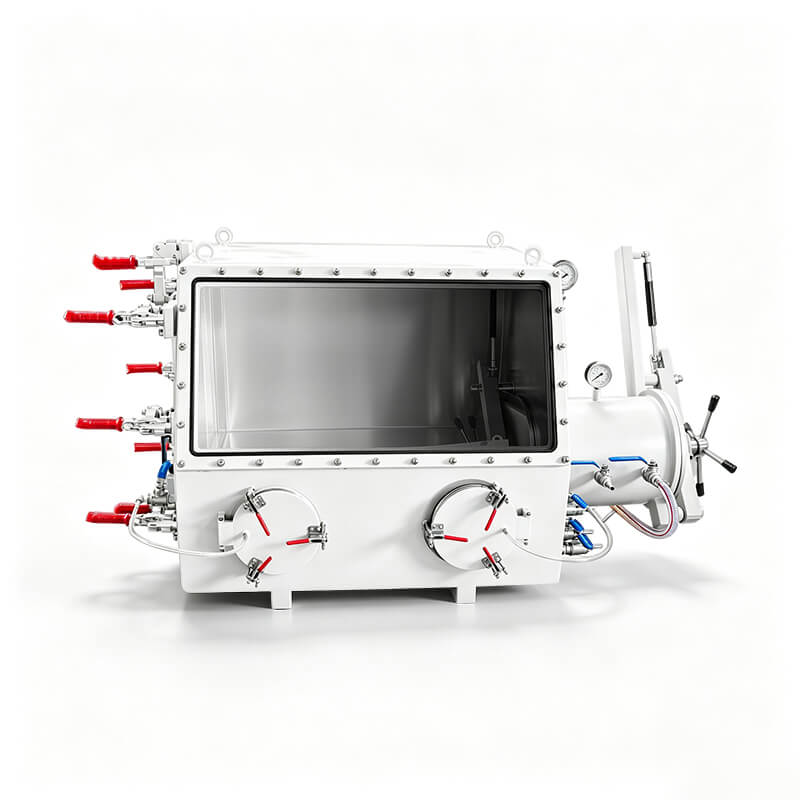
Its primary job is to create a working space in which the sample is separated from ambient laboratory air. The stainless steel chamber provides a rigid, cleanable barrier; the window and gloves allow observation and manipulation; valves and ports let gas enter, air leave and instruments or utilities connect. The operator can therefore weigh, mix, load, transfer or inspect a material without handling it in the open room.
Many vacuum glove boxes include an antechamber so that samples and tools can be transferred without opening the main chamber to the room. Whether the GBV-2 includes one, and how that antechamber is configured, is a specification question rather than something to infer from the model name. The same applies to viewports, feedthroughs, gas inlets, sampling ports and analytical instruments.
The word vacuum in the product name describes evacuation capability. It does not mean that the box continuously circulates gas through purification columns, and it does not establish a particular oxygen or moisture level. Those capabilities belong to the complete system and must be documented for the exact configuration.
How vacuum and inert gas exchange work
A vacuum glove box normally works in cycles. The operator seals the chamber, evacuates it to a pressure the design allows, and refills it with an inert gas such as nitrogen or argon. Repeating the cycle dilutes the original air. The result depends on the chamber volume, the vacuum level reached, the purity of the purge gas, the number of cycles, the leak rate and outgassing from surfaces and samples.
This is a replacement process, not a purification loop. Vacuum removes gas from the chamber, and the inert gas fill reduces the remaining oxygen and moisture concentration. It does not chemically strip oxygen or water from a recirculating gas stream. If a continuous purifier is fitted, a blower circulates gas through purification material and instruments monitor the atmosphere; that is a different architecture with different performance claims, maintenance needs and failure modes.
For that reason, vacuum level, purge gas quality, leak rate, oxygen concentration and moisture concentration should be treated as separate variables. A deeper vacuum does not automatically produce a drier or more oxygen-free workspace if the refill gas is wet or the chamber leaks. A low oxygen reading at one moment does not prove that the level will stay low during a long experiment. The product data sheet should state what is measured, where it is measured and under which conditions.
Which specifications matter?
The model name alone does not define the delivered configuration. A buyer should specify the GBV-2 by the functions the work actually needs, then check that the quoted equipment and documentation support those functions.
Workspace, access and transfer
Confirm the internal dimensions, glove port count and spacing, window size, and the number and position of ports. If an antechamber is required, confirm its volume, door arrangement, vacuum capability and whether it can be purged independently. These details determine whether a sample can be loaded without contaminating the main chamber and whether two operators can work together comfortably.
Vacuum design, pump and gas supply
Ask for the chamber pressure rating, the antechamber rating if present, the intended pump type and the connection standard. The working pressure of the box, the vacuum level at the antechamber, the pump ultimate pressure and the leak rate are not interchangeable numbers. The inert gas supply also matters: line pressure, purity, available flow and the type of regulator all affect the purge. Confirm whether the gas inlet is suitable for the gas you intend to use and whether exhaust or vent routing is required.
Sealing, materials and instrumentation
Stainless steel is a family of alloys, not a complete specification. For corrosive vapors or solvent exposure, confirm the actual alloy, surface finish, seal material and glove material. Oxygen and moisture analyzers, if supplied, should be selected by range, resolution, accuracy, calibration method and location. Resolution is not the same as accuracy, and an analyzer measures the atmosphere rather than improving it. Pressure gauges, vacuum gauges and flow meters should also be matched to their actual range.
Where is it suitable, and what are its limits?
A stainless steel vacuum glove box is relevant to work with air-sensitive chemistry, lithium and solid-state battery materials, perovskite and OLED samples, semiconductor components, advanced materials and additive manufacturing post-processing. It is also useful for routine sample transfer and preparation where a lower-oxygen environment is helpful. In each case, the material requirement should come first: if a process needs a sustained moisture level below what a vacuum and purge box can document, a continuously purified system or a different equipment architecture may be required.
The limits are just as important. A vacuum glove box is not a fume hood, a sterile isolator, a cleanroom classification, a biological safety cabinet or a hazardous-materials containment system unless it has been specifically designed and documented for that duty. Vacuum and inert gas exchange do not remove solvent vapor in the way a solvent adsorption system does, and HEPA filtration addresses particles rather than oxygen or water. Not every sample tolerates vacuum or rapid pressure change, and fine powders can be disturbed by gas flow. Inert gas is not automatically inert to every material, and no practical system should be sold on an absolute zero-oxygen promise.
How should you select or integrate a GBV-2?
Start with a written atmosphere target rather than a model number. Define the oxygen and moisture limits and the conditions under which they apply; state the sample size, transfer frequency and acceptable cycle time; list solvents, acids and reactive gases; decide whether continuous purification is mandatory; confirm the vacuum requirement and pump compatibility; and plan for gloves, seals, feedthroughs and spare parts.
- Required oxygen and moisture levels, with the test method and operating conditions
- Inert gas type, supply purity, pressure and flow
- Chamber and antechamber dimensions, glove port layout and transfer route
- Vacuum level, pump type, flange and exhaust arrangement
- Instrumentation range, accuracy, calibration and alarm functions
- Seal, glove and chamber material compatibility with the process
- Leak testing, operating instructions, training and spare parts
If continuous purification is essential, do not assume that a vacuum glove box can be converted by adding an arbitrary purifier. The chamber, ports, circulation path, controls and safety interlocks must be compatible. Likewise, an independent purification unit is not a complete glove box with a working space, and it should not be connected to an incompatible enclosure without an engineering review.
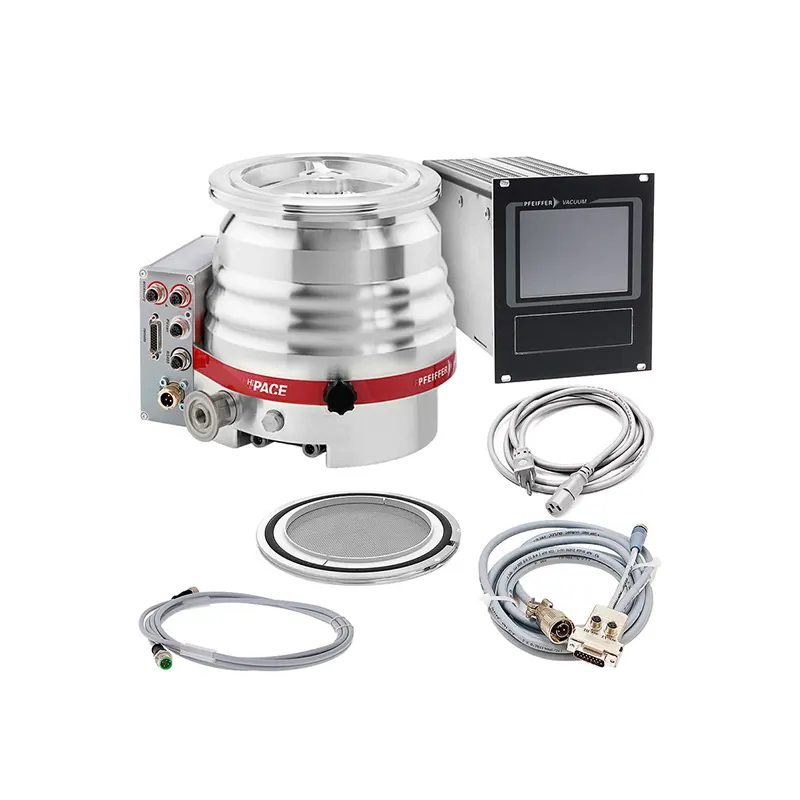
A glove box turbomolecular vacuum pump is a high-vacuum accessory, not a purifier. It may be considered when the chamber or antechamber is designed for high vacuum and the process needs a lower pressure than a roughing pump can provide. Selection depends on the flange, pumping speed, chamber volume, gas load, exhaust arrangement, controller and whether the chamber is rated for that duty. A turbomolecular pump does not remove oxygen or moisture chemically, and it cannot compensate for a leak or an unsuitable purge strategy.
Common questions
Does the GBV-2 include continuous gas purification?
A vacuum glove box designation does not establish that a continuous purifier is included. Check the quotation, flow diagram and data sheet for purification columns, circulation blower, analyzers and the stated oxygen and moisture performance.
Can vacuum alone create an oxygen-free atmosphere?
No practical system should be described as absolutely oxygen-free. Vacuum and inert gas exchange reduce the air fraction, but the final result depends on the complete system, the gas supply and the operating procedure. Ask for documented performance under defined conditions rather than a single best-case number.
Is a turbomolecular pump required?
Not necessarily. Many vacuum glove box tasks rely on a roughing pump or a house vacuum supply. A turbomolecular pump is a specialized high-vacuum choice that should be justified by the process pressure, chamber design and gas load.
Can I use solvents inside the box?
Only after checking compatibility with the gloves, seals, window and stainless steel, and only with suitable vapor management. Solvent adsorption is a separate function from oxygen and water purification.
What should be confirmed before ordering?
Confirm the workspace dimensions, glove port layout, antechamber arrangement, vacuum rating, pump interface, gas connections, instrumentation, alarm and control functions, leak-test method, documentation and spare parts. Ask for the oxygen and moisture performance to be tied to a specified test procedure and operating condition.
The GBV-2 is best understood as a sealed stainless steel workspace that uses vacuum and inert gas exchange to support sensitive work. It is not a universal guarantee of ultra-low oxygen or moisture, and it is not automatically a continuously purified glove box. When the documented configuration matches the sample, the transfer plan and the required atmosphere, it can be a practical platform for materials research and small-scale production. When the process depends on sustained purification, the purification capability must be specified explicitly rather than assumed from the model name.
