
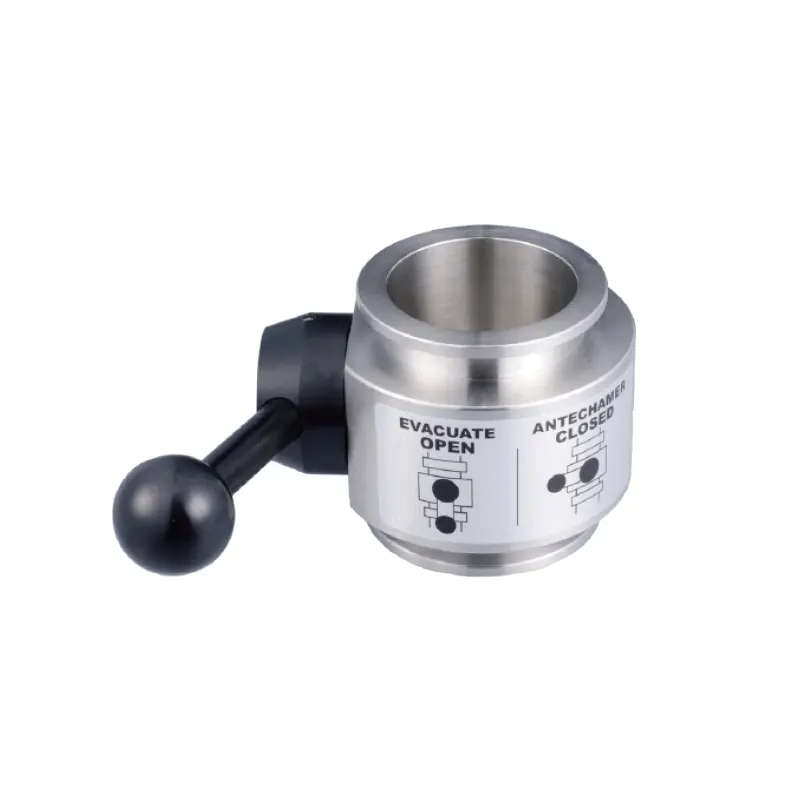
A KF vacuum butterfly valve is a compact isolation and flow-control component for vacuum piping. It combines a KF-style flange connection with a butterfly disc that rotates inside the flow path, so a line can be opened, closed, or partly throttled without dismantling the connection. In a glove box installation, it normally sits on the vacuum side of the system: between an antechamber and a pump, on an evacuation or purge manifold, or on a service line that must be isolated while other work continues. Its role is not to create vacuum or purify the atmosphere. It determines whether gas can pass, how quickly it can pass, and which part of the plumbing is exposed to the pump.
What does a KF vacuum butterfly valve do in a glove box system?
The first job is isolation. When the disc is closed, the valve separates one section of the vacuum circuit from another. That allows an antechamber to be vented while its pump remains protected, a pump to be serviced without opening the entire manifold, or a section that needs attention to be kept out of the main flow path. The value of that isolation depends on the seal, the flange joint, and the operator's ability to see whether the valve is open or closed.
The second job is conductance control. A butterfly valve can be partly opened to reduce pumping speed at a port or to balance flow between lines. This is useful during gentle evacuation, when a sample or a lightweight part could be disturbed by a sudden pressure change. It is not necessarily a precision metering device, however. If a process needs a repeatable, calibrated leakage rate, a dedicated variable leak valve, mass-flow controller, or orifice may be more appropriate. Confirm the intended throttling duty rather than assuming that any butterfly valve will behave like a fine control valve.
The third job is maintenance isolation. A valve at the right point lets a pump, gauge, or transfer chamber be taken out of service without exposing the whole glove box to air. Every additional component is also an additional potential leak path, so the benefit only holds when the valve is specified for the line, installed with the correct seals, and checked after assembly.
How does the valve work?
The body contains a through-bore and a circular disc mounted on a shaft. Rotating the shaft through roughly a quarter turn moves the disc from a position parallel to the flow path to a position across it. At full open, the disc presents a relatively low obstruction and the valve can provide high conductance. As it closes, the disc blocks more of the bore and flow falls. The closing element is therefore simple, but the details around it matter in vacuum: the seat must seal against the disc, the shaft passage must not become a leak path, and the body must withstand the pressure difference without distortion.
The KF connection is a clamp-type flange arrangement. A centering ring and an elastomer seal are normally used between mating flanges, and a clamp holds the joint together. That makes assembly and removal convenient, but it also means the seal material is part of the vacuum boundary. A valve that is mechanically sound can still be unsuitable if its seal swells, hardens, or permeates in the presence of a solvent or trace process gas.
Butterfly valves are often described as quarter-turn valves, yet not every quarter-turn movement is equally useful for control. Near the closed position, a small change in angle can produce a large change in conductance; near the open position, the same angular change may have less effect. For on/off isolation this is not a problem. For throttling, the operator or actuator needs a clear position reference, and the system designer should confirm that the resulting flow behavior is acceptable.
Which configuration details should you check?
The product name identifies a valve family, not a complete specification. Before selecting a KF vacuum butterfly valve, confirm the items below against the actual line and the supplier's current data.
Flange size and installation envelope
The KF size must match the mating flange, centering ring, clamp, and tubing. A valve with the wrong flange size cannot be made compatible by tightening a clamp harder. Check the body length, the outside diameter, and the space needed for the handle or actuator to move. A handle that swings into a pump, gauge, or enclosure wall is an installation problem even when the flange itself fits.
Seal and wetted materials
Identify every material exposed to the process gas: body, disc, shaft, seat, and flange seal. The choice depends on the gases and vapors present, the required vacuum level, and the cleaning procedure. Solvent vapors, oxygen, and trace corrosive species can affect elastomers differently. If the application involves a solvent adsorber or a reactive gas, do not assume that a general-purpose seal is acceptable. Ask for the seal material and its compatibility information, and include spare seals in the maintenance plan where appropriate.
Drive method and position feedback
A manual handle is simple and gives direct feel, but it also requires access. An actuated valve can be integrated with interlocks, pump controls, or sequence logic, but then the specification must cover the actuator supply, mounting, travel, fail position, and position indication. If the valve is used to protect a pump or to sequence an evacuation step, confirm how the open and closed states are sensed. A limit switch or visual indicator is not the same as a guaranteed isolation function.
Vacuum duty and flow requirement
State whether the valve is for rough vacuum, high vacuum, or only for positive-pressure gas routing. The required conductance when open, the acceptable pressure drop, and the leak-tightness needed at the closed position are separate requirements. Do not use a pump's ultimate pressure as a substitute for the valve's own specification. Also confirm whether the valve is intended for frequent cycling or occasional isolation, because that affects wear and maintenance expectations.
Where is it suitable, and what are its limits?
A KF vacuum butterfly valve is suitable where a glove box vacuum circuit needs a compact, clamp-connected isolation point: an antechamber evacuation line, a pump isolation branch, a purge manifold, or a service connection that must be separated from the main volume. It is also useful where a line needs to be opened gradually rather than snapped open, provided the flow behavior has been checked. In these roles it supports atmosphere control by making the vacuum system easier to operate and maintain; it does not itself control the glove box atmosphere.
The limits follow from that role. The valve is not a vacuum pump and cannot create a pressure difference. It is not a gas purifier and cannot remove oxygen, moisture, or solvent vapor from the box. It is not an oxygen or moisture analyzer, and a reading from a separate instrument cannot be attributed to the valve. It does not repair a leaky enclosure, convert a non-vacuum enclosure into a vacuum-rated one, or guarantee that a process is inert. If the glove box has a purification loop, the valve may isolate a line in that loop, but it does not replace the purifier, the circulation blower, or the atmosphere monitoring system.
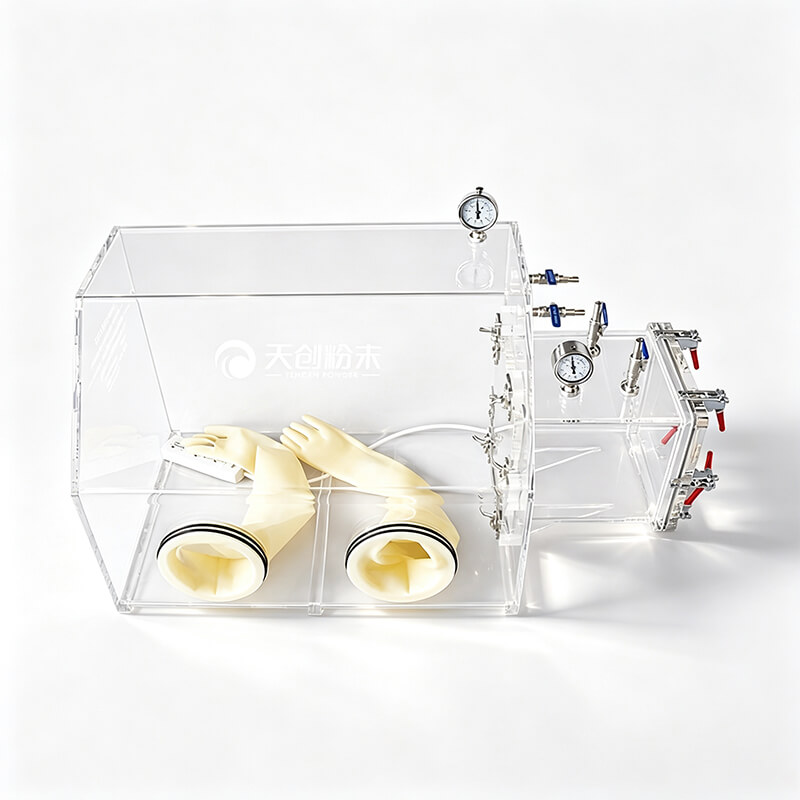
Enclosure choice is a separate decision. The GBT Series Acrylic Glove Box is an enclosure product, and its port arrangement, wall construction, and vacuum suitability must be confirmed for the specific unit. A valve should be selected for a confirmed port and piping design, not because both products appear in the same catalog. Where an acrylic enclosure is used for isolation or low-level vacuum work, the enclosure's own limits govern; the valve cannot extend them.
How should you select and integrate the valve?
Begin with the function, not the part number. If the valve is for isolation only, prioritize a clear open/closed state, a suitable seal, and a flange that matches the line. If it is for throttling, define the range of conductance needed and check whether a butterfly disc gives useful resolution. If it is for automated pump protection, define the safe state on power loss or air loss, the signal that confirms closure, and the sequence in which the valve and pump are switched. These are system-design decisions; the valve is one element in the sequence.
Compatibility and verification list
- Confirm the KF flange size against the mating flange, clamp, centering ring, and seal.
- Confirm the seal and wetted materials against the actual gas, vapor, and cleaning exposure.
- Confirm the required vacuum range, conductance, and acceptable closed-valve leakage for the line.
- Confirm manual or actuated operation, actuator supply, mounting, and position feedback.
- Confirm installation orientation, handle clearance, and access for maintenance.
- Confirm that the enclosure port and tubing are rated for the intended vacuum duty; do not infer this from the glove box category.
During installation, use the correct centering ring and seal, align the flanges without forcing the body, and tighten the clamp according to the manufacturer's instructions. Leak-check the new joint as part of the vacuum section, not only the valve body. Operate the valve through its full travel and confirm that the open and closed positions are clear. If the valve is part of an interlock, test the sequence with the pump isolated and with the line vented, following the system's own operating procedure.
For the specific accessory, start from the KF Vacuum Butterfly Valve product page and ask for the current dimensional drawing, seal material, pressure and vacuum ratings, and actuator details if applicable. Those details determine whether the valve is a direct replacement, a new design, or unsuitable for the line. A low initial cost is not useful if the seal is incompatible or the handle cannot be reached.
Short answers to common questions
Does the valve include a vacuum pump?
No. It controls flow in a line connected to a pump or vacuum source; it does not generate vacuum.
Can it lower the glove box's oxygen or moisture level by itself?
No. It can isolate or route gas, but water and oxygen removal depends on the purifier, gas supply, leak-tightness, and monitoring system. A valve is not a purification device.
Can I fit it to any glove box?
No. The enclosure must have a suitable port, tubing, and vacuum-rated construction for the intended duty. Confirm compatibility with the enclosure manufacturer rather than assuming that a KF flange alone makes the system suitable.
Is it a precision flow-control valve?
Not automatically. A butterfly valve can throttle flow, but fine, repeatable control may require a different valve type or an actuator with position control. Confirm the required control range before selecting it.
Should I choose manual or automated operation?
Choose manual when occasional isolation and direct operator access are sufficient. Choose automated operation when the valve must interlock with a pump, follow a sequence, or be operated from outside the enclosure. In either case, confirm the available space, supply, and feedback.
