
A KF vacuum butterfly valve is a quarter-turn isolation valve with KF clamp-type flange connections. It sits in a vacuum line, often between a transfer chamber, vacuum manifold, or pump inlet, and opens or closes that line without dismantling the plumbing. It does not create an inert atmosphere, remove oxygen or water, or measure vacuum quality. Its job is narrower and still important: isolate a section of the vacuum circuit so that evacuation, pump maintenance, leak checking, or component replacement can be carried out within the limits of the system design.
That distinction matters in glove box work. A purification system manages the recirculating atmosphere; a vacuum valve manages flow in a connected vacuum path. Confusing the two can lead to the wrong purchase or to expectations that a valve alone will solve a moisture or oxygen problem. The TENCAN KF Vacuum Butterfly Valve product page is the place to verify the actual configuration, because the product name and a photograph do not establish flange size, seal material, pressure duty, or actuation.
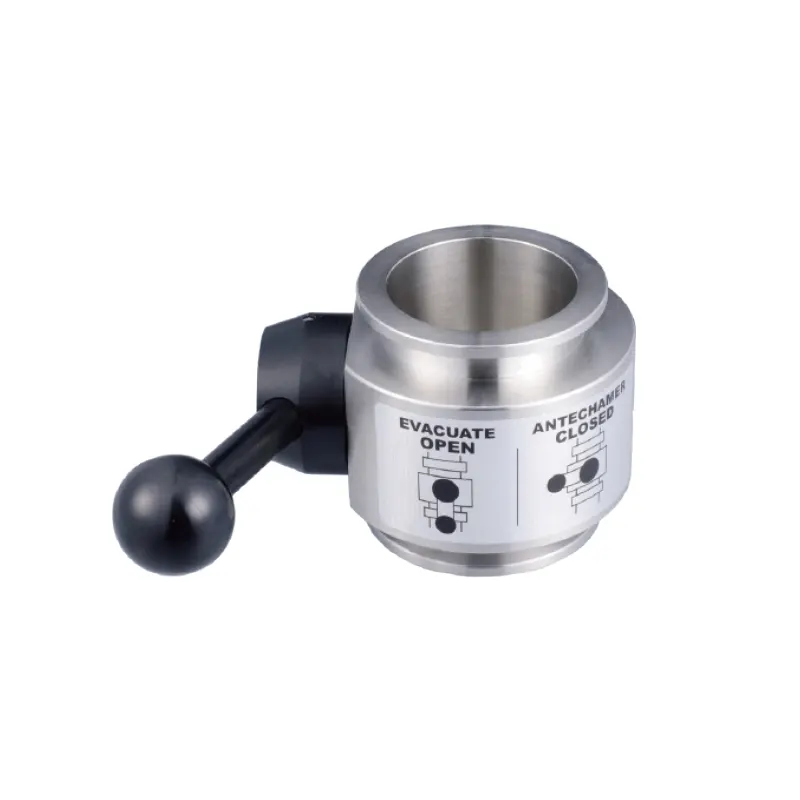
What Does a KF Vacuum Butterfly Valve Do?
A butterfly valve controls flow with a circular disc mounted on a stem. In the open position, the disc sits roughly parallel to the flow, so gas can pass on both sides. In the closed position, the disc rotates against a seat and blocks the bore. The body holds the disc and seat, the stem passes through the body to the handle or actuator, and the KF flanges at each end connect to mating vacuum components. A centering ring and seal sit between the flanges, and a clamp holds the joint together.
Because the stem is a moving part that penetrates the body, the stem seal is one of the important potential leak paths in a vacuum butterfly valve, along with the disc seat and the flange joints. A valve can look simple and still require careful checking of these three areas. The disc also remains in the flow path when the valve is open. That is normal for the design, and it affects conductance, pressure drop, and the way the line behaves when the valve is partly open.
Isolation, not atmosphere generation
Within a glove box installation, the valve's role is to change the flow path, not the chemistry of the atmosphere. It can isolate a transfer chamber from a pump, separate one branch of a vacuum manifold from another, or close a pump inlet for service. It might also isolate a vacuum gauge or sampling point, provided the port, materials, and pressure duty are suitable. It does not remove moisture or oxygen, and it is not a substitute for a gas purification system, a vacuum pump, a HEPA filter, or a solvent adsorber.
One practical point: a closed valve is a boundary, not a guarantee. The achievable isolation depends on the seat and stem seal, the flange seals, the surface condition, and the pressure differential. If the task requires a specific leak rate or a particular vacuum level, ask for the relevant specification and test method rather than inferring performance from the valve type.
Where Does It Sit in a Glove Box System?
In a glove box system, a KF butterfly valve is most likely to appear on the vacuum side of the installation: the line that evacuates a transfer chamber or antechamber, the manifold that distributes vacuum to more than one port, or the pump inlet where isolation is useful during maintenance. The exact location depends on the system's piping and control philosophy. A valve on a roughing line and a valve on a high-vacuum line may look similar from the outside but have different requirements.
Manual valves are common where an operator sets a state and leaves it. An actuated valve is more appropriate when the valve is part of a sequence, difficult to reach, or needs position feedback. In either case, the installation needs room for the handle or actuator, space for the clamp, and access for leak checking. A valve squeezed into a line without service clearance can turn a simple maintenance task into a major disassembly.
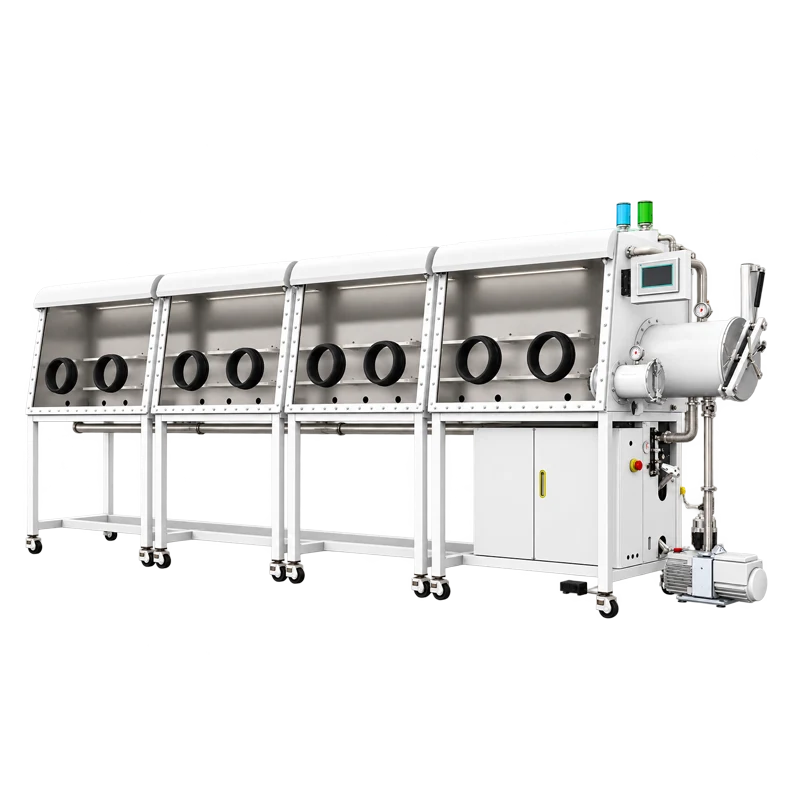
The Four-Station Single-Sided Split-Type Glove Box with Gas Purification System from TENCAN is an example of a larger enclosure in which vacuum and gas paths serve multiple work zones. Such a layout makes section isolation and maintenance access important, but it does not prove that a particular KF valve is installed or compatible. The system and the valve are separate products; compatibility has to be checked at the actual port, flange, and vacuum duty. A useful reading of the system page is to note how many zones and connections need service, then compare that with the isolation points in the vacuum schematic.
Which Details Matter in a KF Butterfly Valve?
The product name identifies the valve family and the connection style. It does not, by itself, define the size, materials, vacuum range, or actuation. Those details belong in the actual product data and should be confirmed before purchase.
KF flange and seal interface
KF is a flange family, not a single size. Before ordering, confirm the nominal KF size, the mating flange on the glove box or pump line, and whether the clamp, centering ring, and seal are included. The photograph in a product listing can show the general shape, but it cannot establish scale. Do not measure a port from a screen image or assume that two KF connections will mate because both are called KF.
The seal material is often the deciding detail. It must suit the gases and vapors in the line, the cleaning agents used, and the temperature of the application. A seal that is acceptable for dry nitrogen may not be acceptable for solvent vapor or oxygen service. If the process involves a material that can attack the elastomer, ask for a compatible seal option or choose a different valve design. The same caution applies to the body and disc materials when corrosive or reactive species are present.
Disc, stem, and seat design
The disc and seat determine how the valve closes; the stem seal determines how well the moving shaft is sealed. Ask how the stem is sealed and whether the valve is intended for the pressure range at that point in the system. A butterfly valve that works well for rough evacuation is not automatically suitable for a high-vacuum branch. The open disc also creates some restriction and wake, so a larger valve is not always the best answer if space is tight or the line is short.
Trapped volume is another consideration. A valve body adds a cavity to the line, and that cavity can affect pump-down or hold a small amount of process gas when the valve is closed. In most glove box vacuum lines this is a secondary issue, but it deserves attention when the line is short, the target pressure is demanding, or the gas is hazardous. The right response is to review the whole vacuum path, not to assume that a different valve alone will fix a system-level problem.
Actuation and position
Manual, pneumatic, and electrically actuated versions serve different purposes, but the product name alone does not say which one is supplied. For an actuated valve, confirm the control signal, air or power requirement, fail-safe position, position indication, and the space needed for the actuator. For a manual valve, confirm handle clearance and whether the handle can be locked or tagged. A valve that cannot be reached is difficult to operate correctly and easy to leave in the wrong state.
Which Specifications Should You Check?
Use the following checklist as a starting point for the actual quotation or product data. It separates what the valve is from what the surrounding system must provide.
| Item to verify | Why it matters |
|---|---|
| Flange size and clamp | The valve must mate with the port, tube, or pump line. Confirm the KF size and whether the clamp, centering ring, and seal are supplied. |
| Seal material | The seal must tolerate the process gas, solvent vapor, cleaning method, and temperature. Oxygen service needs specific attention. |
| Intended vacuum range | Confirm that the valve design is suitable for the pressure regime at that location. Do not extend one application's claim to another. |
| Leak specification | If low leak is important, ask for the leak rate and the test method. A leak rate is not the same as ultimate pressure or measurement resolution. |
| Actuation | Manual or automated operation changes the required space, control wiring, air supply, and fail-safe behavior. |
| Flow direction and installation | Check disc orientation, pressure differential, service access, and whether the valve can be supported by the piping without strain. |
Where Is It Suitable, and Where Is It Not?
Suitable roles
A KF vacuum butterfly valve is a good candidate where the job is to isolate a vacuum branch, provide a service boundary at a pump, divide a manifold, or close a line that does not need precision throttling. It is also useful as an isolation point for a gauge or sensor when the connection and materials match. In these roles, its value comes from a direct flow path, a visible open or closed state, and a straightforward clamp connection.
Limits and non-uses
It is not a purification device, a particle filter, a moisture trap, or an oxygen analyzer. It cannot by itself establish or maintain a low-oxygen or low-moisture atmosphere, and a closed valve does not prove that a chamber is leak-free. It is not a universal gas-compatible component: the seal and body materials must be checked against the process. It should not be treated as a precision metering valve unless the design and actuator are intended for that duty. And it should not be assumed to fit a glove box just because the box has a KF port; the size, seal, vacuum range, and space must all match.
How Should You Select and Integrate It?
Start with the line, not the catalog. The following sequence keeps the decision tied to the actual duty.
- Define the function. Is the valve for pump isolation, manifold sectioning, transfer chamber evacuation, or sensor isolation? Write down what must remain closed and what must remain open during normal operation.
- Confirm the interface. Match the KF size, clamp, centering ring, and seal to the mating hardware. Check that the valve body and actuator clear nearby components.
- Check material compatibility. Review the process gas, solvent vapor, cleaning agents, and temperature against the seal, body, and disc materials. If the data is incomplete, ask before ordering.
- Check vacuum duty and leak needs. Confirm the intended pressure range and the leak specification. If the valve is on a sensitive branch, ask how the stem and seat are sealed.
- Choose the actuation method. Select manual operation for a simple, reachable isolation point. Consider an actuator when the valve is part of a sequence or needs remote status. Confirm the fail-safe position.
- Plan installation and service. Leave room for the clamp, handle, and leak check. Support the line so the valve body is not carrying unsupported weight, and record the open and closed states in the system documentation.
Frequently Asked Questions
Does a KF vacuum butterfly valve purify the glove box atmosphere?
No. It isolates a vacuum line. Gas purification is a separate function that uses a purifier, circulation, and monitoring. A valve can support maintenance or evacuation, but it does not remove oxygen, moisture, or solvent vapor from the atmosphere.
Can it directly reduce oxygen and moisture levels?
No. Closing or opening the valve changes the flow path, not the concentration of contaminants. A purifier's removal stage does that work. A valve can be part of a leak-check or isolation procedure, but it does not guarantee a particular oxygen or moisture result.
How can I tell whether it will fit my glove box?
Check the actual port, not the product picture. Confirm the KF size, mating flange, seal material, intended vacuum range, and clearance for the handle or actuator. If the glove box documentation does not identify the port, ask the system supplier before ordering.
Is a larger valve always better?
No. A larger bore may reduce restriction, but it also takes more space and can add cost and pumping load. Match the valve to the line and the required conductance. If precise flow control is needed, confirm that the valve and actuator are intended for that use rather than assuming a butterfly valve will meter accurately.
